1).Longitudinal Marking (LM)
2).Transverse Marking (TM)
3). Hazard Marking (HM)
4). Block Marking (BM)
5).Arrow Marking (AM)
6). Directional Marking (DM)
7). Facility Marking (FM)
1
 The longitudinal marking are generally provided
along the traffic movement.
 These are generally located parallel & adjoining to
the traffic flow and help to separate the traffic flow
in the same direction.
 These are generally white in color but when their
color is yellow , it means traffic flow is in opposite
direction.
 These lines marked on the pavement can be either
broken, solid, double solid or dotted.
2
Centre line
Traffic lane
lines
No passing
zones/Solid
lines
Warning lines
Edge lines
Edge lines
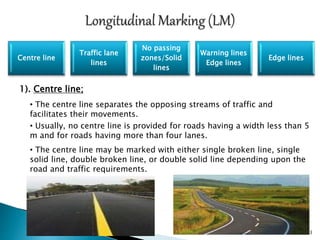
• The centre line separates the opposing streams of traffic and
facilitates their movements.
• Usually, no centre line is provided for roads having a width less than 5
m and for roads having more than four lanes.
1). Centre line;
• The centre line may be marked with either single broken line, single
solid line, double broken line, or double solid line depending upon the
road and traffic requirements.
3
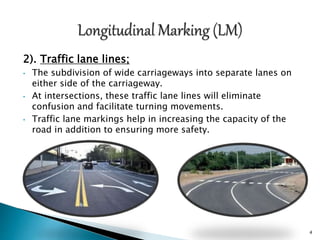
2). Traffic lane lines;
• The subdivision of wide carriageways into separate lanes on
either side of the carriageway.
• At intersections, these traffic lane lines will eliminate
confusion and facilitate turning movements.
• Traffic lane markings help in increasing the capacity of the
road in addition to ensuring more safety.
4
3). No passing zones/Solid lines;
• Solid lines do not allow the drivers to cross between the
lanes.
• No passing zones are established on summit curves,
horizontal, curves.
• And on two-lane and three-lane highways where overtaking
maneuvers are prohibited because of low sight distance.
5
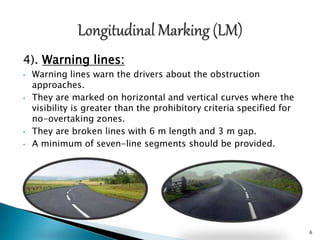
4). Warning lines:
• Warning lines warn the drivers about the obstruction
approaches.
• They are marked on horizontal and vertical curves where the
visibility is greater than the prohibitory criteria specified for
no-overtaking zones.
• They are broken lines with 6 m length and 3 m gap.
• A minimum of seven-line segments should be provided.
6
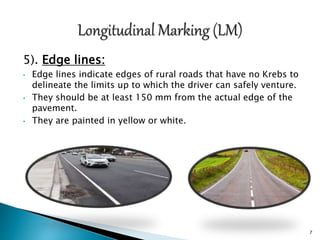
5). Edge lines:
• Edge lines indicate edges of rural roads that have no Krebs to
delineate the limits up to which the driver can safely venture.
• They should be at least 150 mm from the actual edge of the
pavement.
• They are painted in yellow or white.
7
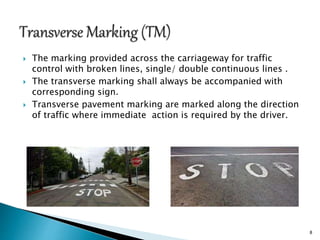
 The marking provided across the carriageway for traffic
control with broken lines, single/ double continuous lines .
 The transverse marking shall always be accompanied with
corresponding sign.
 Transverse pavement marking are marked along the direction
of traffic where immediate action is required by the driver.
8
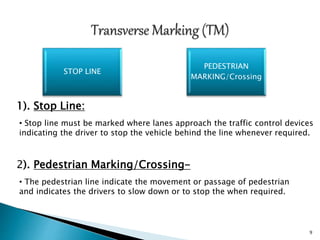
STOP LINE
PEDESTRIAN
MARKING/Crossing
• Stop line must be marked where lanes approach the traffic control devices
indicating the driver to stop the vehicle behind the line whenever required.
1). Stop Line:
2). Pedestrian Marking/Crossing-
• The pedestrian line indicate the movement or passage of pedestrian
and indicates the drivers to slow down or to stop the when required.
9
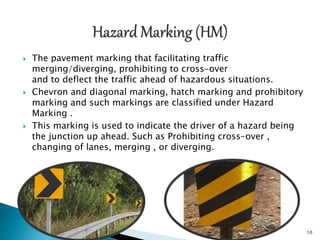
 The pavement marking that facilitating traffic
merging/diverging, prohibiting to cross-over
and to deflect the traffic ahead of hazardous situations.
 Chevron and diagonal marking, hatch marking and prohibitory
marking and such markings are classified under Hazard
Marking .
 This marking is used to indicate the driver of a hazard being
the junction up ahead. Such as Prohibiting cross-over ,
changing of lanes, merging , or diverging.
10
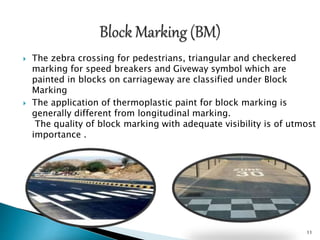
 The zebra crossing for pedestrians, triangular and checkered
marking for speed breakers and Giveway symbol which are
painted in blocks on carriageway are classified under Block
Marking
 The application of thermoplastic paint for block marking is
generally different from longitudinal marking.
The quality of block marking with adequate visibility is of utmost
importance .
11
12
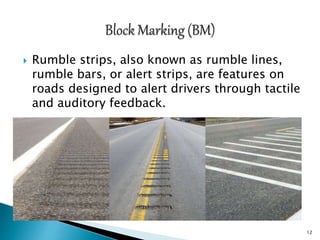
 Rumble strips, also known as rumble lines,
rumble bars, or alert strips, are features on
roads designed to alert drivers through tactile
and auditory feedback.
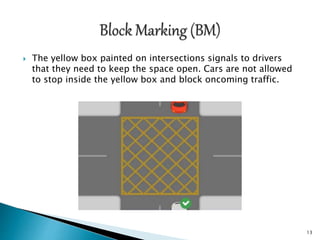
 The yellow box painted on intersections signals to drivers
that they need to keep the space open. Cars are not allowed
to stop inside the yellow box and block oncoming traffic.
13
 The arrows painted on carriageway are meant to give
direction for driver to take mandatorily.
 Drivers must take or follow these mandatory turns to avoid
traffic confusion.
Bi-directional Uni-directional
14
 The word message which are directional nature are classified
under Directional Marking.
 The characters of the message are elongated , so it is visible
to the driver looking at a lower angle.
 Some directional words are : STOP , SLOW , EXIT ONLY ETC.
15
 This marking helps to facilitates the marking of vehicle and
gives the driver an idea about parking space limits and
restrictions.
 It also prevents encroachment of designated place like Bys
stop, fire hydrant zones, etc.
16
 https://www.ruacorp.com/types-of-
highway-line-markings/
17

Pavement Markings/Pavement Markings.pptx

  • 1.
    1).Longitudinal Marking (LM) 2).TransverseMarking (TM) 3). Hazard Marking (HM) 4). Block Marking (BM) 5).Arrow Marking (AM) 6). Directional Marking (DM) 7). Facility Marking (FM) 1
  • 2.
     The longitudinalmarking are generally provided along the traffic movement.  These are generally located parallel & adjoining to the traffic flow and help to separate the traffic flow in the same direction.  These are generally white in color but when their color is yellow , it means traffic flow is in opposite direction.  These lines marked on the pavement can be either broken, solid, double solid or dotted. 2
  • 3.
    Centre line Traffic lane lines Nopassing zones/Solid lines Warning lines Edge lines Edge lines • The centre line separates the opposing streams of traffic and facilitates their movements. • Usually, no centre line is provided for roads having a width less than 5 m and for roads having more than four lanes. 1). Centre line; • The centre line may be marked with either single broken line, single solid line, double broken line, or double solid line depending upon the road and traffic requirements. 3
  • 4.
    2). Traffic lanelines; • The subdivision of wide carriageways into separate lanes on either side of the carriageway. • At intersections, these traffic lane lines will eliminate confusion and facilitate turning movements. • Traffic lane markings help in increasing the capacity of the road in addition to ensuring more safety. 4
  • 5.
    3). No passingzones/Solid lines; • Solid lines do not allow the drivers to cross between the lanes. • No passing zones are established on summit curves, horizontal, curves. • And on two-lane and three-lane highways where overtaking maneuvers are prohibited because of low sight distance. 5
  • 6.
    4). Warning lines: •Warning lines warn the drivers about the obstruction approaches. • They are marked on horizontal and vertical curves where the visibility is greater than the prohibitory criteria specified for no-overtaking zones. • They are broken lines with 6 m length and 3 m gap. • A minimum of seven-line segments should be provided. 6
  • 7.
    5). Edge lines: •Edge lines indicate edges of rural roads that have no Krebs to delineate the limits up to which the driver can safely venture. • They should be at least 150 mm from the actual edge of the pavement. • They are painted in yellow or white. 7
  • 8.
     The markingprovided across the carriageway for traffic control with broken lines, single/ double continuous lines .  The transverse marking shall always be accompanied with corresponding sign.  Transverse pavement marking are marked along the direction of traffic where immediate action is required by the driver. 8
  • 9.
    STOP LINE PEDESTRIAN MARKING/Crossing • Stopline must be marked where lanes approach the traffic control devices indicating the driver to stop the vehicle behind the line whenever required. 1). Stop Line: 2). Pedestrian Marking/Crossing- • The pedestrian line indicate the movement or passage of pedestrian and indicates the drivers to slow down or to stop the when required. 9
  • 10.
     The pavementmarking that facilitating traffic merging/diverging, prohibiting to cross-over and to deflect the traffic ahead of hazardous situations.  Chevron and diagonal marking, hatch marking and prohibitory marking and such markings are classified under Hazard Marking .  This marking is used to indicate the driver of a hazard being the junction up ahead. Such as Prohibiting cross-over , changing of lanes, merging , or diverging. 10
  • 11.
     The zebracrossing for pedestrians, triangular and checkered marking for speed breakers and Giveway symbol which are painted in blocks on carriageway are classified under Block Marking  The application of thermoplastic paint for block marking is generally different from longitudinal marking. The quality of block marking with adequate visibility is of utmost importance . 11
  • 12.
    12  Rumble strips,also known as rumble lines, rumble bars, or alert strips, are features on roads designed to alert drivers through tactile and auditory feedback.
  • 13.
     The yellowbox painted on intersections signals to drivers that they need to keep the space open. Cars are not allowed to stop inside the yellow box and block oncoming traffic. 13
  • 14.
     The arrowspainted on carriageway are meant to give direction for driver to take mandatorily.  Drivers must take or follow these mandatory turns to avoid traffic confusion. Bi-directional Uni-directional 14
  • 15.
     The wordmessage which are directional nature are classified under Directional Marking.  The characters of the message are elongated , so it is visible to the driver looking at a lower angle.  Some directional words are : STOP , SLOW , EXIT ONLY ETC. 15
  • 16.
     This markinghelps to facilitates the marking of vehicle and gives the driver an idea about parking space limits and restrictions.  It also prevents encroachment of designated place like Bys stop, fire hydrant zones, etc. 16
  • 17.