RMG 914
INTRODUCTIONTO LUXURY RETAIL
Module 4 B
REPOSITIONING
THE BRAND
FIRST SECTION: EILEEN FISHER AND SECOND
SESSION; DOVE
ANALYSISTOOLS
EILEEN FISHER:
REPOSITIONINGTHE
BRANDReference information: --
Author: Anat Keinan, Fiona Wilson,
Jill Avery & Michael L. Norton
Published: N/A
Reference No.: N/A
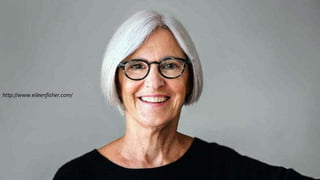
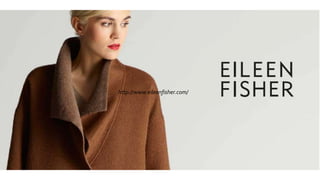
http://www.eileenfisher.com/
Company History
• STARTED -1984 with $ 350 –could not sew and had
never had fashion experience
• Was trained as an interior designer/graphic designer
• Determined there was a void for stylish yet
comfortable clothes
• Simple shapes, beautiful fabrics, color and
proportions
• Was coming off 80”s structured “women as men”
suiting
• Was not fond of lipstick, make up and high heels
• Fisher “sought to design fad-proof, but trend-relevant, timeless
clothes that had an indefinite shelf life. “
• Designing for RealWomen regardless of figure shape/silhouette
• Designed upon the “no fuss “ possibility- ways to integrate for every
day wear that could be mixed and matched from season to season.
• Fluid and Practical
• First show – sold only 3,000 dollars worth
• Second show- 40,000 dollars worth
• Passion Pieces- emotional connections
• By 2010- baby boomers ( 45-64) – 1/3 population and 25% of the
womens apparel 200 billion market
• Living Longer ( 79.6 life expectancy )
• Fifty is the new 40
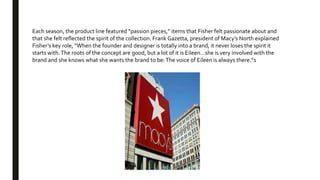
Each season, the product line featured “passion pieces,” items that Fisher felt passionate about and
that she felt reflected the spirit of the collection. Frank Gazetta, president of Macy’s North explained
Fisher’s key role, “When the founder and designer is totally into a brand, it never loses the spirit it
starts with.The roots of the concept are good, but a lot of it is Eileen…she is very involved with the
brand and she knows what she wants the brand to be:The voice of Eileen is always there.”1
■ Michael Gould, Chairman and CEO of Bloomingdale’s believed that EILEEN FISHER’s
success was due to the fact that Fisher herself lived her customers’ lifestyles, “What is
uniquely distinctive about EILEEN FISHER is the soul and heart of Eileen herself.The
company consistently embodies Eileen’s beliefs, convictions, and lifestyle. She never
deviates from her course, while always staying in tune with the changing times.”2
Jim Gundell, co-chief operating officer and facilitating leader, “Our relationship with our customer is our
competitive advantage. We don’t look at what anybody else is doing … It’s important what we’re doing and it’s
important how we’re building a relationship with our customers.”
The company was populated with employees, many of whom had been there for decades, who embodied the
brand’s ethos. Many customer-facing employees in the retail stores shared an age and a lifestyle with the
EILEEN FISHER core customer. “It happened so naturally that we hired our customer.We look for a more
holistic person, who loves our clothes and has outside passions and interests,” said Fisher.4 Gundell explained,
“It’s almost a cult-like following.When our customer comes in, we’re friends with her, we’re connected to her,
we know her name, we know her family …we just know so much about her.”This was key, claimed Pete
Nordstrom, President, Merchandising, Nordstrom’s,
Relationships with others
1EILEEN FISHER Brand Statement
At the heart of EILEEN FISHER is great design, ideas brought to life through clean lines, simple shapes, and
sensual fabrics. Our design strives to balance the timeless with the modern, function with beauty. Ours is an
organic system, always evolving, changing, building upon what’s come before. It’s a dialogue between
seasonal perspectives and enduring ideals. Our values ground us in the essentials of design – simple, sensual,
beautiful, timeless, functional.These values are threaded through every collection we create.They are where
we started and where we will always start again. Our culture of design is born of passionate individuals. We
inspire creativity, we translate the beauty of the unexpected into artful expression.Abandoning ourselves to
the spirit of creative play, we encourage surprise and discovery, courage and vision, instinct and intuition.We
instill confidence, we honor our voices, letting each one ring out as valid and valued. By supporting and
nurturing each other, we find our individual strengths.We bring the love of self expression to our customers,
instilling confidence through the beauty and performance of great design.We encourage connections.We
each listen seeking to be surprised by what we don’t know, inspired to reach beyond the shadows we cast.
From our nearest whispers to our most distant touches, we demonstrate singular action and collective impact
and bear the essence of Eileen Fisher, a woman and a community. Beautifully simple clothing designed to
move with real life. EILEEN FISHER.
Brand Statement: Beautifully simple clothing designed to move with real life.
DesignValues: Simple. Sensual. Beautiful.Timeless. Functional.
CultureValues:We inspire creativity.We instill confidence.We cultivate connection.
ServiceValues: Authentic. Inspiring.Collaborative. Intuitive. Inclusive.
Fisher’s belief was that if the product was right, business and profits would follow.The
goal of having “our mission drive our business and our profitability foster our mission”
was central. From inception, EILEEN FISHER was an organization with a strong social
consciousness. Fisher wanted her business to make a social difference, “It’s not really
about making clothes. Clothes are the vehicle for making substantive change in the
world and even though we’re a smaller company, it’s through our partnerships that we
can drive bigger change. Our business is a movement.”
Facts –There are 50 corporate stores in early 2000’s – of which 25% of sales come from- they are located
within 16 states
- E commerce is 12% of business – click to receive is 17% and click to open is over 52%
- HR within stores are geared towards people who have an understanding of clothes and love
people
and are not based on usual retail parameters
Fact- 478 dept. stores in the USA- including Bloomies, Nordstrom's, Macys and SFA
- 315 Specialty Stores-
-WHY ??The product sells and mostly at full price- it is a pillar brand- generally 1000 sq.ft.
Fact – 2008-2010-The Retail world fell apart- Heavy Discounting- and
EF still thought of as Bridge- whereas competitors have fallen by
wayside- Buchman and EllenTracy-TopTier turns out to be St John-
Other Newer Competitors-Theory EllieTahari , 148 Lafayette, M
Missoni,Tory Birch
Fact - 25th Anniversary- average age level of client is 59 and keeps
advancing by one year at a time-
- Perception: MOMS BRAND –Larger silhouettes – general
perception is “when you get to a percentage, you wear Eileen Fisher and
it’s as if you have given up”
Fact-The Canadian licensee was fired after 20 years and the company
took over Canadian operations.They have opened an office at 21 Prince
Arthur Avenue inToronto.
Fact – 2008-2010-The Retail world fell apart- Heavy Discounting- and EF still thought
of as Bridge- whereas competitors have fallen by wayside- Buchman and EllenTracy-
TopTier turns out to be St John-
Other Newer Competitors-Theory EllieTahari , 148 Lafayette, M Missoni,Tory Birch
Fact - 25th Anniversary- average age level of client is 59 and keeps advancing by one
year at a time-
- Perception: MOMS BRAND –Larger silhouettes – general perception is “when
you get to a percentage, you wear Eileen Fisher and it’s as if you have given up”
Fact-The Canadian licensee was fired after 20 years and the company took over
Canadian operations.They have opened an office at 21 Prince Arthur Avenue in
Toronto
FACTS :
Hired IDEO- a leading design and innovation company to help clarify the vision to rebrand.
-Definitions of age and attitudes needed to be defined and clarified- everybody and a different vision
Of “young” or “attitude” .
To do this the IDEO team handled in this way;
1.Spent time with the employees, 1 x 1, dinners, retail visits and shop a longs
2.Spent time speaking to the consumers- talking, shopping in their closets raiding with woman of a
Variety of ages- individual interviews- group shopping- and just trying to understand women in everyday
Life- both in and put of store situations
3.Current Customers and those who have never bought-
4.Aha Moments- “It looks like a sack” “Ads look very modern’’- MIXED MESSAGES
- Existing Clients- “looking for more edginess and are swerving to other collections”
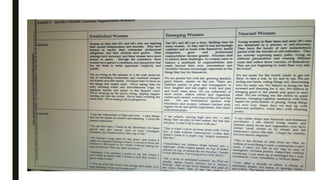
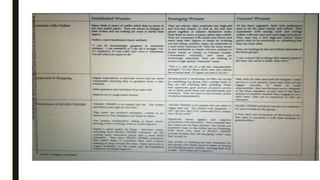
Therefore Established that - Emerging “Nascent” - attitudes –life stages- shopping behaviors – brand
Attitudes can be reflected in chart # 5
STITCH PROJECT
1. ShortTerm need to convey message of how the message of how the company had evolved to
Dismantle negative perception and stereotypes
2.Transform IDEO offices to show Eileen Fisher mixed with other brands
• More body conscious Fit with relation to boxy jackets, cardigans and top pieces
• Addition of metallic trims and more shine in fabrics
• New more fashion driven pieces
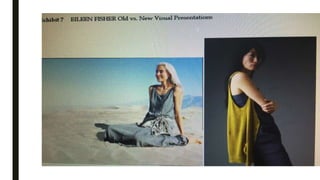
• New Art Direction –photography, edgier look- heels, red lipstick, boots …more edgy overall
• Led to New Accessory Lines- belts, scarves
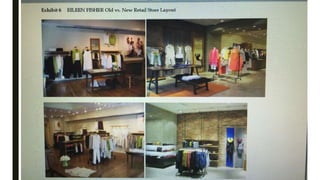
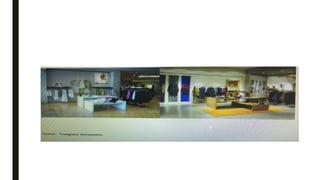
• Store Make overs- more modern looking and more flexible to changes in product(6)
• In-StoreVisuals (7)
• Overall Advertising Strategy- use of models as opposed to previous relatable older clients etc.
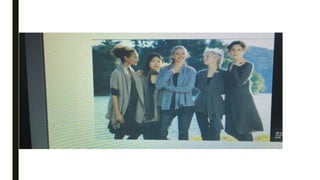
• Single Model in a Shot, not groups-
• Attitudinal Shots
• Media Strategy – drop publication that were spiritual, wellness and feel good publications
• And added such publications asVOGUE, Style.com, Hulu
• Web Site Redo- more video content in store and on site
• Art Direction was Consistent
• “Evolutionary vs Revolutionary “
•
CHANGESTOTAKE PLACE
What happened to existing Customer;
The overall trend was that the corporate stores- kept a good balance of new and traditional
• ‘Still found enough to love”
• Company started focusing on their expansion to Canada and the UK – could control the
• Actual vision of the company
• Lab stores
• Outlet stores
• Sub Brand- Eileen Fisher NewYork- more expensive and younger in styling within the same
• Overall framework
• Brand Extension; accessories-Accessories
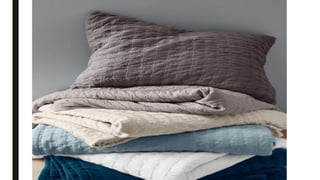
• Brand Licensing-Garnet Hill – Bedding and Bath
Dove: evolution of a brand
■ Reference information: --
Author: N/A
Published: August 8th, 2014
■ Reference No.: NSB – 9508 – 047
o Company embarked on a strategic project to develop a new brand
expression
o Set a new foundation for the future direction of the company
o The project embarked on a brand repositioning
DOVE
Dove: Evolution of a Brand
In 2007, Unilever’s Dove was the world’s number one “cleansing” brand in the health
and beauty
sector with sales of over $2.5 billion a year in more than 80 countries. It competed in categories that
included cleansing bars, body washes, hand washes, face care, hair care, deodorants, anti-perspirants
and body lotions. It competed with brands like Procter andGamble’s Ivory, Kao’s Jergens and
Beiersdorf’s Nivea.
Dove had recently launched what it termed a Masterbrand campaign under the title ofThe Dove
Campaign for Real Beauty. For some marketing observers the Campaign was an unqualified success,
giving a single identity to the wide range of health and beauty products. But the vivid identity owed
much to the Campaign’s use of the unruly, unmapped world of Internet media.1Were there risks to
putting the ‘Real Beauty’ story out on media likeYouTube, where consumers were free to weigh in
with opinion and dissent?On blogs and in newsletters, marketing commentators argued that Dove’s
management was abdicating its responsibility to manage what was said about the brand, and was
putting its multi-billion dollar asset at risk.2
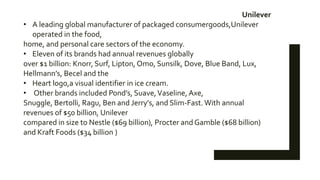
Unilever
• A leading global manufacturer of packaged consumergoods,Unilever
operated in the food,
home, and personal care sectors of the economy.
• Eleven of its brands had annual revenues globally
over $1 billion: Knorr, Surf, Lipton, Omo, Sunsilk, Dove, Blue Band, Lux,
Hellmann’s, Becel and the
• Heart logo,a visual identifier in ice cream.
• Other brands included Pond’s, Suave,Vaseline, Axe,
Snuggle, Bertolli, Ragu, Ben and Jerry’s, and Slim-Fast. With annual
revenues of $50 billion, Unilever
compared in size to Nestle ($69 billion), Procter and Gamble ($68 billion)
and Kraft Foods ($34 billion )
■ The 1957 launch advertising campaign for Dove was created by the Ogilvy and
Mather
■ advertising agency.The message was “Dove soap doesn’t dry your skin because
it’s one-quarter
■ cleansing cream,” and the claim was illustrated with photographs that showed
cream being poured
■ into a tablet. In time there were minor
■ changes in slogan, for example the term ‘cleansing cream’ was replaced with
‘moisturizing cream,’
■ but Dove stayed with the claim not to dry skin and the refusal to call itself a soap
for over 40 years.
■ The advertising aspired to project honesty and authenticity, preferring to have
natural-looking
■ women testifying to Dove’s benefits rather than stylized fashion models.
■ Dove was tapped to become a Masterbrand in February 2000. In that role it was called on to lend
■ its name to Unilever entries into personal care
categories beyond the beauty bar category, such as
■ deodorants, hair care products, facial cleansers, body lotions, and hair styling products.While much
■ of the advertising for these entrants spoke of functional benefits, communication to build the
■ Masterbrand needed to do something different—it had to establish a meaning for Dove that could
■ apply to and extend over the entire stable of products. No longer could Dove communicate just
■ functional superiority because functionality meant different things in different categories.Unilever
■ brand director for Dove, led a world-wide investigation into women’s responses to the iconography
■ of the beauty industry, and unearthed deep discontent. “Young, white, blonde and thin” were the
■ almost universal characteristics of women portrayed in advertising and packaging, but for many
■ women these were unattainable standards and far from feeling inspired they felt taunted.
■ In the search for an alternative view of the goal of personal care, Unilever
■ tapped two experts. Nancy Etcoff was a Harvard University psychiatrist working at the Massachusetts
General Hospital, author of the book, Survival of the Prettiest. Suzy Orbach was a London-based
psychotherapist
■ best known for having treated Lady Diana Spencer and was the author of the book, Fat is a Feminist
Issue.
■ Philippe Harousseau, vice president for brand development at Dove, explained, “Working
■ with psychologists was a real plus and the payoffs were enormous. By comparison,
■ focus groups would have just scratched the surface.” Unilever made some use of
■ surveys. It went to 3,000 women in 10countries and explored some of the hypotheses generated by the
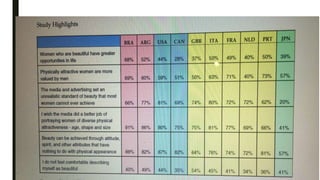
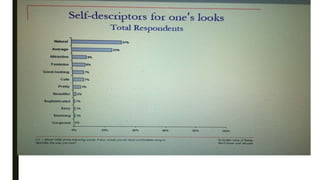
psychologists. Among the findings was the fact that only 2% of respondents worldwide chose to
describe themselves as beautiful
■ Informed by the research, Lagnado initiated the first exploratory advertising
executions. She
■ hired British photographer John Rankin Waddell, an avant guarde fashion
photographer well-known
■ for using ordinary people in supermodel contexts and for books of nudes
featuring plain looking
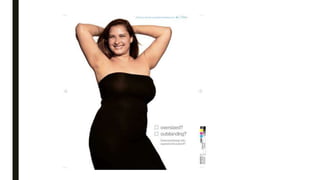
■ models.The result was the so-calledTick-Box campaign.
■ In this campaign, billboards were erected and viewers were asked to phone 1-
888-342-DOVE to vote on whether a woman on the billboard was “outsized” or
“outstanding.” A counter on the billboard showed the votes in
■ real time.The campaign attracted keen public interest as “outsized” first raced
ahead and then fell back.
REAL BEAUTY
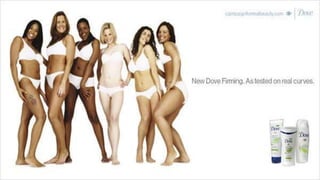
The next series of Dove ads,
in June 2005, were known
internally as the Firming campaign because they promoted a cream that
firmed the skin.They
featured six “real” women cheerfully posing in plain white underwear. Dove
marketing director for
the United States, Kathy O’Brien, told the Press that the company wanted
the ads to “change the way
society views beauty,” and “provoke discussion and debate about real
beauty.”
BRAND HERITAGEVS NEW REALITY ?
“When you talk of real beauty do you lose
the aspirational element? Are consumers going to be inspired to buy a
brand that doesn’t promise to
take you to a new level of attractiveness? Debunking the beauty myth
brings with it the danger that
you are debunking the whole reason to spend a little more money for the
product.You’re setting
yourself up to be an ordinary brand.”
The next step in the campaign was particularly controversial. At a Dove
leadership team offsite
■ Stage four of the Real Beauty campaign involved not an advertisement, but a film. In Canada, the
■ Dove regional brand building team was running self esteem workshops for women, and theToronto
■ office of advertising agency Ogilvy and Mather developed a 112
■ second film to drive traffic to the workshops.The North
■ American brand building team saw the film and decided it
■ deserved a wider audience.The resulting digital film was
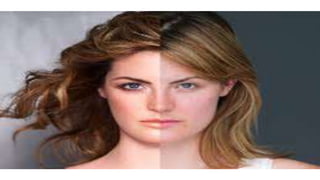
■ known as “Evolution.” It showed the face of a young woman as
■ cosmetics, hair styling and Photoshop editing transformed it
■ from plainness to billboard glamour. Given its unusual length
■ television was not an option, and in October 2006 the film was
■ posted toYouTube, a popular video sharing website. Within
■ three months it had been viewed 3 million times.
DOVES MISSION STATEMENT
Dove’s mission is to make more women feel beautiful every day by broadening
the narrow
definition of beauty and inspiring them to take great care of themselves.
The mission statement’s purpose was summed up by Harousseau,
If you are not crystal clear what the brand’s mission is, you cannot control what
happens
when people amplify it. Everyone working on Dove knows these words by heart.
They know
that the mission statement does not say Dove is about women feeling more
beautiful, but that
Dove is about more women feeling beautiful. Our notion of beauty is not elitist. It
is
celebratory, inclusive, and democratic.
Media Planning-
Campaign for Real Beauty
BLITZ OF Paid media-Grand Central campaign- creating Buzz
Katie Couric-Today Show- July 14th
Superbowl Ad- Oprah Show-YouTube videos
Self Esteem issues, Anorexia, Father/Daughter complexities etc.
Public Relations
Unilever’s public relations strategy was an element, together with advertising, media
planning,
consumer promotions and customer marketing, in an integrated approach to marketing
planning.
WALKTHETALK
The final pillar of the plan was to “walk the talk.” Unilever established the global Dove Self-
Esteem Fund to raise the self-esteem of girls and young women. In the United States, the fund
supported uniquely ME!, a partnership with the Girl Scouts of the USA that helped build self
confidence in girls aged 8 to 17 with educational resources and hands-on activities. Communications
linked to campaignforrealbeauty.com, which invited visitors to learn more and share their views on a
message forum, as well as to download tips and tools for developing self-esteem.
“We knew we were well on our way to achieving our goals when the media began covering the
media covering the campaign,” said Bright. On September 4, 2005, RobWalker of the NewYorkTimes
Magazine wrote an essay entitled “Social Lubricant—How a marketing campaign became the catalyst
for a societal debate.” In it, he remarked: “. . . the more intriguing fact is that it is a marketing
campaign—not a political figure or a major news organization or even a film—that ‘opened a
BRAND BUILDING & DEVELOPMENT
Brand Development took responsibility for developing the idea behind a brand, for innovation
and for evolving the idea into the future. It was accountable for medium to long term market share,
for brand health, for measures of innovativeness and for creating value in the category. It had
responsibility for television advertising strategy, and for deciding which non-traditional media the
brand should explore. It developed the brand plan. It was usually located in the region of the world
in which the brand was strongest.
Brand Building was replicated in each of Unilever’s major markets around the world. Managers
in the brand building chain of command were charged with bringing the brand to life in their
marketplace.They were accountable for growth, profit, cash flow and short-term market share.
Working within the mission inherited from brand development, they had the freedom to use
imagination to break through their particular market’s media clutter. They managed public relations
and informal communications, and made decisions on what level of spending to put behind the
media advertising campaigns that they received from brand development. Brand builders reported
to a general manager for a collection of brands, who in turn reported to a country or region manager.
o Unilever’s Dove was the world’s number one “cleansing” brand in the
health and beauty sector
o Sales of over $2.5 billion a year
o Operates in over 80 countries
o Launched Real Ads byWomen in late 2006
o Link:
o http://www.ardiansyahzein.com/SEMESTER%201/MARKETING%20MANAGEME
NT/CASE%20STUDY/Dove%20Evolution%20of%20brand.pdf
Rmg 914 - week 4b
Rmg 914 - week 4b

Rmg 914 - week 4b

  • 1.
  • 2.
    REPOSITIONING THE BRAND FIRST SECTION:EILEEN FISHER AND SECOND SESSION; DOVE ANALYSISTOOLS
  • 3.
    EILEEN FISHER: REPOSITIONINGTHE BRANDReference information:-- Author: Anat Keinan, Fiona Wilson, Jill Avery & Michael L. Norton Published: N/A Reference No.: N/A
  • 4.
  • 5.
  • 6.
    Company History • STARTED-1984 with $ 350 –could not sew and had never had fashion experience • Was trained as an interior designer/graphic designer • Determined there was a void for stylish yet comfortable clothes • Simple shapes, beautiful fabrics, color and proportions • Was coming off 80”s structured “women as men” suiting • Was not fond of lipstick, make up and high heels
  • 7.
    • Fisher “soughtto design fad-proof, but trend-relevant, timeless clothes that had an indefinite shelf life. “ • Designing for RealWomen regardless of figure shape/silhouette • Designed upon the “no fuss “ possibility- ways to integrate for every day wear that could be mixed and matched from season to season. • Fluid and Practical • First show – sold only 3,000 dollars worth • Second show- 40,000 dollars worth • Passion Pieces- emotional connections • By 2010- baby boomers ( 45-64) – 1/3 population and 25% of the womens apparel 200 billion market • Living Longer ( 79.6 life expectancy ) • Fifty is the new 40
  • 8.
    Each season, theproduct line featured “passion pieces,” items that Fisher felt passionate about and that she felt reflected the spirit of the collection. Frank Gazetta, president of Macy’s North explained Fisher’s key role, “When the founder and designer is totally into a brand, it never loses the spirit it starts with.The roots of the concept are good, but a lot of it is Eileen…she is very involved with the brand and she knows what she wants the brand to be:The voice of Eileen is always there.”1
  • 9.
    ■ Michael Gould,Chairman and CEO of Bloomingdale’s believed that EILEEN FISHER’s success was due to the fact that Fisher herself lived her customers’ lifestyles, “What is uniquely distinctive about EILEEN FISHER is the soul and heart of Eileen herself.The company consistently embodies Eileen’s beliefs, convictions, and lifestyle. She never deviates from her course, while always staying in tune with the changing times.”2
  • 10.
    Jim Gundell, co-chiefoperating officer and facilitating leader, “Our relationship with our customer is our competitive advantage. We don’t look at what anybody else is doing … It’s important what we’re doing and it’s important how we’re building a relationship with our customers.” The company was populated with employees, many of whom had been there for decades, who embodied the brand’s ethos. Many customer-facing employees in the retail stores shared an age and a lifestyle with the EILEEN FISHER core customer. “It happened so naturally that we hired our customer.We look for a more holistic person, who loves our clothes and has outside passions and interests,” said Fisher.4 Gundell explained, “It’s almost a cult-like following.When our customer comes in, we’re friends with her, we’re connected to her, we know her name, we know her family …we just know so much about her.”This was key, claimed Pete Nordstrom, President, Merchandising, Nordstrom’s, Relationships with others
  • 11.
    1EILEEN FISHER BrandStatement At the heart of EILEEN FISHER is great design, ideas brought to life through clean lines, simple shapes, and sensual fabrics. Our design strives to balance the timeless with the modern, function with beauty. Ours is an organic system, always evolving, changing, building upon what’s come before. It’s a dialogue between seasonal perspectives and enduring ideals. Our values ground us in the essentials of design – simple, sensual, beautiful, timeless, functional.These values are threaded through every collection we create.They are where we started and where we will always start again. Our culture of design is born of passionate individuals. We inspire creativity, we translate the beauty of the unexpected into artful expression.Abandoning ourselves to the spirit of creative play, we encourage surprise and discovery, courage and vision, instinct and intuition.We instill confidence, we honor our voices, letting each one ring out as valid and valued. By supporting and nurturing each other, we find our individual strengths.We bring the love of self expression to our customers, instilling confidence through the beauty and performance of great design.We encourage connections.We each listen seeking to be surprised by what we don’t know, inspired to reach beyond the shadows we cast. From our nearest whispers to our most distant touches, we demonstrate singular action and collective impact and bear the essence of Eileen Fisher, a woman and a community. Beautifully simple clothing designed to move with real life. EILEEN FISHER. Brand Statement: Beautifully simple clothing designed to move with real life. DesignValues: Simple. Sensual. Beautiful.Timeless. Functional. CultureValues:We inspire creativity.We instill confidence.We cultivate connection. ServiceValues: Authentic. Inspiring.Collaborative. Intuitive. Inclusive.
  • 12.
    Fisher’s belief wasthat if the product was right, business and profits would follow.The goal of having “our mission drive our business and our profitability foster our mission” was central. From inception, EILEEN FISHER was an organization with a strong social consciousness. Fisher wanted her business to make a social difference, “It’s not really about making clothes. Clothes are the vehicle for making substantive change in the world and even though we’re a smaller company, it’s through our partnerships that we can drive bigger change. Our business is a movement.”
  • 13.
    Facts –There are50 corporate stores in early 2000’s – of which 25% of sales come from- they are located within 16 states - E commerce is 12% of business – click to receive is 17% and click to open is over 52% - HR within stores are geared towards people who have an understanding of clothes and love people and are not based on usual retail parameters Fact- 478 dept. stores in the USA- including Bloomies, Nordstrom's, Macys and SFA - 315 Specialty Stores- -WHY ??The product sells and mostly at full price- it is a pillar brand- generally 1000 sq.ft.
  • 14.
    Fact – 2008-2010-TheRetail world fell apart- Heavy Discounting- and EF still thought of as Bridge- whereas competitors have fallen by wayside- Buchman and EllenTracy-TopTier turns out to be St John- Other Newer Competitors-Theory EllieTahari , 148 Lafayette, M Missoni,Tory Birch Fact - 25th Anniversary- average age level of client is 59 and keeps advancing by one year at a time- - Perception: MOMS BRAND –Larger silhouettes – general perception is “when you get to a percentage, you wear Eileen Fisher and it’s as if you have given up” Fact-The Canadian licensee was fired after 20 years and the company took over Canadian operations.They have opened an office at 21 Prince Arthur Avenue inToronto.
  • 15.
    Fact – 2008-2010-TheRetail world fell apart- Heavy Discounting- and EF still thought of as Bridge- whereas competitors have fallen by wayside- Buchman and EllenTracy- TopTier turns out to be St John- Other Newer Competitors-Theory EllieTahari , 148 Lafayette, M Missoni,Tory Birch Fact - 25th Anniversary- average age level of client is 59 and keeps advancing by one year at a time- - Perception: MOMS BRAND –Larger silhouettes – general perception is “when you get to a percentage, you wear Eileen Fisher and it’s as if you have given up” Fact-The Canadian licensee was fired after 20 years and the company took over Canadian operations.They have opened an office at 21 Prince Arthur Avenue in Toronto FACTS :
  • 20.
    Hired IDEO- aleading design and innovation company to help clarify the vision to rebrand. -Definitions of age and attitudes needed to be defined and clarified- everybody and a different vision Of “young” or “attitude” . To do this the IDEO team handled in this way; 1.Spent time with the employees, 1 x 1, dinners, retail visits and shop a longs 2.Spent time speaking to the consumers- talking, shopping in their closets raiding with woman of a Variety of ages- individual interviews- group shopping- and just trying to understand women in everyday Life- both in and put of store situations 3.Current Customers and those who have never bought- 4.Aha Moments- “It looks like a sack” “Ads look very modern’’- MIXED MESSAGES - Existing Clients- “looking for more edginess and are swerving to other collections” Therefore Established that - Emerging “Nascent” - attitudes –life stages- shopping behaviors – brand Attitudes can be reflected in chart # 5 STITCH PROJECT 1. ShortTerm need to convey message of how the message of how the company had evolved to Dismantle negative perception and stereotypes 2.Transform IDEO offices to show Eileen Fisher mixed with other brands
  • 21.
    • More bodyconscious Fit with relation to boxy jackets, cardigans and top pieces • Addition of metallic trims and more shine in fabrics • New more fashion driven pieces • New Art Direction –photography, edgier look- heels, red lipstick, boots …more edgy overall • Led to New Accessory Lines- belts, scarves • Store Make overs- more modern looking and more flexible to changes in product(6) • In-StoreVisuals (7) • Overall Advertising Strategy- use of models as opposed to previous relatable older clients etc. • Single Model in a Shot, not groups- • Attitudinal Shots • Media Strategy – drop publication that were spiritual, wellness and feel good publications • And added such publications asVOGUE, Style.com, Hulu • Web Site Redo- more video content in store and on site • Art Direction was Consistent • “Evolutionary vs Revolutionary “ • CHANGESTOTAKE PLACE
  • 22.
    What happened toexisting Customer; The overall trend was that the corporate stores- kept a good balance of new and traditional • ‘Still found enough to love” • Company started focusing on their expansion to Canada and the UK – could control the • Actual vision of the company • Lab stores • Outlet stores • Sub Brand- Eileen Fisher NewYork- more expensive and younger in styling within the same • Overall framework • Brand Extension; accessories-Accessories • Brand Licensing-Garnet Hill – Bedding and Bath
  • 27.
    Dove: evolution ofa brand ■ Reference information: -- Author: N/A Published: August 8th, 2014 ■ Reference No.: NSB – 9508 – 047
  • 28.
    o Company embarkedon a strategic project to develop a new brand expression o Set a new foundation for the future direction of the company o The project embarked on a brand repositioning
  • 29.
    DOVE Dove: Evolution ofa Brand In 2007, Unilever’s Dove was the world’s number one “cleansing” brand in the health and beauty sector with sales of over $2.5 billion a year in more than 80 countries. It competed in categories that included cleansing bars, body washes, hand washes, face care, hair care, deodorants, anti-perspirants and body lotions. It competed with brands like Procter andGamble’s Ivory, Kao’s Jergens and Beiersdorf’s Nivea. Dove had recently launched what it termed a Masterbrand campaign under the title ofThe Dove Campaign for Real Beauty. For some marketing observers the Campaign was an unqualified success, giving a single identity to the wide range of health and beauty products. But the vivid identity owed much to the Campaign’s use of the unruly, unmapped world of Internet media.1Were there risks to putting the ‘Real Beauty’ story out on media likeYouTube, where consumers were free to weigh in with opinion and dissent?On blogs and in newsletters, marketing commentators argued that Dove’s management was abdicating its responsibility to manage what was said about the brand, and was putting its multi-billion dollar asset at risk.2
  • 30.
    Unilever • A leadingglobal manufacturer of packaged consumergoods,Unilever operated in the food, home, and personal care sectors of the economy. • Eleven of its brands had annual revenues globally over $1 billion: Knorr, Surf, Lipton, Omo, Sunsilk, Dove, Blue Band, Lux, Hellmann’s, Becel and the • Heart logo,a visual identifier in ice cream. • Other brands included Pond’s, Suave,Vaseline, Axe, Snuggle, Bertolli, Ragu, Ben and Jerry’s, and Slim-Fast. With annual revenues of $50 billion, Unilever compared in size to Nestle ($69 billion), Procter and Gamble ($68 billion) and Kraft Foods ($34 billion )
  • 31.
    ■ The 1957launch advertising campaign for Dove was created by the Ogilvy and Mather ■ advertising agency.The message was “Dove soap doesn’t dry your skin because it’s one-quarter ■ cleansing cream,” and the claim was illustrated with photographs that showed cream being poured ■ into a tablet. In time there were minor ■ changes in slogan, for example the term ‘cleansing cream’ was replaced with ‘moisturizing cream,’ ■ but Dove stayed with the claim not to dry skin and the refusal to call itself a soap for over 40 years. ■ The advertising aspired to project honesty and authenticity, preferring to have natural-looking ■ women testifying to Dove’s benefits rather than stylized fashion models.
  • 32.
    ■ Dove wastapped to become a Masterbrand in February 2000. In that role it was called on to lend ■ its name to Unilever entries into personal care categories beyond the beauty bar category, such as ■ deodorants, hair care products, facial cleansers, body lotions, and hair styling products.While much ■ of the advertising for these entrants spoke of functional benefits, communication to build the ■ Masterbrand needed to do something different—it had to establish a meaning for Dove that could ■ apply to and extend over the entire stable of products. No longer could Dove communicate just ■ functional superiority because functionality meant different things in different categories.Unilever
  • 34.
    ■ brand directorfor Dove, led a world-wide investigation into women’s responses to the iconography ■ of the beauty industry, and unearthed deep discontent. “Young, white, blonde and thin” were the ■ almost universal characteristics of women portrayed in advertising and packaging, but for many ■ women these were unattainable standards and far from feeling inspired they felt taunted. ■ In the search for an alternative view of the goal of personal care, Unilever ■ tapped two experts. Nancy Etcoff was a Harvard University psychiatrist working at the Massachusetts General Hospital, author of the book, Survival of the Prettiest. Suzy Orbach was a London-based psychotherapist ■ best known for having treated Lady Diana Spencer and was the author of the book, Fat is a Feminist Issue. ■ Philippe Harousseau, vice president for brand development at Dove, explained, “Working ■ with psychologists was a real plus and the payoffs were enormous. By comparison, ■ focus groups would have just scratched the surface.” Unilever made some use of ■ surveys. It went to 3,000 women in 10countries and explored some of the hypotheses generated by the psychologists. Among the findings was the fact that only 2% of respondents worldwide chose to describe themselves as beautiful
  • 35.
    ■ Informed bythe research, Lagnado initiated the first exploratory advertising executions. She ■ hired British photographer John Rankin Waddell, an avant guarde fashion photographer well-known ■ for using ordinary people in supermodel contexts and for books of nudes featuring plain looking ■ models.The result was the so-calledTick-Box campaign. ■ In this campaign, billboards were erected and viewers were asked to phone 1- 888-342-DOVE to vote on whether a woman on the billboard was “outsized” or “outstanding.” A counter on the billboard showed the votes in ■ real time.The campaign attracted keen public interest as “outsized” first raced ahead and then fell back.
  • 37.
    REAL BEAUTY The nextseries of Dove ads, in June 2005, were known internally as the Firming campaign because they promoted a cream that firmed the skin.They featured six “real” women cheerfully posing in plain white underwear. Dove marketing director for the United States, Kathy O’Brien, told the Press that the company wanted the ads to “change the way society views beauty,” and “provoke discussion and debate about real beauty.”
  • 38.
    BRAND HERITAGEVS NEWREALITY ? “When you talk of real beauty do you lose the aspirational element? Are consumers going to be inspired to buy a brand that doesn’t promise to take you to a new level of attractiveness? Debunking the beauty myth brings with it the danger that you are debunking the whole reason to spend a little more money for the product.You’re setting yourself up to be an ordinary brand.” The next step in the campaign was particularly controversial. At a Dove leadership team offsite
  • 40.
    ■ Stage fourof the Real Beauty campaign involved not an advertisement, but a film. In Canada, the ■ Dove regional brand building team was running self esteem workshops for women, and theToronto ■ office of advertising agency Ogilvy and Mather developed a 112 ■ second film to drive traffic to the workshops.The North ■ American brand building team saw the film and decided it ■ deserved a wider audience.The resulting digital film was ■ known as “Evolution.” It showed the face of a young woman as ■ cosmetics, hair styling and Photoshop editing transformed it ■ from plainness to billboard glamour. Given its unusual length ■ television was not an option, and in October 2006 the film was ■ posted toYouTube, a popular video sharing website. Within ■ three months it had been viewed 3 million times.
  • 41.
    DOVES MISSION STATEMENT Dove’smission is to make more women feel beautiful every day by broadening the narrow definition of beauty and inspiring them to take great care of themselves. The mission statement’s purpose was summed up by Harousseau, If you are not crystal clear what the brand’s mission is, you cannot control what happens when people amplify it. Everyone working on Dove knows these words by heart. They know that the mission statement does not say Dove is about women feeling more beautiful, but that Dove is about more women feeling beautiful. Our notion of beauty is not elitist. It is celebratory, inclusive, and democratic.
  • 42.
    Media Planning- Campaign forReal Beauty BLITZ OF Paid media-Grand Central campaign- creating Buzz Katie Couric-Today Show- July 14th Superbowl Ad- Oprah Show-YouTube videos Self Esteem issues, Anorexia, Father/Daughter complexities etc. Public Relations Unilever’s public relations strategy was an element, together with advertising, media planning, consumer promotions and customer marketing, in an integrated approach to marketing planning.
  • 43.
    WALKTHETALK The final pillarof the plan was to “walk the talk.” Unilever established the global Dove Self- Esteem Fund to raise the self-esteem of girls and young women. In the United States, the fund supported uniquely ME!, a partnership with the Girl Scouts of the USA that helped build self confidence in girls aged 8 to 17 with educational resources and hands-on activities. Communications linked to campaignforrealbeauty.com, which invited visitors to learn more and share their views on a message forum, as well as to download tips and tools for developing self-esteem. “We knew we were well on our way to achieving our goals when the media began covering the media covering the campaign,” said Bright. On September 4, 2005, RobWalker of the NewYorkTimes Magazine wrote an essay entitled “Social Lubricant—How a marketing campaign became the catalyst for a societal debate.” In it, he remarked: “. . . the more intriguing fact is that it is a marketing campaign—not a political figure or a major news organization or even a film—that ‘opened a
  • 44.
    BRAND BUILDING &DEVELOPMENT Brand Development took responsibility for developing the idea behind a brand, for innovation and for evolving the idea into the future. It was accountable for medium to long term market share, for brand health, for measures of innovativeness and for creating value in the category. It had responsibility for television advertising strategy, and for deciding which non-traditional media the brand should explore. It developed the brand plan. It was usually located in the region of the world in which the brand was strongest. Brand Building was replicated in each of Unilever’s major markets around the world. Managers in the brand building chain of command were charged with bringing the brand to life in their marketplace.They were accountable for growth, profit, cash flow and short-term market share. Working within the mission inherited from brand development, they had the freedom to use imagination to break through their particular market’s media clutter. They managed public relations and informal communications, and made decisions on what level of spending to put behind the media advertising campaigns that they received from brand development. Brand builders reported to a general manager for a collection of brands, who in turn reported to a country or region manager.
  • 45.
    o Unilever’s Dovewas the world’s number one “cleansing” brand in the health and beauty sector o Sales of over $2.5 billion a year o Operates in over 80 countries o Launched Real Ads byWomen in late 2006 o Link: o http://www.ardiansyahzein.com/SEMESTER%201/MARKETING%20MANAGEME NT/CASE%20STUDY/Dove%20Evolution%20of%20brand.pdf

Editor's Notes

  • #4 Anat Keinan,Fiona Wilson, Jill Avery and Michael Norton ”Eileen Fisher: Repositioning the Brand- (HBS 9-512-085)
  • #7 Anat Keinan,Fiona Wilson, Jill Avery and Michael Norton ”Eileen Fisher: Repositioning the Brand- (HBS 9-512-085)
  • #8 Anat Keinan,Fiona Wilson, Jill Avery and Michael Norton ”Eileen Fisher: Repositioning the Brand- (HBS 9-512-085)
  • #9 Anat Keinan,Fiona Wilson, Jill Avery and Michael Norton ”Eileen Fisher: Repositioning the Brand- (HBS 9-512-085) Photo Credit; www.macys.com
  • #10 Anat Keinan,Fiona Wilson, Jill Avery and Michael Norton ”Eileen Fisher: Repositioning the Brand- (HBS 9-512-085) Photo credit: www.bloomingdales.com
  • #11 Anat Keinan,Fiona Wilson, Jill Avery and Michael Norton ”Eileen Fisher: Repositioning the Brand- (HBS 9-512-085)
  • #12 Anat Keinan,Fiona Wilson, Jill Avery and Michael Norton ”Eileen Fisher: Repositioning the Brand- (HBS 9-512-085)
  • #13 Logo credit: www.eileenfisher.com
  • #16 Anat Keinan,Fiona Wilson, Jill Avery and Michael Norton ”Eileen Fisher: Repositioning the Brand- (HBS 9-512-085)
  • #17 Harvard Business Case Study Dove Evolution of a Brand –(Harvard Business Stores- 9-508-047) Case Study
  • #18 Harvard Business Case Study Anat Keinan,Fiona Wilson, Jill Avery and Michael Norton ”Eileen Fisher: Repositioning the Brand- (HBS 9-512-085)
  • #19 Harvard Business Case Study Anat Keinan,Fiona Wilson, Jill Avery and Michael Norton ”Eileen Fisher: Repositioning the Brand- (HBS 9-512-085)
  • #20 Group Ads trying to catch a representative of the whole demographic. African American, Asian, Caucasian in x3 decades. Anat Keinan,Fiona Wilson, Jill Avery and Michael Norton ”Eileen Fisher: Repositioning the Brand- (HBS 9-512-085)
  • #21 Anat Keinan,Fiona Wilson, Jill Avery and Michael Norton ”Eileen Fisher: Repositioning the Brand- (HBS 9-512-085)
  • #22 Anat Keinan,Fiona Wilson, Jill Avery and Michael Norton ”Eileen Fisher: Repositioning the Brand- (HBS 9-512-085)
  • #23 Trying to replace volume lost:with US customer re aligning with other brands Expansion to UK and Canada- Outlet stores- what does this do for the brand- tarnish the image ? Anat Keinan,Fiona Wilson, Jill Avery and Michael Norton ”Eileen Fisher: Repositioning the Brand- (HBS 9-512-085)
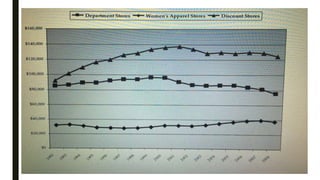
  • #24 Sales based upon types of stores that sold the Eileen Fisher Product Dove Evolution of a Brand –(Harvard Business Stores- 9-508-047) Case Study
  • #25 Notes form the Research Study group based upon Lifestyle and Attitudes of the Key Core Customers Anat Keinan,Fiona Wilson, Jill Avery and Michael Norton ”Eileen Fisher: Repositioning the Brand- (HBS 9-512-085)
  • #26 Anat Keinan,Fiona Wilson, Jill Avery and Michael Norton ”Eileen Fisher: Repositioning the Brand- (HBS 9-512-085)
  • #27 Brand Extensions- Bath and Bedding License Anat Keinan,Fiona Wilson, Jill Avery and Michael Norton ”Eileen Fisher: Repositioning the Brand- (HBS 9-512-085)
  • #28 Dove Evolution of a Brand –(Harvard Business Stores- 9-508-047) Case Study
  • #29 Dove Evolution of a Brand –(Harvard Business Stores- 9-508-047) Case Study
  • #30 Dove Evolution of a Brand –(Harvard Business Stores- 9-508-047) Case Study WHO IS UNILEVER- A leading global manufacturer of packaged consumer goods, Unilever operated in the food, home, and personal care sectors of the economy. Eleven of its brands had annual revenues globally over $1 billion: Knorr, Surf, Lipton, Omo, Sunsilk, Dove, Blue Band, Lux, Hellmann’s, Becel and the Heart logo,a visual identifier in ice cream. Other brands included Pond’s, Suave, Vaseline, Axe, Snuggle, Bertolli, Ragu, Ben and Jerry’s, and Slim-Fast. With annual revenues of $50 billion, Unilever compared in size to Nestle ($69 billion), Procter and Gamble ($68 billion) and Kraft Foods ($34 BILLION)
  • #32 Dove Evolution of a Brand –(Harvard Business Stores- 9-508-047) Case Study
  • #33 Dove Evolution of a Brand –(Harvard Business Stores- 9-508-047) Case Study They decided instead that Dove should stand for a point of view. A search for that point of view began right away. A process of exploratory market research, consultation with experts, conversations with women, and message testing led to “The Campaign for Real Beauty.”
  • #37 Dove Evolution of a Brand –(Harvard Business Stores- 9-508-047) Case Study
  • #40 Dove Evolution of a Brand –(Harvard Business Stores- 9-508-047) Case Study
  • #41 Dove Evolution of a Brand –(Harvard Business Stores- 9-508-047) Case Study
  • #45 Dove Evolution of a Brand –(Harvard Business Stores- 9-508-047) Case Study
  • #46 Dove Evolution of a Brand –(Harvard Business Stores- 9-508-047) Case Study
  • #47 Very interesting that Brazil really pushes the beauty angle and that Japan does not. Dove Evolution of a Brand –(Harvard Business Stores- 9-508-047) Case Study
  • #48 Telling Averages; Most responded they felt themselves average and 0 % responded as gorgeous and only 1% as sexy. What does that tell us a head set for women? Dove Evolution of a Brand –(Harvard Business Stores- 9-508-047) Case Study