Risk Management
University of Economics, Kraków, 2012
              Tomasz Aleksandrowicz
financial risk management

             financial risks types
sources of financial risks
• organization’s exposure to changes in market prices, such as
  interest rates, exchange rates, and commodity prices
• 2. Financial risks arising from the actions of, and transactions
  with, other organizations such as vendors, customers, and
  counterparties in derivatives transactions
• 3. Financial risks resulting from internal actions or failures of
  the organization, particularly people, processes, and systems
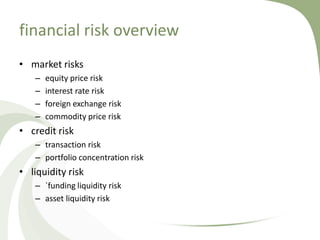
financial risk overview
• market risks
   –   equity price risk
   –   interest rate risk
   –   foreign exchange risk
   –   commodity price risk
• credit risk
   – transaction risk
   – portfolio concentration risk
• liquidity risk
   – `funding liquidity risk
   – asset liquidity risk
market risk

      equity price risk
     interest rate risk
foreign exchange risk
commodity price risk
equity price risk
• risk resulting from holding equities or assets with
  performance tied to equity prices
• faced by all organizations possessing or issuing
  equities
interest rate risk
• risk resulting from volatility of interest rates
• faced by all companies with borrowings (affecting
  cost of funds)
   – loan with fixed rate of interest
   – loan with floating (variable) rate of interest
• impact depends on company structure / relation of:
   – capital and debt (leverage ratio)
   – short and long term debt
   – fixed and floating rate debt
foreign exchange rate risk
• risk resulting from change in the exchange rate of
  one currency against another
• faced by all organizations involved in foreign
  exchange or utilizing commodities denominated in
  other currency
commodity price risk
• risk resulting from commodity prices rising or falling

• faced by all organizations that produce or purchase
  commodities
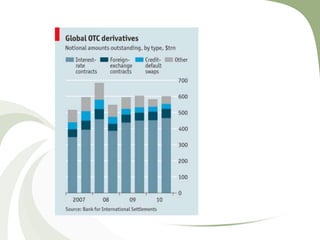
derivatives
Portfolio creation approach


                              12
diversification (I)

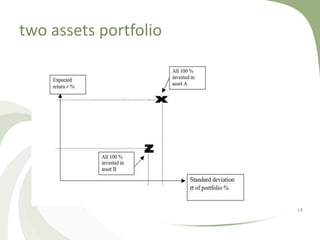
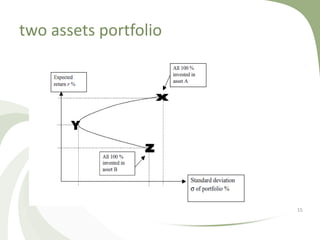
• diversification means reducing risk by investing in a variety of
  assets
• it means: don't put all your eggs in one basket
• diversified portfolio will have less risk than the weighted
  average risk of its elements
• often less risk than the least risky of its parts
• crucial element is selection of assets with low correlation
• correlaton values:[-1,1]

                                                                     13
two assets portfolio


                       14
two assets portfolio


                       15
divrsification (II)
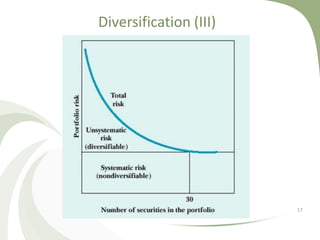
• specific risk and systematic risk
• individual, specific securities are much more risky than the
  market
• specific risk can be lowered by diversification
• systematic risk is a limit for diversification efficiency – can not
  be elimitnated by diversification


                                                                        16
Diversification (III)


                        17
Asset specific risk – variance / sd
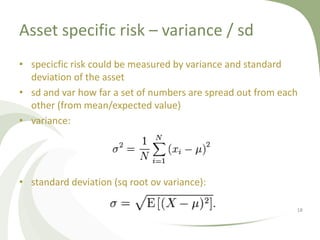
• specicfic risk could be measured by variance and standard
  deviation of the asset
• sd and var how far a set of numbers are spread out from each
  other (from mean/expected value)
• variance:


• standard deviation (sq root ov variance):

                                                             18
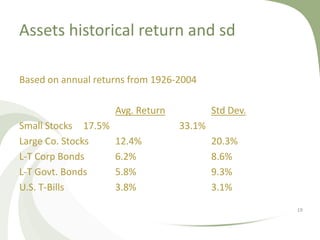
Assets historical return and sd

Based on annual returns from 1926-2004

                     Avg. Return           Std Dev.
Small Stocks 17.5%                 33.1%
Large Co. Stocks     12.4%                 20.3%
L-T Corp Bonds       6.2%                  8.6%
L-T Govt. Bonds      5.8%                  9.3%
U.S. T-Bills         3.8%                  3.1%
                                                      19
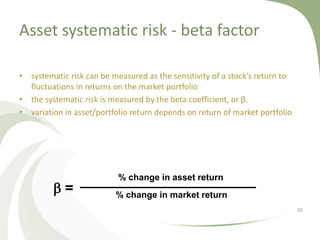
Asset systematic risk - beta factor

• systematic risk can be measured as the sensitivity of a stock’s return to
  fluctuations in returns on the market portfolio
• the systematic risk is measured by the beta coefficient, or β.
• variation in asset/portfolio return depends on return of market portfolio


                           % change in asset return
         b=               % change in market return
                                                                              20
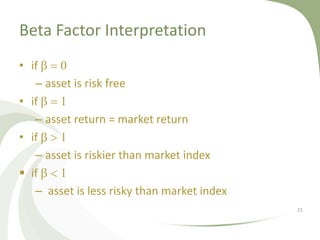
Beta Factor Interpretation
• if b = 0
   – asset is risk free
• if b = 1
   – asset return = market return
• if b > 1
   – asset is riskier than market index
 if b < 1
   – asset is less risky than market index
                                             21
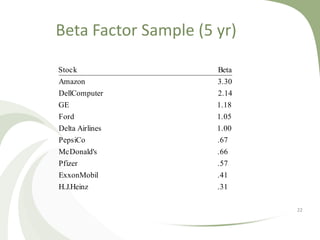
Beta Factor Sample (5 yr)

Stock                 Beta
Amazon                3.30
DellComputer          2.14
GE                    1.18
Ford                  1.05
Delta Airlines        1.00
PepsiCo               .67
McDonald's            .66
Pfizer                .57
ExxonMobil            .41
H.J.Heinz             .31

                             22

Rm 07-v1

  • 1.
    Risk Management University ofEconomics, Kraków, 2012 Tomasz Aleksandrowicz
  • 2.
    financial risk management financial risks types
  • 3.
    sources of financialrisks • organization’s exposure to changes in market prices, such as interest rates, exchange rates, and commodity prices • 2. Financial risks arising from the actions of, and transactions with, other organizations such as vendors, customers, and counterparties in derivatives transactions • 3. Financial risks resulting from internal actions or failures of the organization, particularly people, processes, and systems
  • 4.
    financial risk overview •market risks – equity price risk – interest rate risk – foreign exchange risk – commodity price risk • credit risk – transaction risk – portfolio concentration risk • liquidity risk – `funding liquidity risk – asset liquidity risk
  • 5.
    market risk equity price risk interest rate risk foreign exchange risk commodity price risk
  • 6.
    equity price risk •risk resulting from holding equities or assets with performance tied to equity prices • faced by all organizations possessing or issuing equities
  • 7.
    interest rate risk •risk resulting from volatility of interest rates • faced by all companies with borrowings (affecting cost of funds) – loan with fixed rate of interest – loan with floating (variable) rate of interest • impact depends on company structure / relation of: – capital and debt (leverage ratio) – short and long term debt – fixed and floating rate debt
  • 8.
    foreign exchange raterisk • risk resulting from change in the exchange rate of one currency against another • faced by all organizations involved in foreign exchange or utilizing commodities denominated in other currency
  • 9.
    commodity price risk •risk resulting from commodity prices rising or falling • faced by all organizations that produce or purchase commodities
  • 10.
  • 12.
  • 13.
    diversification (I) • diversificationmeans reducing risk by investing in a variety of assets • it means: don't put all your eggs in one basket • diversified portfolio will have less risk than the weighted average risk of its elements • often less risk than the least risky of its parts • crucial element is selection of assets with low correlation • correlaton values:[-1,1] 13
  • 14.
  • 15.
  • 16.
    divrsification (II) • specificrisk and systematic risk • individual, specific securities are much more risky than the market • specific risk can be lowered by diversification • systematic risk is a limit for diversification efficiency – can not be elimitnated by diversification 16
  • 17.
  • 18.
    Asset specific risk– variance / sd • specicfic risk could be measured by variance and standard deviation of the asset • sd and var how far a set of numbers are spread out from each other (from mean/expected value) • variance: • standard deviation (sq root ov variance): 18
  • 19.
    Assets historical returnand sd Based on annual returns from 1926-2004 Avg. Return Std Dev. Small Stocks 17.5% 33.1% Large Co. Stocks 12.4% 20.3% L-T Corp Bonds 6.2% 8.6% L-T Govt. Bonds 5.8% 9.3% U.S. T-Bills 3.8% 3.1% 19
  • 20.
    Asset systematic risk- beta factor • systematic risk can be measured as the sensitivity of a stock’s return to fluctuations in returns on the market portfolio • the systematic risk is measured by the beta coefficient, or β. • variation in asset/portfolio return depends on return of market portfolio % change in asset return b= % change in market return 20
  • 21.
    Beta Factor Interpretation •if b = 0 – asset is risk free • if b = 1 – asset return = market return • if b > 1 – asset is riskier than market index  if b < 1 – asset is less risky than market index 21
  • 22.
    Beta Factor Sample(5 yr) Stock Beta Amazon 3.30 DellComputer 2.14 GE 1.18 Ford 1.05 Delta Airlines 1.00 PepsiCo .67 McDonald's .66 Pfizer .57 ExxonMobil .41 H.J.Heinz .31 22