Risk Management
University of Economics, Kraków, 2012
              Tomasz Aleksandrowicz
risk at financial markets

             current financial crisis
        financial risk management
Biggest XX centaury financial crises
•   1929 - Wall Street Crash (Great Depression)
•   1973 – oil prices crisis (1973 – 1974 market crash)
•   1987 – Black Monday (19 October)
•   1989 – 1991 - savings and loan crisis (US)
•   1990 - Japanese asset price bubble
•   1992–93 – Black Wednesday (16 September)
•   1994 - economic crisis in Mexico
•   1997 - Asian financial crisis
•   1998 - Russian financial crisis
•   2001 - dot-com bubble
world financial crisis

           financial crisis in 2007 – 2012 (?)
case story: dramatic turn of events of 2008
phases of the crisis
•   US housing bubble burst causing sub-prime
    mortgage crash (2006)
•   banking and financial market crisis (2008 - 2009)
•   global recession (started 2009)
•   sovereign debt crisis (started 2010)
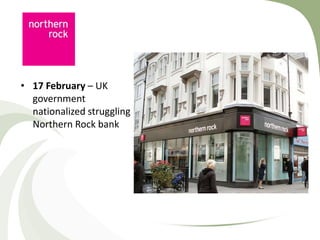
• 17 February – UK
  government
  nationalized struggling
  Northern Rock bank
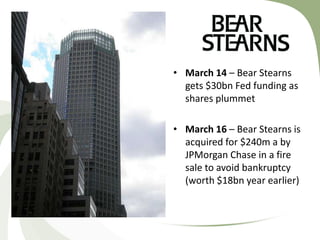
• March 14 – Bear Stearns
  gets $30bn Fed funding as
  shares plummet

• March 16 – Bear Stearns is
  acquired for $240m a by
  JPMorgan Chase in a fire
  sale to avoid bankruptcy
  (worth $18bn year earlier)
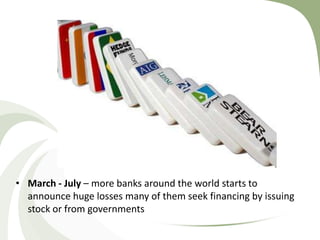
• March - July – more banks around the world starts to
  announce huge losses many of them seek financing by issuing
  stock or from governments
• September 7 - US government takeover of Fannie Mae and
  Freddie Mac
• two companies at that time owned or guaranteed about half
  of the US $12 trillion mortgage market
• this move causes panic on the markets
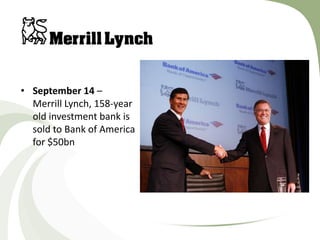
• September 14 –
  Merrill Lynch, 158-year
  old investment bank is
  sold to Bank of America
  for $50bn
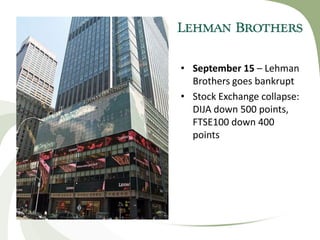
• September 15 – Lehman
  Brothers goes bankrupt
• Stock Exchange collapse:
  DIJA down 500 points,
  FTSE100 down 400
  points
• September 16 – AIG credit
  ratings downgraded
• September 16 – $140bn
  withdrawn from money
  market funds which causes
  freeze of CP market
• September 17 – US FED lends
  $85bn to AIG to prevent
  bankruptcy
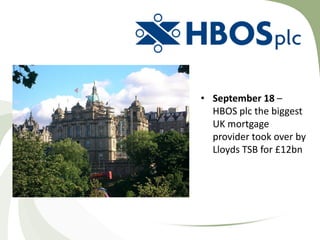
• September 18 –
  HBOS plc the biggest
  UK mortgage
  provider took over by
  Lloyds TSB for £12bn
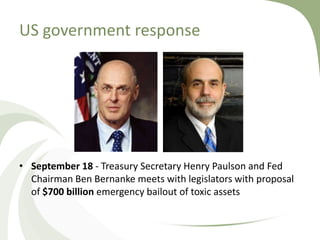
US government response


• September 18 - Treasury Secretary Henry Paulson and Fed
  Chairman Ben Bernanke meets with legislators with proposal
  of $700 billion emergency bailout of toxic assets
• September 25 – due to
  bank run and $16.4bn
  deposit withdrawn in 10
  days Washington Mutual is
  closed down by regulator –
  remaining assets sold to JP
  Morgan Chase for $1.9bn
• at that time bank assets
  were worth $307bn
• September 29 - Citigroup Inc.
  announced that he would acquire
  banking operations of Wachovia
• Later October 3: Wells Fargo
  makes a higher offer for Wachovia
  paying $15bn
• September 29 –
  September 31: As
  crisis hits Europe –
  more banks
  nationalized
• First days of October
  – Iceland banking
  sector nationalized
• stock exchange
  operations
  suspended
• rating agencies
  downgrades
• economic downturn
• Iceland first country
  to seek IMF help
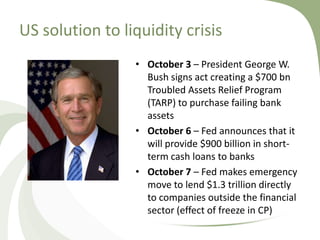
US solution to liquidity crisis
                 • October 3 – President George W.
                   Bush signs act creating a $700 bn
                   Troubled Assets Relief Program
                   (TARP) to purchase failing bank
                   assets
                 • October 6 – Fed announces that it
                   will provide $900 billion in short-
                   term cash loans to banks
                 • October 7 – Fed makes emergency
                   move to lend $1.3 trillion directly
                   to companies outside the financial
                   sector (effect of freeze in CP)
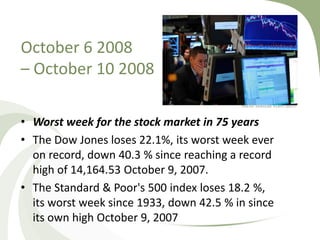
October 6 2008
– October 10 2008

• Worst week for the stock market in 75 years
• The Dow Jones loses 22.1%, its worst week ever
  on record, down 40.3 % since reaching a record
  high of 14,164.53 October 9, 2007.
• The Standard & Poor's 500 index loses 18.2 %,
  its worst week since 1933, down 42.5 % in since
  its own high October 9, 2007
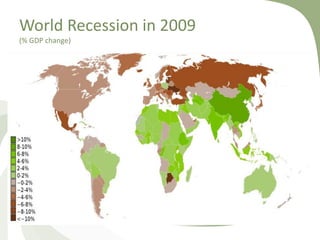
World Recession in 2009
(% GDP change)
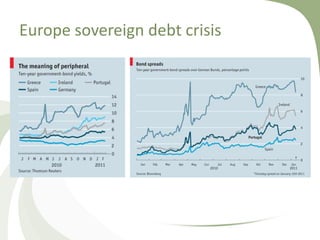
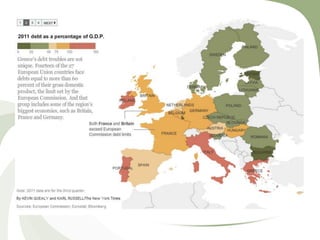
Europe sovereign debt crisis
roots of world financial crisis

         causes of crisis in risk perspective
                        main consequences
causes of financial crisis
•   no simple answer
•   many direct and indirect factors
•   variety of narratives describing the crisis
•   highlights from risk management perspective
• Regulatory and market-based controls did not effectively
  protect this system or measure the buildup of risk
roots of financial crisis
• policy of deregulation of financial sector
• historically low interest rates
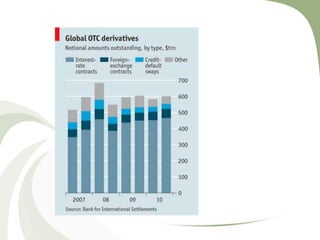
• derivatives market not regulated
• rise of financial engineering and complexity of the securities
• sub-prime loans and predatory loans
• rating agencies paid by security issuer model
• financial sector salaries and incentives connected with short
  term performance (not regulated)
• commodities boom
sources of financial risk

                      xxx
Rm 06
Rm 06
Rm 06

Rm 06

  • 1.
    Risk Management University ofEconomics, Kraków, 2012 Tomasz Aleksandrowicz
  • 2.
    risk at financialmarkets current financial crisis financial risk management
  • 3.
    Biggest XX centauryfinancial crises • 1929 - Wall Street Crash (Great Depression) • 1973 – oil prices crisis (1973 – 1974 market crash) • 1987 – Black Monday (19 October) • 1989 – 1991 - savings and loan crisis (US) • 1990 - Japanese asset price bubble • 1992–93 – Black Wednesday (16 September) • 1994 - economic crisis in Mexico • 1997 - Asian financial crisis • 1998 - Russian financial crisis • 2001 - dot-com bubble
  • 4.
    world financial crisis financial crisis in 2007 – 2012 (?) case story: dramatic turn of events of 2008
  • 5.
    phases of thecrisis • US housing bubble burst causing sub-prime mortgage crash (2006) • banking and financial market crisis (2008 - 2009) • global recession (started 2009) • sovereign debt crisis (started 2010)
  • 8.
    • 17 February– UK government nationalized struggling Northern Rock bank
  • 9.
    • March 14– Bear Stearns gets $30bn Fed funding as shares plummet • March 16 – Bear Stearns is acquired for $240m a by JPMorgan Chase in a fire sale to avoid bankruptcy (worth $18bn year earlier)
  • 10.
    • March -July – more banks around the world starts to announce huge losses many of them seek financing by issuing stock or from governments
  • 11.
    • September 7- US government takeover of Fannie Mae and Freddie Mac • two companies at that time owned or guaranteed about half of the US $12 trillion mortgage market • this move causes panic on the markets
  • 12.
    • September 14– Merrill Lynch, 158-year old investment bank is sold to Bank of America for $50bn
  • 13.
    • September 15– Lehman Brothers goes bankrupt • Stock Exchange collapse: DIJA down 500 points, FTSE100 down 400 points
  • 14.
    • September 16– AIG credit ratings downgraded • September 16 – $140bn withdrawn from money market funds which causes freeze of CP market • September 17 – US FED lends $85bn to AIG to prevent bankruptcy
  • 15.
    • September 18– HBOS plc the biggest UK mortgage provider took over by Lloyds TSB for £12bn
  • 16.
    US government response •September 18 - Treasury Secretary Henry Paulson and Fed Chairman Ben Bernanke meets with legislators with proposal of $700 billion emergency bailout of toxic assets
  • 17.
    • September 25– due to bank run and $16.4bn deposit withdrawn in 10 days Washington Mutual is closed down by regulator – remaining assets sold to JP Morgan Chase for $1.9bn • at that time bank assets were worth $307bn
  • 18.
    • September 29- Citigroup Inc. announced that he would acquire banking operations of Wachovia • Later October 3: Wells Fargo makes a higher offer for Wachovia paying $15bn
  • 19.
    • September 29– September 31: As crisis hits Europe – more banks nationalized
  • 20.
    • First daysof October – Iceland banking sector nationalized • stock exchange operations suspended • rating agencies downgrades • economic downturn • Iceland first country to seek IMF help
  • 21.
    US solution toliquidity crisis • October 3 – President George W. Bush signs act creating a $700 bn Troubled Assets Relief Program (TARP) to purchase failing bank assets • October 6 – Fed announces that it will provide $900 billion in short- term cash loans to banks • October 7 – Fed makes emergency move to lend $1.3 trillion directly to companies outside the financial sector (effect of freeze in CP)
  • 22.
    October 6 2008 –October 10 2008 • Worst week for the stock market in 75 years • The Dow Jones loses 22.1%, its worst week ever on record, down 40.3 % since reaching a record high of 14,164.53 October 9, 2007. • The Standard & Poor's 500 index loses 18.2 %, its worst week since 1933, down 42.5 % in since its own high October 9, 2007
  • 23.
    World Recession in2009 (% GDP change)
  • 24.
  • 26.
    roots of worldfinancial crisis causes of crisis in risk perspective main consequences
  • 27.
    causes of financialcrisis • no simple answer • many direct and indirect factors • variety of narratives describing the crisis • highlights from risk management perspective
  • 28.
    • Regulatory andmarket-based controls did not effectively protect this system or measure the buildup of risk
  • 29.
    roots of financialcrisis • policy of deregulation of financial sector • historically low interest rates • derivatives market not regulated • rise of financial engineering and complexity of the securities • sub-prime loans and predatory loans • rating agencies paid by security issuer model • financial sector salaries and incentives connected with short term performance (not regulated) • commodities boom
  • 30.