Risk Management
University of Economics, Kraków, 2012
              Tomasz Aleksandrowicz
Risk Treatment
Risk monitoring & reporting
                Ryanair case study
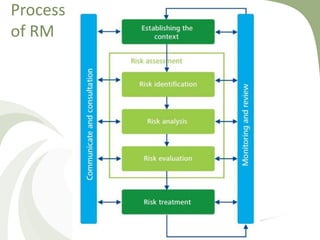
Process
of RM
risk treatment (risk mitigation)
• selecting and implementing response to risks
• in line with organizations risk approach and risk
  appetite
• decisions as to whether particular risks should be
  avoided, reduced, shared (transferred) or accepted
risk treatment common methods
• avoidance
• reduction – internal control
• sharing (transfer)
   – insurance
   – portfolio diversification
   – hedging
   – outsourcing
• acceptance
• other less common methods
risk avoidance

• hold back or exit risk related activities
• in terms of product, geographical region, customer
  segment, etc.
• result of organization goals and strategy
• simple and commonly used method
risk reduction
• based on prioritization of risks by risk matrix
• activities to reduce:
   – likelihood (probability) of a risk
   – severity (consequences) of a risk
   – both aspects
• costs and benefits taken into consideration
• implemented mostly by internal control
• could be performed by risk function (run by CRO),
  internal audit or compliance activities
risk reduction – internal control

• system established to provide reasonable
    assurance of effective and efficient operation
• internal controls:
   – financial (e.g. financial ratios, budgets, variance analysis)
   – non-financial quantitative (e.g. customer satisfaction,
     wastage, personnel rotation)
   – qualitative (e.g. plans, procedures, rules, access to
     computers or buildings, project management, corporate
     culture)
risk sharing – insurance


• protection against hazards by taking out an insurance
  policy against an uncertain event
• involves payment of a premium to an insurer
• insurer will compensate the loss in case of event
  occurrence
• used only for insurable risks
• internal approach: self-insurance
risk sharing – diversification


•   using idea of ”don't put all your eggs in one basket”
•   wider range of activities/investments lowers the risk
•   holding a portfolio of assets/activities/customers
•   need of low correlation between portfolio items
risk sharing – hedging


• in relation to ‘underlying’ factor (e.g. interest rate,
  currency exchange, commodity, share or bond price)
• implemented by instruments with opposite-value
  movements to the ‘underlying’ (i.e. negative
  correlation)
• protection from unfavorable movement of an
  ‘underlying’ while still benefit from favorable
  movement
risk sharing – outsourcing


• transfer activities or processes to third party
• release organization sources
• possible process improvement and expertise
risk acceptance

• precise definition what could be accepted
• no action taken in relation to the risk
• should be covered by day-to-day business activities
  and its budget
risk treatment pro-active methods
•   performance and quality management
•   public relations
•   lobbying
•   strategic alliances
•   mergers and acquisitions
•   public aid utilization
RM process
                           Risk treatment
Ryanair case – create risk treatment ideas
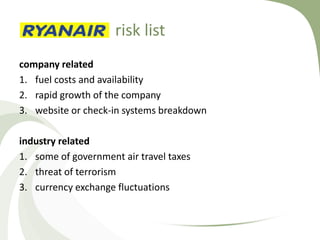
risk list
company related
1. fuel costs and availability
2. rapid growth of the company
3. website or check-in systems breakdown

industry related
1. some of government air travel taxes
2. threat of terrorism
3. currency exchange fluctuations
risk monitoring
• continuous process based on risk framework
• undertaken by risk owners, management and the
  board (or equivalent)
• many methods, commonly used: checklists, risk
  register, information scanning, media monitoring
• risk register
   – commonly used by organizations
   – no standardized format
   – most important items form risk register are subject of risk
     reporting
risk register – examples of criteria
•   risk number (an unique identifier)
•   risk category
•   description of risk
•   date risk identified
•   name of person who identified risk
•   likelihood
•   consequences
•   a monetary value, if such can be allocated to the risk
•   interdependencies with other risks
risk reporting
• based on monitoring process
• in line with financial reporting
• reporting for internal audience: management and the
  board
• reporting for external audience:
   – investor relations (quarterly and annual reporting)
   – regulatory reporting (e.g. SOX or Basel II)
• reporting covers:
   – identified risks and its treatment
   – prioritized actions for decision makers
   – process of risk management review

Rm 05-v2

  • 1.
    Risk Management University ofEconomics, Kraków, 2012 Tomasz Aleksandrowicz
  • 2.
    Risk Treatment Risk monitoring& reporting Ryanair case study
  • 3.
  • 4.
    risk treatment (riskmitigation) • selecting and implementing response to risks • in line with organizations risk approach and risk appetite • decisions as to whether particular risks should be avoided, reduced, shared (transferred) or accepted
  • 5.
    risk treatment commonmethods • avoidance • reduction – internal control • sharing (transfer) – insurance – portfolio diversification – hedging – outsourcing • acceptance • other less common methods
  • 6.
    risk avoidance • holdback or exit risk related activities • in terms of product, geographical region, customer segment, etc. • result of organization goals and strategy • simple and commonly used method
  • 7.
    risk reduction • basedon prioritization of risks by risk matrix • activities to reduce: – likelihood (probability) of a risk – severity (consequences) of a risk – both aspects • costs and benefits taken into consideration • implemented mostly by internal control • could be performed by risk function (run by CRO), internal audit or compliance activities
  • 8.
    risk reduction –internal control • system established to provide reasonable assurance of effective and efficient operation • internal controls: – financial (e.g. financial ratios, budgets, variance analysis) – non-financial quantitative (e.g. customer satisfaction, wastage, personnel rotation) – qualitative (e.g. plans, procedures, rules, access to computers or buildings, project management, corporate culture)
  • 9.
    risk sharing –insurance • protection against hazards by taking out an insurance policy against an uncertain event • involves payment of a premium to an insurer • insurer will compensate the loss in case of event occurrence • used only for insurable risks • internal approach: self-insurance
  • 10.
    risk sharing –diversification • using idea of ”don't put all your eggs in one basket” • wider range of activities/investments lowers the risk • holding a portfolio of assets/activities/customers • need of low correlation between portfolio items
  • 11.
    risk sharing –hedging • in relation to ‘underlying’ factor (e.g. interest rate, currency exchange, commodity, share or bond price) • implemented by instruments with opposite-value movements to the ‘underlying’ (i.e. negative correlation) • protection from unfavorable movement of an ‘underlying’ while still benefit from favorable movement
  • 12.
    risk sharing –outsourcing • transfer activities or processes to third party • release organization sources • possible process improvement and expertise
  • 13.
    risk acceptance • precisedefinition what could be accepted • no action taken in relation to the risk • should be covered by day-to-day business activities and its budget
  • 14.
    risk treatment pro-activemethods • performance and quality management • public relations • lobbying • strategic alliances • mergers and acquisitions • public aid utilization
  • 15.
    RM process Risk treatment Ryanair case – create risk treatment ideas
  • 16.
    risk list company related 1.fuel costs and availability 2. rapid growth of the company 3. website or check-in systems breakdown industry related 1. some of government air travel taxes 2. threat of terrorism 3. currency exchange fluctuations
  • 17.
    risk monitoring • continuousprocess based on risk framework • undertaken by risk owners, management and the board (or equivalent) • many methods, commonly used: checklists, risk register, information scanning, media monitoring • risk register – commonly used by organizations – no standardized format – most important items form risk register are subject of risk reporting
  • 18.
    risk register –examples of criteria • risk number (an unique identifier) • risk category • description of risk • date risk identified • name of person who identified risk • likelihood • consequences • a monetary value, if such can be allocated to the risk • interdependencies with other risks
  • 19.
    risk reporting • basedon monitoring process • in line with financial reporting • reporting for internal audience: management and the board • reporting for external audience: – investor relations (quarterly and annual reporting) – regulatory reporting (e.g. SOX or Basel II) • reporting covers: – identified risks and its treatment – prioritized actions for decision makers – process of risk management review