Risk Management
University of Economics, Kraków, 2012
              Tomasz Aleksandrowicz
Risk in general
• possibility of loss or injury
   – something could be lost / injuried by accident or misfortune
• potential for a negative impact.
   – something could go wrong
• likelihood of an undesirable event
   – some event may cause negative influence
Risk definition
Risk definition
• probability that an actual return on an investment will be
  lower than the expected return (finance)

• combination of the probability of an event and its
  consequences (RM Intiture)

• uncertain future events that could influence the achievement
  of the organization’s, strategic, operational and financial
  objectives
Risk vs uncertainty
• risk - variability that can be quantified in terms of
  probabilities
• uncertainty - variability that cannot be quantified at
  all

• In effect there is need for clarity of degree to which the
  results depend on statistically measurable risk and to which
  depend on factors that are entirely uncertain at the time of
  the analysis.
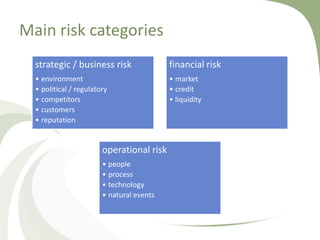
Main risk categories
  strategic / business risk                financial risk
  • environment                            • market
  • political / regulatory                 • credit
  • competitors                            • liquidity
  • customers
  • reputation


                        operational risk
                        • people
                        • process
                        • technology
                        • natural events
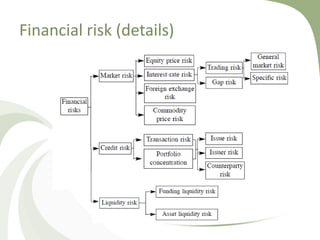
Financial risk (details)
Risk sources
History of risk

• In middle ages in Europe word ‘risicum’ used in context of sea
  trade
• English word ‘risk’ comes from old French word risqué -
  “danger, in which there is an element of chance”
• games of chance and hazard has been popular since accient
  times (as far as Egypt 3500 BC)
• until the Renaissance that no “scientific” or statistical basis for
  gambling was presented
   – arabic numerc system 0-9 digits between X-XII,
   – treated as secret knowledge)
                                                                    10
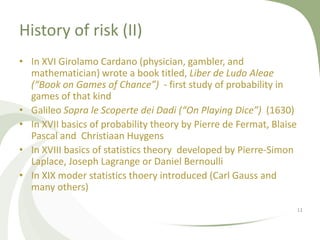
History of risk (II)
• In XVI Girolamo Cardano (physician, gambler, and
  mathematician) wrote a book titled, Liber de Ludo Aleae
  (“Book on Games of Chance”) - first study of probability in
  games of that kind
• Galileo Sopra le Scoperte dei Dadi (“On Playing Dice”) (1630)
• In XVII basics of probability theory by Pierre de Fermat, Blaise
  Pascal and Christiaan Huygens
• In XVIII basics of statistics theory developed by Pierre-Simon
  Laplace, Joseph Lagrange or Daniel Bernoulli
• In XIX moder statistics thoery introduced (Carl Gauss and
  many others)

                                                                     11
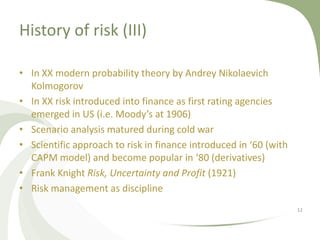
History of risk (III)

• In XX modern probability theory by Andrey Nikolaevich
  Kolmogorov
• In XX risk introduced into finance as first rating agencies
  emerged in US (i.e. Moody’s at 1906)
• Scenario analysis matured during cold war
• Scientific approach to risk in finance introduced in ‘60 (with
  CAPM model) and become popular in ‘80 (derivatives)
• Frank Knight Risk, Uncertainty and Profit (1921)
• Risk management as discipline
                                                                   12

Rm 02

  • 1.
    Risk Management University ofEconomics, Kraków, 2012 Tomasz Aleksandrowicz
  • 2.
    Risk in general •possibility of loss or injury – something could be lost / injuried by accident or misfortune • potential for a negative impact. – something could go wrong • likelihood of an undesirable event – some event may cause negative influence
  • 3.
  • 4.
    Risk definition • probabilitythat an actual return on an investment will be lower than the expected return (finance) • combination of the probability of an event and its consequences (RM Intiture) • uncertain future events that could influence the achievement of the organization’s, strategic, operational and financial objectives
  • 5.
    Risk vs uncertainty •risk - variability that can be quantified in terms of probabilities • uncertainty - variability that cannot be quantified at all • In effect there is need for clarity of degree to which the results depend on statistically measurable risk and to which depend on factors that are entirely uncertain at the time of the analysis.
  • 6.
    Main risk categories strategic / business risk financial risk • environment • market • political / regulatory • credit • competitors • liquidity • customers • reputation operational risk • people • process • technology • natural events
  • 7.
  • 8.
  • 10.
    History of risk •In middle ages in Europe word ‘risicum’ used in context of sea trade • English word ‘risk’ comes from old French word risqué - “danger, in which there is an element of chance” • games of chance and hazard has been popular since accient times (as far as Egypt 3500 BC) • until the Renaissance that no “scientific” or statistical basis for gambling was presented – arabic numerc system 0-9 digits between X-XII, – treated as secret knowledge) 10
  • 11.
    History of risk(II) • In XVI Girolamo Cardano (physician, gambler, and mathematician) wrote a book titled, Liber de Ludo Aleae (“Book on Games of Chance”) - first study of probability in games of that kind • Galileo Sopra le Scoperte dei Dadi (“On Playing Dice”) (1630) • In XVII basics of probability theory by Pierre de Fermat, Blaise Pascal and Christiaan Huygens • In XVIII basics of statistics theory developed by Pierre-Simon Laplace, Joseph Lagrange or Daniel Bernoulli • In XIX moder statistics thoery introduced (Carl Gauss and many others) 11
  • 12.
    History of risk(III) • In XX modern probability theory by Andrey Nikolaevich Kolmogorov • In XX risk introduced into finance as first rating agencies emerged in US (i.e. Moody’s at 1906) • Scenario analysis matured during cold war • Scientific approach to risk in finance introduced in ‘60 (with CAPM model) and become popular in ‘80 (derivatives) • Frank Knight Risk, Uncertainty and Profit (1921) • Risk management as discipline 12