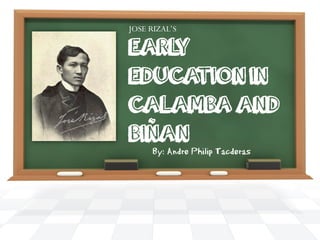
EARLY
EDUCATION IN
CALAMBA AND
BIÑAN
JOSE RIZAL’S
By: Andre Philip Tacderas
Rizal had his early education in Calamba and Biñan.
characterized by the four R’s- reading, writing,
arithmetic, and religion.
Instruction was rigid and strict. Knowledge was
forced into the minds of the pupils by means of the
tedious memory method aided by the teacher’s whip.
It may be said that Rizal, who was born a physical
weakling, rose to become an intellect-
tual giant not because of, but rather in
spite of, the outmoded and back-
ward system of instruction obtaining
in the Philippines during the last decades
of Spanish regime.
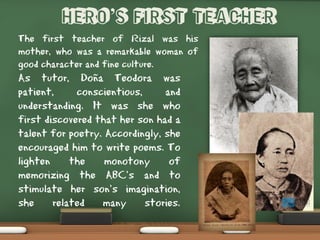
HERO’S FIRST TEACHER
As tutor, Doña Teodora was
patient, conscientious, and
understanding. It was she who
first discovered that her son had a
talent for poetry. Accordingly, she
encouraged him to write poems. To
lighten the monotony of
memorizing the ABC’s and to
stimulate her son’s imagination,
she related many stories.
The first teacher of Rizal was his
mother, who was a remarkable woman of
good character and fine culture.
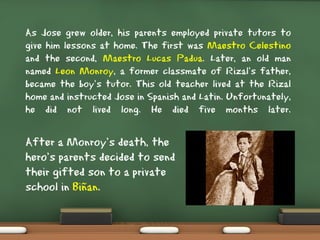
As Jose grew older, his parents employed private tutors to
give him lessons at home. The first was Maestro Celestino
and the second, Maestro Lucas Padua. Later, an old man
named Leon Monroy, a former classmate of Rizal’s father,
became the boy’s tutor. This old teacher lived at the Rizal
home and instructed Jose in Spanish and Latin. Unfortunately,
he did not lived long. He died five months later.
After a Monroy’s death, the
hero’s parents decided to send
their gifted son to a private
school in Biñan.
Jose Goes to Biñan
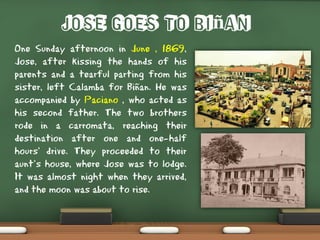
One Sunday afternoon in June , 1869,
Jose, after kissing the hands of his
parents and a tearful parting from his
sister, left Calamba for Biñan. He was
accompanied by Paciano , who acted as
his second father. The two brothers
rode in a carromata, reaching their
destination after one and one-half
hours’ drive. They proceeded to their
aunt’s house, where Jose was to lodge.
It was almost night when they arrived,
and the moon was about to rise.
First Day in Biñan School
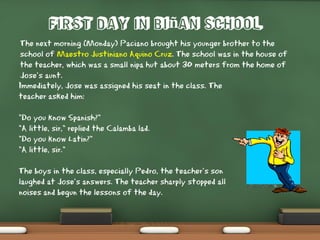
The next morning (Monday) Paciano brought his younger brother to the
school of Maestro Justiniano Aquino Cruz. The school was in the house of
the teacher, which was a small nipa hut about 30 meters from the home of
Jose’s aunt.
Immediately, Jose was assigned his seat in the class. The
teacher asked him:
"Do you know Spanish?"
"A little, sir," replied the Calamba lad.
"Do you know Latin?"
"A little, sir."
The boys in the class, especially Pedro, the teacher’s son
laughed at Jose’s answers. The teacher sharply stopped all
noises and begun the lessons of the day.
Jose described his teacher in Biñan as follows: "He was tall, thin,
long-necked, with sharp nose and a body slightly bent forward, and
he used to wear a sinamay shirt, woven by the skilled hands of the
women of Batangas. He knew by the heart the grammars by Nebrija
and Gainza. Add to this severity that in my judgement was
exaggerated and you have a picture, perhaps vague, that I have made
of him, but I remember only this."
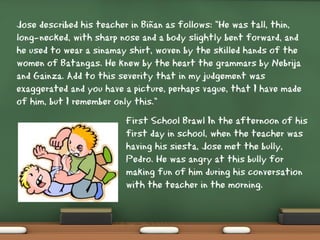
First School Brawl In the afternoon of his
first day in school, when the teacher was
having his siesta, Jose met the bully,
Pedro. He was angry at this bully for
making fun of him during his conversation
with the teacher in the morning.
Jose challenged Pedro to a fight. The latter readily accepted,
thinking that he could easily beat the Calamba boy who was smaller
and younger.
The two boys wrestled furiously in the classroom, much to the glee
of their classmates. Jose, having learned the art of wrestling from
his athletic Tio Manuel, defeated the bigger boy. For this feat, he
became popular among his classmates.
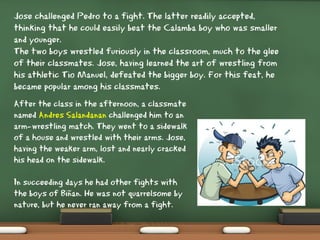
After the class in the afternoon, a classmate
named Andres Salandanan challenged him to an
arm-wrestling match. They went to a sidewalk
of a house and wrestled with their arms. Jose,
having the weaker arm, lost and nearly cracked
his head on the sidewalk.
In succeeding days he had other fights with
the boys of Biñan. He was not quarrelsome by
nature, but he never ran away from a fight.
Jose’s daily routine in Binan
 Hears mass at 4 a.m. or
studies lesson before
going to mass
 Goes to orchard to look
for mabolo to eat
 Breakfast
 Goes to class at 10 a.m.
 Lunch break
 Goes back to school at
2 p.m.
 Goes home at 5 p.m.
 Prays with cousins
 Studies lessons, then
draws a little
 Has supper
 Prays again
 Plays in the street if
moon is bright
 Sleeps
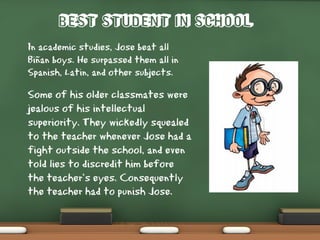
Best Student in School
In academic studies, Jose beat all
Biñan boys. He surpassed them all in
Spanish, Latin, and other subjects.
Some of his older classmates were
jealous of his intellectual
superiority. They wickedly squealed
to the teacher whenever Jose had a
fight outside the school, and even
told lies to discredit him before
the teacher’s eyes. Consequently
the teacher had to punish Jose.
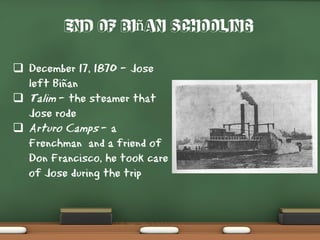
End of Biñan Schooling
 December 17, 1870 – Jose
left Biñan
 Talim – the steamer that
Jose rode
 Arturo Camps – a
Frenchman and a friend of
Don Francisco, he took care
of Jose during the trip
REFERENCE:
http://www.joserizal.ph/ed01.html

Rizal's Early Education in Calamba and Binan

  • 1.
    EARLY EDUCATION IN CALAMBA AND BIÑAN JOSERIZAL’S By: Andre Philip Tacderas
  • 2.
    Rizal had hisearly education in Calamba and Biñan. characterized by the four R’s- reading, writing, arithmetic, and religion. Instruction was rigid and strict. Knowledge was forced into the minds of the pupils by means of the tedious memory method aided by the teacher’s whip. It may be said that Rizal, who was born a physical weakling, rose to become an intellect- tual giant not because of, but rather in spite of, the outmoded and back- ward system of instruction obtaining in the Philippines during the last decades of Spanish regime.
  • 3.
    HERO’S FIRST TEACHER Astutor, Doña Teodora was patient, conscientious, and understanding. It was she who first discovered that her son had a talent for poetry. Accordingly, she encouraged him to write poems. To lighten the monotony of memorizing the ABC’s and to stimulate her son’s imagination, she related many stories. The first teacher of Rizal was his mother, who was a remarkable woman of good character and fine culture.
  • 4.
    As Jose grewolder, his parents employed private tutors to give him lessons at home. The first was Maestro Celestino and the second, Maestro Lucas Padua. Later, an old man named Leon Monroy, a former classmate of Rizal’s father, became the boy’s tutor. This old teacher lived at the Rizal home and instructed Jose in Spanish and Latin. Unfortunately, he did not lived long. He died five months later. After a Monroy’s death, the hero’s parents decided to send their gifted son to a private school in Biñan.
  • 5.
    Jose Goes toBiñan One Sunday afternoon in June , 1869, Jose, after kissing the hands of his parents and a tearful parting from his sister, left Calamba for Biñan. He was accompanied by Paciano , who acted as his second father. The two brothers rode in a carromata, reaching their destination after one and one-half hours’ drive. They proceeded to their aunt’s house, where Jose was to lodge. It was almost night when they arrived, and the moon was about to rise.
  • 6.
    First Day inBiñan School The next morning (Monday) Paciano brought his younger brother to the school of Maestro Justiniano Aquino Cruz. The school was in the house of the teacher, which was a small nipa hut about 30 meters from the home of Jose’s aunt. Immediately, Jose was assigned his seat in the class. The teacher asked him: "Do you know Spanish?" "A little, sir," replied the Calamba lad. "Do you know Latin?" "A little, sir." The boys in the class, especially Pedro, the teacher’s son laughed at Jose’s answers. The teacher sharply stopped all noises and begun the lessons of the day.
  • 7.
    Jose described histeacher in Biñan as follows: "He was tall, thin, long-necked, with sharp nose and a body slightly bent forward, and he used to wear a sinamay shirt, woven by the skilled hands of the women of Batangas. He knew by the heart the grammars by Nebrija and Gainza. Add to this severity that in my judgement was exaggerated and you have a picture, perhaps vague, that I have made of him, but I remember only this." First School Brawl In the afternoon of his first day in school, when the teacher was having his siesta, Jose met the bully, Pedro. He was angry at this bully for making fun of him during his conversation with the teacher in the morning.
  • 8.
    Jose challenged Pedroto a fight. The latter readily accepted, thinking that he could easily beat the Calamba boy who was smaller and younger. The two boys wrestled furiously in the classroom, much to the glee of their classmates. Jose, having learned the art of wrestling from his athletic Tio Manuel, defeated the bigger boy. For this feat, he became popular among his classmates. After the class in the afternoon, a classmate named Andres Salandanan challenged him to an arm-wrestling match. They went to a sidewalk of a house and wrestled with their arms. Jose, having the weaker arm, lost and nearly cracked his head on the sidewalk. In succeeding days he had other fights with the boys of Biñan. He was not quarrelsome by nature, but he never ran away from a fight.
  • 9.
    Jose’s daily routinein Binan  Hears mass at 4 a.m. or studies lesson before going to mass  Goes to orchard to look for mabolo to eat  Breakfast  Goes to class at 10 a.m.  Lunch break  Goes back to school at 2 p.m.  Goes home at 5 p.m.  Prays with cousins  Studies lessons, then draws a little  Has supper  Prays again  Plays in the street if moon is bright  Sleeps
  • 10.
    Best Student inSchool In academic studies, Jose beat all Biñan boys. He surpassed them all in Spanish, Latin, and other subjects. Some of his older classmates were jealous of his intellectual superiority. They wickedly squealed to the teacher whenever Jose had a fight outside the school, and even told lies to discredit him before the teacher’s eyes. Consequently the teacher had to punish Jose.
  • 11.
    End of BiñanSchooling  December 17, 1870 – Jose left Biñan  Talim – the steamer that Jose rode  Arturo Camps – a Frenchman and a friend of Don Francisco, he took care of Jose during the trip
  • 12.