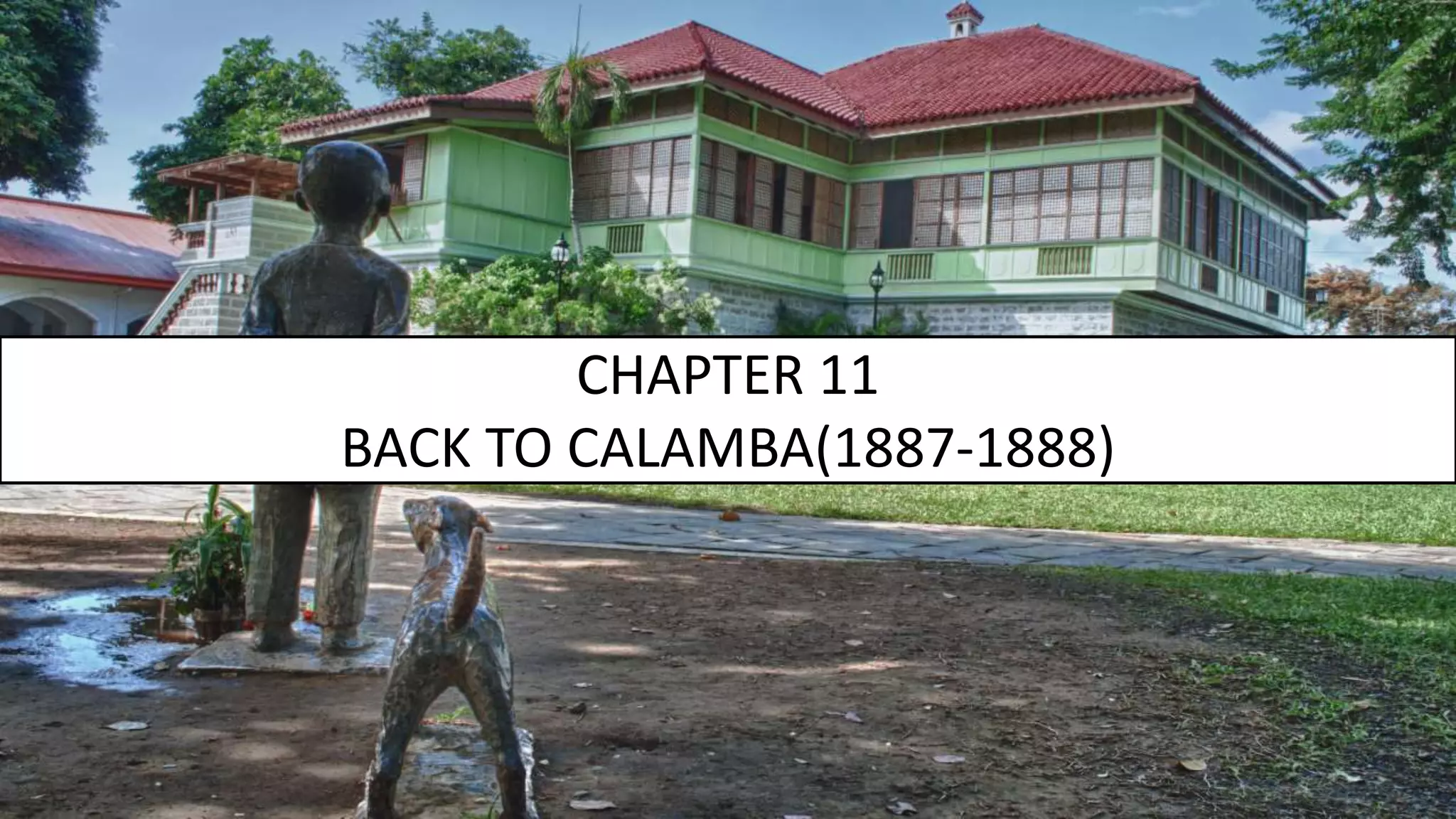
CHAPTER 11
BACK TO CALAMBA(1887-1888)
After 5 years of memorable
sojourn in Europe, He returned to
Philippines in August, 1887.
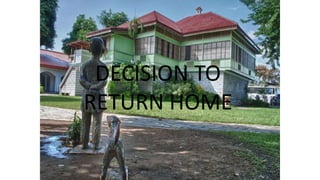
DECISION TO
RETURN HOME
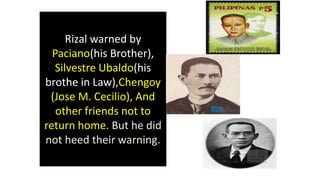
Rizal warned by
Paciano(his Brother),
Silvestre Ubaldo(his
brothe in Law),Chengoy
(Jose M. Cecilio), And
other friends not to
return home. But he did
not heed their warning.
He was determined to return to the
Philippines for the following reasons:
1. to operate his mother’s eyes
2.to serve his people who had long
been oppressed by Spanish Tyrants
3.to find out for himself how the Noli
and his other writings were affecting
Filipinos and Spaniards in the
Philippines. And
4. To find out why Leonor Rivera
had remained silent.
Delightful Trip To Manila
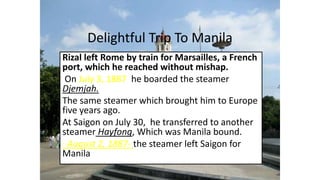
Rizal left Rome by train for Marsailles, a French
port, which he reached without mishap.
On July 3, 1887, he boarded the steamer
Djemjah.
The same steamer which brought him to Europe
five years ago.
At Saigon on July 30, he transferred to another
steamer Hayfong, Which was Manila bound.
· August 2, 1887- the steamer left Saigon for
Manila
Arrival in Manila
· August 3, 1887- the moon was full
and Rizal slept soundly the whole
night. The calm sea, illuminated by
the silvery moonlight, was a
magnificent sight to him
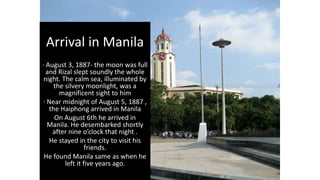
· Near midnight of August 5, 1887 ,
the Haiphong arrived in Manila
On August 6th he arrived in
Manila. He desembarked shortly
after nine o’clock that night .
He stayed in the city to visit his
friends.
He found Manila same as when he
left it five years ago.
Happy Home
Coming
On August 8th Two days after
his arrival in Manila, he
reached Calamba.
His family welcome him
affectionately, with plentiful
tears of joy.
Writing to Blumentritt about
his home coming.
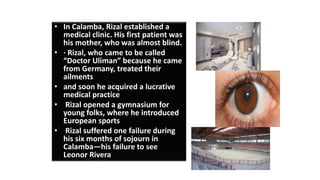
• In Calamba, Rizal established a
medical clinic. His first patient was
his mother, who was almost blind.
• · Rizal, who came to be called
“Doctor Uliman” because he came
from Germany, treated their
ailments
• and soon he acquired a lucrative
medical practice
• Rizal opened a gymnasium for
young folks, where he introduced
European sports
• Rizal suffered one failure during
his six months of sojourn in
Calamba—his failure to see
Leonor Rivera
Storm over Noli
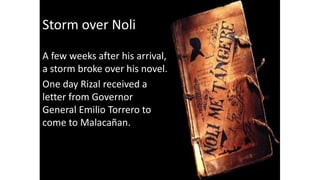
A few weeks after his arrival,
a storm broke over his novel.
One day Rizal received a
letter from Governor
General Emilio Torrero to
come to Malacañan.
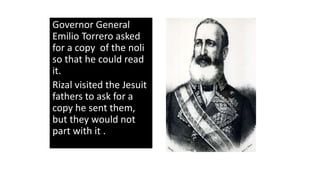
Governor General
Emilio Torrero asked
for a copy of the noli
so that he could read
it.
Rizal visited the Jesuit
fathers to ask for a
copy he sent them,
but they would not
part with it .
• For security measures
Governor General Emilio
Torrero assigned Spanish
lieutenant Don Jose
Taviel de Andrade as a
body guard of rizal.
• This lieutenant came
belonged to noble family.
He is cultured and knew
painting and he could
speak English, French,
and Spanish.
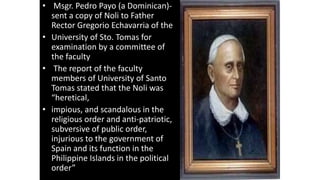
• Msgr. Pedro Payo (a Dominican)-
sent a copy of Noli to Father
Rector Gregorio Echavarria of the
• University of Sto. Tomas for
examination by a committee of
the faculty
• The report of the faculty
members of University of Santo
Tomas stated that the Noli was
“heretical,
• impious, and scandalous in the
religious order and anti-patriotic,
subversive of public order,
injurious to the government of
Spain and its function in the
Philippine Islands in the political
order”
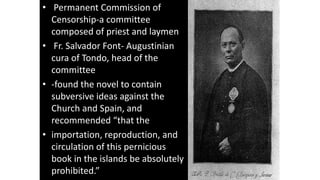
• Permanent Commission of
Censorship-a committee
composed of priest and laymen
• Fr. Salvador Font- Augustinian
cura of Tondo, head of the
committee
• -found the novel to contain
subversive ideas against the
Church and Spain, and
recommended “that the
• importation, reproduction, and
circulation of this pernicious
book in the islands be absolutely
prohibited.”
• Fr. Jose Rodriguez- Augustinian priest,
published a series of eight pamphlets
under the general heading Cuestiones
de Sumo Interes (Questions of
Supreme Interest) to blast the Noli and
other anti-Spanish writings
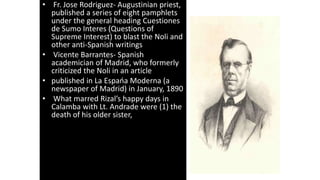
• Vicente Barrantes- Spanish
academician of Madrid, who formerly
criticized the Noli in an article
• published in La Espańa Moderna (a
newspaper of Madrid) in January, 1890
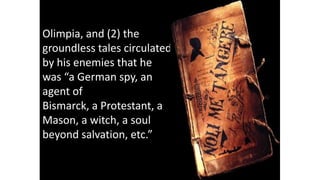
• What marred Rizal’s happy days in
Calamba with Lt. Andrade were (1) the
death of his older sister,
Olimpia, and (2) the
groundless tales circulated
by his enemies that he
was “a German spy, an
agent of
Bismarck, a Protestant, a
Mason, a witch, a soul
beyond salvation, etc.”
DEFENDERS OF NOLI
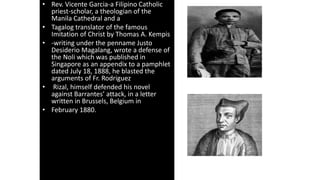
• Rev. Vicente Garcia-a Filipino Catholic
priest-scholar, a theologian of the
Manila Cathedral and a
• Tagalog translator of the famous
Imitation of Christ by Thomas A. Kempis
• -writing under the penname Justo
Desiderio Magalang, wrote a defense of
the Noli which was published in
Singapore as an appendix to a pamphlet
dated July 18, 1888, he blasted the
arguments of Fr. Rodriguez
• Rizal, himself defended his novel
against Barrantes’ attack, in a letter
written in Brussels, Belgium in
• February 1880.
• Marcelo H. Del Pilar- editor of La Solidaridad
• -he published a pamphlet entitled “Caiigat Cayo”
• Caiigat Cayo- it means “Be slippery as an Eel”
• Father Francisco Sanchez- Rizal’s beloved Jesuit professor
• Don Segismundo Moret- a former President of the Council of
Minister
• -he read and like the book very much.
• Rev. Vicente Garcia- a Filipino Catholic priest-scholar, a
theologian of the Manila Cathedral and a Tagalog translator of
the famous Imitation of Christ by Thomas A Kempis
• Father Garcia- writing under the pen name Justo Desiderio
Magalang
-he wrote a defense of the Noli which was published in
Singapore as an appendix to a pamphlet dated on July 18, 1888.
Rizal and Andrade
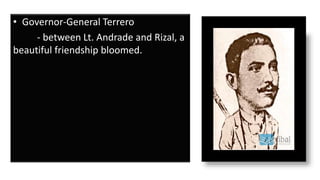
• Governor-General Terrero
- between Lt. Andrade and Rizal, a
beautiful friendship bloomed.
Calamba’s Agrarian Trouble
Governor-General Terrero, influenced by a certain facts
in Noli Me Tangere, ordered a government investigation
of the friars estates to remedy whatever iniquities might
have been presents in connection with land taxes and
with tenant relations.
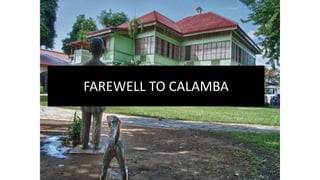
FAREWELL TO CALAMBA
The friars asked Governor General Terrero to deport
him, but latter refused because there was no valid
charge against Rizal in court.
· Rizal was compelled to leave Calamba for two
reasons: (1) his presence in Calamba was jeopardizing
the safety and happiness of his family and friends (2)
he could fight better his enemies and serve his
country’s cause with greater efficacy by writing in
foreign countries
A POEM FOR LIPA
Before Rizal left Calamba in 1888
his friend from Lipa requested him to
write a poem in commemoration of
the town’s elevation to a villa (city), by
virtue of the Becerra Law of 1888. He
wrote a poem this was the Himno Al
Trabajo (Hymn to Labor). He finished it
and sent to Lipa before his departure
from Calamba.
ACTIVITY
Answer the following question correctly
write T if the statement is True; write F if the statement is
False.
1. The first novel of Rizal is Noli Me Tangere
2. The Friend of Rizal is Lt. Jose De Andrade
3. Father Francisco Sanchez is Rizal’s beloved Jesuit
professor.
4. Before Rizal was left to Calamba he wrote a poem in
Lipa.
5. Governor-General Terrero, influenced by a certain facts
in Noli Me Tangere.
References: Pictures/Curicatures-
www. Google.com.ph
Life and works of Rizal by: Gregorio
Zaide

Rizal Report Chapter 11

  • 1.
    CHAPTER 11 BACK TOCALAMBA(1887-1888)
  • 2.
    After 5 yearsof memorable sojourn in Europe, He returned to Philippines in August, 1887.
  • 3.
  • 4.
    Rizal warned by Paciano(hisBrother), Silvestre Ubaldo(his brothe in Law),Chengoy (Jose M. Cecilio), And other friends not to return home. But he did not heed their warning.
  • 5.
    He was determinedto return to the Philippines for the following reasons: 1. to operate his mother’s eyes 2.to serve his people who had long been oppressed by Spanish Tyrants 3.to find out for himself how the Noli and his other writings were affecting Filipinos and Spaniards in the Philippines. And
  • 6.
    4. To findout why Leonor Rivera had remained silent.
  • 7.
    Delightful Trip ToManila Rizal left Rome by train for Marsailles, a French port, which he reached without mishap. On July 3, 1887, he boarded the steamer Djemjah. The same steamer which brought him to Europe five years ago. At Saigon on July 30, he transferred to another steamer Hayfong, Which was Manila bound. · August 2, 1887- the steamer left Saigon for Manila
  • 8.
    Arrival in Manila ·August 3, 1887- the moon was full and Rizal slept soundly the whole night. The calm sea, illuminated by the silvery moonlight, was a magnificent sight to him · Near midnight of August 5, 1887 , the Haiphong arrived in Manila On August 6th he arrived in Manila. He desembarked shortly after nine o’clock that night . He stayed in the city to visit his friends. He found Manila same as when he left it five years ago.
  • 9.
    Happy Home Coming On August8th Two days after his arrival in Manila, he reached Calamba. His family welcome him affectionately, with plentiful tears of joy. Writing to Blumentritt about his home coming.
  • 10.
    • In Calamba,Rizal established a medical clinic. His first patient was his mother, who was almost blind. • · Rizal, who came to be called “Doctor Uliman” because he came from Germany, treated their ailments • and soon he acquired a lucrative medical practice • Rizal opened a gymnasium for young folks, where he introduced European sports • Rizal suffered one failure during his six months of sojourn in Calamba—his failure to see Leonor Rivera
  • 11.
    Storm over Noli Afew weeks after his arrival, a storm broke over his novel. One day Rizal received a letter from Governor General Emilio Torrero to come to Malacañan.
  • 12.
    Governor General Emilio Torreroasked for a copy of the noli so that he could read it. Rizal visited the Jesuit fathers to ask for a copy he sent them, but they would not part with it .
  • 13.
    • For securitymeasures Governor General Emilio Torrero assigned Spanish lieutenant Don Jose Taviel de Andrade as a body guard of rizal. • This lieutenant came belonged to noble family. He is cultured and knew painting and he could speak English, French, and Spanish.
  • 14.
    • Msgr. PedroPayo (a Dominican)- sent a copy of Noli to Father Rector Gregorio Echavarria of the • University of Sto. Tomas for examination by a committee of the faculty • The report of the faculty members of University of Santo Tomas stated that the Noli was “heretical, • impious, and scandalous in the religious order and anti-patriotic, subversive of public order, injurious to the government of Spain and its function in the Philippine Islands in the political order”
  • 15.
    • Permanent Commissionof Censorship-a committee composed of priest and laymen • Fr. Salvador Font- Augustinian cura of Tondo, head of the committee • -found the novel to contain subversive ideas against the Church and Spain, and recommended “that the • importation, reproduction, and circulation of this pernicious book in the islands be absolutely prohibited.”
  • 16.
    • Fr. JoseRodriguez- Augustinian priest, published a series of eight pamphlets under the general heading Cuestiones de Sumo Interes (Questions of Supreme Interest) to blast the Noli and other anti-Spanish writings • Vicente Barrantes- Spanish academician of Madrid, who formerly criticized the Noli in an article • published in La Espańa Moderna (a newspaper of Madrid) in January, 1890 • What marred Rizal’s happy days in Calamba with Lt. Andrade were (1) the death of his older sister,
  • 17.
    Olimpia, and (2)the groundless tales circulated by his enemies that he was “a German spy, an agent of Bismarck, a Protestant, a Mason, a witch, a soul beyond salvation, etc.”
  • 18.
  • 19.
    • Rev. VicenteGarcia-a Filipino Catholic priest-scholar, a theologian of the Manila Cathedral and a • Tagalog translator of the famous Imitation of Christ by Thomas A. Kempis • -writing under the penname Justo Desiderio Magalang, wrote a defense of the Noli which was published in Singapore as an appendix to a pamphlet dated July 18, 1888, he blasted the arguments of Fr. Rodriguez • Rizal, himself defended his novel against Barrantes’ attack, in a letter written in Brussels, Belgium in • February 1880.
  • 20.
    • Marcelo H.Del Pilar- editor of La Solidaridad • -he published a pamphlet entitled “Caiigat Cayo” • Caiigat Cayo- it means “Be slippery as an Eel” • Father Francisco Sanchez- Rizal’s beloved Jesuit professor • Don Segismundo Moret- a former President of the Council of Minister • -he read and like the book very much. • Rev. Vicente Garcia- a Filipino Catholic priest-scholar, a theologian of the Manila Cathedral and a Tagalog translator of the famous Imitation of Christ by Thomas A Kempis • Father Garcia- writing under the pen name Justo Desiderio Magalang -he wrote a defense of the Noli which was published in Singapore as an appendix to a pamphlet dated on July 18, 1888.
  • 21.
  • 22.
    • Governor-General Terrero -between Lt. Andrade and Rizal, a beautiful friendship bloomed.
  • 23.
    Calamba’s Agrarian Trouble Governor-GeneralTerrero, influenced by a certain facts in Noli Me Tangere, ordered a government investigation of the friars estates to remedy whatever iniquities might have been presents in connection with land taxes and with tenant relations.
  • 24.
  • 25.
    The friars askedGovernor General Terrero to deport him, but latter refused because there was no valid charge against Rizal in court. · Rizal was compelled to leave Calamba for two reasons: (1) his presence in Calamba was jeopardizing the safety and happiness of his family and friends (2) he could fight better his enemies and serve his country’s cause with greater efficacy by writing in foreign countries
  • 26.
  • 27.
    Before Rizal leftCalamba in 1888 his friend from Lipa requested him to write a poem in commemoration of the town’s elevation to a villa (city), by virtue of the Becerra Law of 1888. He wrote a poem this was the Himno Al Trabajo (Hymn to Labor). He finished it and sent to Lipa before his departure from Calamba.
  • 28.
  • 29.
    Answer the followingquestion correctly write T if the statement is True; write F if the statement is False. 1. The first novel of Rizal is Noli Me Tangere 2. The Friend of Rizal is Lt. Jose De Andrade 3. Father Francisco Sanchez is Rizal’s beloved Jesuit professor. 4. Before Rizal was left to Calamba he wrote a poem in Lipa. 5. Governor-General Terrero, influenced by a certain facts in Noli Me Tangere.
  • 30.
    References: Pictures/Curicatures- www. Google.com.ph Lifeand works of Rizal by: Gregorio Zaide