Risk & Volume Assessment in
Exploration
Your Expert Course Leader:
Dr Jan de Jager
Dr. Jan de Jager joined Shell in 1979 as an exploration geologist, and worked in several locations around the
world (Netherlands, Gabon, USA, Australia, Argentina, Malaysia) in technical and management positions. During
the last ten years of his career he was responsible for the quality assurance of Shell's exploration prospects in
many parts of the world and for upgrading and replenishing Shell's global exploration portfolio.
What past participants said about his previous training courses?
“It was very helpful training for me and it increased my knowledge” Sr. Geologist, Oil & Gas Development Company Ltd (OGDCL)
“This is a wonderful step by step build-up of skills for maturing prospects, leading to a reasonable and balanced decision for future E&P
projects“ Professor, Chungbuk National
“Good materials, clear hands outs and good exercises too” Reservoir Engineer, Brunei Shell Petroleum
“The course is really good and provided us further understanding and a more standardise way to mature our prospect. All aspects are
covered from geology, engineering to economics”, Geologist, Brunei National Petroleum Company
“Dr Jager’s vast knowledge & skills, coupled with his excellent presentation & communication skills are what brought this course to life”
Geoscientist, Petronas Carigali
Risk & Volume Assessment in Exploration
Conduct this training course in-house for more effective savings!
Call us at +65 6741 9927 or email to info@asiaedge.net. For more information, visit us at www.petroedgeasia.net
About Risk & Volume Assessment of Undrilled Exploration Prospects
A decision to drill an exploration well with the objective to find a new oil or gas field must be based on a sound
assessment of the prospect’s risks and of the volumes: what is the chance that a well will find hydrocarbons, and how
much could it be? Risk and volume assessments form the basis for decisions to drill a well or not, and as such it is the
link between subsurface evaluation and the business aspects of the petroleum industry. This course explains how risks
and volumes can be assessed in a realistic and pragmatic manner, based on a sound understanding of the geological
details of the prospect as well as of its regional geological setting and our play understanding.
In this 3-day course the main aspects that need to be considered for risk & volume assessment in exploration will be
discussed, including:
 The way Risk and Uncertainty are used in the assessment of undrilled exploration prospects
 The basic volume equation used as used all R&V applications
 Probabilistic volume assessment and its outputs (expectation curve, probability density functions, Mean Success Volumes,
P90, P50, P10.
 The difference between Mode, P50 and Mean
 Input distribution types and pragmatic recommendations on what to use
 Pitfalls in input parameters
 Biases in prospect assessment
 Prospect risk profiles and ranking of prospects
 When scenarios could (or should) be used in prospect evaluation – and when not
 The critical issues of trap assessment
 Column length prediction, and pragmatic recommendations on realistic column length uncertainty distributions
 Input parameters for reservoir, and how they relate to relevant well data and understanding of depositional systems
 Mechanisms of seal failure, and how seals may impact trapped HC column length and gas-oil distributions
 The critical issues for charge: source rock types, maturity, fetch areas, migration (and migration shadows), timing issues
 How to deal with prospects with multiple reservoir-seal pairs to arrive at realistic POS and volumes
 Dependencies between prospects
 Correlations between input parameters; such as porosity, HC saturation and Recovery Factor
 How to deal with geophysical evidence (DHIs), and how they impact POS and volume assessment
 If available, time will be reserved for discussion of prospect examples brought in by participants
Learning, Methods and Tools
This is an exercise-rich course to risk and volume assessment in exploration. The course will make available all the time
needed discussions and local prospect examples. Emphasis is on a sound and pragmatic understanding of the play, the
main risk elements (trap/structure, reservoir, seal and charge), the prospect geology and geometry. The course
provides pragmatic guidance for translating geological knowledge and understanding in sound and realistic numbers
and ranges for consistent risk and volume assessment of exploration prospects.
Each topic is introduced by a lecture, and leaning is re-enforced by practical exercises (on paper). There is time for
discussions of general issues and any specific questions participants may have.
Who Should Attend
This course is designed in the firsts place for geoscientists working in exploration and their direct supervisors. The
course is also very instructive for staff from other disciplines working closely with exploration staff, such as reservoir
engineers, petrophysicists and prospect portfolio analysts.
Risk & Volume Assessment in Exploration
Conduct this training course in-house for more effective savings!
Call us at +65 6741 9927 or email to info@asiaedge.net. For more information, visit us at www.petroedgeasia.net
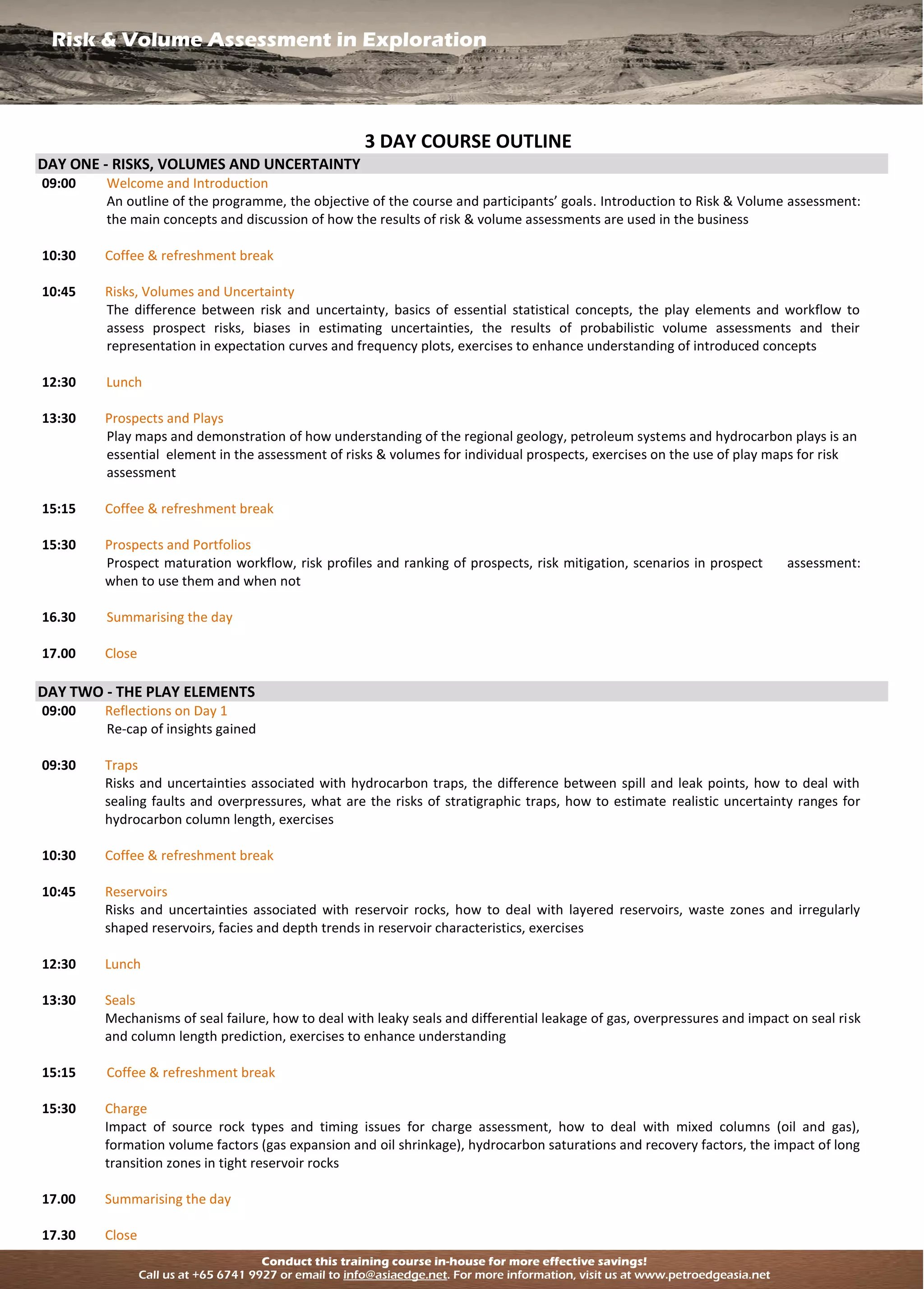
3 DAY COURSE OUTLINE
DAY ONE - RISKS, VOLUMES AND UNCERTAINTY
09:00 Welcome and Introduction
An outline of the programme, the objective of the course and participants’ goals. Introduction to Risk & Volume assessment:
the main concepts and discussion of how the results of risk & volume assessments are used in the business
10:30 Coffee & refreshment break
10:45 Risks, Volumes and Uncertainty
The difference between risk and uncertainty, basics of essential statistical concepts, the play elements and workflow to
assess prospect risks, biases in estimating uncertainties, the results of probabilistic volume assessments and their
representation in expectation curves and frequency plots, exercises to enhance understanding of introduced concepts
12:30 Lunch
13:30 Prospects and Plays
Play maps and demonstration of how understanding of the regional geology, petroleum systems and hydrocarbon plays is an
essential element in the assessment of risks & volumes for individual prospects, exercises on the use of play maps for risk
assessment
15:15 Coffee & refreshment break
15:30 Prospects and Portfolios
Prospect maturation workflow, risk profiles and ranking of prospects, risk mitigation, scenarios in prospect assessment:
when to use them and when not
16.30 Summarising the day
17.00 Close
DAY TWO - THE PLAY ELEMENTS
09:00 Reflections on Day 1
Re-cap of insights gained
09:30 Traps
Risks and uncertainties associated with hydrocarbon traps, the difference between spill and leak points, how to deal with
sealing faults and overpressures, what are the risks of stratigraphic traps, how to estimate realistic uncertainty ranges for
hydrocarbon column length, exercises
10:30 Coffee & refreshment break
10:45 Reservoirs
Risks and uncertainties associated with reservoir rocks, how to deal with layered reservoirs, waste zones and irregularly
shaped reservoirs, facies and depth trends in reservoir characteristics, exercises
12:30 Lunch
13:30 Seals
Mechanisms of seal failure, how to deal with leaky seals and differential leakage of gas, overpressures and impact on seal risk
and column length prediction, exercises to enhance understanding
15:15 Coffee & refreshment break
15:30 Charge
Impact of source rock types and timing issues for charge assessment, how to deal with mixed columns (oil and gas),
formation volume factors (gas expansion and oil shrinkage), hydrocarbon saturations and recovery factors, the impact of long
transition zones in tight reservoir rocks
17.00 Summarising the day
17.30 Close
Risk & Volume Assessment in Exploration
Conduct this training course in-house for more effective savings!
Call us at +65 6741 9927 or email to info@asiaedge.net. For more information, visit us at www.petroedgeasia.net
DAY THREE - BRINGING IT ALL TOGETHER
09:00 Reflections on Day 1
Re-cap of insights gained
09:30 Risk assessment
Practical exercise in small groups on prospect risk assessment, group discussion on the impact of positive and/or negative
geological indications for the presence or absence of play elements
10:45 Coffee & refreshment break
11:00 Volume assessment
Practical back-of-the-envelope volume calculation exercise, how to quickly calculate low, medium and high volumes for a
prospect, recapitulation of how to select appropriate distributions
12:30 Lunch
13:30 Volumes an portfolios
The impact of dependencies between prospects in a portfolio, risking and volume assessment of prospects with stacked
reservoir-seal pairs, adding probabilistic prospect volumes statistically correct
14:45 Coffee & refreshment break
15:00 Geophysical evidence
The impact on prospect POS (probability of success) of direct hydrocarbon indicators (DHIs) and/or positive (or negative)
evidence form controlled source electromagnetics (CSEM) – consistent with Bayes’ theorem, exercises
16.30 Course summary
17.00 Course ends
About Your Expert Trainer: Dr Jan de Jager
Dr. Jan de Jager has a PhD in Geology from the University of Utrecht. He joined Shell in 1979 as an
exploration geologist, and worked in several locations around the world (Netherlands, Gabon, USA,
Australia, Argentina, Malaysia) in technical and management positions. During the last ten years of his
career he was responsible for the quality assurance of Shell's exploration prospects in many parts of
the world and for upgrading and replenishing Shell's global exploration portfolio. During this period he
has also developed extensive expertise in Prospect Risk and Volume assessments for which he ran
successful internal training programmes. Following his retirement from Shell in 2010, Jan de Jager took on a position
as part time professor at the University of Amsterdam and he is also working as consultant exploration advisor for
various E&P companies.
Conduct this training course in-house for more effective savings!
Call us at +65 6741 9927 or email to info@asiaedge.net. For more information, visit us at www.petroedgeasia.net
Trap and Seal Analysis
25 – 29 September 2017 | Jakarta, Indonesia
Risk & Volume Assessment in Exploration
R E G I S T R A T I O N F O R M
a
DELEGATE DETAILS
Delegate 1
Please note
- Indicate if you have already registered by Phone +Fax +Email
+Web
- If you have not received an acknowledgement before the
training course, please call us to confirm your booking.
- Photocopy this form to register multiple delegates.
PAYMENT METHODS
By Cheque/ Bank Draft
Make Payable to Asia Edge Pte. Ltd.
By Direct Transfer
Please quote your invoice number with the remittance advise
Account Name: Asia Edge Pte. Ltd.
Bank Number: 508 Account Number: 762903-001 Swift Code:
OCBCSGSG
All bank charges to be borne by payer. Please ensure that Asia
Edge Pte Ltd receives the full invoiced amount.
PAYMENT POLICY
Payment is due in full at the time of registration. Full payment is
mandatory for event attendance. By submitting this registration
form, you have agreed to Asia Edge Pte Ltd’s payment terms
CANCELLATIONS & SUBSTITUTIONS
You may substitute delegates at any time. For cancellations
received in writing more than seven (7) days prior to the training
course, delegates will receive a 100% credit on the amount paid
which can be used in another Asia Edge Pte. Ltd. training course for
up to one year from the date of issuance. The credit is transferable
to other persons in the same company and applicable against any
future Asia Edge Pte. Ltd. public course. For cancellations received
seven (7) days or less prior to an event (including day 7), no credit
will be issued. In addition, a cancellation fee equivalent to 15% of
the course fee will be charged. In the event that Asia Edge Pte. Ltd.
postpones or cancels a course, delegate payments at the date of
cancellation or postponement will be credited to a future Asia Edge
Pte. Ltd. course. This credit will be available for up to one year from
the date of issuance, and it is transferable to other persons in the
same company and applicable against any future Asia Edge Pte. Ltd.
public course. Asia Edge Pte. Ltd. does not provide refunds for
cancellations and postponements or waive fees for unpaid invoices
upon receipt of registration.
PROGRAM CHANGE POLICY
Please note that speakers and topics were confirmed at the time
of publishing; however, circumstances beyond the control of the
organizers may necessitate substitutions, alterations or
cancellations of the speakers and/or topics. As such, ASIA EDGE
PTE LTD reserves the right to alter or modify the advertised
speakers and/or topics if necessary. Any substitutions or
alterations will be updated on our web page as soon as possible.
This brochure may not be copied, photocopied, reproduced,
translated, or converted to any electronic or machine-readable
form in whole or in part without prior written approval of ASIA
EDGE PTE LTD
ASIA EDGE PTE. LTD.
Company Registration No: No. 200710561C
Copyright@ 2005 ASIA EDGE PTE LTD. All rights reserved.
 Mr  Ms  Mrs  Dr  Others:
Name :
Job Title :
Department :
Telephone No. :
Email :
Delegate 2
 Mr  Ms  Mrs  Dr  Others:
Name :
Job Title :
Department :
Telephone No. :
Email :
Company :
Address :
Country : Postcode:
Attention
Invoice to :
Telephone No. :
Fax No. :
TO REGISTER
 Email: info@asiaedge.net
 Phone: +65 8255 1929

Risk volume assessment in exploration

  • 1.
    Risk & VolumeAssessment in Exploration Your Expert Course Leader: Dr Jan de Jager Dr. Jan de Jager joined Shell in 1979 as an exploration geologist, and worked in several locations around the world (Netherlands, Gabon, USA, Australia, Argentina, Malaysia) in technical and management positions. During the last ten years of his career he was responsible for the quality assurance of Shell's exploration prospects in many parts of the world and for upgrading and replenishing Shell's global exploration portfolio. What past participants said about his previous training courses? “It was very helpful training for me and it increased my knowledge” Sr. Geologist, Oil & Gas Development Company Ltd (OGDCL) “This is a wonderful step by step build-up of skills for maturing prospects, leading to a reasonable and balanced decision for future E&P projects“ Professor, Chungbuk National “Good materials, clear hands outs and good exercises too” Reservoir Engineer, Brunei Shell Petroleum “The course is really good and provided us further understanding and a more standardise way to mature our prospect. All aspects are covered from geology, engineering to economics”, Geologist, Brunei National Petroleum Company “Dr Jager’s vast knowledge & skills, coupled with his excellent presentation & communication skills are what brought this course to life” Geoscientist, Petronas Carigali
  • 2.
    Risk & VolumeAssessment in Exploration Conduct this training course in-house for more effective savings! Call us at +65 6741 9927 or email to info@asiaedge.net. For more information, visit us at www.petroedgeasia.net About Risk & Volume Assessment of Undrilled Exploration Prospects A decision to drill an exploration well with the objective to find a new oil or gas field must be based on a sound assessment of the prospect’s risks and of the volumes: what is the chance that a well will find hydrocarbons, and how much could it be? Risk and volume assessments form the basis for decisions to drill a well or not, and as such it is the link between subsurface evaluation and the business aspects of the petroleum industry. This course explains how risks and volumes can be assessed in a realistic and pragmatic manner, based on a sound understanding of the geological details of the prospect as well as of its regional geological setting and our play understanding. In this 3-day course the main aspects that need to be considered for risk & volume assessment in exploration will be discussed, including:  The way Risk and Uncertainty are used in the assessment of undrilled exploration prospects  The basic volume equation used as used all R&V applications  Probabilistic volume assessment and its outputs (expectation curve, probability density functions, Mean Success Volumes, P90, P50, P10.  The difference between Mode, P50 and Mean  Input distribution types and pragmatic recommendations on what to use  Pitfalls in input parameters  Biases in prospect assessment  Prospect risk profiles and ranking of prospects  When scenarios could (or should) be used in prospect evaluation – and when not  The critical issues of trap assessment  Column length prediction, and pragmatic recommendations on realistic column length uncertainty distributions  Input parameters for reservoir, and how they relate to relevant well data and understanding of depositional systems  Mechanisms of seal failure, and how seals may impact trapped HC column length and gas-oil distributions  The critical issues for charge: source rock types, maturity, fetch areas, migration (and migration shadows), timing issues  How to deal with prospects with multiple reservoir-seal pairs to arrive at realistic POS and volumes  Dependencies between prospects  Correlations between input parameters; such as porosity, HC saturation and Recovery Factor  How to deal with geophysical evidence (DHIs), and how they impact POS and volume assessment  If available, time will be reserved for discussion of prospect examples brought in by participants Learning, Methods and Tools This is an exercise-rich course to risk and volume assessment in exploration. The course will make available all the time needed discussions and local prospect examples. Emphasis is on a sound and pragmatic understanding of the play, the main risk elements (trap/structure, reservoir, seal and charge), the prospect geology and geometry. The course provides pragmatic guidance for translating geological knowledge and understanding in sound and realistic numbers and ranges for consistent risk and volume assessment of exploration prospects. Each topic is introduced by a lecture, and leaning is re-enforced by practical exercises (on paper). There is time for discussions of general issues and any specific questions participants may have. Who Should Attend This course is designed in the firsts place for geoscientists working in exploration and their direct supervisors. The course is also very instructive for staff from other disciplines working closely with exploration staff, such as reservoir engineers, petrophysicists and prospect portfolio analysts.
  • 3.
    Risk & VolumeAssessment in Exploration Conduct this training course in-house for more effective savings! Call us at +65 6741 9927 or email to info@asiaedge.net. For more information, visit us at www.petroedgeasia.net 3 DAY COURSE OUTLINE DAY ONE - RISKS, VOLUMES AND UNCERTAINTY 09:00 Welcome and Introduction An outline of the programme, the objective of the course and participants’ goals. Introduction to Risk & Volume assessment: the main concepts and discussion of how the results of risk & volume assessments are used in the business 10:30 Coffee & refreshment break 10:45 Risks, Volumes and Uncertainty The difference between risk and uncertainty, basics of essential statistical concepts, the play elements and workflow to assess prospect risks, biases in estimating uncertainties, the results of probabilistic volume assessments and their representation in expectation curves and frequency plots, exercises to enhance understanding of introduced concepts 12:30 Lunch 13:30 Prospects and Plays Play maps and demonstration of how understanding of the regional geology, petroleum systems and hydrocarbon plays is an essential element in the assessment of risks & volumes for individual prospects, exercises on the use of play maps for risk assessment 15:15 Coffee & refreshment break 15:30 Prospects and Portfolios Prospect maturation workflow, risk profiles and ranking of prospects, risk mitigation, scenarios in prospect assessment: when to use them and when not 16.30 Summarising the day 17.00 Close DAY TWO - THE PLAY ELEMENTS 09:00 Reflections on Day 1 Re-cap of insights gained 09:30 Traps Risks and uncertainties associated with hydrocarbon traps, the difference between spill and leak points, how to deal with sealing faults and overpressures, what are the risks of stratigraphic traps, how to estimate realistic uncertainty ranges for hydrocarbon column length, exercises 10:30 Coffee & refreshment break 10:45 Reservoirs Risks and uncertainties associated with reservoir rocks, how to deal with layered reservoirs, waste zones and irregularly shaped reservoirs, facies and depth trends in reservoir characteristics, exercises 12:30 Lunch 13:30 Seals Mechanisms of seal failure, how to deal with leaky seals and differential leakage of gas, overpressures and impact on seal risk and column length prediction, exercises to enhance understanding 15:15 Coffee & refreshment break 15:30 Charge Impact of source rock types and timing issues for charge assessment, how to deal with mixed columns (oil and gas), formation volume factors (gas expansion and oil shrinkage), hydrocarbon saturations and recovery factors, the impact of long transition zones in tight reservoir rocks 17.00 Summarising the day 17.30 Close
  • 4.
    Risk & VolumeAssessment in Exploration Conduct this training course in-house for more effective savings! Call us at +65 6741 9927 or email to info@asiaedge.net. For more information, visit us at www.petroedgeasia.net DAY THREE - BRINGING IT ALL TOGETHER 09:00 Reflections on Day 1 Re-cap of insights gained 09:30 Risk assessment Practical exercise in small groups on prospect risk assessment, group discussion on the impact of positive and/or negative geological indications for the presence or absence of play elements 10:45 Coffee & refreshment break 11:00 Volume assessment Practical back-of-the-envelope volume calculation exercise, how to quickly calculate low, medium and high volumes for a prospect, recapitulation of how to select appropriate distributions 12:30 Lunch 13:30 Volumes an portfolios The impact of dependencies between prospects in a portfolio, risking and volume assessment of prospects with stacked reservoir-seal pairs, adding probabilistic prospect volumes statistically correct 14:45 Coffee & refreshment break 15:00 Geophysical evidence The impact on prospect POS (probability of success) of direct hydrocarbon indicators (DHIs) and/or positive (or negative) evidence form controlled source electromagnetics (CSEM) – consistent with Bayes’ theorem, exercises 16.30 Course summary 17.00 Course ends About Your Expert Trainer: Dr Jan de Jager Dr. Jan de Jager has a PhD in Geology from the University of Utrecht. He joined Shell in 1979 as an exploration geologist, and worked in several locations around the world (Netherlands, Gabon, USA, Australia, Argentina, Malaysia) in technical and management positions. During the last ten years of his career he was responsible for the quality assurance of Shell's exploration prospects in many parts of the world and for upgrading and replenishing Shell's global exploration portfolio. During this period he has also developed extensive expertise in Prospect Risk and Volume assessments for which he ran successful internal training programmes. Following his retirement from Shell in 2010, Jan de Jager took on a position as part time professor at the University of Amsterdam and he is also working as consultant exploration advisor for various E&P companies.
  • 5.
    Conduct this trainingcourse in-house for more effective savings! Call us at +65 6741 9927 or email to info@asiaedge.net. For more information, visit us at www.petroedgeasia.net Trap and Seal Analysis 25 – 29 September 2017 | Jakarta, Indonesia Risk & Volume Assessment in Exploration R E G I S T R A T I O N F O R M a DELEGATE DETAILS Delegate 1 Please note - Indicate if you have already registered by Phone +Fax +Email +Web - If you have not received an acknowledgement before the training course, please call us to confirm your booking. - Photocopy this form to register multiple delegates. PAYMENT METHODS By Cheque/ Bank Draft Make Payable to Asia Edge Pte. Ltd. By Direct Transfer Please quote your invoice number with the remittance advise Account Name: Asia Edge Pte. Ltd. Bank Number: 508 Account Number: 762903-001 Swift Code: OCBCSGSG All bank charges to be borne by payer. Please ensure that Asia Edge Pte Ltd receives the full invoiced amount. PAYMENT POLICY Payment is due in full at the time of registration. Full payment is mandatory for event attendance. By submitting this registration form, you have agreed to Asia Edge Pte Ltd’s payment terms CANCELLATIONS & SUBSTITUTIONS You may substitute delegates at any time. For cancellations received in writing more than seven (7) days prior to the training course, delegates will receive a 100% credit on the amount paid which can be used in another Asia Edge Pte. Ltd. training course for up to one year from the date of issuance. The credit is transferable to other persons in the same company and applicable against any future Asia Edge Pte. Ltd. public course. For cancellations received seven (7) days or less prior to an event (including day 7), no credit will be issued. In addition, a cancellation fee equivalent to 15% of the course fee will be charged. In the event that Asia Edge Pte. Ltd. postpones or cancels a course, delegate payments at the date of cancellation or postponement will be credited to a future Asia Edge Pte. Ltd. course. This credit will be available for up to one year from the date of issuance, and it is transferable to other persons in the same company and applicable against any future Asia Edge Pte. Ltd. public course. Asia Edge Pte. Ltd. does not provide refunds for cancellations and postponements or waive fees for unpaid invoices upon receipt of registration. PROGRAM CHANGE POLICY Please note that speakers and topics were confirmed at the time of publishing; however, circumstances beyond the control of the organizers may necessitate substitutions, alterations or cancellations of the speakers and/or topics. As such, ASIA EDGE PTE LTD reserves the right to alter or modify the advertised speakers and/or topics if necessary. Any substitutions or alterations will be updated on our web page as soon as possible. This brochure may not be copied, photocopied, reproduced, translated, or converted to any electronic or machine-readable form in whole or in part without prior written approval of ASIA EDGE PTE LTD ASIA EDGE PTE. LTD. Company Registration No: No. 200710561C Copyright@ 2005 ASIA EDGE PTE LTD. All rights reserved.  Mr  Ms  Mrs  Dr  Others: Name : Job Title : Department : Telephone No. : Email : Delegate 2  Mr  Ms  Mrs  Dr  Others: Name : Job Title : Department : Telephone No. : Email : Company : Address : Country : Postcode: Attention Invoice to : Telephone No. : Fax No. : TO REGISTER  Email: info@asiaedge.net  Phone: +65 8255 1929