www.platts.com/oil
www.pira.com
Oil special report
April 2017
Rick Joswick, Managing Director of Global Oil, PIRA Energy Group
Major changes in 2020 for the
global refining industry
Special report: Oil Major changes in 2020 for the global refining industry
2© 2017 S&P Global Platts, a division of S&P Global. All rights reserved.
Conversion capacity additions continue but
at a slower pace
Refiners generally have incentives to upgrade their
refineries, by adding conversion units to produce greater
amounts of clean products (e.g., gasoline, diesel) and
lesser amounts of fuel oil. All else being equal, refiners
with conversion achieve higher margins than simple
refineries without conversion. However, it usually takes at
least four to five years from initial planning to actual start-
up of a conversion project.
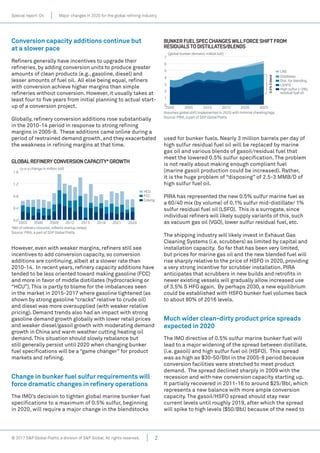
Globally, refinery conversion additions rose substantially
in the 2010-14 period in response to strong refining
margins in 2005-8. These additions came online during a
period of restrained demand growth, and they exacerbated
the weakness in refining margins at that time.
However, even with weaker margins, refiners still see
incentives to add conversion capacity, so conversion
additions are continuing, albeit at a slower rate than
2010-14. In recent years, refinery capacity additions have
tended to be less oriented toward making gasoline (FCC)
and more in favor of middle distillates (hydrocracking or
“HCU”). This is partly to blame for the imbalances seen
in the market in 2015-2017 where gasoline tightened (as
shown by strong gasoline “cracks” relative to crude oil)
and diesel was more oversupplied (with weaker relative
pricing). Demand trends also had an impact with strong
gasoline demand growth globally with lower retail prices
and weaker diesel/gasoil growth with moderating demand
growth in China and warm weather cutting heating oil
demand. This situation should slowly rebalance but
still generally persist until 2020 when changing bunker
fuel specifications will be a “game changer” for product
markets and refining.
Change in bunker fuel sulfur requirements will
force dramatic changes in refinery operations
The IMO’s decision to tighten global marine bunker fuel
specifications to a maximum of 0.5% sulfur, beginning
in 2020, will require a major change in the blendstocks
used for bunker fuels. Nearly 3 million barrels per day of
high sulfur residual fuel oil will be replaced by marine
gas oil and various blends of gasoil/residual fuel that
meet the lowered 0.5% sulfur specification. The problem
is not really about making enough compliant fuel
(marine gasoil production could be increased). Rather,
it is the huge problem of “disposing” of 2.5-3 MMB/D of
high sulfur fuel oil.
PIRA has represented the new 0.5% sulfur marine fuel as
a 60/40 mix (by volume) of 0.1% sulfur mid-distillate/ 1%
sulfur residual fuel oil (LSFO). This is a surrogate, since
individual refiners will likely supply variants of this, such
as vacuum gas oil (VGO), lower sulfur residual fuel, etc.
The shipping industry will likely invest in Exhaust Gas
Cleaning Systems (i.e. scrubbers) as limited by capital and
installation capacity. So far that has been very limited,
but prices for marine gas oil and the new blended fuel will
rise sharply relative to the price of HSFO in 2020, providing
a very strong incentive for scrubber installation. PIRA
anticipates that scrubbers in new builds and retrofits in
newer existing vessels will gradually allow increased use
of 3.5% S HFO again. By perhaps 2030, a new equilibrium
could be established with HSFO bunker fuel volumes back
to about 80% of 2016 levels.
Much wider clean-dirty product price spreads
expected in 2020
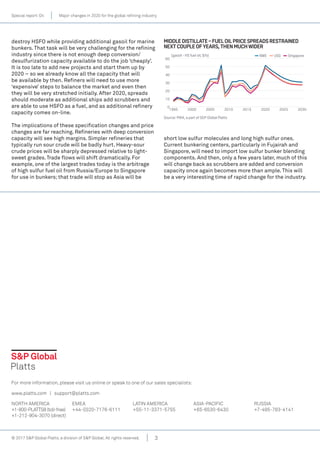
The IMO directive of 0.5% sulfur marine bunker fuel will
lead to a major widening of the spread between distillate,
(i.e. gasoil) and high sulfur fuel oil (HSFO). This spread
was as high as $30-50/Bbl in the 2005-8 period because
conversion facilities were stretched to meet product
demand. The spread declined sharply in 2009 with the
recession and with new conversion capacity starting up.
It partially recovered in 2011-16 to around $25/Bbl, which
represents a new balance with more ample conversion
capacity. The gasoil/HSFO spread should stay near
current levels until roughly 2019, after which the spread
will spike to high levels ($50/Bbl) because of the need to
GLOBALREFINERYCONVERSIONCAPACITY*GROWTH
0.0
0.4
0.8
1.2
1.6
20242021201820152012200920062003
*Net of refinery closures; reflects startup delays
Source: PIRA, a part of S&P Global Platts
(y-o-y change in million b/d)
Coking
FCC
HCU
BUNKER FUEL SPEC CHANGESWILLFORCESHIFTFROM
RESIDUALSTO DISTILLATES BLENDS
0
1
2
3
4
5
6
7
202520202015201020052000
Assumes global shift implemented in 2020 with minimal cheating/lags
Source: PIRA, a part of S&P Global Platts
(global bunker demand, million b/d)
LSHFO
High sulfur (~3%)
residual fuel oil
Dist. for blending
Distillates
LNG
0.5%Sblend
Special report: Oil Major changes in 2020 for the global refining industry
3© 2017 S&P Global Platts, a division of S&P Global. All rights reserved.
For more information, please visit us online or speak to one of our sales specialists:
www.platts.com | support@platts.com
NORTH AMERICA
+1-800-PLATTS8(toll-free)
+1-212-904-3070 (direct)
EMEA
+44-(0)20-7176-6111
LATIN AMERICA
+55-11-3371-5755
ASIA-PACIFIC
+65-6530-6430
RUSSIA
+7-495-783-4141
destroy HSFO while providing additional gasoil for marine
bunkers. That task will be very challenging for the refining
industry since there is not enough deep conversion/
desulfurization capacity available to do the job ‘cheaply’.
It is too late to add new projects and start them up by
2020 – so we already know all the capacity that will
be available by then. Refiners will need to use more
‘expensive’ steps to balance the market and even then
they will be very stretched initially. After 2020, spreads
should moderate as additional ships add scrubbers and
are able to use HSFO as a fuel, and as additional refinery
capacity comes on-line.
The implications of these specification changes and price
changes are far reaching. Refineries with deep conversion
capacity will see high margins. Simpler refineries that
typically run sour crude will be badly hurt. Heavy-sour
crude prices will be sharply depressed relative to light-
sweet grades. Trade flows will shift dramatically. For
example, one of the largest trades today is the arbitrage
of high sulfur fuel oil from Russia/Europe to Singapore
for use in bunkers; that trade will stop as Asia will be
short low sulfur molecules and long high sulfur ones.
Current bunkering centers, particularly in Fujairah and
Singapore, will need to import low sulfur bunker blending
components. And then, only a few years later, much of this
will change back as scrubbers are added and conversion
capacity once again becomes more than ample. This will
be a very interesting time of rapid change for the industry.
MIDDLEDISTILLATE FUELOILPRICESPREADSRESTRAINED
NEXTCOUPLEOF YEARS,THENMUCHWIDER
0
10
20
30
40
50
60
20302025202020152010200520001995
Source: PIRA, a part of S&P Global Platts
(gasoil - HS fuel oil, $/b) USG SingaporeNWE

Major changes in 2020 for the global refining industry

  • 1.
    www.platts.com/oil www.pira.com Oil special report April2017 Rick Joswick, Managing Director of Global Oil, PIRA Energy Group Major changes in 2020 for the global refining industry
  • 2.
    Special report: OilMajor changes in 2020 for the global refining industry 2© 2017 S&P Global Platts, a division of S&P Global. All rights reserved. Conversion capacity additions continue but at a slower pace Refiners generally have incentives to upgrade their refineries, by adding conversion units to produce greater amounts of clean products (e.g., gasoline, diesel) and lesser amounts of fuel oil. All else being equal, refiners with conversion achieve higher margins than simple refineries without conversion. However, it usually takes at least four to five years from initial planning to actual start- up of a conversion project. Globally, refinery conversion additions rose substantially in the 2010-14 period in response to strong refining margins in 2005-8. These additions came online during a period of restrained demand growth, and they exacerbated the weakness in refining margins at that time. However, even with weaker margins, refiners still see incentives to add conversion capacity, so conversion additions are continuing, albeit at a slower rate than 2010-14. In recent years, refinery capacity additions have tended to be less oriented toward making gasoline (FCC) and more in favor of middle distillates (hydrocracking or “HCU”). This is partly to blame for the imbalances seen in the market in 2015-2017 where gasoline tightened (as shown by strong gasoline “cracks” relative to crude oil) and diesel was more oversupplied (with weaker relative pricing). Demand trends also had an impact with strong gasoline demand growth globally with lower retail prices and weaker diesel/gasoil growth with moderating demand growth in China and warm weather cutting heating oil demand. This situation should slowly rebalance but still generally persist until 2020 when changing bunker fuel specifications will be a “game changer” for product markets and refining. Change in bunker fuel sulfur requirements will force dramatic changes in refinery operations The IMO’s decision to tighten global marine bunker fuel specifications to a maximum of 0.5% sulfur, beginning in 2020, will require a major change in the blendstocks used for bunker fuels. Nearly 3 million barrels per day of high sulfur residual fuel oil will be replaced by marine gas oil and various blends of gasoil/residual fuel that meet the lowered 0.5% sulfur specification. The problem is not really about making enough compliant fuel (marine gasoil production could be increased). Rather, it is the huge problem of “disposing” of 2.5-3 MMB/D of high sulfur fuel oil. PIRA has represented the new 0.5% sulfur marine fuel as a 60/40 mix (by volume) of 0.1% sulfur mid-distillate/ 1% sulfur residual fuel oil (LSFO). This is a surrogate, since individual refiners will likely supply variants of this, such as vacuum gas oil (VGO), lower sulfur residual fuel, etc. The shipping industry will likely invest in Exhaust Gas Cleaning Systems (i.e. scrubbers) as limited by capital and installation capacity. So far that has been very limited, but prices for marine gas oil and the new blended fuel will rise sharply relative to the price of HSFO in 2020, providing a very strong incentive for scrubber installation. PIRA anticipates that scrubbers in new builds and retrofits in newer existing vessels will gradually allow increased use of 3.5% S HFO again. By perhaps 2030, a new equilibrium could be established with HSFO bunker fuel volumes back to about 80% of 2016 levels. Much wider clean-dirty product price spreads expected in 2020 The IMO directive of 0.5% sulfur marine bunker fuel will lead to a major widening of the spread between distillate, (i.e. gasoil) and high sulfur fuel oil (HSFO). This spread was as high as $30-50/Bbl in the 2005-8 period because conversion facilities were stretched to meet product demand. The spread declined sharply in 2009 with the recession and with new conversion capacity starting up. It partially recovered in 2011-16 to around $25/Bbl, which represents a new balance with more ample conversion capacity. The gasoil/HSFO spread should stay near current levels until roughly 2019, after which the spread will spike to high levels ($50/Bbl) because of the need to GLOBALREFINERYCONVERSIONCAPACITY*GROWTH 0.0 0.4 0.8 1.2 1.6 20242021201820152012200920062003 *Net of refinery closures; reflects startup delays Source: PIRA, a part of S&P Global Platts (y-o-y change in million b/d) Coking FCC HCU BUNKER FUEL SPEC CHANGESWILLFORCESHIFTFROM RESIDUALSTO DISTILLATES BLENDS 0 1 2 3 4 5 6 7 202520202015201020052000 Assumes global shift implemented in 2020 with minimal cheating/lags Source: PIRA, a part of S&P Global Platts (global bunker demand, million b/d) LSHFO High sulfur (~3%) residual fuel oil Dist. for blending Distillates LNG 0.5%Sblend
  • 3.
    Special report: OilMajor changes in 2020 for the global refining industry 3© 2017 S&P Global Platts, a division of S&P Global. All rights reserved. For more information, please visit us online or speak to one of our sales specialists: www.platts.com | support@platts.com NORTH AMERICA +1-800-PLATTS8(toll-free) +1-212-904-3070 (direct) EMEA +44-(0)20-7176-6111 LATIN AMERICA +55-11-3371-5755 ASIA-PACIFIC +65-6530-6430 RUSSIA +7-495-783-4141 destroy HSFO while providing additional gasoil for marine bunkers. That task will be very challenging for the refining industry since there is not enough deep conversion/ desulfurization capacity available to do the job ‘cheaply’. It is too late to add new projects and start them up by 2020 – so we already know all the capacity that will be available by then. Refiners will need to use more ‘expensive’ steps to balance the market and even then they will be very stretched initially. After 2020, spreads should moderate as additional ships add scrubbers and are able to use HSFO as a fuel, and as additional refinery capacity comes on-line. The implications of these specification changes and price changes are far reaching. Refineries with deep conversion capacity will see high margins. Simpler refineries that typically run sour crude will be badly hurt. Heavy-sour crude prices will be sharply depressed relative to light- sweet grades. Trade flows will shift dramatically. For example, one of the largest trades today is the arbitrage of high sulfur fuel oil from Russia/Europe to Singapore for use in bunkers; that trade will stop as Asia will be short low sulfur molecules and long high sulfur ones. Current bunkering centers, particularly in Fujairah and Singapore, will need to import low sulfur bunker blending components. And then, only a few years later, much of this will change back as scrubbers are added and conversion capacity once again becomes more than ample. This will be a very interesting time of rapid change for the industry. MIDDLEDISTILLATE FUELOILPRICESPREADSRESTRAINED NEXTCOUPLEOF YEARS,THENMUCHWIDER 0 10 20 30 40 50 60 20302025202020152010200520001995 Source: PIRA, a part of S&P Global Platts (gasoil - HS fuel oil, $/b) USG SingaporeNWE