Welcome
RISK MANAGEMENT PROCESS IN
PHARMACOVIGILANCE
Kalakada Bhavya Sree
M. Pharmacy
CSRPL_STD_IND_HYD_ONL/CLS_172/082023
10/18/2022
www.clinosol.com | follow us on social media
@clinosolresearch
1
INDEX
• Introduction
• Definition
• Aim and Objectives
• Parts of RMP
• Different Steps of Risk Management
• Risk Management Legal Framework
• Risk Management Cycle
• Summary
08/26/2023
www.clinosol.com | follow us on social media
@clinosolresearch
2
INTRODUCTION
 Risk management in pharmacovigilance is to promote the safe use of medicines and safeguard
health of patients.
 It is a set of activities performed for identification of risk, risk assessment, and risk
minimization and prevention.
 Risk management has the following stages: identification and characterization of the safety
profile of the medicinal product; planning of pharmacovigilance activities to characterize risks
and identify new risks; planning and implementation of risk minimization and mitigation and
assessment of the effectiveness of these activities; and document post approval obligations that
have been imposed as a condition of the marketing authorization.
 All these activities together constitute the risk management plan, which is required to be
submitted during the authorization of the drug.
08/26/2023
www.clinosol.com | follow us on social media
@clinosolresearch
3
DEFINITION
 A set of pharmacovigilance activities and interventions designed to identify, characterize,
prevent or minimize risks relating to medicinal products, including the assessment of the
effectiveness of those interventions.
AIM & OBJECTIVES OF THE RMP
 The overall aim of risk management is to ensure that the benefits of the medicinal product
outweigh the risks by a wide margin for the treatment of a particular indication both at
individual level and for the target population as a whole.
 Identify or characterize safety profile.
 Measures to prevent or minimize risks including assessment of the effectiveness.
 Document post-authorisation obligations.
08/26/2023
www.clinosol.com | follow us on social media
@clinosolresearch
4
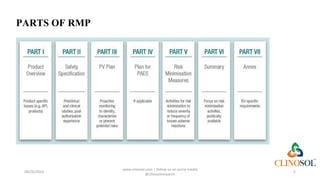
PARTS OF RMP
www.clinosol.com | follow us on social media
@clinosolresearch
5
08/26/2023
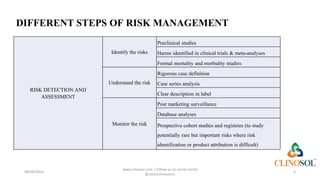
DIFFERENT STEPS OF RISK MANAGEMENT
www.clinosol.com | follow us on social media
@clinosolresearch
6
RISK DETECTION AND
ASSESSMENT
Identify the risks
Preclinical studies
Harms identified in clinical trials & meta-analyses
Formal mortality and morbidity studies
Understand the risk
Rigorous case definition
Case series analysis
Clear description in label
Monitor the risk
Post marketing surveillance
Database analyses
Prospective cohort studies and registries (to study
potentially rare but important risks where risk
identification or product attribution is difficult)
08/26/2023
www.clinosol.com | follow us on social media
@clinosolresearch
7
RISK MINIMISATION AND
COMMUNICATION
Communicate the risk
Advice in label (not enough to communicate
specific risk minimization activities or
change behaviors)
Partnership with regulators
Education of physicians, patients, company
staff
Act to reduce the risk
Limited distribution
Limited prescribing rights
Contra-indicate for certain groups,
indications, routes of
administration
Advice for high risk groups
08/26/2023
RISK MANEGEMENT LEGAL FRAMEWORK
www.clinosol.com | follow us on social media
@clinosolresearch
8
08/26/2023
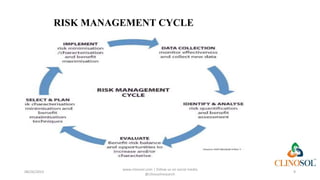
RISK MANAGEMENT CYCLE
www.clinosol.com | follow us on social media
@clinosolresearch
9
08/26/2023
SUMMARY
 Risk Management represents a growing awareness of the need for continuing evaluation of
risks related to drug products and the implementation of plans to minimize those risks after
marketing.
08/26/2023
www.clinosol.com | follow us on social media
@clinosolresearch
10
Thank You!
www.clinosol.com
(India | Canada)
9121151622/623/624
info@clinosol.com
08/26/2023
www.clinosol.com | follow us on social media
@clinosolresearch
11

Risk Management Process

  • 1.
    Welcome RISK MANAGEMENT PROCESSIN PHARMACOVIGILANCE Kalakada Bhavya Sree M. Pharmacy CSRPL_STD_IND_HYD_ONL/CLS_172/082023 10/18/2022 www.clinosol.com | follow us on social media @clinosolresearch 1
  • 2.
    INDEX • Introduction • Definition •Aim and Objectives • Parts of RMP • Different Steps of Risk Management • Risk Management Legal Framework • Risk Management Cycle • Summary 08/26/2023 www.clinosol.com | follow us on social media @clinosolresearch 2
  • 3.
    INTRODUCTION  Risk managementin pharmacovigilance is to promote the safe use of medicines and safeguard health of patients.  It is a set of activities performed for identification of risk, risk assessment, and risk minimization and prevention.  Risk management has the following stages: identification and characterization of the safety profile of the medicinal product; planning of pharmacovigilance activities to characterize risks and identify new risks; planning and implementation of risk minimization and mitigation and assessment of the effectiveness of these activities; and document post approval obligations that have been imposed as a condition of the marketing authorization.  All these activities together constitute the risk management plan, which is required to be submitted during the authorization of the drug. 08/26/2023 www.clinosol.com | follow us on social media @clinosolresearch 3
  • 4.
    DEFINITION  A setof pharmacovigilance activities and interventions designed to identify, characterize, prevent or minimize risks relating to medicinal products, including the assessment of the effectiveness of those interventions. AIM & OBJECTIVES OF THE RMP  The overall aim of risk management is to ensure that the benefits of the medicinal product outweigh the risks by a wide margin for the treatment of a particular indication both at individual level and for the target population as a whole.  Identify or characterize safety profile.  Measures to prevent or minimize risks including assessment of the effectiveness.  Document post-authorisation obligations. 08/26/2023 www.clinosol.com | follow us on social media @clinosolresearch 4
  • 5.
    PARTS OF RMP www.clinosol.com| follow us on social media @clinosolresearch 5 08/26/2023
  • 6.
    DIFFERENT STEPS OFRISK MANAGEMENT www.clinosol.com | follow us on social media @clinosolresearch 6 RISK DETECTION AND ASSESSMENT Identify the risks Preclinical studies Harms identified in clinical trials & meta-analyses Formal mortality and morbidity studies Understand the risk Rigorous case definition Case series analysis Clear description in label Monitor the risk Post marketing surveillance Database analyses Prospective cohort studies and registries (to study potentially rare but important risks where risk identification or product attribution is difficult) 08/26/2023
  • 7.
    www.clinosol.com | followus on social media @clinosolresearch 7 RISK MINIMISATION AND COMMUNICATION Communicate the risk Advice in label (not enough to communicate specific risk minimization activities or change behaviors) Partnership with regulators Education of physicians, patients, company staff Act to reduce the risk Limited distribution Limited prescribing rights Contra-indicate for certain groups, indications, routes of administration Advice for high risk groups 08/26/2023
  • 8.
    RISK MANEGEMENT LEGALFRAMEWORK www.clinosol.com | follow us on social media @clinosolresearch 8 08/26/2023
  • 9.
    RISK MANAGEMENT CYCLE www.clinosol.com| follow us on social media @clinosolresearch 9 08/26/2023
  • 10.
    SUMMARY  Risk Managementrepresents a growing awareness of the need for continuing evaluation of risks related to drug products and the implementation of plans to minimize those risks after marketing. 08/26/2023 www.clinosol.com | follow us on social media @clinosolresearch 10
  • 11.
    Thank You! www.clinosol.com (India |Canada) 9121151622/623/624 info@clinosol.com 08/26/2023 www.clinosol.com | follow us on social media @clinosolresearch 11