
Pharmaceutical Care Concept
Sreenu Thalla
Assistant Professor
Department of Pharmacology
Definition
• The pharmaceutical care is defined as “the responsible provision
of drug therapy for the purpose of achieving definite therapeutic
outcomes that improve the patients quality of life”.
Outcomes
 Cure of a disease
 Elimination or reduction of patients symptoms
 Arresting or slowing of a disease process
 Preventing a disease or symptoms
Pharmaceutical Care
• Pharmaceutical care involves the process through which a
pharmacist cooperates with a patient and other professional in
designing, implementation and monitoring a therapeutic plan
that will produce specific therapeutic outcomes for the patient
this in turn involves three major functions
Major Functions
 Identifying potential and actual drug related problems
 Resolving actual drug related problems
 Preventing potential drug related problems
• Pharmaceutical care is important element of health care and should
be integrated with other elements of health care.
• Pharmaceutical care is however provided for the direct benefit of the
patient and the pharmacist is responsible directly to the patient of
that care.
Process of Pharmaceutical Care
Collection of Patients Data
• The pharmacist must collect and generate subjective and objective
information regarding the patients
 General health and activity status
 Past medical history medication history
 Social history
 Diet, exercise, Study
 History of present illness
 Economic situations sources of information may include; but
not necessarily limited to the patient medical charts and
reports pharmacist conducted health physical assessment
 The patients family or caretaker, insurers and other
healthcare providers like his doctors, nurse and his regular
pharmacists to whom he goes
Elements of Patients Information Data
 Demographics
 Age, sex, race, height‐weight
 Current problems
 Signs and symptoms
 Past Medical History
 Allergies and intolerance
 Pregnancy and lactation status
 Habits
 Economic conditions
 Relevant lab data
Identification of Problems
• The data collected can be used to identify actual or potential
drug‐related problems.
• Since the main focus of pharmaceutical care is patient and since the
pharmacist attends the patient, it follows that the a pharmacist only
can tackle, all drug related problems.
• These problems may be related to the patients current drug therapy,
drug administration, drug compliance, drug toxicity, adverse drug
reactions and failure to achieve desired outcomes by the treatment.
• It is estimated by USFDA that 12000 deaths and 15000 cases of
hospitalization in the USA were due to the ADR
Drug Related Morbidity
• DRM (Drug Related Morbidity) is a phenomenon of therapeutic
malfunction.
• It is a failure of a therapeutic agents or agents together to produce
intended therapeutic outcome.
• The concept of DRM includes both treatment failure and production
of a new medical problem, like ADR or toxic drug effect.
• If DRM is not recognized in time it may lead to drug related
mortality which is ultimate disaster
Drug Related Problems
 New or additional drug required
 Wrong drug
 Too little of the right drug
 Too much of the right drug
 Adverse drug reaction
 Drug not taken appropriately
 Medication not indicated
Establishing Outcome Goals
• Drug therapy can produce a range of positive clinical outcomes
• It may also result in negative outcomes resulting in disease
morbidity and even in extreme case mortality.
• Clearly the potential clinical outcomes are related to the disease
being treated and the efficacy of the available drug treatments
Disease Positive Outcomes
Hypertension Decreased risk of mi stroke arrhythmia
Ischemic heart disease Fewer mi angina attacks reduced risk of sudden
death
Peripheral vascular disease Better circulation decreased need of circulation
Diabetes Fewer hypoglycemic events less compliance of
kidney or vision
Asthma Fewer acute attacks less occasions of
hospitalization
Important considerations
 Patients expectation of the treatment
 Patient's suitability for the treatment
 All his resources to meet the cost of the treatment
• A patient may have a curable disease but his other concurrent ailment
may prevent the most effective treatment to be given.
• Example – A DM patient may not be given steroids for severe allergyas
it will aggregate his condition.
• An Asthma patient also having DM cannot be treated with steroids for
his chronic airflow obstruction
• Similarly , non availability of certain most effective drugs that cannot be
prescribed due to hospitals DTC , decisions putting restrictions on the
number of drugs per prescription or strict antibiotic policy
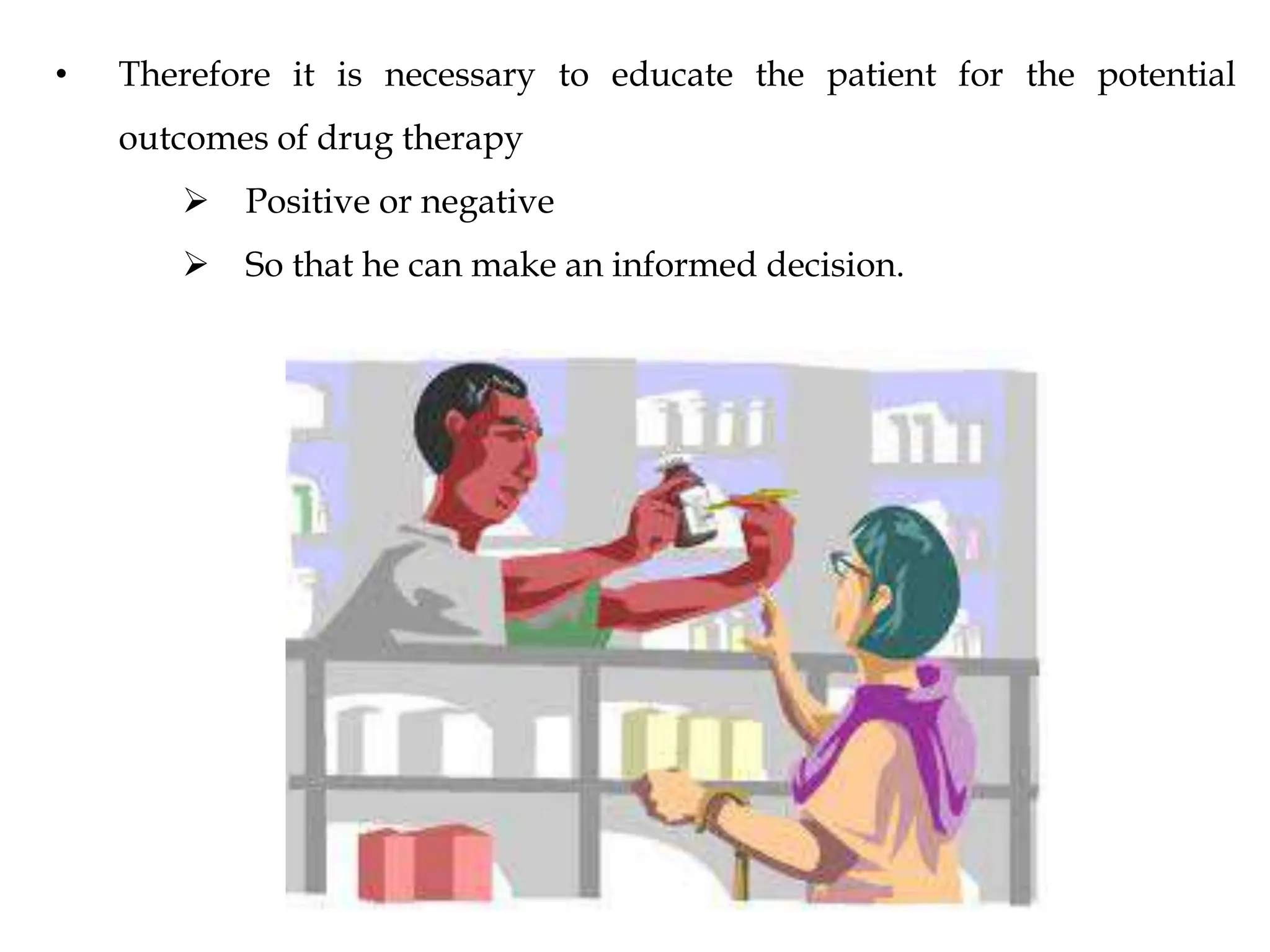
• Therefore it is necessary to educate the patient for the potential
outcomes of drug therapy
 Positive or negative
 So that he can make an informed decision.
Evaluating Treatment Alternatives by Monitoring and
Modifying Therapeutic Plan
• While evaluating treatment alternatives or therapeutic options the
following factors have to be considered such as efficacy and safety
availability and cost of treatment and suitability of the treatment to the
patient.
• Efficacy and safety must be considered when evaluating the risk
benefit ratio of a particular treatment.
• The risk –benefit ratio will depend upon many factors.
Some of the factors are
 Seriousness of disease
 Consequences of not treating the disease
 The efficacy of the drug.
 ADRs associated with the drug therapy
 Efficacy of alternative drug or non‐drug therapy
 Side effect profile of alternative drugs
• The pharmacists role especially clinical pharmacists role is increasingly
becoming more evident in evaluating therapeutic options, modifying
and monitoring therapeutic plan.
• Some of the case studies to support this, can be cited as follows.
• In one case, pharmacist monitored therapeutic plan of one group was 2.4
days shorter than the control group in which the plan was not monitored
by pharmacist.
• In another case study it was found that pharmacist managed group had
significantly fewer active prescriptions significantly more discharges
from hospitals and significantly fewer deaths.
• The pharmacists managed group also had a less number of
hospitalizations than the control group had.
• The net monetary savings between the two groups was 7000 dollars per
patient.
Individualizing Drug Regimen
Patient factors Drug factors
 Diagnosis
 Treatment goals
 Physiological & pathological
factors
 Past medical history, past
medicines received
 Contraindication
 Allergies & adverse effects
 Patient compliance
 Patients cooperation and
convenience
 Special consideration
 Efficacy
 Adverse effects
 Prevalence, ability to minimize
 Ability to monitor for efficacy & avoid ADR
 Drug‐drug interactions
 Pharmacokinetics and pharmacodynamics
 Dosage form
 Route and method of administration
 Cost to the patient
 Government or insurance company
payments, presentation of bills in their
formats
Monitoring Outcomes
• The goals of any therapeutic treatments are obviously the following
 To cure the disease
 To eliminate or reduce patients symptoms
 To arrest or slow down disease process
 To prevent the disease or its symptoms to reappear
• Inappropriate monitoring is often cited as a major cause for therapeutic
failure.
• It leads to failure to detect and resolve inappropriate therapy decisions;
and or failure to monitor for the drugs with narrow therapeutic index.
• Example if digitalis or Theophylline IV delivery is not followed by
TDM, either the desired outcome to stop arrhythmia (by digitalis), or
shortness of breath (by theophylline) is not achieved or worst a
digitalis or Theophylline toxicity may develop, due to overdose.
• But often suboptimal result due to the following broad reasons, some
of which are circumstantial, like the following
 Inappropriate prescribing
 Inappropriate or unnecessary drug regimen
 Inappropriate drug regimen
 Drugs not available ,dispensing error.
 Inappropriate behavior of the patient
 Inappropriate compliance or non‐compliance of the drug
treatment
 Patient idiosyncrasy
 Inappropriate monitoring
• Monitoring outcomes involve monitoring four S’s
• These are
 Signs
 Symptoms
 Side effects
 Sequelae (Consequences)
• This applies to all diseases
Types of Pharmaceutical Care
• SOAP Analysis
• CORE Pharmacotherapy plan
• FARM Analysis.
• PRIME Pharmacotherapy plan
• P-Pharmaceutical based problems
 Patient not receiving a prescribed drug
 Routine monitoring (lab data)
 R-risks, to patients – ADR
Format of a SOAP note
• The SOAP format is the one used most often by medical practitioners
• However, when used within the pharmaceutical care context, the
content of the sections must be revised to match the pharmacist’s legal
scope of practice.
 S-subjective findings. Ex-chief complaints and duration or
severity of symptoms.
 O-objective findings. Ex-laboratory data, weight, height, blood
pressure, and pulse.
 A-assessment. Diagnosis or possible explanations for the
patients medical problems.
 P-Plan. Drug regimen or surgical procedure
CORE
• C-Condition or patient need, it may include nonmedical conditions or
need and is thus not a reiteration of the current medical problem.
• O-outcome, desired for the condition or needs.
• Patient outcomes (POEMS: patient- oriented evidence that matters)
• There are generally five category of patient outcome
 Mortality
 Morbidity
 A)-related to disease process
 B)-related to medication/ treatment plan
 Behavior
 Economic
 Quality of life
• Therapeutic end point (surrogate markers; DOES: disease oriented
evidence)
 A therapeutic end point represents the pharmacological or
therapeutic effects that is expected, ultimately, to achieve
the desired outcome.
 More than one end point is usually needed to achieve an
outcome-for example, both near normal glycemic control
and normalization of blood pressure are necessary to
significant reduce the risk
• R-regimen to achieve desired outcome
 Therapeutic regimens
 Existing therapy
 Initial therapy
• Goal setting and behavior regimens.
 Identify the type of goal being set, such as the following
 Start a new positive action-exercise program
 Increase the frequency or intensity of a positive action- drink
2 more cup
• Stop or decrease- stop smoking
• Continue an action that is perfect- continue to exercise 30 min a day,
every day.
• State the behavior goal in terms that are clear, specific and reasonable.
• E-Evaluation parameter to assess outcome achievement.
 Efficacy parameters
 Toxicity parameters- ADRs, allergic reactions, or toxicity is
not occurring
FARM Note
• Formulate a FARM note or SOAP note to describe and document the
interventions intented or provided by the pharmacist.
• Some healthcare facility may specific one format over the other
F-findings
• The patient-specific information that gives a basis for, or leads to, the
recognition of a pharmacotherapy problem or indication for pharmacist
intervention, finding include subjective and objective information about
the patient.
A-assessment
• Any additional information that is needed to best access the problem to
make recommendations
• The severity, priority or urgency of the problem
• The short-term and long term goals of the problam
Short term goals
• Eliminate symptoms, lower BP to 140/90 mm Hg within 6 weeks,
manage acute asthma flareup without requiring hospitalization.
R-resolution (including prevention)
• The intervention plan includes actual or proposed action by
pharmacist
 Observing and reassessing
 Counseling
 Making recommendations to the patients
 Informing the prescriber
 Making recommendations to the prescriber
 Withholding medication or advising against use
M-monitoring and follow up
 The parameter to be followed (pain, depressed mood, serum
potassium level)
 The intent of the monitoring (efficacy, toxicity, adverse event)
 How the parameter will be monitored (patient interview, serum
drug level, physical examination)
 Frequency of monitoring (weekly, monthly)
 Duration of monitoring (weekly, monthly)
 Duration of monitoring (until resolved, while on antibiotic, until
resolved them monthly for 1 year)
• Anticipated or desired finding -no pain, euglycemia, healing of lesion
• Decision point to alter therapy when or if outcome is not achieved (pain
still present after 3 days, mild hypoglycemia more than two times a
week)
PRIME
• Pharmacotherapy Plan
• I-Interactions -Drug-drug interaction, food drug interaction
• M-Mismatch between medication and condition or pt needs.
• E-Efficacy, efficacy issues
 Too much of the correct drug
 Too much little of the correct drug
 Wrong drug, device, intervention, or regimen prescribed; more
efficacious choice possible)
Documentation of Information
• One of the jobs of a pharmacist as outlined above, is to regularly
update records of the patient with documentation.
• This is a critical component of pharmaceutical care.
• Documenting the provision of pharmaceutical care is important for
many reasons, but the primary reason is to improve the quality of
patient care.
• Documentation provides a record of care provided and history of the
decision made for a specific patient.
IF IT IS NOT DOCUMENTED, IT IS NOT DONE
Pharmaceutical Care Plan in Clinical Pharmacy

Pharmaceutical Care Plan in Clinical Pharmacy

  • 1.
    Pharmaceutical Care Concept SreenuThalla Assistant Professor Department of Pharmacology
  • 2.
    Definition • The pharmaceuticalcare is defined as “the responsible provision of drug therapy for the purpose of achieving definite therapeutic outcomes that improve the patients quality of life”. Outcomes  Cure of a disease  Elimination or reduction of patients symptoms  Arresting or slowing of a disease process  Preventing a disease or symptoms
  • 3.
    Pharmaceutical Care • Pharmaceuticalcare involves the process through which a pharmacist cooperates with a patient and other professional in designing, implementation and monitoring a therapeutic plan that will produce specific therapeutic outcomes for the patient this in turn involves three major functions Major Functions  Identifying potential and actual drug related problems  Resolving actual drug related problems  Preventing potential drug related problems
  • 4.
    • Pharmaceutical careis important element of health care and should be integrated with other elements of health care. • Pharmaceutical care is however provided for the direct benefit of the patient and the pharmacist is responsible directly to the patient of that care.
  • 6.
  • 7.
    Collection of PatientsData • The pharmacist must collect and generate subjective and objective information regarding the patients  General health and activity status  Past medical history medication history  Social history  Diet, exercise, Study  History of present illness  Economic situations sources of information may include; but not necessarily limited to the patient medical charts and reports pharmacist conducted health physical assessment  The patients family or caretaker, insurers and other healthcare providers like his doctors, nurse and his regular pharmacists to whom he goes
  • 8.
    Elements of PatientsInformation Data  Demographics  Age, sex, race, height‐weight  Current problems  Signs and symptoms  Past Medical History  Allergies and intolerance  Pregnancy and lactation status  Habits  Economic conditions  Relevant lab data
  • 9.
    Identification of Problems •The data collected can be used to identify actual or potential drug‐related problems. • Since the main focus of pharmaceutical care is patient and since the pharmacist attends the patient, it follows that the a pharmacist only can tackle, all drug related problems. • These problems may be related to the patients current drug therapy, drug administration, drug compliance, drug toxicity, adverse drug reactions and failure to achieve desired outcomes by the treatment. • It is estimated by USFDA that 12000 deaths and 15000 cases of hospitalization in the USA were due to the ADR
  • 10.
    Drug Related Morbidity •DRM (Drug Related Morbidity) is a phenomenon of therapeutic malfunction. • It is a failure of a therapeutic agents or agents together to produce intended therapeutic outcome. • The concept of DRM includes both treatment failure and production of a new medical problem, like ADR or toxic drug effect. • If DRM is not recognized in time it may lead to drug related mortality which is ultimate disaster
  • 11.
    Drug Related Problems New or additional drug required  Wrong drug  Too little of the right drug  Too much of the right drug  Adverse drug reaction  Drug not taken appropriately  Medication not indicated
  • 12.
    Establishing Outcome Goals •Drug therapy can produce a range of positive clinical outcomes • It may also result in negative outcomes resulting in disease morbidity and even in extreme case mortality. • Clearly the potential clinical outcomes are related to the disease being treated and the efficacy of the available drug treatments Disease Positive Outcomes Hypertension Decreased risk of mi stroke arrhythmia Ischemic heart disease Fewer mi angina attacks reduced risk of sudden death Peripheral vascular disease Better circulation decreased need of circulation Diabetes Fewer hypoglycemic events less compliance of kidney or vision Asthma Fewer acute attacks less occasions of hospitalization
  • 13.
    Important considerations  Patientsexpectation of the treatment  Patient's suitability for the treatment  All his resources to meet the cost of the treatment • A patient may have a curable disease but his other concurrent ailment may prevent the most effective treatment to be given. • Example – A DM patient may not be given steroids for severe allergyas it will aggregate his condition. • An Asthma patient also having DM cannot be treated with steroids for his chronic airflow obstruction • Similarly , non availability of certain most effective drugs that cannot be prescribed due to hospitals DTC , decisions putting restrictions on the number of drugs per prescription or strict antibiotic policy
  • 14.
    • Therefore itis necessary to educate the patient for the potential outcomes of drug therapy  Positive or negative  So that he can make an informed decision.
  • 15.
    Evaluating Treatment Alternativesby Monitoring and Modifying Therapeutic Plan • While evaluating treatment alternatives or therapeutic options the following factors have to be considered such as efficacy and safety availability and cost of treatment and suitability of the treatment to the patient. • Efficacy and safety must be considered when evaluating the risk benefit ratio of a particular treatment. • The risk –benefit ratio will depend upon many factors.
  • 16.
    Some of thefactors are  Seriousness of disease  Consequences of not treating the disease  The efficacy of the drug.  ADRs associated with the drug therapy  Efficacy of alternative drug or non‐drug therapy  Side effect profile of alternative drugs
  • 17.
    • The pharmacistsrole especially clinical pharmacists role is increasingly becoming more evident in evaluating therapeutic options, modifying and monitoring therapeutic plan. • Some of the case studies to support this, can be cited as follows. • In one case, pharmacist monitored therapeutic plan of one group was 2.4 days shorter than the control group in which the plan was not monitored by pharmacist. • In another case study it was found that pharmacist managed group had significantly fewer active prescriptions significantly more discharges from hospitals and significantly fewer deaths. • The pharmacists managed group also had a less number of hospitalizations than the control group had. • The net monetary savings between the two groups was 7000 dollars per patient.
  • 18.
    Individualizing Drug Regimen Patientfactors Drug factors  Diagnosis  Treatment goals  Physiological & pathological factors  Past medical history, past medicines received  Contraindication  Allergies & adverse effects  Patient compliance  Patients cooperation and convenience  Special consideration  Efficacy  Adverse effects  Prevalence, ability to minimize  Ability to monitor for efficacy & avoid ADR  Drug‐drug interactions  Pharmacokinetics and pharmacodynamics  Dosage form  Route and method of administration  Cost to the patient  Government or insurance company payments, presentation of bills in their formats
  • 19.
    Monitoring Outcomes • Thegoals of any therapeutic treatments are obviously the following  To cure the disease  To eliminate or reduce patients symptoms  To arrest or slow down disease process  To prevent the disease or its symptoms to reappear • Inappropriate monitoring is often cited as a major cause for therapeutic failure. • It leads to failure to detect and resolve inappropriate therapy decisions; and or failure to monitor for the drugs with narrow therapeutic index. • Example if digitalis or Theophylline IV delivery is not followed by TDM, either the desired outcome to stop arrhythmia (by digitalis), or shortness of breath (by theophylline) is not achieved or worst a digitalis or Theophylline toxicity may develop, due to overdose.
  • 20.
    • But oftensuboptimal result due to the following broad reasons, some of which are circumstantial, like the following  Inappropriate prescribing  Inappropriate or unnecessary drug regimen  Inappropriate drug regimen  Drugs not available ,dispensing error.  Inappropriate behavior of the patient  Inappropriate compliance or non‐compliance of the drug treatment  Patient idiosyncrasy  Inappropriate monitoring
  • 21.
    • Monitoring outcomesinvolve monitoring four S’s • These are  Signs  Symptoms  Side effects  Sequelae (Consequences) • This applies to all diseases
  • 22.
    Types of PharmaceuticalCare • SOAP Analysis • CORE Pharmacotherapy plan • FARM Analysis. • PRIME Pharmacotherapy plan • P-Pharmaceutical based problems  Patient not receiving a prescribed drug  Routine monitoring (lab data)  R-risks, to patients – ADR
  • 23.
    Format of aSOAP note • The SOAP format is the one used most often by medical practitioners • However, when used within the pharmaceutical care context, the content of the sections must be revised to match the pharmacist’s legal scope of practice.  S-subjective findings. Ex-chief complaints and duration or severity of symptoms.  O-objective findings. Ex-laboratory data, weight, height, blood pressure, and pulse.  A-assessment. Diagnosis or possible explanations for the patients medical problems.  P-Plan. Drug regimen or surgical procedure
  • 24.
    CORE • C-Condition orpatient need, it may include nonmedical conditions or need and is thus not a reiteration of the current medical problem. • O-outcome, desired for the condition or needs. • Patient outcomes (POEMS: patient- oriented evidence that matters) • There are generally five category of patient outcome  Mortality  Morbidity  A)-related to disease process  B)-related to medication/ treatment plan  Behavior  Economic  Quality of life
  • 25.
    • Therapeutic endpoint (surrogate markers; DOES: disease oriented evidence)  A therapeutic end point represents the pharmacological or therapeutic effects that is expected, ultimately, to achieve the desired outcome.  More than one end point is usually needed to achieve an outcome-for example, both near normal glycemic control and normalization of blood pressure are necessary to significant reduce the risk
  • 26.
    • R-regimen toachieve desired outcome  Therapeutic regimens  Existing therapy  Initial therapy • Goal setting and behavior regimens.  Identify the type of goal being set, such as the following  Start a new positive action-exercise program  Increase the frequency or intensity of a positive action- drink 2 more cup
  • 27.
    • Stop ordecrease- stop smoking • Continue an action that is perfect- continue to exercise 30 min a day, every day. • State the behavior goal in terms that are clear, specific and reasonable. • E-Evaluation parameter to assess outcome achievement.  Efficacy parameters  Toxicity parameters- ADRs, allergic reactions, or toxicity is not occurring
  • 28.
    FARM Note • Formulatea FARM note or SOAP note to describe and document the interventions intented or provided by the pharmacist. • Some healthcare facility may specific one format over the other F-findings • The patient-specific information that gives a basis for, or leads to, the recognition of a pharmacotherapy problem or indication for pharmacist intervention, finding include subjective and objective information about the patient.
  • 29.
    A-assessment • Any additionalinformation that is needed to best access the problem to make recommendations • The severity, priority or urgency of the problem • The short-term and long term goals of the problam Short term goals • Eliminate symptoms, lower BP to 140/90 mm Hg within 6 weeks, manage acute asthma flareup without requiring hospitalization.
  • 30.
    R-resolution (including prevention) •The intervention plan includes actual or proposed action by pharmacist  Observing and reassessing  Counseling  Making recommendations to the patients  Informing the prescriber  Making recommendations to the prescriber  Withholding medication or advising against use
  • 31.
    M-monitoring and followup  The parameter to be followed (pain, depressed mood, serum potassium level)  The intent of the monitoring (efficacy, toxicity, adverse event)  How the parameter will be monitored (patient interview, serum drug level, physical examination)  Frequency of monitoring (weekly, monthly)  Duration of monitoring (weekly, monthly)  Duration of monitoring (until resolved, while on antibiotic, until resolved them monthly for 1 year) • Anticipated or desired finding -no pain, euglycemia, healing of lesion • Decision point to alter therapy when or if outcome is not achieved (pain still present after 3 days, mild hypoglycemia more than two times a week)
  • 32.
    PRIME • Pharmacotherapy Plan •I-Interactions -Drug-drug interaction, food drug interaction • M-Mismatch between medication and condition or pt needs. • E-Efficacy, efficacy issues  Too much of the correct drug  Too much little of the correct drug  Wrong drug, device, intervention, or regimen prescribed; more efficacious choice possible)
  • 33.
    Documentation of Information •One of the jobs of a pharmacist as outlined above, is to regularly update records of the patient with documentation. • This is a critical component of pharmaceutical care. • Documenting the provision of pharmaceutical care is important for many reasons, but the primary reason is to improve the quality of patient care. • Documentation provides a record of care provided and history of the decision made for a specific patient. IF IT IS NOT DOCUMENTED, IT IS NOT DONE