RISK MANAGEMENT PLAN
By: Turacoz Healthcare Solutions
WHAT IS RMP?
 Risk management plan (RMP) is a regulatory document required
for submission to health authorities
 Includes information on:
a medicine's safety profile
how its risks will be prevented or minimised in patients
plans for studies and other activities to gain more knowledge
about the safety and efficacy of the medicine
risk factors for developing adverse reactions
measuring the effectiveness of risk-minimisation measures
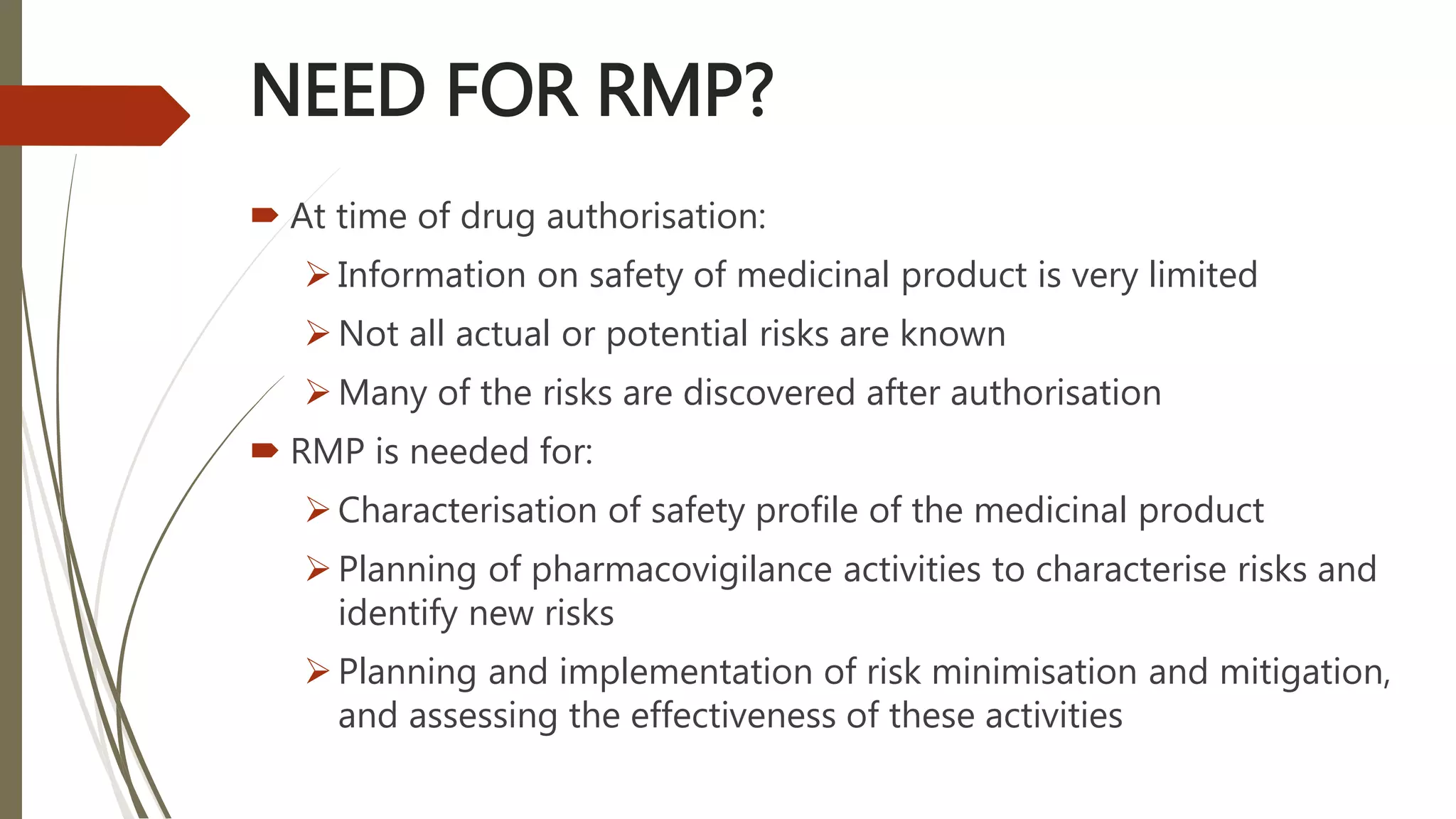
NEED FOR RMP?
 At time of drug authorisation:
Information on safety of medicinal product is very limited
Not all actual or potential risks are known
Many of the risks are discovered after authorisation
 RMP is needed for:
Characterisation of safety profile of the medicinal product
Planning of pharmacovigilance activities to characterise risks and
identify new risks
Planning and implementation of risk minimisation and mitigation,
and assessing the effectiveness of these activities
IMPORTANT DEFINITIONS
 Identified risk
An untoward occurrence for which there is adequate evidence of an
association with the medicinal product of interest
 Potential risk
An untoward occurrence for which there is some basis for suspicion of
an association with the medicinal product of interest but where this
association has not been confirmed
 Missing information
Gaps in knowledge about a medicinal product, related to safety or use
in particular patient populations, which could be clinically significant.
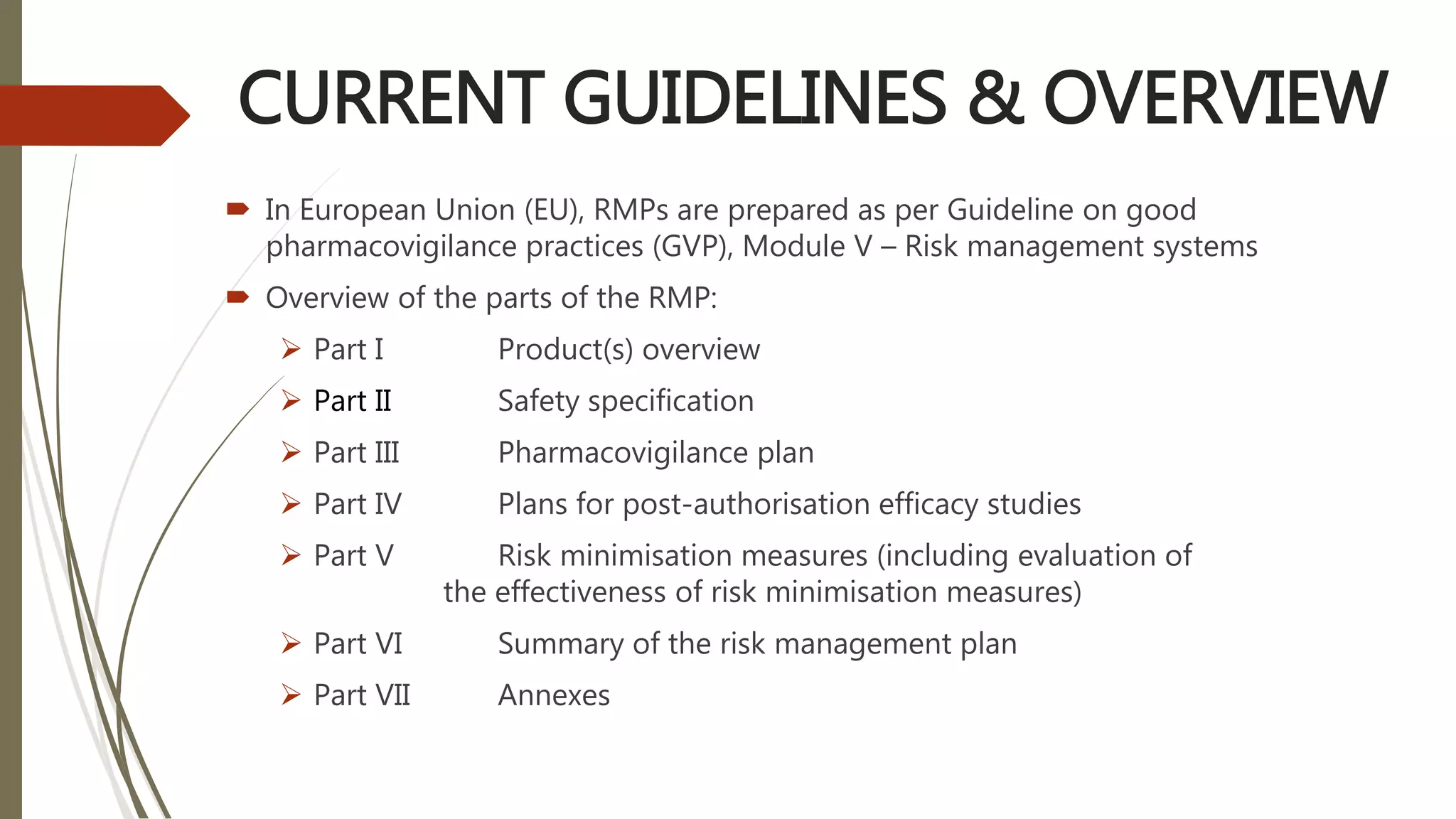
CURRENT GUIDELINES & OVERVIEW
 In European Union (EU), RMPs are prepared as per Guideline on good
pharmacovigilance practices (GVP), Module V – Risk management systems
 Overview of the parts of the RMP:
 Part I Product(s) overview
 Part II Safety specification
 Part III Pharmacovigilance plan
 Part IV Plans for post-authorisation efficacy studies
 Part V Risk minimisation measures (including evaluation of
the effectiveness of risk minimisation measures)
 Part VI Summary of the risk management plan
 Part VII Annexes
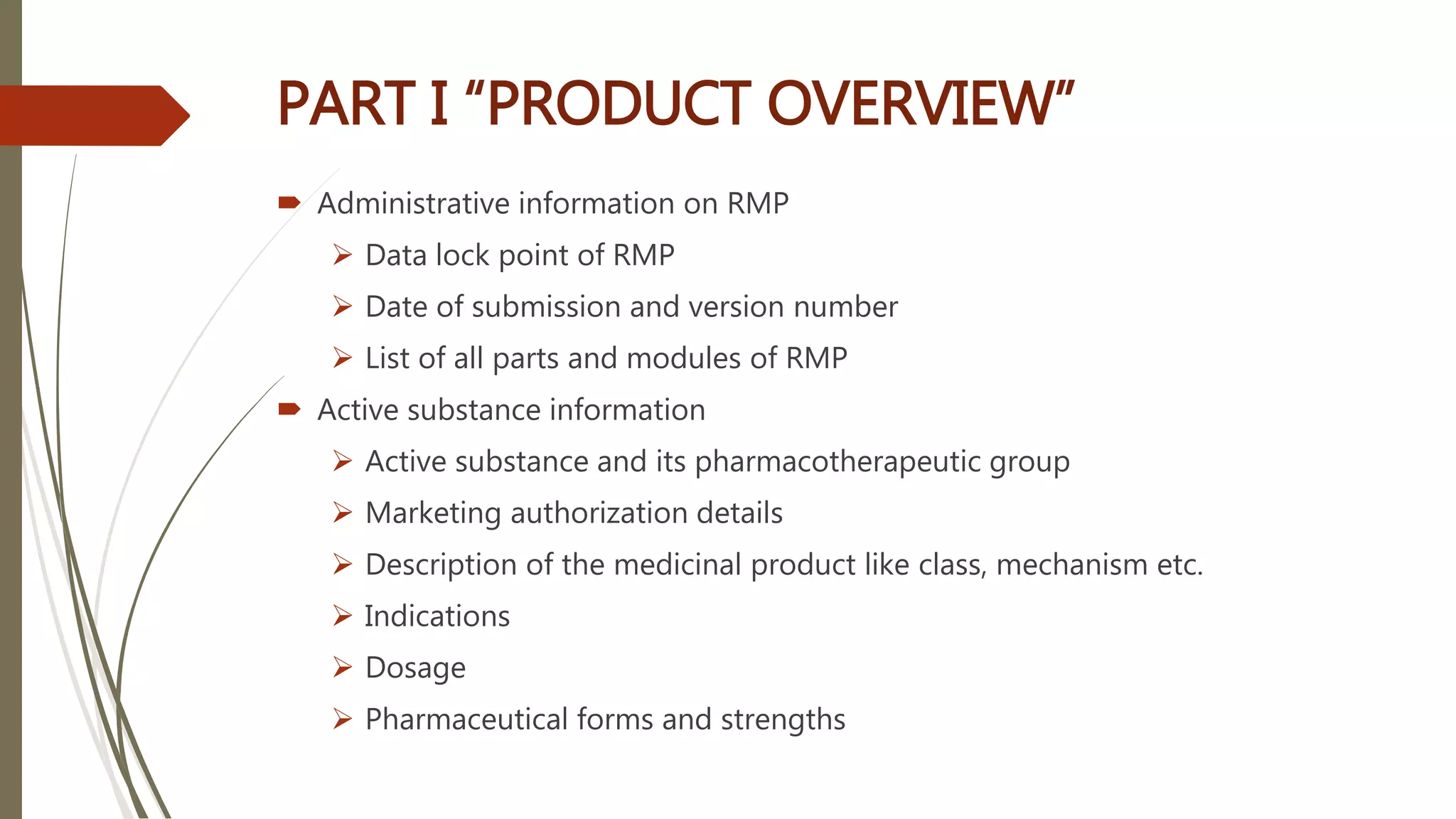
PART I “PRODUCT OVERVIEW”
 Administrative information on RMP
 Data lock point of RMP
 Date of submission and version number
 List of all parts and modules of RMP
 Active substance information
 Active substance and its pharmacotherapeutic group
 Marketing authorization details
 Description of the medicinal product like class, mechanism etc.
 Indications
 Dosage
 Pharmaceutical forms and strengths
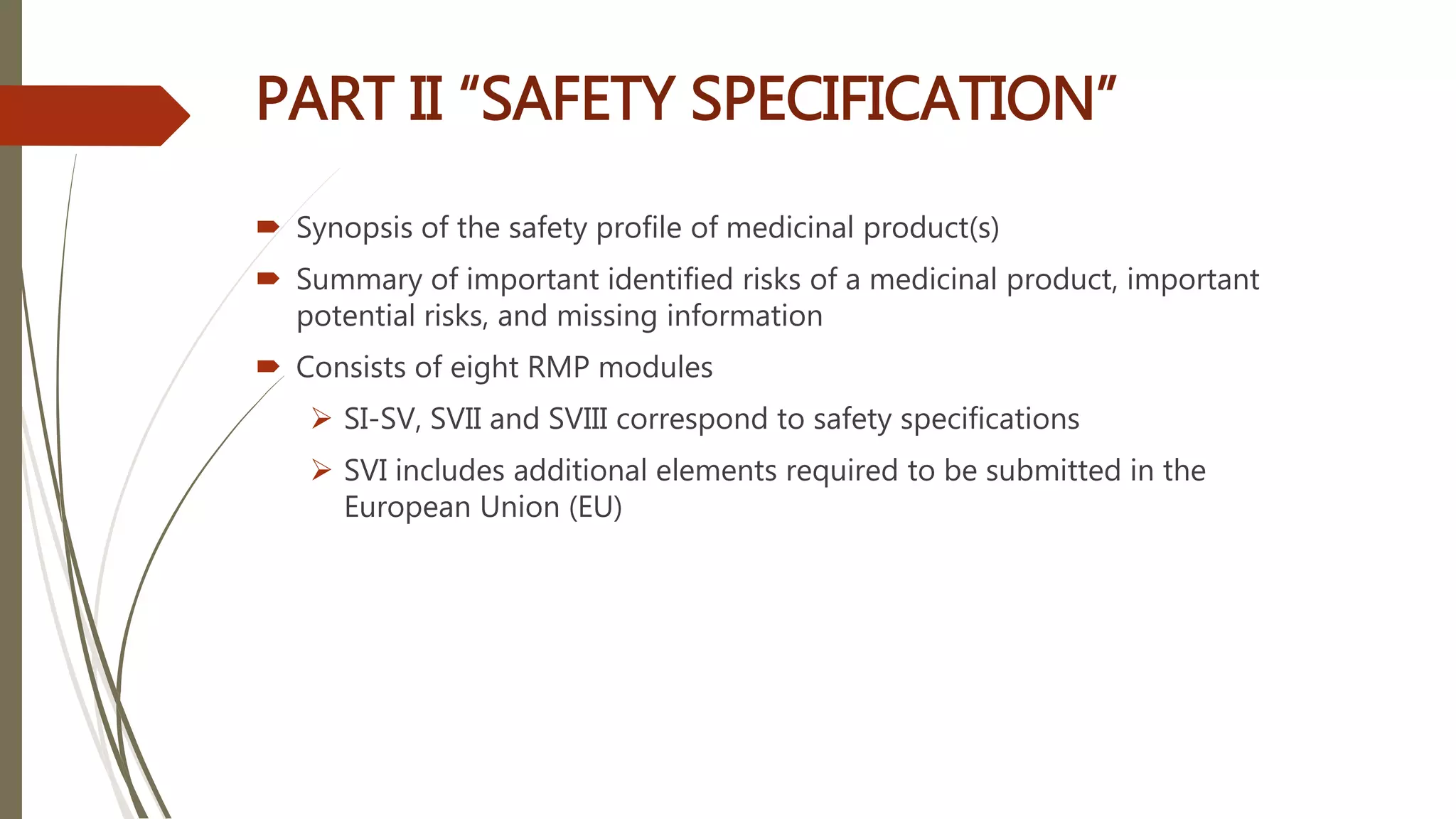
 Synopsis of the safety profile of medicinal product(s)
 Summary of important identified risks of a medicinal product, important
potential risks, and missing information
 Consists of eight RMP modules
 SI-SV, SVII and SVIII correspond to safety specifications
 SVI includes additional elements required to be submitted in the
European Union (EU)
PART II “SAFETY SPECIFICATION”
 Module SI Epidemiology of the indication(s) and target
population(s)
 Module SII Non-clinical part of the safety specification
 Module SIII Clinical trial exposure
 Module SIV Populations not studied in clinical trials
 Module SV Post-authorisation experience
 Module SVI Additional EU requirements for the safety
specification
 Module SVII Identified and potential risks
 Module SVIII Summary of the safety concerns
PART II “SAFETY SPECIFICATION” (contd.)
PART III “PHARMACOVIGILANCE PLAN”
 Structured plan for:
 identification of new safety concerns
 further characterisation of known safety concerns
 investigation of whether a potential safety concern is real or not
 how missing information will be sought
 Includes following sections:
1. Routine pharmacovigilance activities
2. Additional pharmacovigilance activities (may include any non-clinical
studies, clinical trials or non- interventional studies)
3. Action plans for safety concerns with additional pharmacovigilance
requirements
4. Summary table of additional pharmacovigilance activities
PART IV “PLANS FOR POST-
AUTHORISATION EFFICACY STUDIES”
 Required for products:
 Where efficacy may vary over time
 Where there are concerns about efficacy which can only be resolved
after the product has been marketed, or
 When knowledge about the disease or the clinical methodology used
to investigate efficacy indicate that previous efficacy evaluations may
need significant revision
 Includes following sections:
1. Summary of existing efficacy data
2. Tables of post-authorisation efficacy studies
PART V “RISK MINIMISATION MEASURES”
 Details of the risk minimisation measures which will be taken to reduce the
risks associated with individual safety concerns
 Includes following sections:
1. Routine risk minimization
Example: labelling, legal status, pack size etc.
2. Additional risk minimisation activities
Example: educational material
3. Evaluation of the effectiveness of risk minimisation activities
4. Summary of risk minimisation measures
PART VI “SUMMARY OF ACTIVITIES IN THE RISK
MANAGEMENT PLAN BY MEDICINAL PRODUCT”
 Includes a summary of the RMP which shall be made publically available [REG Art
23(3), Art 26(c), DIR Art 106(c) IR Art 31(2)]
 Includes key elements of the RMP with a specific focus on risk minimisation
activities
 Includes following sections:
1. Format and content of the summary of the RMP
2. Overview of disease epidemiology
3. Summary of treatment benefits
4. Unknowns relating to treatment benefits
5. Summary of safety concerns
6. Summary of risk minimisation activities by safety concern
7. Planned post-authorisation development plan
8. Summary of changes to the risk management plan over time
PART VII “ANNEXES TO THE RISK
MANAGEMENT”
1. Interface between RMP and Eudravigilance/EPITT (electronic only)
2. Current (or proposed if product is not authorised) local
(centralised/mutual recognition/decentralised/national) summary of
product characteristics (SmPC) and package leaflet
3. Worldwide marketing authorisation status by country (including EEA)
4. Synopsis of on-going and completed clinical trial programme
5. Synopsis of on-going and completed pharmacoepidemiological study
programme
6. Protocols for proposed and on-going studies in categories 1-3 of the
section “Summary table of additional pharmacovigilance activities” in RMP
part III
PART VII “ANNEXES TO THE RISK
MANAGEMENT” (contd.)
7. Specific adverse event follow-up forms
8. Protocols for proposed and on-going studies in RMP part IV
9. Synopsis of newly available study reports for RMP parts III-IV
10. Details of proposed additional risk minimisation activities (if applicable)
11. Mock up examples in English (or the National language if the product is
only authorised in a single Member State) of the material provided to
healthcare professionals and patients as a requirement of Annex II of the
Commission Decision or as a requirement of national authorisations
including those using the mutual recognition or decentralised procedure
as applicable
12. Other supporting data (including referenced material)
SOURCE DOCUMENTS FOR RMP?
 Summary of products characteristics (SmPC/SPC)
 Patient information leaflet (PIL)
 Clinical overview
 Non-clinical overview
 Literature evidence
WHEN IS RMP REQUIRED?
 While applying for marketing authorization
 At the time of significant change to the marketing authorization.
 Whenever there is a concern about a risk affecting the benefit-
risk balance of a medicine
 Any changes in periodic safety update report (PSUR)
 RMPs are continually modified and updated throughout the
lifetime of the medicine
THANKS
“Life is more risk management, rather than exclusion of risks”
-Walter Wriston

Turacoz - Risk Management Plan ( Regulatory Writing )

  • 1.
    RISK MANAGEMENT PLAN By:Turacoz Healthcare Solutions
  • 2.
    WHAT IS RMP? Risk management plan (RMP) is a regulatory document required for submission to health authorities  Includes information on: a medicine's safety profile how its risks will be prevented or minimised in patients plans for studies and other activities to gain more knowledge about the safety and efficacy of the medicine risk factors for developing adverse reactions measuring the effectiveness of risk-minimisation measures
  • 3.
    NEED FOR RMP? At time of drug authorisation: Information on safety of medicinal product is very limited Not all actual or potential risks are known Many of the risks are discovered after authorisation  RMP is needed for: Characterisation of safety profile of the medicinal product Planning of pharmacovigilance activities to characterise risks and identify new risks Planning and implementation of risk minimisation and mitigation, and assessing the effectiveness of these activities
  • 4.
    IMPORTANT DEFINITIONS  Identifiedrisk An untoward occurrence for which there is adequate evidence of an association with the medicinal product of interest  Potential risk An untoward occurrence for which there is some basis for suspicion of an association with the medicinal product of interest but where this association has not been confirmed  Missing information Gaps in knowledge about a medicinal product, related to safety or use in particular patient populations, which could be clinically significant.
  • 5.
    CURRENT GUIDELINES &OVERVIEW  In European Union (EU), RMPs are prepared as per Guideline on good pharmacovigilance practices (GVP), Module V – Risk management systems  Overview of the parts of the RMP:  Part I Product(s) overview  Part II Safety specification  Part III Pharmacovigilance plan  Part IV Plans for post-authorisation efficacy studies  Part V Risk minimisation measures (including evaluation of the effectiveness of risk minimisation measures)  Part VI Summary of the risk management plan  Part VII Annexes
  • 6.
    PART I “PRODUCTOVERVIEW”  Administrative information on RMP  Data lock point of RMP  Date of submission and version number  List of all parts and modules of RMP  Active substance information  Active substance and its pharmacotherapeutic group  Marketing authorization details  Description of the medicinal product like class, mechanism etc.  Indications  Dosage  Pharmaceutical forms and strengths
  • 7.
     Synopsis ofthe safety profile of medicinal product(s)  Summary of important identified risks of a medicinal product, important potential risks, and missing information  Consists of eight RMP modules  SI-SV, SVII and SVIII correspond to safety specifications  SVI includes additional elements required to be submitted in the European Union (EU) PART II “SAFETY SPECIFICATION”
  • 8.
     Module SIEpidemiology of the indication(s) and target population(s)  Module SII Non-clinical part of the safety specification  Module SIII Clinical trial exposure  Module SIV Populations not studied in clinical trials  Module SV Post-authorisation experience  Module SVI Additional EU requirements for the safety specification  Module SVII Identified and potential risks  Module SVIII Summary of the safety concerns PART II “SAFETY SPECIFICATION” (contd.)
  • 9.
    PART III “PHARMACOVIGILANCEPLAN”  Structured plan for:  identification of new safety concerns  further characterisation of known safety concerns  investigation of whether a potential safety concern is real or not  how missing information will be sought  Includes following sections: 1. Routine pharmacovigilance activities 2. Additional pharmacovigilance activities (may include any non-clinical studies, clinical trials or non- interventional studies) 3. Action plans for safety concerns with additional pharmacovigilance requirements 4. Summary table of additional pharmacovigilance activities
  • 10.
    PART IV “PLANSFOR POST- AUTHORISATION EFFICACY STUDIES”  Required for products:  Where efficacy may vary over time  Where there are concerns about efficacy which can only be resolved after the product has been marketed, or  When knowledge about the disease or the clinical methodology used to investigate efficacy indicate that previous efficacy evaluations may need significant revision  Includes following sections: 1. Summary of existing efficacy data 2. Tables of post-authorisation efficacy studies
  • 11.
    PART V “RISKMINIMISATION MEASURES”  Details of the risk minimisation measures which will be taken to reduce the risks associated with individual safety concerns  Includes following sections: 1. Routine risk minimization Example: labelling, legal status, pack size etc. 2. Additional risk minimisation activities Example: educational material 3. Evaluation of the effectiveness of risk minimisation activities 4. Summary of risk minimisation measures
  • 12.
    PART VI “SUMMARYOF ACTIVITIES IN THE RISK MANAGEMENT PLAN BY MEDICINAL PRODUCT”  Includes a summary of the RMP which shall be made publically available [REG Art 23(3), Art 26(c), DIR Art 106(c) IR Art 31(2)]  Includes key elements of the RMP with a specific focus on risk minimisation activities  Includes following sections: 1. Format and content of the summary of the RMP 2. Overview of disease epidemiology 3. Summary of treatment benefits 4. Unknowns relating to treatment benefits 5. Summary of safety concerns 6. Summary of risk minimisation activities by safety concern 7. Planned post-authorisation development plan 8. Summary of changes to the risk management plan over time
  • 13.
    PART VII “ANNEXESTO THE RISK MANAGEMENT” 1. Interface between RMP and Eudravigilance/EPITT (electronic only) 2. Current (or proposed if product is not authorised) local (centralised/mutual recognition/decentralised/national) summary of product characteristics (SmPC) and package leaflet 3. Worldwide marketing authorisation status by country (including EEA) 4. Synopsis of on-going and completed clinical trial programme 5. Synopsis of on-going and completed pharmacoepidemiological study programme 6. Protocols for proposed and on-going studies in categories 1-3 of the section “Summary table of additional pharmacovigilance activities” in RMP part III
  • 14.
    PART VII “ANNEXESTO THE RISK MANAGEMENT” (contd.) 7. Specific adverse event follow-up forms 8. Protocols for proposed and on-going studies in RMP part IV 9. Synopsis of newly available study reports for RMP parts III-IV 10. Details of proposed additional risk minimisation activities (if applicable) 11. Mock up examples in English (or the National language if the product is only authorised in a single Member State) of the material provided to healthcare professionals and patients as a requirement of Annex II of the Commission Decision or as a requirement of national authorisations including those using the mutual recognition or decentralised procedure as applicable 12. Other supporting data (including referenced material)
  • 15.
    SOURCE DOCUMENTS FORRMP?  Summary of products characteristics (SmPC/SPC)  Patient information leaflet (PIL)  Clinical overview  Non-clinical overview  Literature evidence
  • 16.
    WHEN IS RMPREQUIRED?  While applying for marketing authorization  At the time of significant change to the marketing authorization.  Whenever there is a concern about a risk affecting the benefit- risk balance of a medicine  Any changes in periodic safety update report (PSUR)  RMPs are continually modified and updated throughout the lifetime of the medicine
  • 17.
    THANKS “Life is morerisk management, rather than exclusion of risks” -Walter Wriston