D o k u z E y l u l U n i v e r s i t y
PROJECT RISK MANAGEMENT
B Y :
S A Y E D A M I R A L A W I
2 0 1 8
Introduction
In our today’s live by improving science and technology we face much
more risks in our business and daily life. And it is impossible that we don’t
risk and earn benefit. Since, the nature of business is taking risk.
The crucial thing to be considered is:
Which kind of risks are acceptable and which kind of them are more
dangerous to accept. So they must be declined in our project, daily lives
or future.
What Is Risk?!
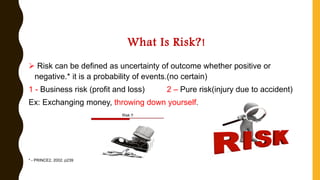
➢ Risk can be defined as uncertainty of outcome whether positive or
negative.* it is a probability of events.(no certain)
1 - Business risk (profit and loss) 2 – Pure risk(injury due to accident)
Ex: Exchanging money, throwing down yourself.
* - PRINCE2, 2002. p239
Risk Management
What is risk management?
✓The processes of identifying and reducing risks are called risk
management.
Why risk management in PM?
Project problems can be reduced as much as 90% by risk analysis.
➢ Positive: more info available during planning, improve probability of
success
➢ Negative: project cut due to risk level
Causes of Risk on a Project
➢ Quality
➢ Schedule
➢ Resources
➢ Cost
➢ Scope
➢ Customers satisfaction
Risk assessment and Risk management
Risk assessment:
➢ What can go wrong?
➢What is the likelihood that it would go wrong?
➢ What are the consequences?
➢ What is the time domain?
Risk Assessment And Risk Management (continue)
Risk management:
✓ What can be done and what options are available?
✓ what are the associated trad-offs in terms of cost, benefits and risks?
✓What are the effects of current management decision to the future
options?
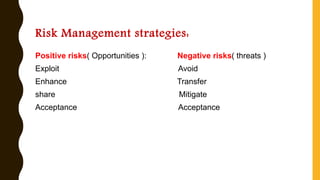
Risk Management strategies:
Positive risks( Opportunities ): Negative risks( threats )
Exploit Avoid
Enhance Transfer
share Mitigate
Acceptance Acceptance
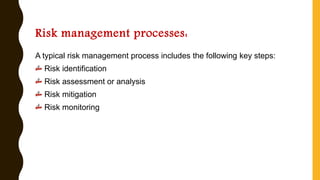
Risk management processes:
A typical risk management process includes the following key steps:
Risk identification
Risk assessment or analysis
Risk mitigation
Risk monitoring
Risk Identification
Risk identification develops the basis for the next steps.
Correct risk identification ensures risk management effectiveness. The
identification and mitigation of project risks are crucial steps in managing
successful projects*.
*- Carbone and Tippett
Risk Identification(continue)
In risk identification we look for the following steps:
1 – Causes of failures:
Unclear objectives
Unrealistic plan
Poor communication
Poor leadership
Lack of skills/ training
Risk Identification(continue)
2 - Questions to identifying risks:
What could go wrong?
What could prevent this from happening?
What can harm us?
What is the worst case?
What threats do we face?
What opportunity could we face?
Risk Identification(continue)
3 - Using PESTLE:
Political risk
Economic risk
Socio-cultural risk
Technological risk
Legal risk
Environmental risk
Risk Identification(continue)
Risk checklist:
Funding
Time
Staffing
Customer relation
Project size or complexity
Overall structure
External factors
Risk Assessment
It identify and evaluate hazards and take measures to control risks
arising from them.
Hazards: A situation that has the potential to cause human injury,
damage to property, damage to environment or economic loss.
Examples:
➢ A wet floor
➢ An open manhole
➢ Pothole
Risk Assessment(continue)
The risk assessment process will vary between organizations. But should
start with:
✓ Identification of hazards
✓ Analysis of who and what might be harmed
✓ Evaluation of the risk
✓ Documentation of the risks
✓ Taking action and review
Risk Assessment(continue)
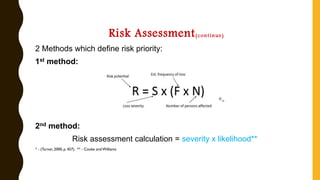
2 Methods which define risk priority:
1st method:
*-
2nd method:
Risk assessment calculation = severity x likelihood**
* - (Turner, 2000, p. 457). ** - Cooke and Williams
Risk Mitigation
Risk Mitigation is the process of reducing the impact of a risk or the
likelihood of a risk being realized.
What to do about identified risk?
✓ Reduce likelihood of risk occurrence
✓ Reduce the impact of risk
Risk mitigation(continue)
How to deal with each risk?
Although construction risk may be varied and complicated, risk
management techniques fall into 4 simple categories:
✓ Avoid
✓ Transfer
✓ Mitigate
✓ Accept
Risk Monitor and Controlling Process
Risk Monitoring and Control is the process of putting into action all of the
risk planning done earlier in the project life-cycle.
✓ Monitor Identified risk
✓ Identify new risk
✓ Ensure the proper execution of planned risk responses
✓ Evaluate the overall effectiveness of the risk management plan in
reducing risk
Conclusion
Importance of risk management in construction projects or any other
projects is clear. So, the crucial and key steps who are risk identification
and risk mitigation need to be done by skilled and experienced risk
managers.
The variation of risk by developing science and technology depends to
these two steps specially risk identification process because only by
identified risks taking proper actions to prepare future plan and reduce the
risks are possible.
References
• Risk modeling, assessment and management. 3rd edition Yacov Y. Haimes
• Risk analysis and management in construction (article) - Akintola S Akintoye. Department of Building and
Surveying, Glasgow Caledonian University, Glasgow, G40BA, UK
Malcolm J MacLeod - 1RISC Technical Services, International Loss Adjusters, 35 Seething Lane, London,
EC3N 4AH, UK
• different sites of internet.
• Risk analysis in construction project (article) - chosen methods. Agnieszka Dziadosza* Mariusz Rejmentb**
* - Institute of Structural Engineering, Poznan University of Technology, Piotrowo 5, 60-965 Poznan, Poland
** - Institute of Building Engineering , Wroclaw University of Technology, Wybrzeze Wyspianskiego 27, 50-
370 Wroclaw, Poland

Projects risk management

  • 1.
    D o ku z E y l u l U n i v e r s i t y PROJECT RISK MANAGEMENT B Y : S A Y E D A M I R A L A W I 2 0 1 8
  • 2.
    Introduction In our today’slive by improving science and technology we face much more risks in our business and daily life. And it is impossible that we don’t risk and earn benefit. Since, the nature of business is taking risk. The crucial thing to be considered is: Which kind of risks are acceptable and which kind of them are more dangerous to accept. So they must be declined in our project, daily lives or future.
  • 3.
    What Is Risk?! ➢Risk can be defined as uncertainty of outcome whether positive or negative.* it is a probability of events.(no certain) 1 - Business risk (profit and loss) 2 – Pure risk(injury due to accident) Ex: Exchanging money, throwing down yourself. * - PRINCE2, 2002. p239
  • 4.
    Risk Management What isrisk management? ✓The processes of identifying and reducing risks are called risk management. Why risk management in PM? Project problems can be reduced as much as 90% by risk analysis. ➢ Positive: more info available during planning, improve probability of success ➢ Negative: project cut due to risk level
  • 5.
    Causes of Riskon a Project ➢ Quality ➢ Schedule ➢ Resources ➢ Cost ➢ Scope ➢ Customers satisfaction
  • 6.
    Risk assessment andRisk management Risk assessment: ➢ What can go wrong? ➢What is the likelihood that it would go wrong? ➢ What are the consequences? ➢ What is the time domain?
  • 7.
    Risk Assessment AndRisk Management (continue) Risk management: ✓ What can be done and what options are available? ✓ what are the associated trad-offs in terms of cost, benefits and risks? ✓What are the effects of current management decision to the future options?
  • 8.
    Risk Management strategies: Positiverisks( Opportunities ): Negative risks( threats ) Exploit Avoid Enhance Transfer share Mitigate Acceptance Acceptance
  • 9.
    Risk management processes: Atypical risk management process includes the following key steps: Risk identification Risk assessment or analysis Risk mitigation Risk monitoring
  • 10.
    Risk Identification Risk identificationdevelops the basis for the next steps. Correct risk identification ensures risk management effectiveness. The identification and mitigation of project risks are crucial steps in managing successful projects*. *- Carbone and Tippett
  • 11.
    Risk Identification(continue) In riskidentification we look for the following steps: 1 – Causes of failures: Unclear objectives Unrealistic plan Poor communication Poor leadership Lack of skills/ training
  • 12.
    Risk Identification(continue) 2 -Questions to identifying risks: What could go wrong? What could prevent this from happening? What can harm us? What is the worst case? What threats do we face? What opportunity could we face?
  • 13.
    Risk Identification(continue) 3 -Using PESTLE: Political risk Economic risk Socio-cultural risk Technological risk Legal risk Environmental risk
  • 14.
    Risk Identification(continue) Risk checklist: Funding Time Staffing Customerrelation Project size or complexity Overall structure External factors
  • 15.
    Risk Assessment It identifyand evaluate hazards and take measures to control risks arising from them. Hazards: A situation that has the potential to cause human injury, damage to property, damage to environment or economic loss. Examples: ➢ A wet floor ➢ An open manhole ➢ Pothole
  • 16.
    Risk Assessment(continue) The riskassessment process will vary between organizations. But should start with: ✓ Identification of hazards ✓ Analysis of who and what might be harmed ✓ Evaluation of the risk ✓ Documentation of the risks ✓ Taking action and review
  • 17.
    Risk Assessment(continue) 2 Methodswhich define risk priority: 1st method: *- 2nd method: Risk assessment calculation = severity x likelihood** * - (Turner, 2000, p. 457). ** - Cooke and Williams
  • 18.
    Risk Mitigation Risk Mitigationis the process of reducing the impact of a risk or the likelihood of a risk being realized. What to do about identified risk? ✓ Reduce likelihood of risk occurrence ✓ Reduce the impact of risk
  • 19.
    Risk mitigation(continue) How todeal with each risk? Although construction risk may be varied and complicated, risk management techniques fall into 4 simple categories: ✓ Avoid ✓ Transfer ✓ Mitigate ✓ Accept
  • 20.
    Risk Monitor andControlling Process Risk Monitoring and Control is the process of putting into action all of the risk planning done earlier in the project life-cycle. ✓ Monitor Identified risk ✓ Identify new risk ✓ Ensure the proper execution of planned risk responses ✓ Evaluate the overall effectiveness of the risk management plan in reducing risk
  • 21.
    Conclusion Importance of riskmanagement in construction projects or any other projects is clear. So, the crucial and key steps who are risk identification and risk mitigation need to be done by skilled and experienced risk managers. The variation of risk by developing science and technology depends to these two steps specially risk identification process because only by identified risks taking proper actions to prepare future plan and reduce the risks are possible.
  • 22.
    References • Risk modeling,assessment and management. 3rd edition Yacov Y. Haimes • Risk analysis and management in construction (article) - Akintola S Akintoye. Department of Building and Surveying, Glasgow Caledonian University, Glasgow, G40BA, UK Malcolm J MacLeod - 1RISC Technical Services, International Loss Adjusters, 35 Seething Lane, London, EC3N 4AH, UK • different sites of internet. • Risk analysis in construction project (article) - chosen methods. Agnieszka Dziadosza* Mariusz Rejmentb** * - Institute of Structural Engineering, Poznan University of Technology, Piotrowo 5, 60-965 Poznan, Poland ** - Institute of Building Engineering , Wroclaw University of Technology, Wybrzeze Wyspianskiego 27, 50- 370 Wroclaw, Poland