Neuroimaging Research Unit, Institute of Experimental
Neurology, Division of Neuroscience, San Raffaele Scientific
Institute, Vita-Salute San Raffaele University, Milan, Italy.
MRI MARKERS
TO UNDERSTAND PROGRESSION
MECHANISMS
Maria A. Rocca
• WM lesions: brain, spinal cord
• Atrophy
• WM damage: extent, topography
• GM damage: cortical lesions, diffuse
and regional damage
• Spinal cord damage
• CNS reorganization (brain, spinal cord)
• Conclusions
• WM lesions: brain, spinal cord
• Atrophy
• WM damage: extent, topography
• GM damage: cortical lesions, diffuse
and regional damage
• Spinal cord damage
• CNS reorganization (brain, spinal cord)
• Conclusions
MRI & Progressive MS
Outline of presentation
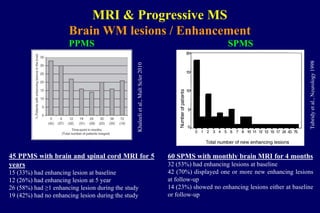
SPMS
60 SPMS with monthly brain MRI for 4 months
32 (53%) had enhancing lesions at baseline
42 (70%) displayed one or more new enhancing lesions
at follow-up
14 (23%) showed no enhancing lesions either at baseline
or follow-up
Tubridyetal.,Neurology1998
Khaleelietal.,MultScler2010
PPMS
45 PPMS with brain and spinal cord MRI for 5
years
15 (33%) had enhancing lesion at baseline
12 (26%) had enhancing lesion at 5 year
26 (58%) had ≥1 enhancing lesion during the study
19 (42%) had no enhancing lesion during the study
MRI & Progressive MS
Brain WM lesions / Enhancement
Khaleeli et al., Ann Neurol 2008
101 PPMS followed up for 10 yrs
MRI & Progressive MS
Brain WM lesions / Prognosis
Mesarosetal.,JNeurol2008
RRMS
Sormani et al., Neurology 2009
• Similar slope of the relationship
between baseline T2LV and
EDSS in RRMS and SPMS
• Median yearly T2LV change:
0.27 mL in RRMS, and 0.30 mL
in SPMS (p=0.59)
T2 lesions
MRI & Progressive MS
Brain WM lesions / Distribution
Ceccarellietal.,NeuroImage2008
CIS RR SP PP
T2 lesion maps
Bodinietal.,JNNP2011
T2 lesion location vs disability worsening
T1 lesion maps
PPMS
PP vs RR: 29 vs 19% peak probability
DiPerrietal.,ArchNeurol2008
• Higher T1 lesion occurrence in the CC,
CST and other tracts adjacent to the lateral
ventricles in SPMS vs RRMS
Filli et al., MSJ 2012
Multiple hyperintense
lesions in the spinal cord
Rovaris et al., Brain 2001
Spinal cord / T2 lesions
MRI & Progressive MS
Number of cord lesions Number of damaged
cord segments
0.0
1.0
2.0
3.0
4.0
5.0
0.0
1.0
2.0
3.0
4.0
5.0
6.0
p = 0.03
0.0
30.0
60.0
90.0
Cord area [mm2]
Rovarisetal.,Brain2001
PPMSSPMSControls
• WM lesions: brain, spinal cord
• Atrophy
• WM damage: extent, topography
• GM damage: cortical lesions, diffuse
and regional damage
• Spinal cord damage
• CNS reorganization (brain, spinal cord)
• Conclusions
MRI & Progressive MS
Outline of presentation
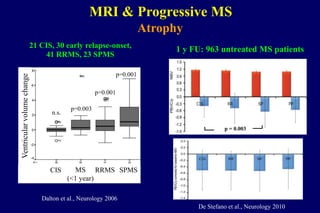
Atrophy
MRI & Progressive MS
1 y FU: 963 untreated MS patients
De Stefano et al., Neurology 2010
p = 0.003


Dalton et al., Neurology 2006
CIS MS
(<1 year)
RRMS SPMS
n.s.
p=0.003
p=0.001
p=0.001
Ventricularvolumechange
21 CIS, 30 early relapse-onset,
41 RRMS, 23 SPMS
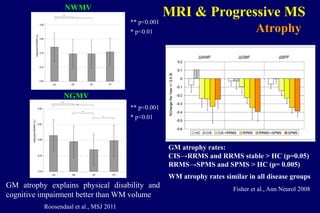
Atrophy
Fisher et al., Ann Neurol 2008
GM atrophy rates:
CIS→RRMS and RRMS stable > HC (p=0.05)
RRMS→SPMS and SPMS > HC (p= 0.005)
WM atrophy rates similar in all disease groups
MRI & Progressive MS
NGMV
NWMV
** p<0.001
* p<0.01
GM atrophy explains physical disability and
cognitive impairment better than WM volume
Roosendaal et al., MSJ 2011
** p<0.001
* p<0.01
MRI & Progressive MS
Outline of presentation
• WM lesions: brain, spinal cord
• Atrophy
• WM damage: extent, topography
• GM damage: cortical lesions, diffuse
and regional damage
• Spinal cord damage
• CNS reorganization (brain, spinal cord)
• Conclusions
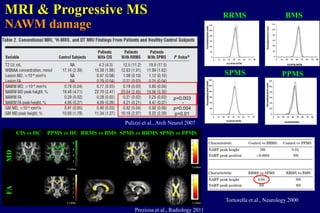
Pulizzi et al., Arch Neurol 2007
CIS vs HC PPMS vs HC
1
2
3
4
5
t value
2
4
6
8
t value
MDFA
RRMS vs BMS
t value
t value
SPMS vs RRMS SPMS vs PPMS
Preziosa et al., Radiology 2011
MRI & Progressive MS
NAWM damage
p=0.003
p=0.01
-
p=0.004
RRMS BMS
SPMS PPMS
Tortorella et al., Neurology 2000
MRI & Progressive MS
Outline of presentation
• WM lesions: brain, spinal cord
• Atrophy
• WM damage: extent, topography
• GM damage: cortical lesions, diffuse
and regional damage
• Spinal cord damage
• CNS reorganization (brain, spinal cord)
• Conclusions
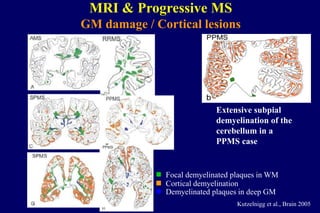
Kutzelnigg et al., Brain 2005
Focal demyelinated plaques in WM
Cortical demyelination
Demyelinated plaques in deep GM
MRI & Progressive MS
GM damage / Cortical lesions
Extensive subpial
demyelination of the
cerebellum in a
PPMS case
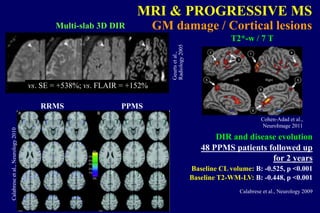
Baseline CL volume: B: -0.525, p <0.001
Baseline T2-WM-LV: B: -0.448, p <0.001
48 PPMS patients followed up
for 2 years
Calabrese et al., Neurology 2009
DIR and disease evolution
MRI & PROGRESSIVE MS
GM damage / Cortical lesionsMulti-slab 3D DIR
Geurtsetal.,
Radiology2005
vs. SE = +538%; vs. FLAIR = +152%
RRMS PPMS
Calabreseetal.,Neurology2010
Cohen-Adad et al.,
NeuroImage 2011
T2*-w / 7 T
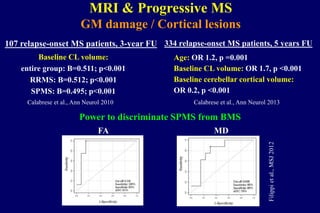
Power to discriminate SPMS from BMS
Filippietal.,MSJ2012
MDFA
Age: OR 1.2, p =0.001
Baseline CL volume: OR 1.7, p <0.001
Baseline cerebellar cortical volume:
OR 0.2, p <0.001
334 relapse-onset MS patients, 5 years FU
Calabrese et al., Ann Neurol 2013
MRI & Progressive MS
GM damage / Cortical lesions
Baseline CL volume:
entire group: B=0.511; p<0.001
RRMS: B=0.512; p<0.001
SPMS: B=0.495; p<0.001
107 relapse-onset MS patients, 3-year FU
Calabrese et al., Ann Neurol 2010
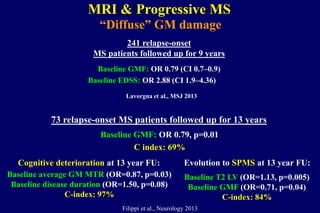
Baseline GMF: OR 0.79, p=0.01
C index: 69%
73 relapse-onset MS patients followed up for 13 years
MRI & Progressive MS
Evolution to SPMS at 13 year FU:
Baseline T2 LV (OR=1.13, p=0.005)
Baseline GMF (OR=0.71, p=0.04)
C-index: 84%
Cognitive deterioration at 13 year FU:
Baseline average GM MTR (OR=0.87, p=0.03)
Baseline disease duration (OR=1.50, p=0.08)
C-index: 97%
Baseline GMF: OR 0.79 (CI 0.7–0.9)
Baseline EDSS: OR 2.88 (CI 1.9–4.36)
241 relapse-onset
MS patients followed up for 9 years
Lavorgna et al., MSJ 2013
“Diffuse” GM damage
Filippi et al., Neurology 2013
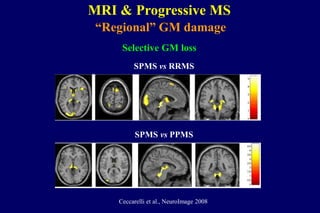
MRI & Progressive MS
“Regional” GM damage
SPMS vs RRMS
SPMS vs PPMS
Ceccarelli et al., NeuroImage 2008
Selective GM loss
MRI & Progressive MS
Outline of presentation
• WM lesions: brain, spinal cord
• Atrophy
• WM damage: extent, topography
• GM damage: cortical lesions, diffuse
and regional damage
• Spinal cord damage
• CNS reorganization (brain, spinal cord)
• Conclusions
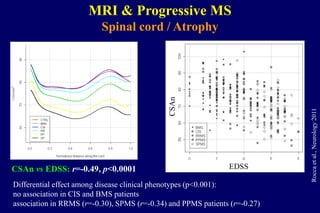
C
MRI & Progressive MS
Spinal cord / Atrophy
CSAn vs EDSS: r=-0.49, p<0.0001 EDSS
CSAn
Differential effect among disease clinical phenotypes (p<0.001):
no association in CIS and BMS patients
association in RRMS (r=-0.30), SPMS (r=-0.34) and PPMS patients (r=-0.27)
Roccaetal.,Neurology2011
Roccaetal.,JNNP2013
BMS vs RRMS SPMS vs RRMS SPMS vs BMS SPMS vs PPMSPPMS vs HC
P A L R P A L R P A L R P A L R P A L R
T2 lesion
probability
RRMS BMS PPMS SPMSCIS
MRI & Progressive MS
Spinal cord damage
Average MD
[x10-3mm2s-1] (SD)
Mean FA
(SD)
Controls
1.203
(0.09)
0.42
(0.04)
PPMS
1.280
(0.10)
0.38
(0.05)
p
0.024
0.007
Agosta et al., Neurology 2005
MRI & Progressive MS
Spinal cord / Diffuse damage
Composite MR model vs EDSS:
Cord area + cord MTR peak height
(r=0.21, p=0.04)
Rovaris et al., Brain 2001
0
10
20
30
40
50
60
70
0 10 20 30 40 50 60 70 80
Controls
MTR [%]
Normalizedpixelcount
SPMS
PPMS
MRI & Progressive MS
Spinal cord damage
Baseline cross-sectional area and FA
vs EDSS at follow-up:
r = -0.40; p = 0.01
Agosta et al., Brain 2007
-10% -5% 0 +5% +10% +15% +20%
FA
MD
Cross-
sectional
area
RRMS
SPMS
PPMS
Overall
UCCA, T1LV, diffuse abnormalities and number of
involved segments were significant explanatory factors for
clinical disability (R2 = 0.564)
Lukas et al., Radiology 2013
MRI & Progressive MS
Outline of presentation
• WM lesions: brain, spinal cord
• Atrophy
• WM damage: extent, topography
• GM damage: cortical lesions, diffuse
and regional damage
• Spinal cord damage
• CNS reorganization (brain, spinal cord)
• Conclusions
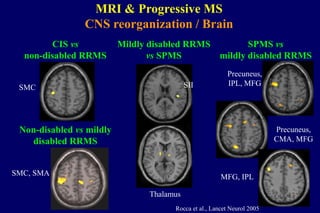
CIS vs
non-disabled RRMS
SMC
Non-disabled vs mildly
disabled RRMS
SMC, SMA
Mildly disabled RRMS
vs SPMS
Thalamus
SII
SPMS vs
mildly disabled RRMS
Precuneus,
IPL, MFG
MFG, IPL
Precuneus,
CMA, MFG
Rocca et al., Lancet Neurol 2005
MRI & Progressive MS
CNS reorganization / Brain
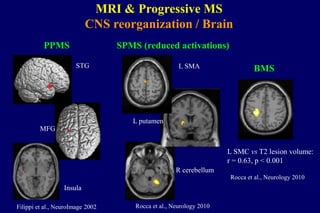
SPMS (reduced activations)
L SMA
L putamen
R cerebellum
Rocca et al., Neurology 2010
BMS
L SMC vs T2 lesion volume:
r = 0.63, p < 0.001
Rocca et al., Neurology 2010
MRI & Progressive MS
CNS reorganization / Brain
STG
MFG
Insula
PPMS
Filippi et al., NeuroImage 2002
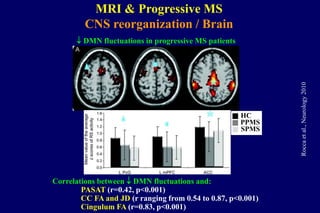
Correlations between  DMN fluctuations and:
PASAT (r=0.42, p<0.001)
CC FA and JD (r ranging from 0.54 to 0.87, p<0.001)
Cingulum FA (r=0.83, p<0.001)
Roccaetal.,Neurology2010
 DMN fluctuations in progressive MS patients
HC
PPMS
SPMS
MRI & Progressive MS
CNS reorganization / Brain
HC
R
ACC
MCC
OFC
MTG
ITG
Cereb
(cr I)
Cereb (cr II)
L
ACC
SFG
PrecunMCC
ITG
MTG
Cereb
(cr I)
Cereb (cr II)
Thal
Put
CP
ACC
MCC
OFC ITG
MTG
Cereb
(cr I)
Cereb (VIII)
Thal
Pall
ACC
MCC
OFC
MTG
ITGSup TP
Cereb
(cr I)
Cereb (cr II)
ThalCaud
CI
ACC
MCC
OFC
ITG
MTG
Cereb (cr I)
Put
MCC
ITG
MTG
Ling
Cereb (cr II)
Cereb (cr I)
Cereb
(IV-V)
Sup
TP
ACC
PrecunMCC
MTG
SFG
Put
ITG
Thal
Cer-crus-II
Cer-crus-I
MTG
MCC
ITG
ACC
OFC
Cer-crus-II
Cer-crus-I
MTG
MCC
ACC
ITGSupTP
Cer-crus-I
Cer-crus-II
BMS
ITG
MTG
MCC
SupTP
Thal
Cer-
crus-II
Cer-crus-I
Cer-lobule-VIII
Cer-lobule-IV-V
ITG
MTG
LingSupTP
PHG
Thal
Cer-crus-II
Cer-crus-I
Cer-lobule-IV-V
HCs
SPMS
RRMS
BMS
ACC
MCC
MTG
ITG
Pall
OFC
Put
Cer-crus-I
ACC
Pall
Put
Thal
ITG
PHG
LingMTG
OFC
Cer-
lobule-VI
Cer-
crus-I
MCC
ACC
OFC
ITG
MTG
Ling
Pall
Thal
Cer-crus-I
Cer-crus-II
Cer-lobule-VIII
RLMRI & Progressive MS
CNS reorganization / Brain
Tactile stimulation of the palm of the R hand
Progressive MS vs controls: p=0.003
SPMS vs PPMS: p=0.05
Cordaveragesignalchange(%)
Controls
SPMS
PPMS
Valsasina et al., Hum Brain Mapp 2011
MRI & Progressive MS
CNS reorganization / Spinal cord
Valsasina et al., JNNP 2010
Controls RRMS SPMS
3.9 %
 1.3 %3. 3 %
 1.1 %
2.7 %
 0.7 %
Task-relatedaveragesignalchange[%]
0.0
0.5
1.0
1.5
2.0
2.5
3.0
3.5
4.0
4.5
5.0
p=0.05
vs controls
p=0.02
vs controls
Cord fMRI vs fatigue
Rocca et al., Mult Scler 2012
MRI & Progressive MS
Outline of presentation
• T2 lesions: brain, spinal cord
• Atrophy
• WM damage: extent, topography
• GM damage: cortical lesions, diffuse
and regional damage
• Spinal cord damage
• CNS reorganization (brain, spinal cord)
• Conclusions
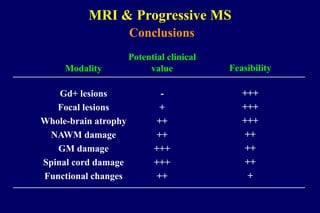
MRI & Progressive MS
Conclusions
Modality
Gd+ lesions
Focal lesions
Whole-brain atrophy
NAWM damage
GM damage
Spinal cord damage
Functional changes
Potential clinical
value
-
+
++
++
+++
+++
++
Feasibility
+++
+++
+++
++
++
++
+
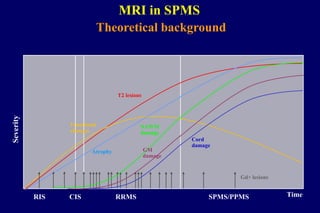
RIS RRMS SPMS/PPMSCIS Time
Severity
T2 lesions
Atrophy
Functional
changes
NAWM
damage
Cord
damage
GM
damage
Gd+ lesions
MRI in SPMS
Theoretical background
Neuroimaging Research Unit & WM
diseases group
Director: M. Filippi
DIVISION OF NEUROSCIENCE INSTITUTE OF EXPERIMENTAL NEUROLOGY
Scientific coordinator: M.A. Rocca
Department of Neurology
G. Comi, B. Colombo,
M. Comola, F. Esposito, V. Martinelli, F.
Martinelli Boneschi,
L. Moiola, G. Pavan, M. Rodegher
Department of Neuroradiology
A. Falini
MAGNIMS
Physicians: M. Absinta
A. Bisecco
G. Boffa
S. Cirillo
E. De Meo
G. Longoni
F. Mele
R. Messina
M.E. Morelli
L. Parisi
P. Preziosa
G. Riccitelli
Physicists:
M. Copetti
E. Pagani
P. Valsasina
Technicians:
L. Dall’Occhio
A. Meani
P. Misci
M. Petrolini
S. Sala
M. Sibilia
R. Vuotto
University of Belgrade
V.S. Kostic,
J. Drulovic, S. Mesaros
Gallarate Hospital, MS Centre
A. Ghezzi

MRI markers to understand progression

  • 1.
    Neuroimaging Research Unit,Institute of Experimental Neurology, Division of Neuroscience, San Raffaele Scientific Institute, Vita-Salute San Raffaele University, Milan, Italy. MRI MARKERS TO UNDERSTAND PROGRESSION MECHANISMS Maria A. Rocca
  • 2.
    • WM lesions:brain, spinal cord • Atrophy • WM damage: extent, topography • GM damage: cortical lesions, diffuse and regional damage • Spinal cord damage • CNS reorganization (brain, spinal cord) • Conclusions • WM lesions: brain, spinal cord • Atrophy • WM damage: extent, topography • GM damage: cortical lesions, diffuse and regional damage • Spinal cord damage • CNS reorganization (brain, spinal cord) • Conclusions MRI & Progressive MS Outline of presentation
  • 3.
    SPMS 60 SPMS withmonthly brain MRI for 4 months 32 (53%) had enhancing lesions at baseline 42 (70%) displayed one or more new enhancing lesions at follow-up 14 (23%) showed no enhancing lesions either at baseline or follow-up Tubridyetal.,Neurology1998 Khaleelietal.,MultScler2010 PPMS 45 PPMS with brain and spinal cord MRI for 5 years 15 (33%) had enhancing lesion at baseline 12 (26%) had enhancing lesion at 5 year 26 (58%) had ≥1 enhancing lesion during the study 19 (42%) had no enhancing lesion during the study MRI & Progressive MS Brain WM lesions / Enhancement
  • 4.
    Khaleeli et al.,Ann Neurol 2008 101 PPMS followed up for 10 yrs MRI & Progressive MS Brain WM lesions / Prognosis Mesarosetal.,JNeurol2008 RRMS Sormani et al., Neurology 2009 • Similar slope of the relationship between baseline T2LV and EDSS in RRMS and SPMS • Median yearly T2LV change: 0.27 mL in RRMS, and 0.30 mL in SPMS (p=0.59) T2 lesions
  • 5.
    MRI & ProgressiveMS Brain WM lesions / Distribution Ceccarellietal.,NeuroImage2008 CIS RR SP PP T2 lesion maps Bodinietal.,JNNP2011 T2 lesion location vs disability worsening T1 lesion maps PPMS PP vs RR: 29 vs 19% peak probability DiPerrietal.,ArchNeurol2008 • Higher T1 lesion occurrence in the CC, CST and other tracts adjacent to the lateral ventricles in SPMS vs RRMS Filli et al., MSJ 2012
  • 6.
    Multiple hyperintense lesions inthe spinal cord Rovaris et al., Brain 2001 Spinal cord / T2 lesions MRI & Progressive MS Number of cord lesions Number of damaged cord segments 0.0 1.0 2.0 3.0 4.0 5.0 0.0 1.0 2.0 3.0 4.0 5.0 6.0 p = 0.03 0.0 30.0 60.0 90.0 Cord area [mm2] Rovarisetal.,Brain2001 PPMSSPMSControls
  • 7.
    • WM lesions:brain, spinal cord • Atrophy • WM damage: extent, topography • GM damage: cortical lesions, diffuse and regional damage • Spinal cord damage • CNS reorganization (brain, spinal cord) • Conclusions MRI & Progressive MS Outline of presentation
  • 8.
    Atrophy MRI & ProgressiveMS 1 y FU: 963 untreated MS patients De Stefano et al., Neurology 2010 p = 0.003   Dalton et al., Neurology 2006 CIS MS (<1 year) RRMS SPMS n.s. p=0.003 p=0.001 p=0.001 Ventricularvolumechange 21 CIS, 30 early relapse-onset, 41 RRMS, 23 SPMS
  • 9.
    Atrophy Fisher et al.,Ann Neurol 2008 GM atrophy rates: CIS→RRMS and RRMS stable > HC (p=0.05) RRMS→SPMS and SPMS > HC (p= 0.005) WM atrophy rates similar in all disease groups MRI & Progressive MS NGMV NWMV ** p<0.001 * p<0.01 GM atrophy explains physical disability and cognitive impairment better than WM volume Roosendaal et al., MSJ 2011 ** p<0.001 * p<0.01
  • 10.
    MRI & ProgressiveMS Outline of presentation • WM lesions: brain, spinal cord • Atrophy • WM damage: extent, topography • GM damage: cortical lesions, diffuse and regional damage • Spinal cord damage • CNS reorganization (brain, spinal cord) • Conclusions
  • 11.
    Pulizzi et al.,Arch Neurol 2007 CIS vs HC PPMS vs HC 1 2 3 4 5 t value 2 4 6 8 t value MDFA RRMS vs BMS t value t value SPMS vs RRMS SPMS vs PPMS Preziosa et al., Radiology 2011 MRI & Progressive MS NAWM damage p=0.003 p=0.01 - p=0.004 RRMS BMS SPMS PPMS Tortorella et al., Neurology 2000
  • 12.
    MRI & ProgressiveMS Outline of presentation • WM lesions: brain, spinal cord • Atrophy • WM damage: extent, topography • GM damage: cortical lesions, diffuse and regional damage • Spinal cord damage • CNS reorganization (brain, spinal cord) • Conclusions
  • 13.
    Kutzelnigg et al.,Brain 2005 Focal demyelinated plaques in WM Cortical demyelination Demyelinated plaques in deep GM MRI & Progressive MS GM damage / Cortical lesions Extensive subpial demyelination of the cerebellum in a PPMS case
  • 14.
    Baseline CL volume:B: -0.525, p <0.001 Baseline T2-WM-LV: B: -0.448, p <0.001 48 PPMS patients followed up for 2 years Calabrese et al., Neurology 2009 DIR and disease evolution MRI & PROGRESSIVE MS GM damage / Cortical lesionsMulti-slab 3D DIR Geurtsetal., Radiology2005 vs. SE = +538%; vs. FLAIR = +152% RRMS PPMS Calabreseetal.,Neurology2010 Cohen-Adad et al., NeuroImage 2011 T2*-w / 7 T
  • 15.
    Power to discriminateSPMS from BMS Filippietal.,MSJ2012 MDFA Age: OR 1.2, p =0.001 Baseline CL volume: OR 1.7, p <0.001 Baseline cerebellar cortical volume: OR 0.2, p <0.001 334 relapse-onset MS patients, 5 years FU Calabrese et al., Ann Neurol 2013 MRI & Progressive MS GM damage / Cortical lesions Baseline CL volume: entire group: B=0.511; p<0.001 RRMS: B=0.512; p<0.001 SPMS: B=0.495; p<0.001 107 relapse-onset MS patients, 3-year FU Calabrese et al., Ann Neurol 2010
  • 16.
    Baseline GMF: OR0.79, p=0.01 C index: 69% 73 relapse-onset MS patients followed up for 13 years MRI & Progressive MS Evolution to SPMS at 13 year FU: Baseline T2 LV (OR=1.13, p=0.005) Baseline GMF (OR=0.71, p=0.04) C-index: 84% Cognitive deterioration at 13 year FU: Baseline average GM MTR (OR=0.87, p=0.03) Baseline disease duration (OR=1.50, p=0.08) C-index: 97% Baseline GMF: OR 0.79 (CI 0.7–0.9) Baseline EDSS: OR 2.88 (CI 1.9–4.36) 241 relapse-onset MS patients followed up for 9 years Lavorgna et al., MSJ 2013 “Diffuse” GM damage Filippi et al., Neurology 2013
  • 17.
    MRI & ProgressiveMS “Regional” GM damage SPMS vs RRMS SPMS vs PPMS Ceccarelli et al., NeuroImage 2008 Selective GM loss
  • 18.
    MRI & ProgressiveMS Outline of presentation • WM lesions: brain, spinal cord • Atrophy • WM damage: extent, topography • GM damage: cortical lesions, diffuse and regional damage • Spinal cord damage • CNS reorganization (brain, spinal cord) • Conclusions
  • 19.
    C MRI & ProgressiveMS Spinal cord / Atrophy CSAn vs EDSS: r=-0.49, p<0.0001 EDSS CSAn Differential effect among disease clinical phenotypes (p<0.001): no association in CIS and BMS patients association in RRMS (r=-0.30), SPMS (r=-0.34) and PPMS patients (r=-0.27) Roccaetal.,Neurology2011
  • 20.
    Roccaetal.,JNNP2013 BMS vs RRMSSPMS vs RRMS SPMS vs BMS SPMS vs PPMSPPMS vs HC P A L R P A L R P A L R P A L R P A L R T2 lesion probability RRMS BMS PPMS SPMSCIS MRI & Progressive MS Spinal cord damage
  • 21.
    Average MD [x10-3mm2s-1] (SD) MeanFA (SD) Controls 1.203 (0.09) 0.42 (0.04) PPMS 1.280 (0.10) 0.38 (0.05) p 0.024 0.007 Agosta et al., Neurology 2005 MRI & Progressive MS Spinal cord / Diffuse damage Composite MR model vs EDSS: Cord area + cord MTR peak height (r=0.21, p=0.04) Rovaris et al., Brain 2001 0 10 20 30 40 50 60 70 0 10 20 30 40 50 60 70 80 Controls MTR [%] Normalizedpixelcount SPMS PPMS
  • 22.
    MRI & ProgressiveMS Spinal cord damage Baseline cross-sectional area and FA vs EDSS at follow-up: r = -0.40; p = 0.01 Agosta et al., Brain 2007 -10% -5% 0 +5% +10% +15% +20% FA MD Cross- sectional area RRMS SPMS PPMS Overall UCCA, T1LV, diffuse abnormalities and number of involved segments were significant explanatory factors for clinical disability (R2 = 0.564) Lukas et al., Radiology 2013
  • 23.
    MRI & ProgressiveMS Outline of presentation • WM lesions: brain, spinal cord • Atrophy • WM damage: extent, topography • GM damage: cortical lesions, diffuse and regional damage • Spinal cord damage • CNS reorganization (brain, spinal cord) • Conclusions
  • 24.
    CIS vs non-disabled RRMS SMC Non-disabledvs mildly disabled RRMS SMC, SMA Mildly disabled RRMS vs SPMS Thalamus SII SPMS vs mildly disabled RRMS Precuneus, IPL, MFG MFG, IPL Precuneus, CMA, MFG Rocca et al., Lancet Neurol 2005 MRI & Progressive MS CNS reorganization / Brain
  • 25.
    SPMS (reduced activations) LSMA L putamen R cerebellum Rocca et al., Neurology 2010 BMS L SMC vs T2 lesion volume: r = 0.63, p < 0.001 Rocca et al., Neurology 2010 MRI & Progressive MS CNS reorganization / Brain STG MFG Insula PPMS Filippi et al., NeuroImage 2002
  • 26.
    Correlations between DMN fluctuations and: PASAT (r=0.42, p<0.001) CC FA and JD (r ranging from 0.54 to 0.87, p<0.001) Cingulum FA (r=0.83, p<0.001) Roccaetal.,Neurology2010  DMN fluctuations in progressive MS patients HC PPMS SPMS MRI & Progressive MS CNS reorganization / Brain
  • 27.
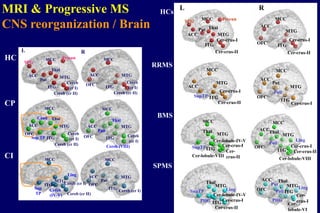
    HC R ACC MCC OFC MTG ITG Cereb (cr I) Cereb (crII) L ACC SFG PrecunMCC ITG MTG Cereb (cr I) Cereb (cr II) Thal Put CP ACC MCC OFC ITG MTG Cereb (cr I) Cereb (VIII) Thal Pall ACC MCC OFC MTG ITGSup TP Cereb (cr I) Cereb (cr II) ThalCaud CI ACC MCC OFC ITG MTG Cereb (cr I) Put MCC ITG MTG Ling Cereb (cr II) Cereb (cr I) Cereb (IV-V) Sup TP ACC PrecunMCC MTG SFG Put ITG Thal Cer-crus-II Cer-crus-I MTG MCC ITG ACC OFC Cer-crus-II Cer-crus-I MTG MCC ACC ITGSupTP Cer-crus-I Cer-crus-II BMS ITG MTG MCC SupTP Thal Cer- crus-II Cer-crus-I Cer-lobule-VIII Cer-lobule-IV-V ITG MTG LingSupTP PHG Thal Cer-crus-II Cer-crus-I Cer-lobule-IV-V HCs SPMS RRMS BMS ACC MCC MTG ITG Pall OFC Put Cer-crus-I ACC Pall Put Thal ITG PHG LingMTG OFC Cer- lobule-VI Cer- crus-I MCC ACC OFC ITG MTG Ling Pall Thal Cer-crus-I Cer-crus-II Cer-lobule-VIII RLMRI & Progressive MS CNS reorganization / Brain
  • 28.
    Tactile stimulation ofthe palm of the R hand Progressive MS vs controls: p=0.003 SPMS vs PPMS: p=0.05 Cordaveragesignalchange(%) Controls SPMS PPMS Valsasina et al., Hum Brain Mapp 2011 MRI & Progressive MS CNS reorganization / Spinal cord Valsasina et al., JNNP 2010 Controls RRMS SPMS 3.9 %  1.3 %3. 3 %  1.1 % 2.7 %  0.7 % Task-relatedaveragesignalchange[%] 0.0 0.5 1.0 1.5 2.0 2.5 3.0 3.5 4.0 4.5 5.0 p=0.05 vs controls p=0.02 vs controls Cord fMRI vs fatigue Rocca et al., Mult Scler 2012
  • 29.
    MRI & ProgressiveMS Outline of presentation • T2 lesions: brain, spinal cord • Atrophy • WM damage: extent, topography • GM damage: cortical lesions, diffuse and regional damage • Spinal cord damage • CNS reorganization (brain, spinal cord) • Conclusions
  • 30.
    MRI & ProgressiveMS Conclusions Modality Gd+ lesions Focal lesions Whole-brain atrophy NAWM damage GM damage Spinal cord damage Functional changes Potential clinical value - + ++ ++ +++ +++ ++ Feasibility +++ +++ +++ ++ ++ ++ +
  • 31.
    RIS RRMS SPMS/PPMSCISTime Severity T2 lesions Atrophy Functional changes NAWM damage Cord damage GM damage Gd+ lesions MRI in SPMS Theoretical background
  • 32.
    Neuroimaging Research Unit& WM diseases group Director: M. Filippi DIVISION OF NEUROSCIENCE INSTITUTE OF EXPERIMENTAL NEUROLOGY Scientific coordinator: M.A. Rocca Department of Neurology G. Comi, B. Colombo, M. Comola, F. Esposito, V. Martinelli, F. Martinelli Boneschi, L. Moiola, G. Pavan, M. Rodegher Department of Neuroradiology A. Falini MAGNIMS Physicians: M. Absinta A. Bisecco G. Boffa S. Cirillo E. De Meo G. Longoni F. Mele R. Messina M.E. Morelli L. Parisi P. Preziosa G. Riccitelli Physicists: M. Copetti E. Pagani P. Valsasina Technicians: L. Dall’Occhio A. Meani P. Misci M. Petrolini S. Sala M. Sibilia R. Vuotto University of Belgrade V.S. Kostic, J. Drulovic, S. Mesaros Gallarate Hospital, MS Centre A. Ghezzi