SPEAKER
P.RAMESH
Ph.D. SCHOLAR
(ABC)
Biotechnology term was coined by “Karl Ereky” in 1919
“Any technological application that uses biological
systems, living organisms, or derivatives thereof, to

make or modify products or processes for specific use”
(United Nation Convention on Biological
Diversity)
Applications:
It has applications in four major Industrial areas
Health Care (Medicine)
Crop Production

Food/Dairy production and
Other Products
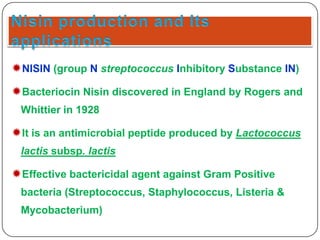
NISIN (group N streptococcus Inhibitory Substance IN)

Bacteriocin Nisin discovered in England by Rogers and
Whittier in 1928

It is an antimicrobial peptide produced by Lactococcus
lactis subsp. lactis

Effective bactericidal agent against Gram Positive
bacteria (Streptococcus, Staphylococcus, Listeria &
Mycobacterium)
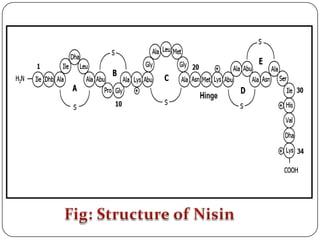
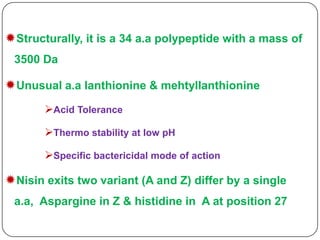
Structurally, it is a 34 a.a polypeptide with a mass of
3500 Da

Unusual a.a lanthionine & mehtyllanthionine
Acid Tolerance
Thermo stability at low pH
Specific bactericidal mode of action

Nisin exits two variant (A and Z) differ by a single
a.a, Aspargine in Z & histidine in A at position 27
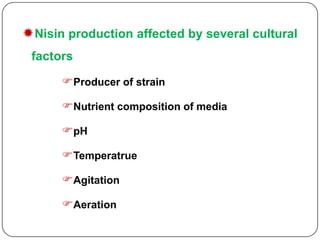
Nisin production affected by several cultural
factors
Producer of strain

Nutrient composition of media
pH

Temperatrue
Agitation
Aeration
A dramatic decrease in nisin level after reaching a peak
value

Solubility, stability & biological activity of nisin
dependent on pH of solution

At pH6.0 for high adsorption onto cell & pH 2.0 for
maximum release from cells

In fermentation process, at pH6.0 more than 80% nisin
released into medium, pH6.0 it is associated with
cellular membrane
It is an effective bactericidal agent against Grampositive bacteria & but not Gram-negative bacteria,
fungi & virus

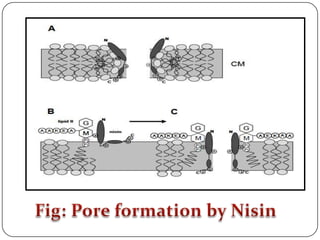
Nisin forms pores that disrupt proton motive force
& causing leakage of ions & hydrolysis of ATP
results in cell death

It also interferes with cell synthesis to bind Lipid II
It is manufactured via fermentation of fluid milk or
whey by strains of Lactococcus lactis subsp. Lactis

Resulting broth is subsequently concentrated &
separated, spray dried & milled to yield small
particles

Optimal nisin production usually requires complex
media & well controlled parameters

Commercial media is mostly recommended
Recommended media contains surplus of proteins
(Tryptone, Peptone, Meat extract, Yeast extract)

Search for cheaper formulation are attractive for
Nisin production such as: Whey, Sugar molasses &
mussel-processing wastes

(Deegam, et al., 2006)
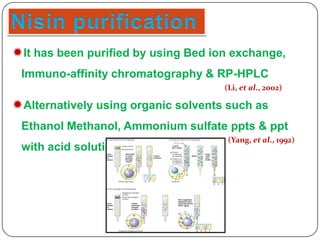
It has been purified by using Bed ion exchange,
Immuno-affinity chromatography & RP-HPLC
(Li, et al., 2002)

Alternatively using organic solvents such as
Ethanol Methanol, Ammonium sulfate ppts & ppt
with acid solution pH2.0

(Yang, et al., 1992)
Now-a-days consumers prefers foods of high
quality, without chemical preservatives, safe &
long shelf life
(Kheadr, et al.,
Several bacteriocins from LAB, used as food 2007)

preservatives is still very limited

Pediocin is a anti-listerial activity & but they are
not currently approved as antimicrobial food
additives

(Devlieghere, et al., 2004)

But only NISIN is approved for food applications
Bacteriocin (Nisin) was first marketed in England
in 1953

It has been approved by FAO/WHO in 1969
Nisin as a food additive for processed cheese at
conc.12.5mg/kg of product

It also used in preservation of Dairy products,
Canned foods

(Ross, et al., 2002)
Nisin is relatively amphipatic because of inclusion of
hydrophobic residues

(Taylor, et al., 2007)

Its can’t be used as a Meat Preservation
Certain food additives (Sodium metabisulphite &
Titanium dioxide) have been shown to be antagonist to

nisin

(Delves.B, et al., 1996)

Liposome encapsulation of nisin & microparticles of
Calcium alginate
(Won, et al., 1997)
Liposome encapsulated Nisin were used in
(Colas et
Nutraceuticals, Cosmetics & Pharmaceuticals al., 2007)

Potential use of Therapeutic purposes in treatment of
Atopic Dermatitis, Stomach ulcers & Colon infections
(Dubois et al., 2003

It also control respiratory tract infections
Future development of a potent Vaginal Contraceptive
for humans

(Aranha et al., 2004)
Nisin Biotechnological production and Applications

Nisin Biotechnological production and Applications

  • 1.
  • 2.
    Biotechnology term wascoined by “Karl Ereky” in 1919 “Any technological application that uses biological systems, living organisms, or derivatives thereof, to make or modify products or processes for specific use” (United Nation Convention on Biological Diversity)
  • 3.
    Applications: It has applicationsin four major Industrial areas Health Care (Medicine) Crop Production Food/Dairy production and Other Products
  • 4.
    NISIN (group Nstreptococcus Inhibitory Substance IN) Bacteriocin Nisin discovered in England by Rogers and Whittier in 1928 It is an antimicrobial peptide produced by Lactococcus lactis subsp. lactis Effective bactericidal agent against Gram Positive bacteria (Streptococcus, Staphylococcus, Listeria & Mycobacterium)
  • 6.
    Structurally, it isa 34 a.a polypeptide with a mass of 3500 Da Unusual a.a lanthionine & mehtyllanthionine Acid Tolerance Thermo stability at low pH Specific bactericidal mode of action Nisin exits two variant (A and Z) differ by a single a.a, Aspargine in Z & histidine in A at position 27
  • 7.
    Nisin production affectedby several cultural factors Producer of strain Nutrient composition of media pH Temperatrue Agitation Aeration
  • 8.
    A dramatic decreasein nisin level after reaching a peak value Solubility, stability & biological activity of nisin dependent on pH of solution At pH6.0 for high adsorption onto cell & pH 2.0 for maximum release from cells In fermentation process, at pH6.0 more than 80% nisin released into medium, pH6.0 it is associated with cellular membrane
  • 9.
    It is aneffective bactericidal agent against Grampositive bacteria & but not Gram-negative bacteria, fungi & virus Nisin forms pores that disrupt proton motive force & causing leakage of ions & hydrolysis of ATP results in cell death It also interferes with cell synthesis to bind Lipid II
  • 11.
    It is manufacturedvia fermentation of fluid milk or whey by strains of Lactococcus lactis subsp. Lactis Resulting broth is subsequently concentrated & separated, spray dried & milled to yield small particles Optimal nisin production usually requires complex media & well controlled parameters Commercial media is mostly recommended
  • 12.
    Recommended media containssurplus of proteins (Tryptone, Peptone, Meat extract, Yeast extract) Search for cheaper formulation are attractive for Nisin production such as: Whey, Sugar molasses & mussel-processing wastes (Deegam, et al., 2006)
  • 13.
    It has beenpurified by using Bed ion exchange, Immuno-affinity chromatography & RP-HPLC (Li, et al., 2002) Alternatively using organic solvents such as Ethanol Methanol, Ammonium sulfate ppts & ppt with acid solution pH2.0 (Yang, et al., 1992)
  • 14.
    Now-a-days consumers prefersfoods of high quality, without chemical preservatives, safe & long shelf life (Kheadr, et al., Several bacteriocins from LAB, used as food 2007) preservatives is still very limited Pediocin is a anti-listerial activity & but they are not currently approved as antimicrobial food additives (Devlieghere, et al., 2004) But only NISIN is approved for food applications
  • 15.
    Bacteriocin (Nisin) wasfirst marketed in England in 1953 It has been approved by FAO/WHO in 1969 Nisin as a food additive for processed cheese at conc.12.5mg/kg of product It also used in preservation of Dairy products, Canned foods (Ross, et al., 2002)
  • 16.
    Nisin is relativelyamphipatic because of inclusion of hydrophobic residues (Taylor, et al., 2007) Its can’t be used as a Meat Preservation Certain food additives (Sodium metabisulphite & Titanium dioxide) have been shown to be antagonist to nisin (Delves.B, et al., 1996) Liposome encapsulation of nisin & microparticles of Calcium alginate (Won, et al., 1997)
  • 17.
    Liposome encapsulated Nisinwere used in (Colas et Nutraceuticals, Cosmetics & Pharmaceuticals al., 2007) Potential use of Therapeutic purposes in treatment of Atopic Dermatitis, Stomach ulcers & Colon infections (Dubois et al., 2003 It also control respiratory tract infections Future development of a potent Vaginal Contraceptive for humans (Aranha et al., 2004)

Editor's Notes

  • #7 Synthesis ofnsin at log pase, nisinZ is higher solubility &diffusion characteristics
  • #8 Synthesis ofnsin at log pase, nisinZ is higher solubility &diffusion characteristics
  • #9 Synthesis ofnsin at log pase, nisinZ is higher solubility &diffusion characteristics
  • #10 Synthesis ofnsin at log pase, nisinZ is higher solubility &diffusion characteristics
  • #12 Synthesis ofnsin at log pase, nisinZ is higher solubility &diffusion characteristics2.5% pure form of nisin cost is us dollar 770 get 25g
  • #13 Synthesis ofnsin at log pase, nisinZ is higher solubility &diffusion characteristics
  • #14 Synthesis ofnsin at log pase, nisinZ is higher solubility &diffusion characteristics
  • #15 Synthesis ofnsin at log pase, nisinZ is higher solubility &diffusion characteristics
  • #16 Synthesis ofnsin at log pase, nisinZ is higher solubility &diffusion characteristics
  • #17 Synthesis ofnsin at log pase, nisinZ is higher solubility &diffusion characteristics