Computer Organization
& Architecture
Lecture 24
CISC and RISC
Introduction to Vector Processing
Array Processing
SIMD Array Processors
By the end of the session, we will be able to:
▪ Differentiate between RISC and CISC in computer
architectures
▪ Analyze how RISC and CISC affect CPU
performance
▪ Explain the role of multicore processors in Intel
and AMD CPUs
Session Objectives
RISC and CISC
CPU Performance
Multicore Processor: Intel, AMD
“
When it comes to computer architecture, two major
categories dominate the landscape: Reduced
Instruction Set Architecture (RISC) and Complex
Instruction Set Architecture (CISC).
▪ The core concept behind RISC is to simplify hardware by
employing an instruction set comprising a few basic
operations for loading, evaluating, and storing data.
▪ For instance, a load command is used for data loading,
and a store command is used for data storage.
▪ Characteristics of RISC
○ Simpler instructions, resulting in straightforward
instruction decoding.
○ Instructions typically fit within a single word in size.
○ Execution of each instruction takes just one clock
cycle.
○ Incorporates more general-purpose registers.
○ Utilizes simple addressing modes.
○ Supports fewer data types.
○ Facilitates pipelining for improved performance.
Reduced Instruction Set Architecture (RISC)
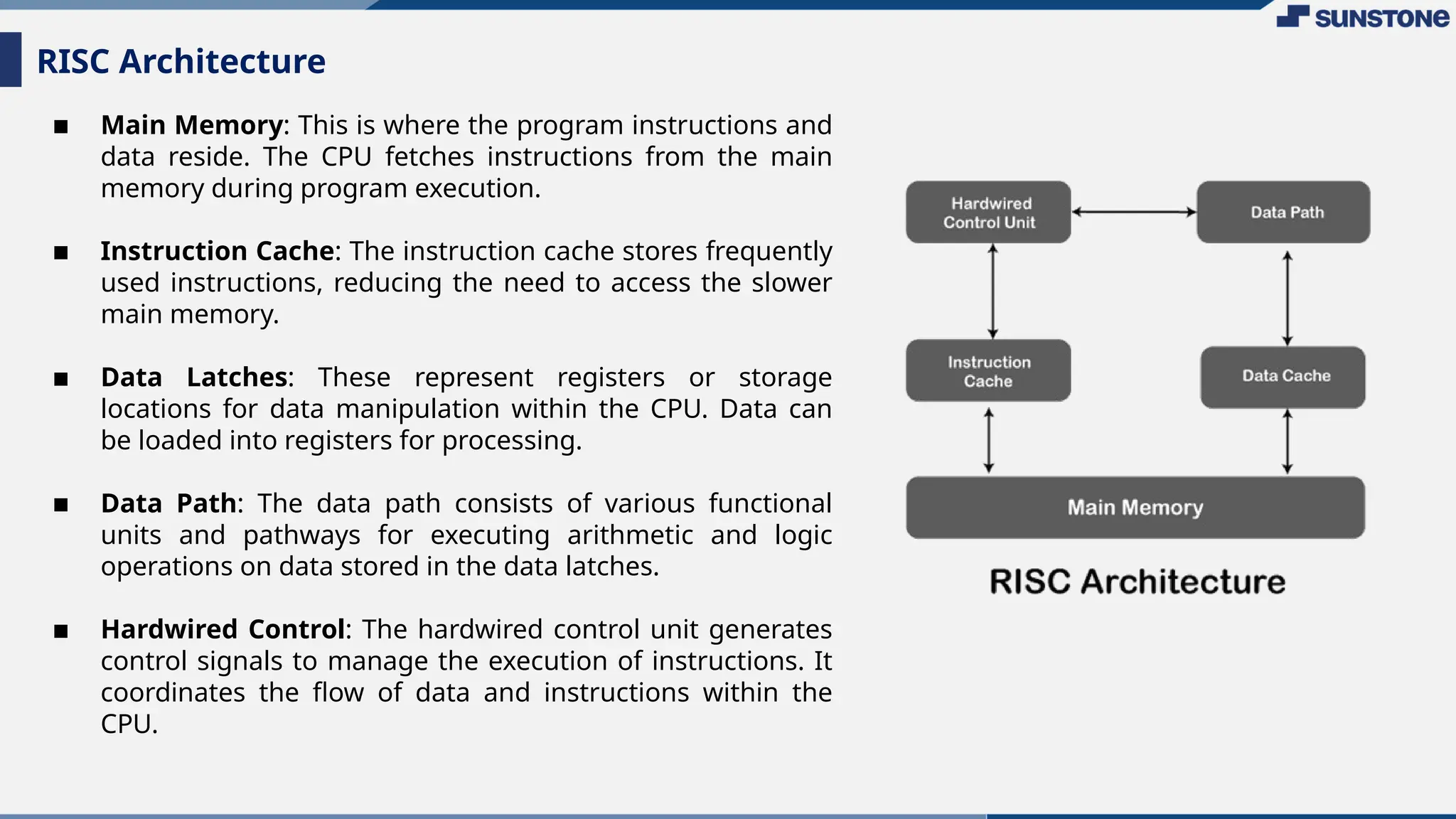
▪ Main Memory: This is where the program instructions and
data reside. The CPU fetches instructions from the main
memory during program execution.
▪ Instruction Cache: The instruction cache stores frequently
used instructions, reducing the need to access the slower
main memory.
▪ Data Latches: These represent registers or storage
locations for data manipulation within the CPU. Data can
be loaded into registers for processing.
▪ Data Path: The data path consists of various functional
units and pathways for executing arithmetic and logic
operations on data stored in the data latches.
▪ Hardwired Control: The hardwired control unit generates
control signals to manage the execution of instructions. It
coordinates the flow of data and instructions within the
CPU.
RISC Architecture
▪ Advantages of RISC
○ Simplicity: RISC processors employ a compact set of
basic instructions, making them easier to decode and
execute quickly.
○ Speed: The streamlined instruction set allows RISC
processors to execute instructions faster than their CISC
counterparts.
○ Lower Power Consumption: RISC processors are known
for their lower power consumption.
▪ Disadvantages of RISC
○ More Instructions Required: Complex tasks demand
more instructions on RISC processors compared to CISC
processors.
○ Increased Memory Usage: Accommodating the
additional instructions for complex tasks requires more
memory.
○ Higher Manufacturing Costs: Developing and
manufacturing RISC processors can be costlier than CISC
processors.
Reduced Instruction Set Architecture (RISC)
▪ CISC, in contrast, is characterized by a single instruction
that performs a multitude of functions, encompassing
data loading, evaluation, and storage.
▪ For instance, a single multiplication command can load,
evaluate, and store data, making it complex by design.
▪ Characteristics of CISC
○ Complex instructions that require intricate
instruction decoding.
○ Instructions are often larger than one word in
size.
○ Some instructions may take more than one clock
cycle to execute.
○ Fewer general-purpose registers, as many
operations are performed in memory.
○ Complex addressing modes.
○ Support for a wide range of data types.
Complex Instruction Set Architecture (CISC)
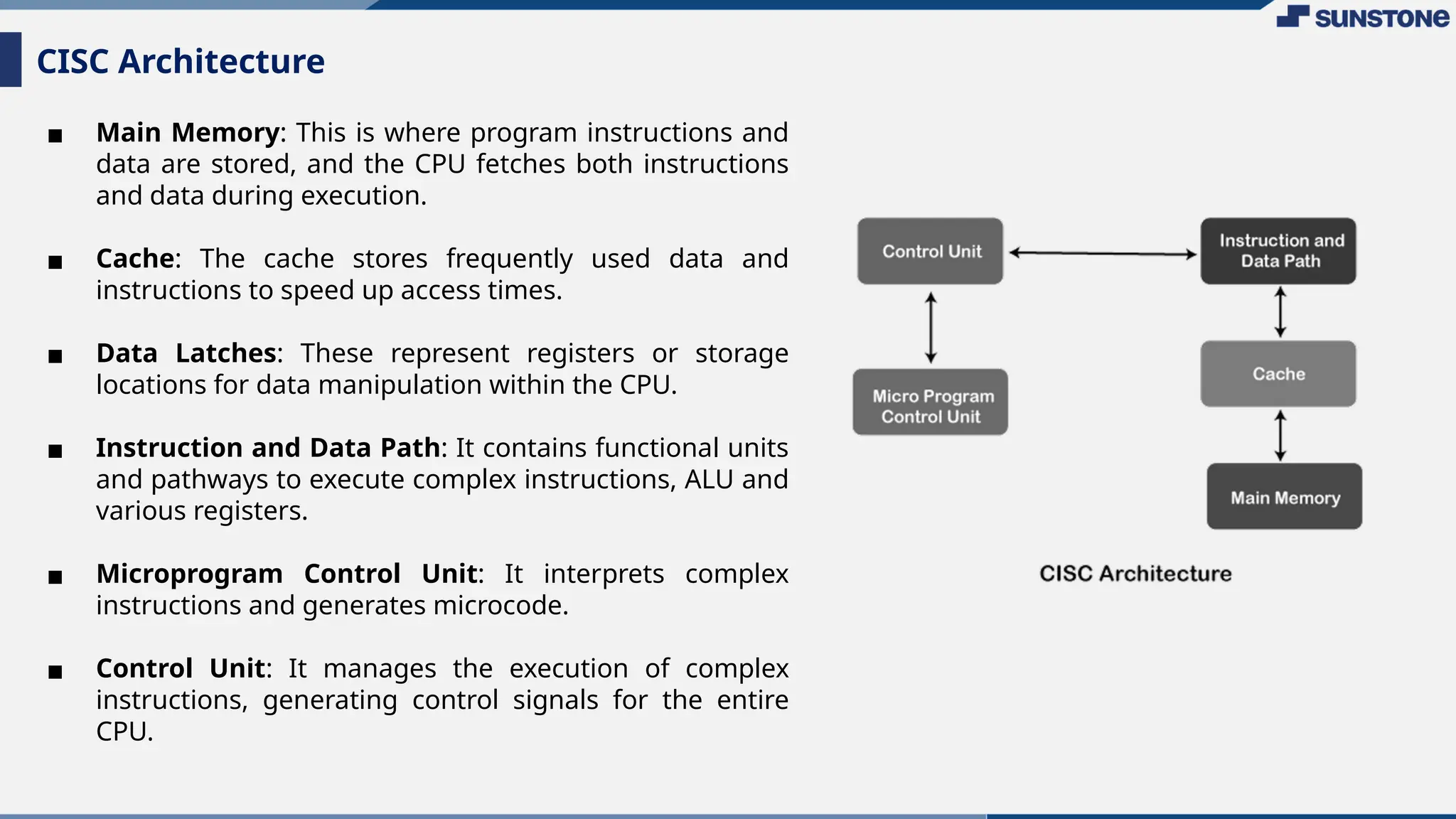
▪ Main Memory: This is where program instructions and
data are stored, and the CPU fetches both instructions
and data during execution.
▪ Cache: The cache stores frequently used data and
instructions to speed up access times.
▪ Data Latches: These represent registers or storage
locations for data manipulation within the CPU.
▪ Instruction and Data Path: It contains functional units
and pathways to execute complex instructions, ALU and
various registers.
▪ Microprogram Control Unit: It interprets complex
instructions and generates microcode.
▪ Control Unit: It manages the execution of complex
instructions, generating control signals for the entire
CPU.
CISC Architecture
■ Advantages of CISC
○ Reduced Code Size: CISC processors utilize
complex instructions that can execute multiple
operations, leading to a reduction in the amount
of code required to accomplish tasks.
○ Improved Memory Efficiency: CISC instructions
are more memory-efficient when handling
complex tasks.
○ Wide Usage and Software Availability: CISC
processors have been in use for an extended
period, resulting in a larger user base and a
wealth of available software.
■ Disadvantages of CISC
○ Slower Execution: The complexity of CISC
instructions leads to longer execution times,
primarily due to increased decoding
requirements.
○ More Complex Design: The intricacy of CISC
instruction sets makes designing and
manufacturing CISC processors more challenging.
○ Higher Power Consumption: CISC processors
Complex Instruction Set Architecture (CISC)
Lecture 24 Activity 1
Time for an activity.
RISC and CISC
CPU Performance
Multicore Processor: Intel, AMD
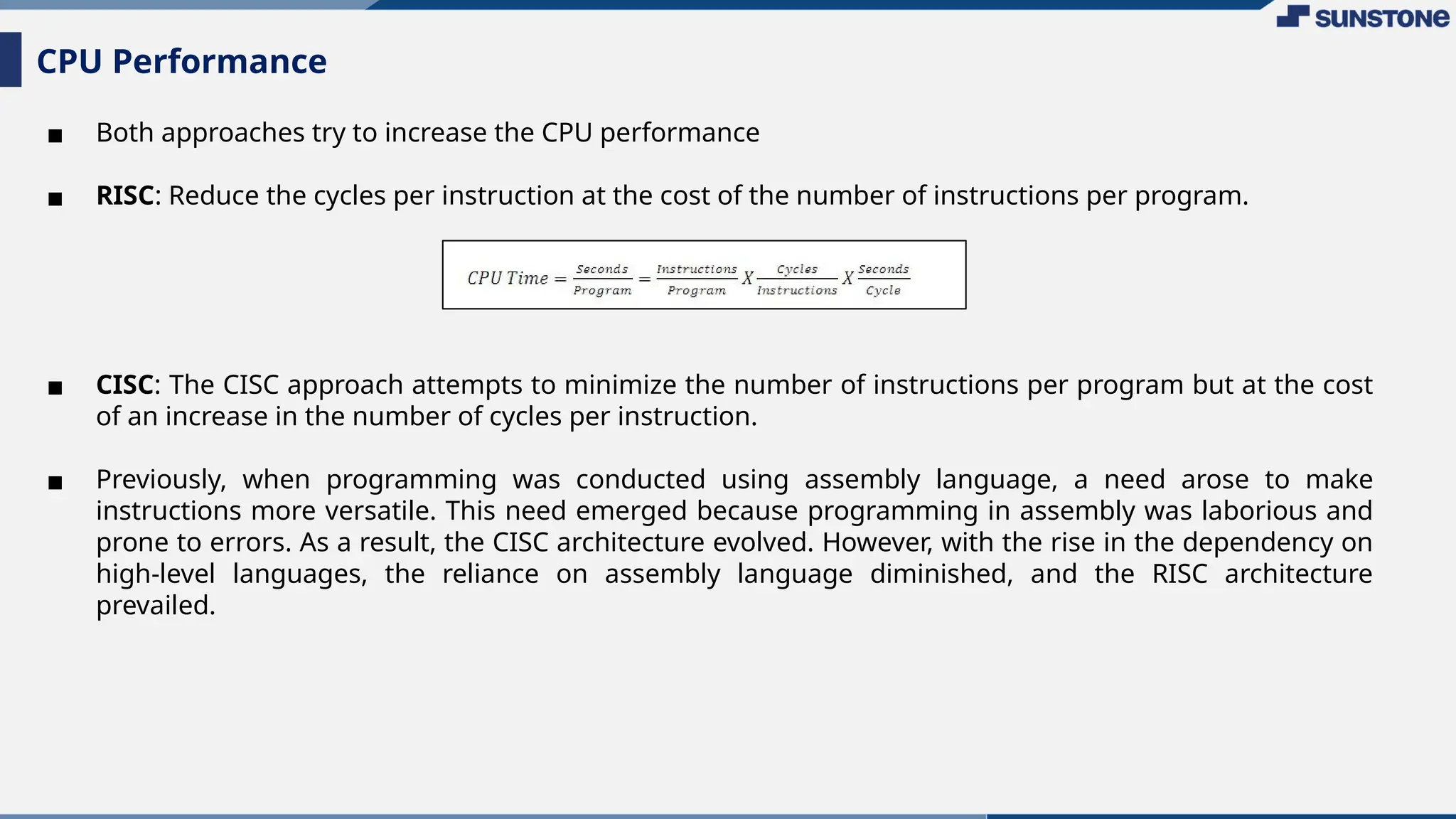
▪ Both approaches try to increase the CPU performance
▪ RISC: Reduce the cycles per instruction at the cost of the number of instructions per program.
▪ CISC: The CISC approach attempts to minimize the number of instructions per program but at the cost
of an increase in the number of cycles per instruction.
▪ Previously, when programming was conducted using assembly language, a need arose to make
instructions more versatile. This need emerged because programming in assembly was laborious and
prone to errors. As a result, the CISC architecture evolved. However, with the rise in the dependency on
high-level languages, the reliance on assembly language diminished, and the RISC architecture
prevailed.
CPU Performance
■ Example:
■ Let's consider the task of adding two 8-bit numbers:
■ CISC approach
○ In this approach, a single command or
instruction, such as 'ADD,' is used to perform
the task.
■ RISC approach
○ In the RISC approach, the programmer writes a
sequence of instructions. First, they load the
data into registers, then they apply the suitable
operator, and finally, they store the result in the
desired location.
○ This division of the 'add' operation into distinct
parts—load, operate, and store—results in RISC
programs that are longer and require more
memory for storage. However, they require
fewer transistors due to the use of less complex
commands.
CPU Performance
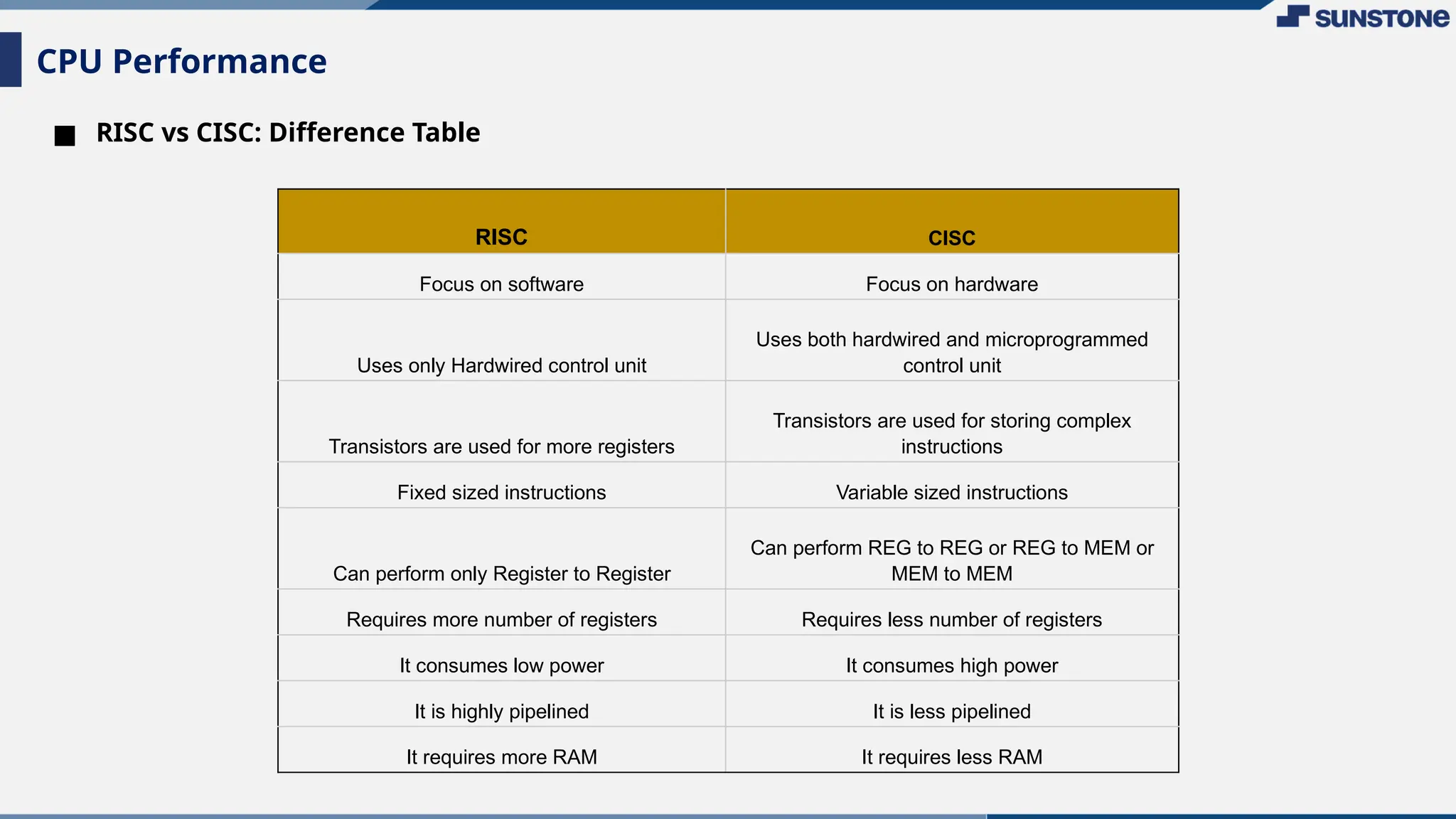
■ RISC vs CISC: Difference Table
CPU Performance
RISC CISC
Focus on software Focus on hardware
Uses only Hardwired control unit
Uses both hardwired and microprogrammed
control unit
Transistors are used for more registers
Transistors are used for storing complex
instructions
Fixed sized instructions Variable sized instructions
Can perform only Register to Register
Can perform REG to REG or REG to MEM or
MEM to MEM
Requires more number of registers Requires less number of registers
It consumes low power It consumes high power
It is highly pipelined It is less pipelined
It requires more RAM It requires less RAM
Introduction to Vector Processing
CPU Performance
Multicore Processor: Intel, AMD
“
Multicore processors are used in a wide range of
computing devices, from desktop and laptop
computers to servers and mobile devices.
“
By having multiple cores on a single chip, multicore
processors can significantly enhance performance,
reduce power consumption, and improve multitasking
capabilities compared to single-core processors.
■ Intel
○ Intel Corporation, headquartered in Santa
Clara, California, is one of the world's leading
semiconductor manufacturers. They are
renowned for producing a wide range of
processors for various computing platforms,
including desktops, laptops, servers, and data
centers. Intel's processors, such as the Core
series for consumers and Xeon for servers,
have been popular choices in the computing
industry.
■ AMD
○ Advanced Micro Devices (AMD), headquartered
in Santa Clara, California, is another prominent
semiconductor manufacturer known for
producing processors and other computing
hardware. AMD is a direct competitor to Intel
and has gained popularity for its Ryzen series
of processors, which are known for offering
competitive performance and value.
Multicore Processor: Intel, AMD
■ Focus on Software vs Focus on Hardware
○ Intel: Intel designs its processors with an
emphasis on optimizing hardware components
to achieve high performance.
○ Intel processors can efficiently run a wide
range of software, but their designs prioritize
hardware efficiency.
○ AMD: AMD processors are designed to provide
competitive performance with an emphasis on
software compatibility.
○ This approach ensures that AMD processors
can work seamlessly with a variety of software
applications.
Multicore Processor: Intel, AMD
■ Control Unit Type
○ Intel: Intel processors predominantly use
hardwired control units. Hardwired control
units are known for their efficiency and speed
in executing instructions.
○ They are a key component of the processor
responsible for managing the execution of
instructions.
○ AMD: AMD processors may use both
hardwired and microprogrammed control
units.
○ Microprogramming allows for more flexibility
in handling complex instructions and can aid in
improving software compatibility.
Multicore Processor: Intel, AMD
■ Transistors Usage
○ Intel: Intel processors may use transistors
primarily for implementing a larger number of
registers.
○ More registers can enhance the processor's
ability to store and manipulate data efficiently.
○ AMD: AMD processors may use transistors for
more complex instructions.
○ This can help in executing a wider range of
instructions efficiently, which can be
advantageous in certain software scenarios.
Multicore Processor: Intel, AMD
▪ Clock Cycle and Instruction Execution
○ Intel: Intel processors are designed to execute
many instructions in a single clock cycle.
○ AMD: AMD processors may require more than
one clock cycle to execute an instruction.
▪ Addressing Modes
○ Intel: Intel processors often provide a simpler
and more limited set of addressing modes.
○ AMD: AMD processors may support a more
complex and varied set of addressing modes.
These modes can provide greater flexibility for
software developers.
Multicore Processor: Intel, AMD
▪ Pipelining
○ Intel: Intel processors are often highly
pipelined. Pipelining is a technique that allows
for the concurrent execution of multiple
instructions, improving overall processing
speed.
○ AMD: AMD processors may have less
aggressive pipelining, which can affect their
processing efficiency.
▪ RAM Requirements
○ Intel: Intel processors may require more RAM
for optimal performance.
○ AMD: AMD processors typically require less
RAM, making them suitable for systems with
limited memory capacity.
Multicore Processor: Intel, AMD
▪ Real-Life Applications of Intel Multicore
Processors
○ Business and Office Productivity
○ High-Performance Laptops
○ High-Performance Servers
○ Real-Time Financial Trading
○ High-End Gaming Desktops
▪ Real-Life Applications of AMD Multicore
Processors
○ Consumer-Level Desktops
○ Mid-Range Laptops
○ Home Theater PCs (HTPCs)
○ HPC and Scientific Computing
○ Affordable Gaming PCs
○ Embedded Systems and IoT
Multicore Processor: Intel, AMD

Lecture 24 Activity 2
Time for an activity.
Introduction to Vector Processing
CPU Performance
Multicore Processor - Intel, AMD
Lecture++24+-+CISC+and+RISC-1699602012829.pptx

Lecture++24+-+CISC+and+RISC-1699602012829.pptx

  • 1.
  • 2.
    Introduction to VectorProcessing Array Processing SIMD Array Processors
  • 3.
    By the endof the session, we will be able to: ▪ Differentiate between RISC and CISC in computer architectures ▪ Analyze how RISC and CISC affect CPU performance ▪ Explain the role of multicore processors in Intel and AMD CPUs Session Objectives
  • 4.
    RISC and CISC CPUPerformance Multicore Processor: Intel, AMD
  • 5.
    “ When it comesto computer architecture, two major categories dominate the landscape: Reduced Instruction Set Architecture (RISC) and Complex Instruction Set Architecture (CISC).
  • 6.
    ▪ The coreconcept behind RISC is to simplify hardware by employing an instruction set comprising a few basic operations for loading, evaluating, and storing data. ▪ For instance, a load command is used for data loading, and a store command is used for data storage. ▪ Characteristics of RISC ○ Simpler instructions, resulting in straightforward instruction decoding. ○ Instructions typically fit within a single word in size. ○ Execution of each instruction takes just one clock cycle. ○ Incorporates more general-purpose registers. ○ Utilizes simple addressing modes. ○ Supports fewer data types. ○ Facilitates pipelining for improved performance. Reduced Instruction Set Architecture (RISC)
  • 7.
    ▪ Main Memory:This is where the program instructions and data reside. The CPU fetches instructions from the main memory during program execution. ▪ Instruction Cache: The instruction cache stores frequently used instructions, reducing the need to access the slower main memory. ▪ Data Latches: These represent registers or storage locations for data manipulation within the CPU. Data can be loaded into registers for processing. ▪ Data Path: The data path consists of various functional units and pathways for executing arithmetic and logic operations on data stored in the data latches. ▪ Hardwired Control: The hardwired control unit generates control signals to manage the execution of instructions. It coordinates the flow of data and instructions within the CPU. RISC Architecture
  • 8.
    ▪ Advantages ofRISC ○ Simplicity: RISC processors employ a compact set of basic instructions, making them easier to decode and execute quickly. ○ Speed: The streamlined instruction set allows RISC processors to execute instructions faster than their CISC counterparts. ○ Lower Power Consumption: RISC processors are known for their lower power consumption. ▪ Disadvantages of RISC ○ More Instructions Required: Complex tasks demand more instructions on RISC processors compared to CISC processors. ○ Increased Memory Usage: Accommodating the additional instructions for complex tasks requires more memory. ○ Higher Manufacturing Costs: Developing and manufacturing RISC processors can be costlier than CISC processors. Reduced Instruction Set Architecture (RISC)
  • 9.
    ▪ CISC, incontrast, is characterized by a single instruction that performs a multitude of functions, encompassing data loading, evaluation, and storage. ▪ For instance, a single multiplication command can load, evaluate, and store data, making it complex by design. ▪ Characteristics of CISC ○ Complex instructions that require intricate instruction decoding. ○ Instructions are often larger than one word in size. ○ Some instructions may take more than one clock cycle to execute. ○ Fewer general-purpose registers, as many operations are performed in memory. ○ Complex addressing modes. ○ Support for a wide range of data types. Complex Instruction Set Architecture (CISC)
  • 10.
    ▪ Main Memory:This is where program instructions and data are stored, and the CPU fetches both instructions and data during execution. ▪ Cache: The cache stores frequently used data and instructions to speed up access times. ▪ Data Latches: These represent registers or storage locations for data manipulation within the CPU. ▪ Instruction and Data Path: It contains functional units and pathways to execute complex instructions, ALU and various registers. ▪ Microprogram Control Unit: It interprets complex instructions and generates microcode. ▪ Control Unit: It manages the execution of complex instructions, generating control signals for the entire CPU. CISC Architecture
  • 11.
    ■ Advantages ofCISC ○ Reduced Code Size: CISC processors utilize complex instructions that can execute multiple operations, leading to a reduction in the amount of code required to accomplish tasks. ○ Improved Memory Efficiency: CISC instructions are more memory-efficient when handling complex tasks. ○ Wide Usage and Software Availability: CISC processors have been in use for an extended period, resulting in a larger user base and a wealth of available software. ■ Disadvantages of CISC ○ Slower Execution: The complexity of CISC instructions leads to longer execution times, primarily due to increased decoding requirements. ○ More Complex Design: The intricacy of CISC instruction sets makes designing and manufacturing CISC processors more challenging. ○ Higher Power Consumption: CISC processors Complex Instruction Set Architecture (CISC)
  • 12.
    Lecture 24 Activity1 Time for an activity.
  • 13.
    RISC and CISC CPUPerformance Multicore Processor: Intel, AMD
  • 14.
    ▪ Both approachestry to increase the CPU performance ▪ RISC: Reduce the cycles per instruction at the cost of the number of instructions per program. ▪ CISC: The CISC approach attempts to minimize the number of instructions per program but at the cost of an increase in the number of cycles per instruction. ▪ Previously, when programming was conducted using assembly language, a need arose to make instructions more versatile. This need emerged because programming in assembly was laborious and prone to errors. As a result, the CISC architecture evolved. However, with the rise in the dependency on high-level languages, the reliance on assembly language diminished, and the RISC architecture prevailed. CPU Performance
  • 15.
    ■ Example: ■ Let'sconsider the task of adding two 8-bit numbers: ■ CISC approach ○ In this approach, a single command or instruction, such as 'ADD,' is used to perform the task. ■ RISC approach ○ In the RISC approach, the programmer writes a sequence of instructions. First, they load the data into registers, then they apply the suitable operator, and finally, they store the result in the desired location. ○ This division of the 'add' operation into distinct parts—load, operate, and store—results in RISC programs that are longer and require more memory for storage. However, they require fewer transistors due to the use of less complex commands. CPU Performance
  • 16.
    ■ RISC vsCISC: Difference Table CPU Performance RISC CISC Focus on software Focus on hardware Uses only Hardwired control unit Uses both hardwired and microprogrammed control unit Transistors are used for more registers Transistors are used for storing complex instructions Fixed sized instructions Variable sized instructions Can perform only Register to Register Can perform REG to REG or REG to MEM or MEM to MEM Requires more number of registers Requires less number of registers It consumes low power It consumes high power It is highly pipelined It is less pipelined It requires more RAM It requires less RAM
  • 17.
    Introduction to VectorProcessing CPU Performance Multicore Processor: Intel, AMD
  • 18.
    “ Multicore processors areused in a wide range of computing devices, from desktop and laptop computers to servers and mobile devices.
  • 19.
    “ By having multiplecores on a single chip, multicore processors can significantly enhance performance, reduce power consumption, and improve multitasking capabilities compared to single-core processors.
  • 20.
    ■ Intel ○ IntelCorporation, headquartered in Santa Clara, California, is one of the world's leading semiconductor manufacturers. They are renowned for producing a wide range of processors for various computing platforms, including desktops, laptops, servers, and data centers. Intel's processors, such as the Core series for consumers and Xeon for servers, have been popular choices in the computing industry. ■ AMD ○ Advanced Micro Devices (AMD), headquartered in Santa Clara, California, is another prominent semiconductor manufacturer known for producing processors and other computing hardware. AMD is a direct competitor to Intel and has gained popularity for its Ryzen series of processors, which are known for offering competitive performance and value. Multicore Processor: Intel, AMD
  • 21.
    ■ Focus onSoftware vs Focus on Hardware ○ Intel: Intel designs its processors with an emphasis on optimizing hardware components to achieve high performance. ○ Intel processors can efficiently run a wide range of software, but their designs prioritize hardware efficiency. ○ AMD: AMD processors are designed to provide competitive performance with an emphasis on software compatibility. ○ This approach ensures that AMD processors can work seamlessly with a variety of software applications. Multicore Processor: Intel, AMD
  • 22.
    ■ Control UnitType ○ Intel: Intel processors predominantly use hardwired control units. Hardwired control units are known for their efficiency and speed in executing instructions. ○ They are a key component of the processor responsible for managing the execution of instructions. ○ AMD: AMD processors may use both hardwired and microprogrammed control units. ○ Microprogramming allows for more flexibility in handling complex instructions and can aid in improving software compatibility. Multicore Processor: Intel, AMD
  • 23.
    ■ Transistors Usage ○Intel: Intel processors may use transistors primarily for implementing a larger number of registers. ○ More registers can enhance the processor's ability to store and manipulate data efficiently. ○ AMD: AMD processors may use transistors for more complex instructions. ○ This can help in executing a wider range of instructions efficiently, which can be advantageous in certain software scenarios. Multicore Processor: Intel, AMD
  • 24.
    ▪ Clock Cycleand Instruction Execution ○ Intel: Intel processors are designed to execute many instructions in a single clock cycle. ○ AMD: AMD processors may require more than one clock cycle to execute an instruction. ▪ Addressing Modes ○ Intel: Intel processors often provide a simpler and more limited set of addressing modes. ○ AMD: AMD processors may support a more complex and varied set of addressing modes. These modes can provide greater flexibility for software developers. Multicore Processor: Intel, AMD
  • 25.
    ▪ Pipelining ○ Intel:Intel processors are often highly pipelined. Pipelining is a technique that allows for the concurrent execution of multiple instructions, improving overall processing speed. ○ AMD: AMD processors may have less aggressive pipelining, which can affect their processing efficiency. ▪ RAM Requirements ○ Intel: Intel processors may require more RAM for optimal performance. ○ AMD: AMD processors typically require less RAM, making them suitable for systems with limited memory capacity. Multicore Processor: Intel, AMD
  • 26.
    ▪ Real-Life Applicationsof Intel Multicore Processors ○ Business and Office Productivity ○ High-Performance Laptops ○ High-Performance Servers ○ Real-Time Financial Trading ○ High-End Gaming Desktops ▪ Real-Life Applications of AMD Multicore Processors ○ Consumer-Level Desktops ○ Mid-Range Laptops ○ Home Theater PCs (HTPCs) ○ HPC and Scientific Computing ○ Affordable Gaming PCs ○ Embedded Systems and IoT Multicore Processor: Intel, AMD
  • 27.
    Lecture 24 Activity2 Time for an activity.
  • 28.
    Introduction to VectorProcessing CPU Performance Multicore Processor - Intel, AMD