
Intellectual Property
In Scholarly Publishing
Rights To
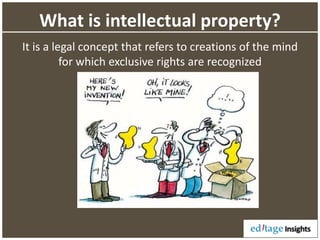
What is intellectual property?
It is a legal concept that refers to creations of the mind
for which exclusive rights are recognized
Under intellectual property law, owners are
granted certain exclusive rights to a variety of
intangible assets, such as musical, literary, and
artistic works; discoveries and inventions; and
words, phrases, symbols, and designs.
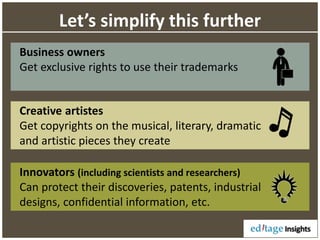
Innovators (including scientists and researchers)
Can protect their discoveries, patents, industrial
designs, confidential information, etc.
Creative artistes
Get copyrights on the musical, literary, dramatic
and artistic pieces they create
Let’s simplify this further
Business owners
Get exclusive rights to use their trademarks
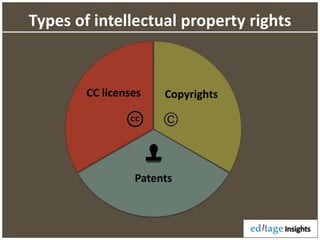
Types of intellectual property rights
Copyrights
Patents
CC licenses
CC licenses
CC licenses are
• Standard form license agreements that can be
attached to a work so that it can be used under
certain circumstances without the need to
contact the author or negotiate terms of use
• Granted free of cost by Creative Commons (CC),
a non-profit organization headquartered in the
United States
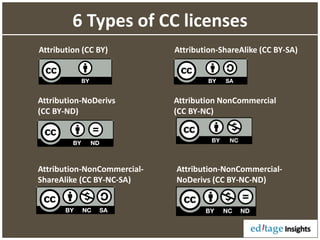
6 Types of CC licenses
Attribution (CC BY) Attribution-ShareAlike (CC BY-SA)
Attribution-NoDerivs
(CC BY-ND)
Attribution NonCommercial
(CC BY-NC)
Attribution-NonCommercial-
ShareAlike (CC BY-NC-SA)
Attribution-NonCommercial-
NoDerivs (CC BY-NC-ND)
More about CC licenses
CC licenses are based on copyrights. They change “all rights reserved” to
“some rights reserved”.
All CC licenses are BY (attribution) licenses by default.
Basic criteria for getting a CC license are that the work should be
copyrightable and should be owned by the applicant.
CC licenses are particularly useful for people who want to share their
work as broadly as possible on the Internet.
CC licenses are irrevocable.
CC is a non-profit organization, so keeping track of any breaches in the
use of work under CC licenses is the responsibility of the license holder.
Science Commons
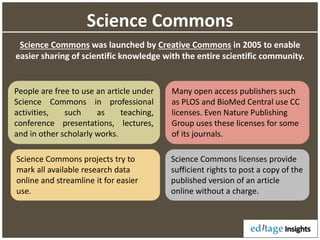
Science Commons was launched by Creative Commons in 2005 to enable
easier sharing of scientific knowledge with the entire scientific community.
People are free to use an article under
Science Commons in professional
activities, such as teaching,
conference presentations, lectures,
and in other scholarly works.
Science Commons licenses provide
sufficient rights to post a copy of the
published version of an article
online without a charge.
Many open access publishers such
as PLOS and BioMed Central use CC
licenses. Even Nature Publishing
Group uses these licenses for some
of its journals.
Science Commons projects try to
mark all available research data
online and streamline it for easier
use.
Copyright
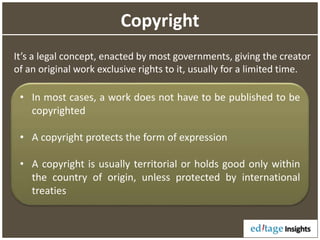
It’s a legal concept, enacted by most governments, giving the creator
of an original work exclusive rights to it, usually for a limited time.
• In most cases, a work does not have to be published to be
copyrighted
• A copyright protects the form of expression
• A copyright is usually territorial or holds good only within
the country of origin, unless protected by international
treaties
Patents
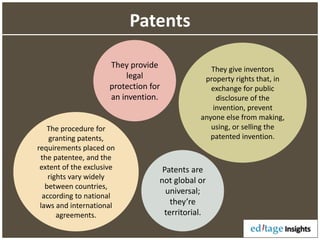
They provide
legal
protection for
an invention.
They give inventors
property rights that, in
exchange for public
disclosure of the
invention, prevent
anyone else from making,
using, or selling the
patented invention.
The procedure for
granting patents,
requirements placed on
the patentee, and the
extent of the exclusive
rights vary widely
between countries,
according to national
laws and international
agreements.
Patents are
not global or
universal;
they’re
territorial.
Summary
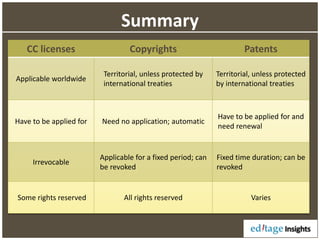
CC licenses Copyrights Patents
Applicable worldwide
Territorial, unless protected by
international treaties
Territorial, unless protected
by international treaties
Have to be applied for Need no application; automatic
Have to be applied for and
need renewal
Irrevocable
Applicable for a fixed period; can
be revoked
Fixed time duration; can be
revoked
Some rights reserved All rights reserved Varies
Sources
• http://en.wikipedia.org/wiki/Creative_Commons
• http://wiki.creativecommons.org/Frequently_Asked_Questions
• http://www.wired.co.uk/news/archive/2011-12/15/what-does-
creative-commons-mean-for-science
• http://en.wikipedia.org/wiki/Copyright
• http://en.wikipedia.org/wiki/Patent
• http://creativecommons.org/
• http://sciencecommons.org/about/
• http://www.flaticon.com/
For more
tips and resources on
scientific writing or
publication, visit…
www.editage.com/insights
CONNECT WITH US

Rights on intellectual property

  • 1.
  • 2.
    What is intellectualproperty? It is a legal concept that refers to creations of the mind for which exclusive rights are recognized
  • 3.
    Under intellectual propertylaw, owners are granted certain exclusive rights to a variety of intangible assets, such as musical, literary, and artistic works; discoveries and inventions; and words, phrases, symbols, and designs.
  • 4.
    Innovators (including scientistsand researchers) Can protect their discoveries, patents, industrial designs, confidential information, etc. Creative artistes Get copyrights on the musical, literary, dramatic and artistic pieces they create Let’s simplify this further Business owners Get exclusive rights to use their trademarks
  • 5.
    Types of intellectualproperty rights Copyrights Patents CC licenses
  • 6.
    CC licenses CC licensesare • Standard form license agreements that can be attached to a work so that it can be used under certain circumstances without the need to contact the author or negotiate terms of use • Granted free of cost by Creative Commons (CC), a non-profit organization headquartered in the United States
  • 7.
    6 Types ofCC licenses Attribution (CC BY) Attribution-ShareAlike (CC BY-SA) Attribution-NoDerivs (CC BY-ND) Attribution NonCommercial (CC BY-NC) Attribution-NonCommercial- ShareAlike (CC BY-NC-SA) Attribution-NonCommercial- NoDerivs (CC BY-NC-ND)
  • 8.
    More about CClicenses CC licenses are based on copyrights. They change “all rights reserved” to “some rights reserved”. All CC licenses are BY (attribution) licenses by default. Basic criteria for getting a CC license are that the work should be copyrightable and should be owned by the applicant. CC licenses are particularly useful for people who want to share their work as broadly as possible on the Internet. CC licenses are irrevocable. CC is a non-profit organization, so keeping track of any breaches in the use of work under CC licenses is the responsibility of the license holder.
  • 9.
    Science Commons Science Commonswas launched by Creative Commons in 2005 to enable easier sharing of scientific knowledge with the entire scientific community. People are free to use an article under Science Commons in professional activities, such as teaching, conference presentations, lectures, and in other scholarly works. Science Commons licenses provide sufficient rights to post a copy of the published version of an article online without a charge. Many open access publishers such as PLOS and BioMed Central use CC licenses. Even Nature Publishing Group uses these licenses for some of its journals. Science Commons projects try to mark all available research data online and streamline it for easier use.
  • 10.
    Copyright It’s a legalconcept, enacted by most governments, giving the creator of an original work exclusive rights to it, usually for a limited time. • In most cases, a work does not have to be published to be copyrighted • A copyright protects the form of expression • A copyright is usually territorial or holds good only within the country of origin, unless protected by international treaties
  • 11.
    Patents They provide legal protection for aninvention. They give inventors property rights that, in exchange for public disclosure of the invention, prevent anyone else from making, using, or selling the patented invention. The procedure for granting patents, requirements placed on the patentee, and the extent of the exclusive rights vary widely between countries, according to national laws and international agreements. Patents are not global or universal; they’re territorial.
  • 12.
    Summary CC licenses CopyrightsPatents Applicable worldwide Territorial, unless protected by international treaties Territorial, unless protected by international treaties Have to be applied for Need no application; automatic Have to be applied for and need renewal Irrevocable Applicable for a fixed period; can be revoked Fixed time duration; can be revoked Some rights reserved All rights reserved Varies
  • 13.
    Sources • http://en.wikipedia.org/wiki/Creative_Commons • http://wiki.creativecommons.org/Frequently_Asked_Questions •http://www.wired.co.uk/news/archive/2011-12/15/what-does- creative-commons-mean-for-science • http://en.wikipedia.org/wiki/Copyright • http://en.wikipedia.org/wiki/Patent • http://creativecommons.org/ • http://sciencecommons.org/about/ • http://www.flaticon.com/
  • 14.
    For more tips andresources on scientific writing or publication, visit…
  • 15.