
Vascular access route (radial vs femoral)
and radiation exposure in percutaneous
coronary interventions and diagnostic
angiography
S. Rigattieri, A. Sciahbasi, E. Mussino, S. Drefahl, F.R. Pugliese
«Sandro Pertini» Hospital
Rome, Italy
Disclosures:
• None of the authors has any relevant financial
interests to disclose
Background
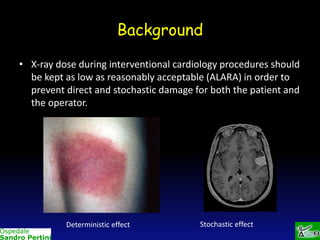
• X-ray dose during interventional cardiology procedures should
be kept as low as reasonably acceptable (ALARA) in order to
prevent direct and stochastic damage for both the patient and
the operator.

Deterministic effect

Stochastic effect
The issue of dose in Interventional
Cardiology
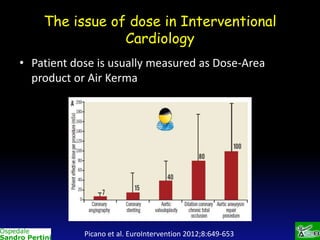
• Patient dose is usually measured as Dose-Area
product or Air Kerma

Picano et al. EuroIntervention 2012;8:649-653
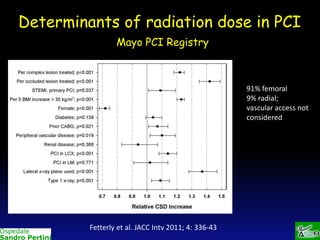
Determinants of radiation dose in PCI
Mayo PCI Registry

91% femoral
9% radial;
vascular access not
considered

Fetterly et al. JACC Intv 2011; 4: 336-43
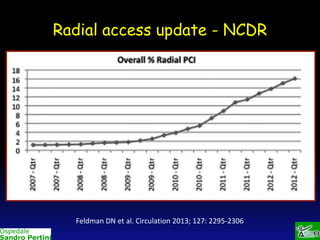
Radial access update - NCDR

Feldman DN et al. Circulation 2013; 127: 2295-2306
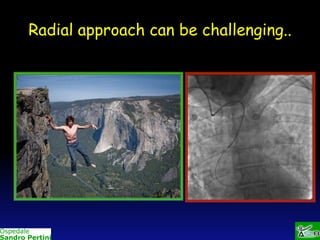
Radial approach can be challenging..
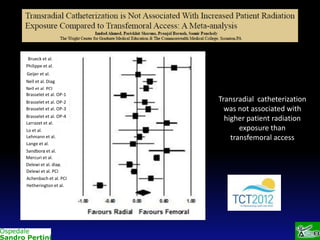
Brueck et al.
Philippe et al.
Geijer et al.
Nell et al. Diag
Nell et al. PCI
Brasselet et al. OP-1
Brasselet et al. OP-2
Brasselet et al. OP-3
Brasselet et al. OP-4
Larrazet et al.
Lo et al.
Lehmann et al.
Lange et al.
Sandborg et al.
Mercuri et al.
Delewi et al. diag.
Delewi et al. PCI
Achenbach et al. PCI
Hetherington et al.

Transradial catheterization
was not associated with
higher patient radiation
exposure than
transfemoral access
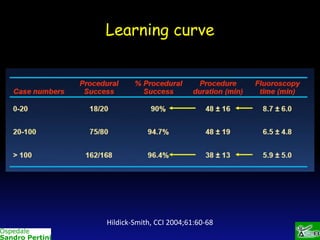
Learning curve

Hildick-Smith, CCI 2004;61:60-68
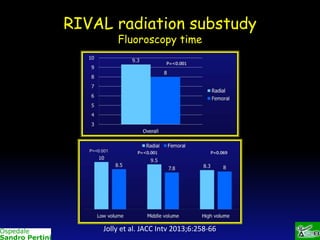
RIVAL radiation substudy
Fluoroscopy time

Jolly et al. JACC Intv 2013;6:258-66
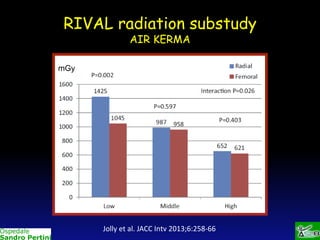
RIVAL radiation substudy
AIR KERMA

mGy

Jolly et al. JACC Intv 2013;6:258-66
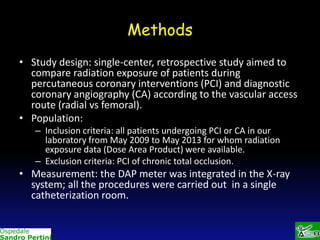
Methods
• Study design: single-center, retrospective study aimed to
compare radiation exposure of patients during
percutaneous coronary interventions (PCI) and diagnostic
coronary angiography (CA) according to the vascular access
route (radial vs femoral).
• Population:
– Inclusion criteria: all patients undergoing PCI or CA in our
laboratory from May 2009 to May 2013 for whom radiation
exposure data (Dose Area Product) were available.
– Exclusion criteria: PCI of chronic total occlusion.

• Measurement: the DAP meter was integrated in the X-ray
system; all the procedures were carried out in a single
catheterization room.
Statistical analysis
• Stepwise multiple linear regression analysis
was performed in order to compare radiation
exposure between RA and FA adjusting for
clinical and procedural confounders.
• Dose Area Product values (DAP, cGy.cm2) were
logarithmically transformed because the
distribution was positively skewed.
• Beta coefficients are routinely interpreted in
terms of percent change.
Results
• DAP values were available for 1396 out of
4110 procedures.
• RA was used in 1153 procedures (82.6%) and
was right-sided in 82.3% of cases.
• The overall rate of RA in the Cath Lab was
68%, 69%, 75% and 87% for each of the 4
years considered, respectively.
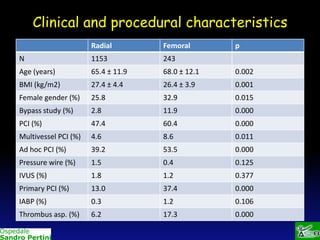
Clinical and procedural characteristics
Radial

Femoral

p

N

1153

243

Age (years)

65.4 ± 11.9

68.0 ± 12.1

0.002

BMI (kg/m2)

27.4 ± 4.4

26.4 ± 3.9

0.001

Female gender (%)

25.8

32.9

0.015

Bypass study (%)

2.8

11.9

0.000

PCI (%)

47.4

60.4

0.000

Multivessel PCI (%)

4.6

8.6

0.011

Ad hoc PCI (%)

39.2

53.5

0.000

Pressure wire (%)

1.5

0.4

0.125

IVUS (%)

1.8

1.2

0.377

Primary PCI (%)

13.0

37.4

0.000

IABP (%)

0.3

1.2

0.106

Thrombus asp. (%)

6.2

17.3

0.000
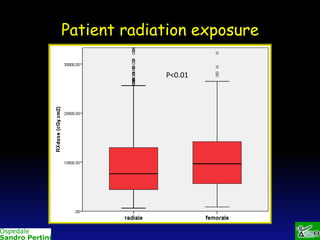
Patient radiation exposure
P<0.01
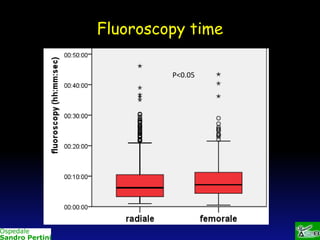
Fluoroscopy time
P<0.05
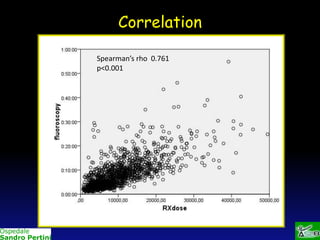
Correlation
Spearman’s rho 0.761
p<0.001
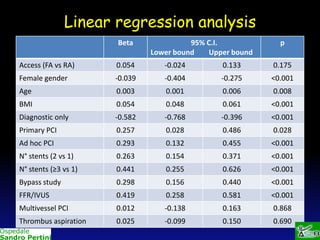
Linear regression analysis
Beta

95% C.I.
Lower bound
Upper bound

p

Access (FA vs RA)

0.054

-0.024

0.133

0.175

Female gender

-0.039

-0.404

-0.275

<0.001

Age

0.003

0.001

0.006

0.008

BMI

0.054

0.048

0.061

<0.001

Diagnostic only

-0.582

-0.768

-0.396

<0.001

Primary PCI

0.257

0.028

0.486

0.028

Ad hoc PCI

0.293

0.132

0.455

<0.001

N° stents (2 vs 1)

0.263

0.154

0.371

<0.001

N° stents (≥3 vs 1)

0.441

0.255

0.626

<0.001

Bypass study

0.298

0.156

0.440

<0.001

FFR/IVUS

0.419

0.258

0.581

<0.001

Multivessel PCI

0.012

-0.138

0.163

0.868

Thrombus aspiration

0.025

-0.099

0.150

0.690
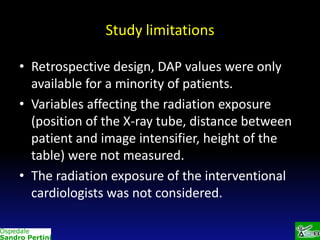
Study limitations
• Retrospective design, DAP values were only
available for a minority of patients.
• Variables affecting the radiation exposure
(position of the X-ray tube, distance between
patient and image intensifier, height of the
table) were not measured.
• The radiation exposure of the interventional
cardiologists was not considered.
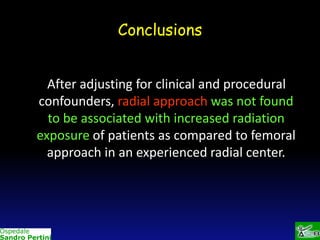
Conclusions
After adjusting for clinical and procedural
confounders, radial approach was not found
to be associated with increased radiation
exposure of patients as compared to femoral
approach in an experienced radial center.
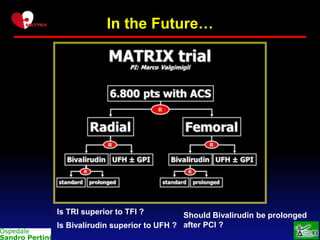
In the Future…

Is TRI superior to TFI ?

Should Bivalirudin be prolonged
Is Bivalirudin superior to UFH ? after PCI ?
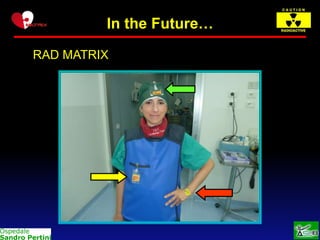
In the Future…
RAD MATRIX

Sciahbasi A - AIMRADIAL 2013 - Radiation exposure

  • 1.
    Vascular access route(radial vs femoral) and radiation exposure in percutaneous coronary interventions and diagnostic angiography S. Rigattieri, A. Sciahbasi, E. Mussino, S. Drefahl, F.R. Pugliese «Sandro Pertini» Hospital Rome, Italy
  • 2.
    Disclosures: • None ofthe authors has any relevant financial interests to disclose
  • 3.
    Background • X-ray doseduring interventional cardiology procedures should be kept as low as reasonably acceptable (ALARA) in order to prevent direct and stochastic damage for both the patient and the operator. Deterministic effect Stochastic effect
  • 4.
    The issue ofdose in Interventional Cardiology • Patient dose is usually measured as Dose-Area product or Air Kerma Picano et al. EuroIntervention 2012;8:649-653
  • 5.
    Determinants of radiationdose in PCI Mayo PCI Registry 91% femoral 9% radial; vascular access not considered Fetterly et al. JACC Intv 2011; 4: 336-43
  • 6.
    Radial access update- NCDR Feldman DN et al. Circulation 2013; 127: 2295-2306
  • 7.
    Radial approach canbe challenging..
  • 8.
    Brueck et al. Philippeet al. Geijer et al. Nell et al. Diag Nell et al. PCI Brasselet et al. OP-1 Brasselet et al. OP-2 Brasselet et al. OP-3 Brasselet et al. OP-4 Larrazet et al. Lo et al. Lehmann et al. Lange et al. Sandborg et al. Mercuri et al. Delewi et al. diag. Delewi et al. PCI Achenbach et al. PCI Hetherington et al. Transradial catheterization was not associated with higher patient radiation exposure than transfemoral access
  • 9.
  • 10.
    RIVAL radiation substudy Fluoroscopytime Jolly et al. JACC Intv 2013;6:258-66
  • 11.
    RIVAL radiation substudy AIRKERMA mGy Jolly et al. JACC Intv 2013;6:258-66
  • 12.
    Methods • Study design:single-center, retrospective study aimed to compare radiation exposure of patients during percutaneous coronary interventions (PCI) and diagnostic coronary angiography (CA) according to the vascular access route (radial vs femoral). • Population: – Inclusion criteria: all patients undergoing PCI or CA in our laboratory from May 2009 to May 2013 for whom radiation exposure data (Dose Area Product) were available. – Exclusion criteria: PCI of chronic total occlusion. • Measurement: the DAP meter was integrated in the X-ray system; all the procedures were carried out in a single catheterization room.
  • 13.
    Statistical analysis • Stepwisemultiple linear regression analysis was performed in order to compare radiation exposure between RA and FA adjusting for clinical and procedural confounders. • Dose Area Product values (DAP, cGy.cm2) were logarithmically transformed because the distribution was positively skewed. • Beta coefficients are routinely interpreted in terms of percent change.
  • 14.
    Results • DAP valueswere available for 1396 out of 4110 procedures. • RA was used in 1153 procedures (82.6%) and was right-sided in 82.3% of cases. • The overall rate of RA in the Cath Lab was 68%, 69%, 75% and 87% for each of the 4 years considered, respectively.
  • 15.
    Clinical and proceduralcharacteristics Radial Femoral p N 1153 243 Age (years) 65.4 ± 11.9 68.0 ± 12.1 0.002 BMI (kg/m2) 27.4 ± 4.4 26.4 ± 3.9 0.001 Female gender (%) 25.8 32.9 0.015 Bypass study (%) 2.8 11.9 0.000 PCI (%) 47.4 60.4 0.000 Multivessel PCI (%) 4.6 8.6 0.011 Ad hoc PCI (%) 39.2 53.5 0.000 Pressure wire (%) 1.5 0.4 0.125 IVUS (%) 1.8 1.2 0.377 Primary PCI (%) 13.0 37.4 0.000 IABP (%) 0.3 1.2 0.106 Thrombus asp. (%) 6.2 17.3 0.000
  • 16.
  • 17.
  • 18.
  • 19.
    Linear regression analysis Beta 95%C.I. Lower bound Upper bound p Access (FA vs RA) 0.054 -0.024 0.133 0.175 Female gender -0.039 -0.404 -0.275 <0.001 Age 0.003 0.001 0.006 0.008 BMI 0.054 0.048 0.061 <0.001 Diagnostic only -0.582 -0.768 -0.396 <0.001 Primary PCI 0.257 0.028 0.486 0.028 Ad hoc PCI 0.293 0.132 0.455 <0.001 N° stents (2 vs 1) 0.263 0.154 0.371 <0.001 N° stents (≥3 vs 1) 0.441 0.255 0.626 <0.001 Bypass study 0.298 0.156 0.440 <0.001 FFR/IVUS 0.419 0.258 0.581 <0.001 Multivessel PCI 0.012 -0.138 0.163 0.868 Thrombus aspiration 0.025 -0.099 0.150 0.690
  • 20.
    Study limitations • Retrospectivedesign, DAP values were only available for a minority of patients. • Variables affecting the radiation exposure (position of the X-ray tube, distance between patient and image intensifier, height of the table) were not measured. • The radiation exposure of the interventional cardiologists was not considered.
  • 21.
    Conclusions After adjusting forclinical and procedural confounders, radial approach was not found to be associated with increased radiation exposure of patients as compared to femoral approach in an experienced radial center.
  • 22.
    In the Future… IsTRI superior to TFI ? Should Bivalirudin be prolonged Is Bivalirudin superior to UFH ? after PCI ?
  • 23.