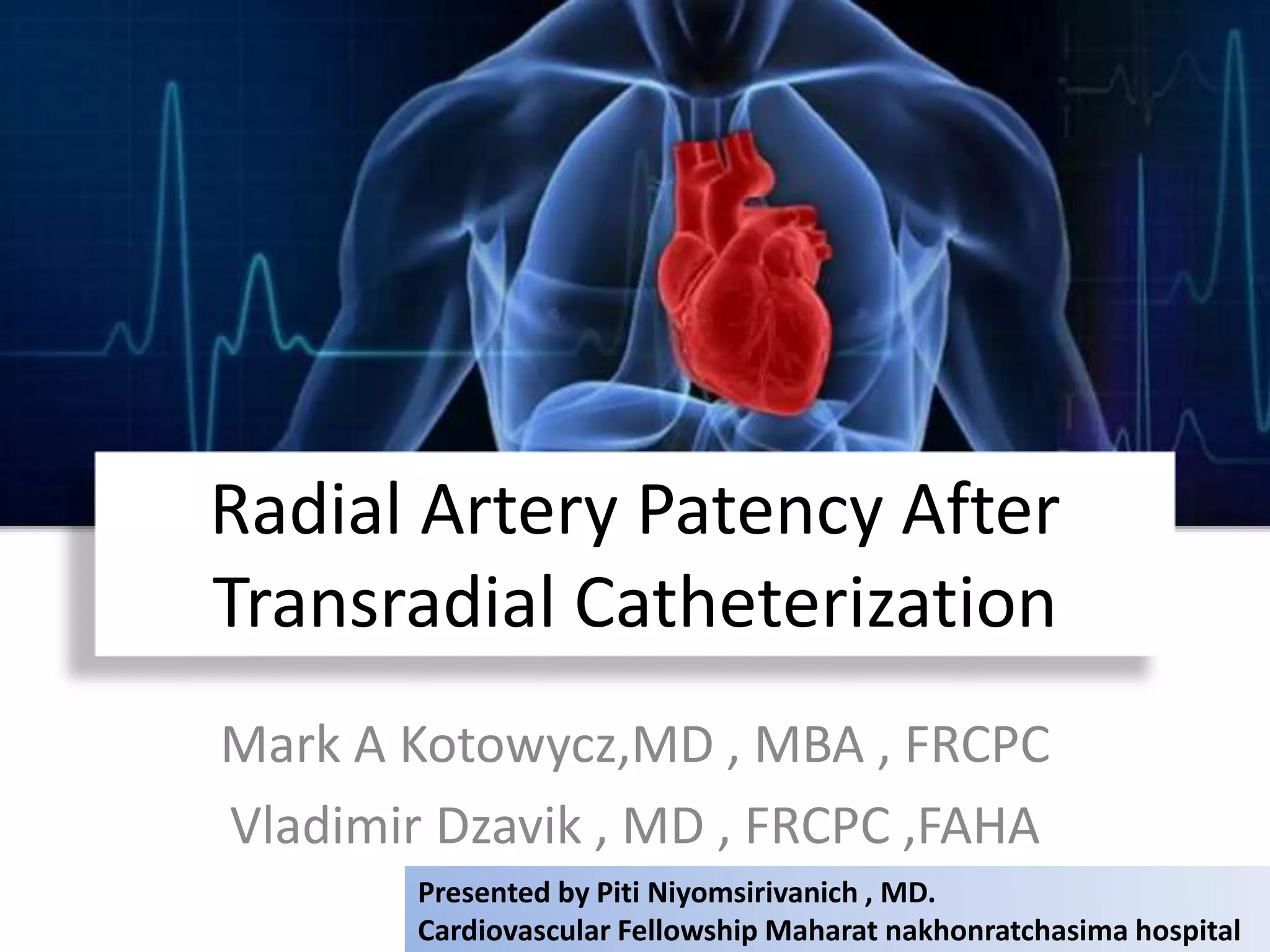
Radial Artery Patency After
Transradial Catheterization
Mark A Kotowycz,MD , MBA , FRCPC
Vladimir Dzavik , MD , FRCPC ,FAHA
Presented by Piti Niyomsirivanich , MD.
Cardiovascular Fellowship Maharat nakhonratchasima hospital
Introduction
• Transradial Catheterization
– Reduce major bleeding
– More QOL questionaires score
– Earlier ambulation
– Same day hospital discharge after PCI
– Decrease Cost
Radial artery occlusion
• 1-10% of cases
• Usually clinically silent due to dual blood supply
• And usually overlooked > 50% doesn’t routinely access
• But once the artery occluded cannot be used as
– access site for the future catheterization
– as an arterial conduit for bypass surgery
Pathophysiology
• Thrombotic process
– reduced with anticoagulant
– radial artery thrombus
• (vascular ultrasound , angiography )
• Local endothelial injury after sheath insertion
• Cessation of blood flow
• Tend to occure early after transradial catheterization
50% spontaneous recanalization within 1-3 months
Negative effects radial structural and function
• Structure
– 67% intimal tear
– 36% medial dissections immediately
– Small lumen area in repeated more than the 1st time
• Intimal hyperplasia
• Intima-media thickness
• Function
– Decrease response to NTG
Negative effects radial structural and
function
• Structure
– 67% intimal tear
– 36% medial dissections immediately
– Small lumen area in repeated more than the 1st time
• Intimal hyperplasia
• Intima-media thickness
• Function
– Decrease response to NTG
 repeated radial access site failure
 reduced graft patency in patient undergoing bypass
surgery with radial artery conduits.
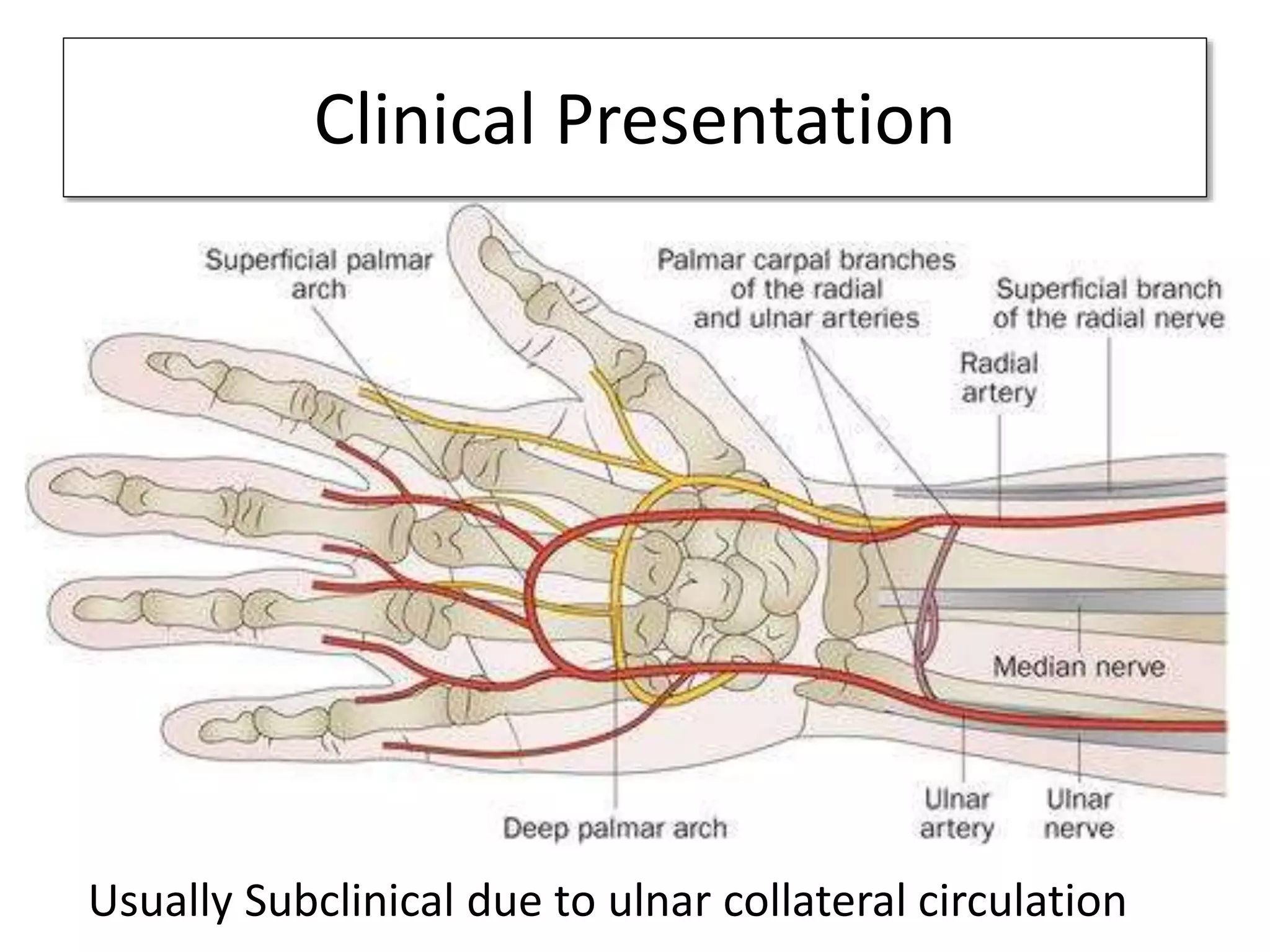
Clinical Presentation
Usually Subclinical due to ulnar collateral circulation
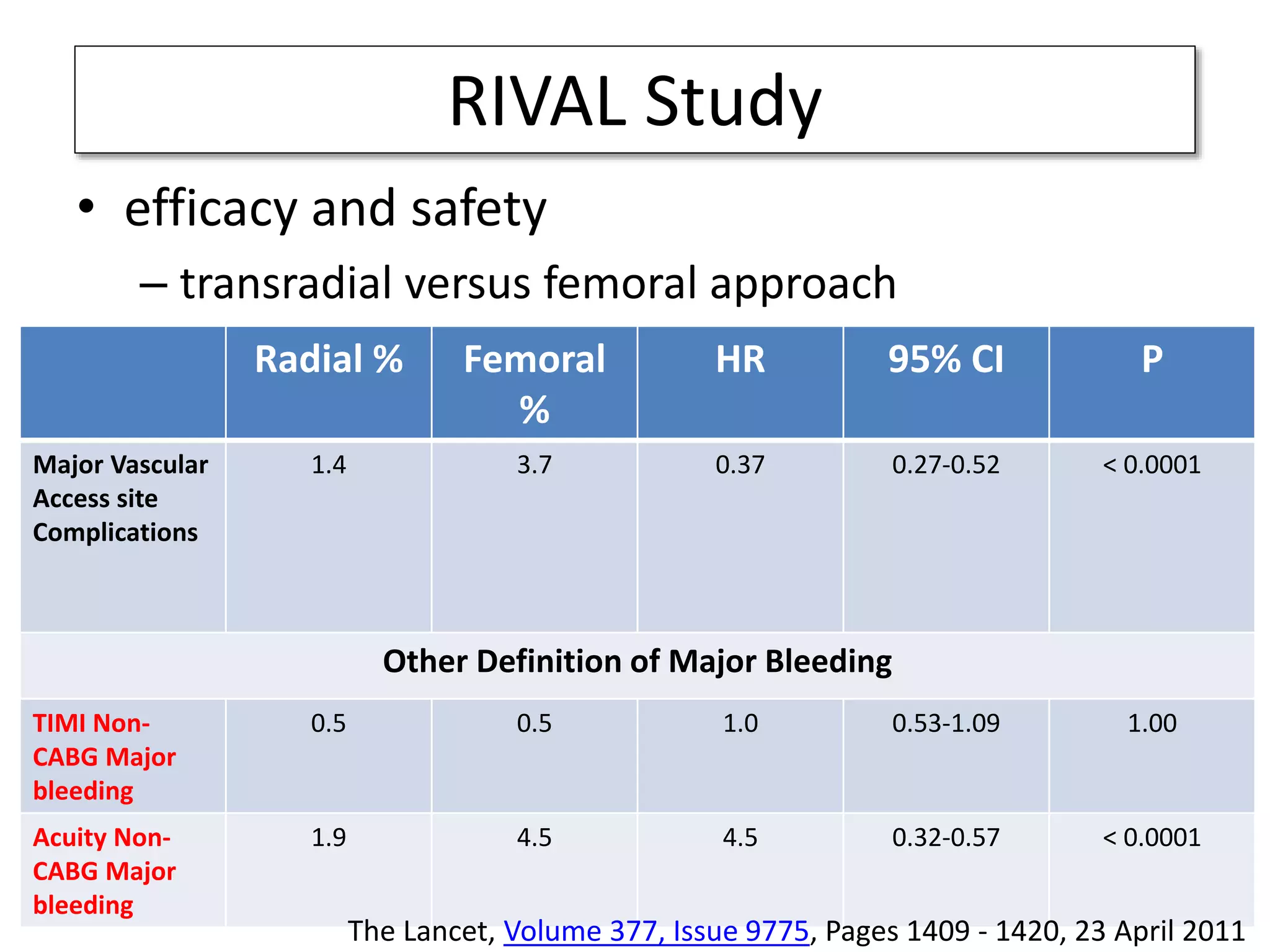
• efficacy and safety
– transradial versus femoral approach
Radial % Femoral
%
HR 95% CI P
Major Vascular
Access site
Complications
1.4 3.7 0.37 0.27-0.52 < 0.0001
Other Definition of Major Bleeding
TIMI Non-
CABG Major
bleeding
0.5 0.5 1.0 0.53-1.09 1.00
Acuity Non-
CABG Major
bleeding
1.9 4.5 4.5 0.32-0.57 < 0.0001
The Lancet, Volume 377, Issue 9775, Pages 1409 - 1420, 23 April 2011
RIVAL Study
• efficacy and safety
– transradial versus femoral approach
Radial % Femoral
%
HR 95% CI P
Major Vascular
Access site
Complications
1.4 3.7 0.37 0.27-0.52 < 0.0001
Other Definition of Major Bleeding
TIMI Non-
CABG Major
bleeding
0.5 0.5 1.0 0.53-1.09 1.00
Acuity Non-
CABG Major
bleeding
1.9 4.5 4.5 0.32-0.57 < 0.0001
The Lancet, Volume 377, Issue 9775, Pages 1409 - 1420, 23 April 2011
RIVAL Study
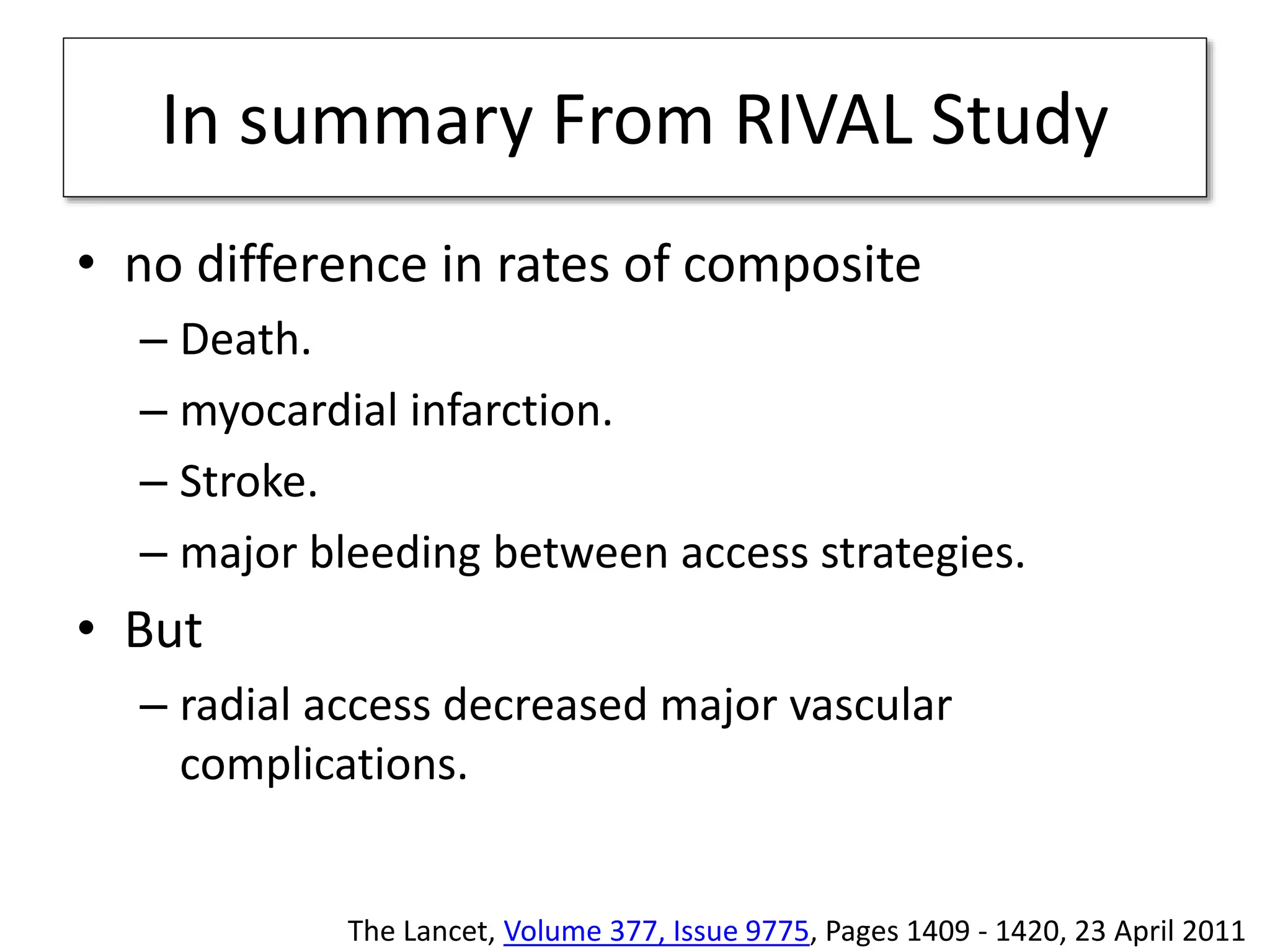
In summary From RIVAL Study
• no difference in rates of composite
– Death.
– myocardial infarction.
– Stroke.
– major bleeding between access strategies.
• But
– radial access decreased major vascular
complications.
The Lancet, Volume 377, Issue 9775, Pages 1409 - 1420, 23 April 2011
Physical examination
• Weak or absent radial pulse.
• But may have a palpable pulse from collateral
ulnar (retrograde filling)
• Thus : Dx of RAO should not depend on
presence or absence pulse.
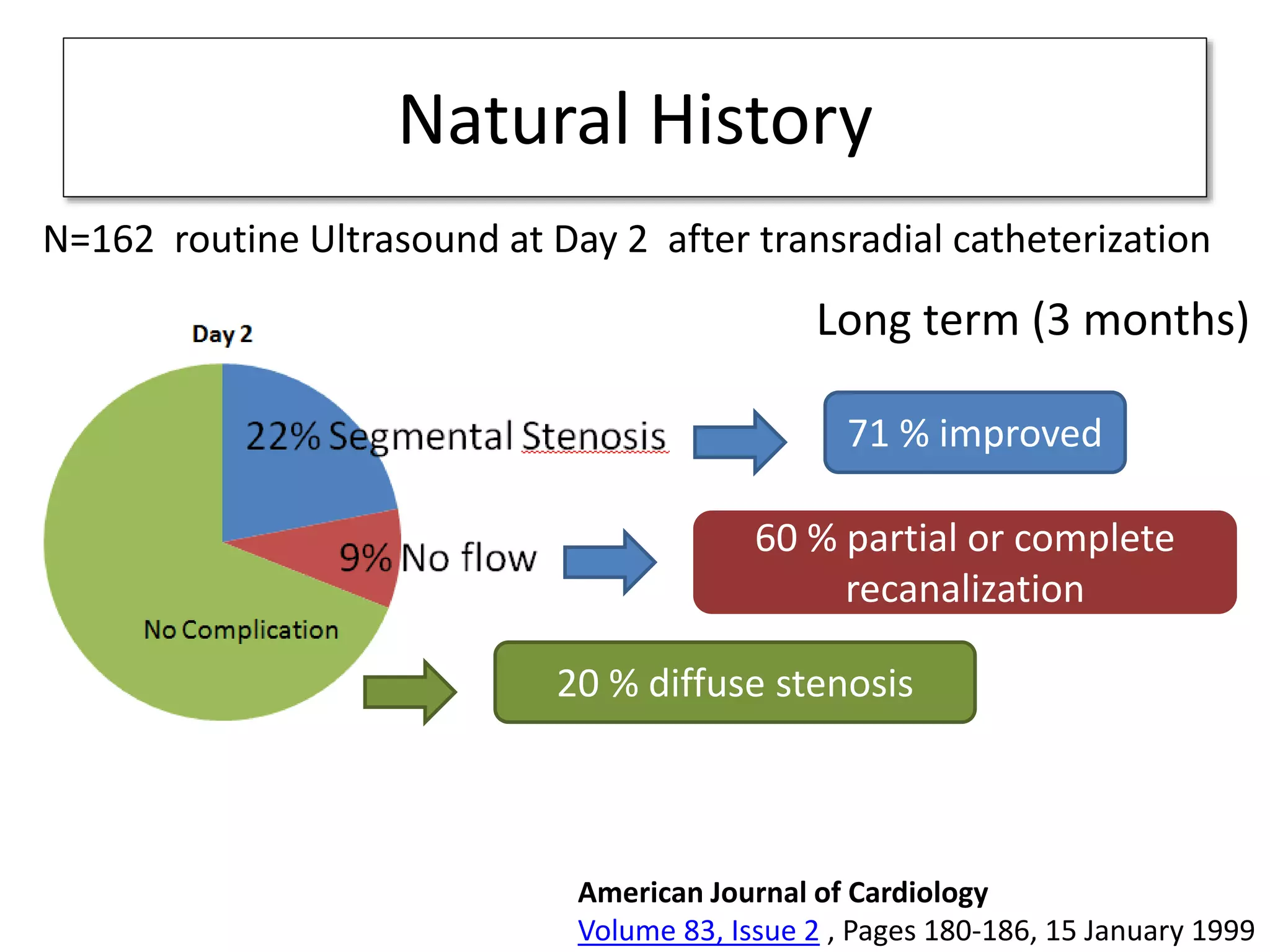
Natural History
71 % improved
20 % diffuse stenosis
60 % partial or complete
recanalization
Long term (3 months)
American Journal of Cardiology
Volume 83, Issue 2 , Pages 180-186, 15 January 1999
N=162 routine Ultrasound at Day 2 after transradial catheterization
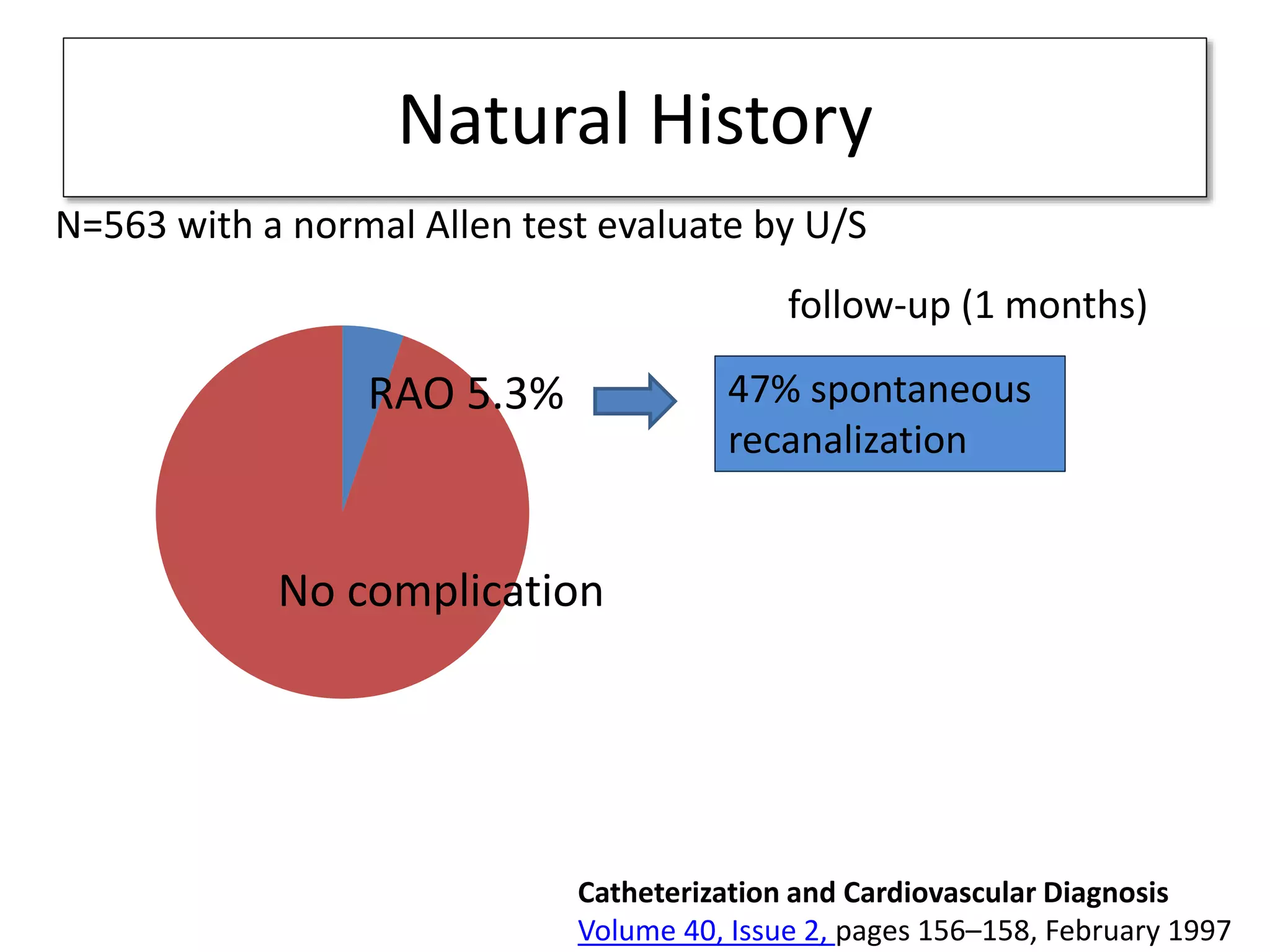
Natural History
Catheterization and Cardiovascular Diagnosis
Volume 40, Issue 2, pages 156–158, February 1997
N=563 with a normal Allen test evaluate by U/S
RAO 5.3%
No complication
47% spontaneous
recanalization
follow-up (1 months)
Assessing Dual Hand Circulation
• Modified Allen Test
Assessing Dual Hand Circulation
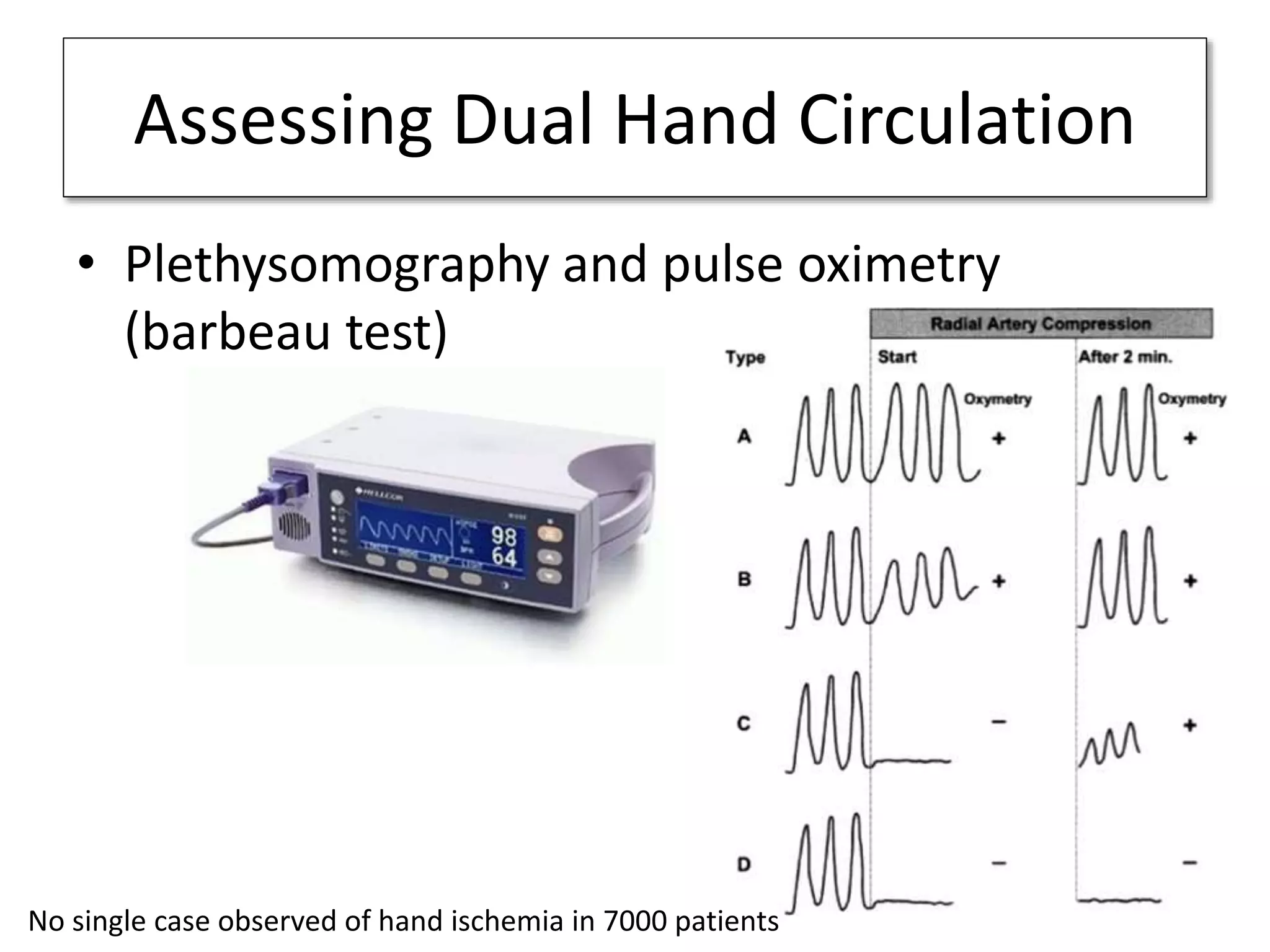
• Plethysomography and pulse oximetry
(barbeau test)
No single case observed of hand ischemia in 7000 patients
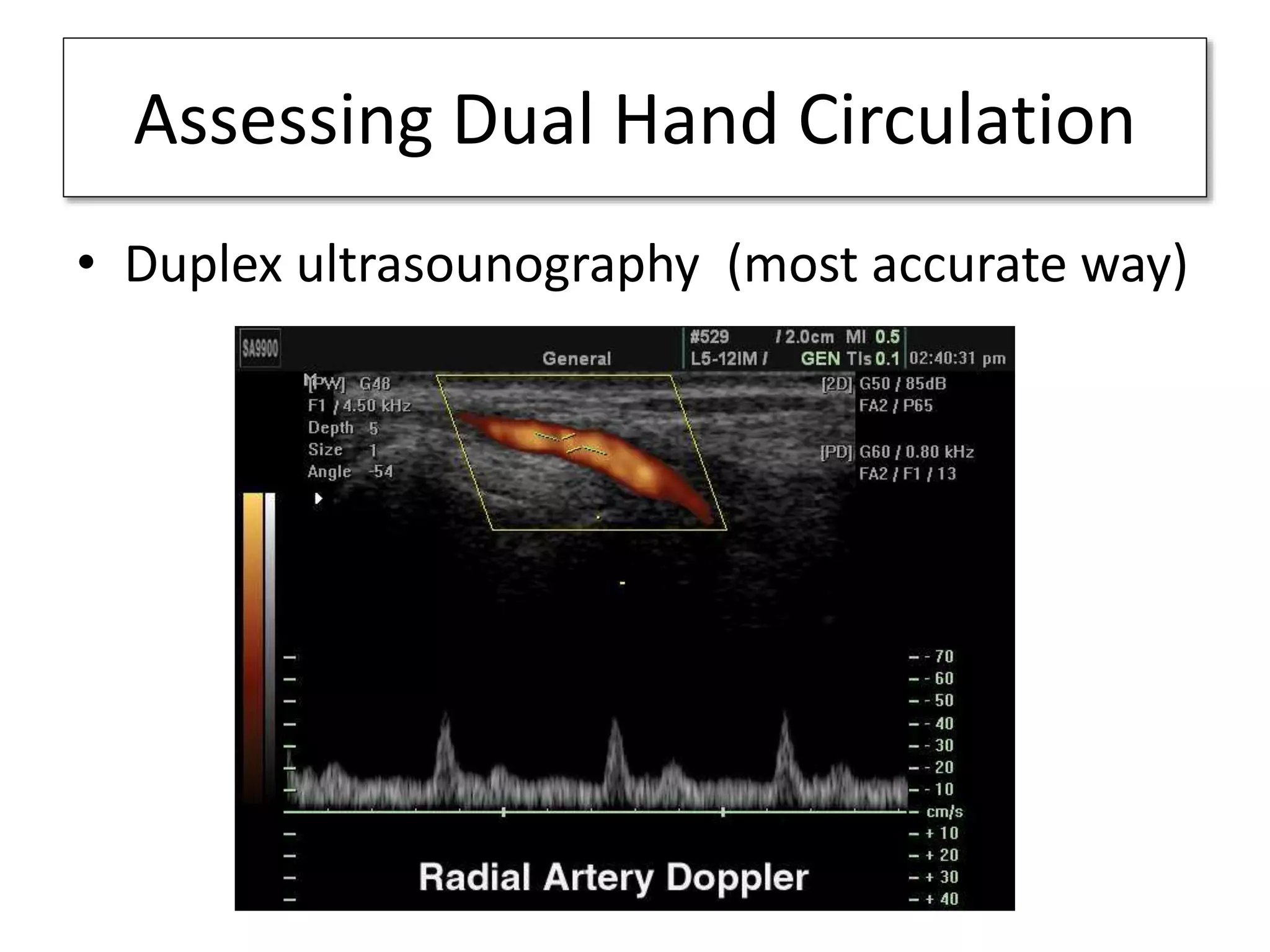
Assessing Dual Hand Circulation
• Duplex ultrasounography (most accurate way)
Predictors of RAO
• Diameter of the sheath
• Postprocedure compression time
• Presence of anterograde flow during
hemostasis
• Use of anticoagulation
Sheath size
• Oversized of Sheath
–  vascular remodeling
– Thrombosis
250 patients
under going PCI
Pretreated
with NO
Journal of the Society for Cardiac Angiography & Interventions [1999, 46(2):173-178]
6F or larger inserted
S-A ratio > 1  RAO 13%
S-A ratio < 1  RAO 4%
(P=0.01)
Sheath size
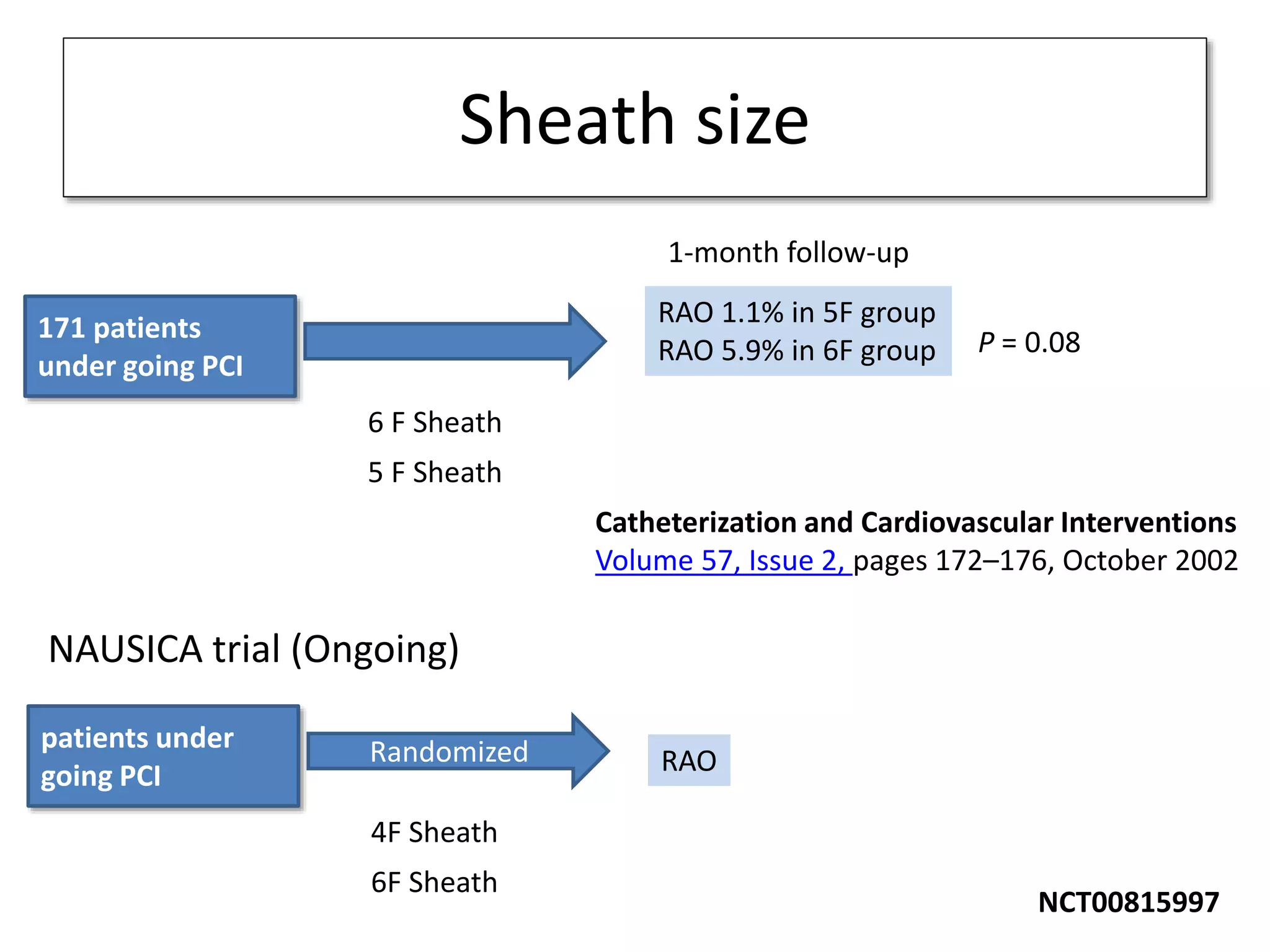
171 patients
under going PCI
6 F Sheath
5 F Sheath
RAO 1.1% in 5F group
RAO 5.9% in 6F group
NAUSICA trial (Ongoing)
patients under
going PCI
Randomized
4F Sheath
6F Sheath
RAO
1-month follow-up
Catheterization and Cardiovascular Interventions
Volume 57, Issue 2, pages 172–176, October 2002
P = 0.08
NCT00815997
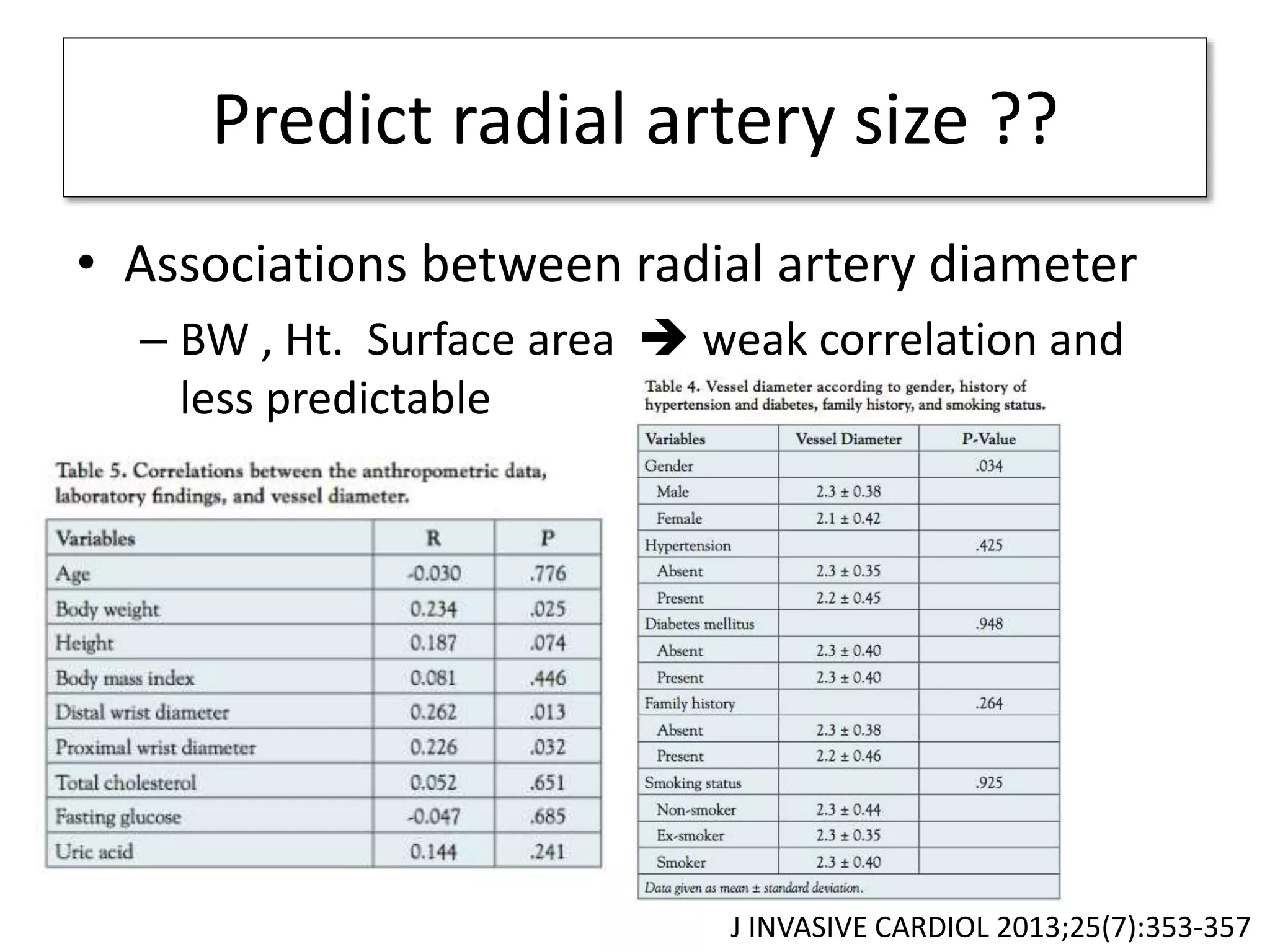
Predict radial artery size ??
• Associations between radial artery diameter
– BW , Ht. Surface area  weak correlation and
less predictable
J INVASIVE CARDIOL 2013;25(7):353-357
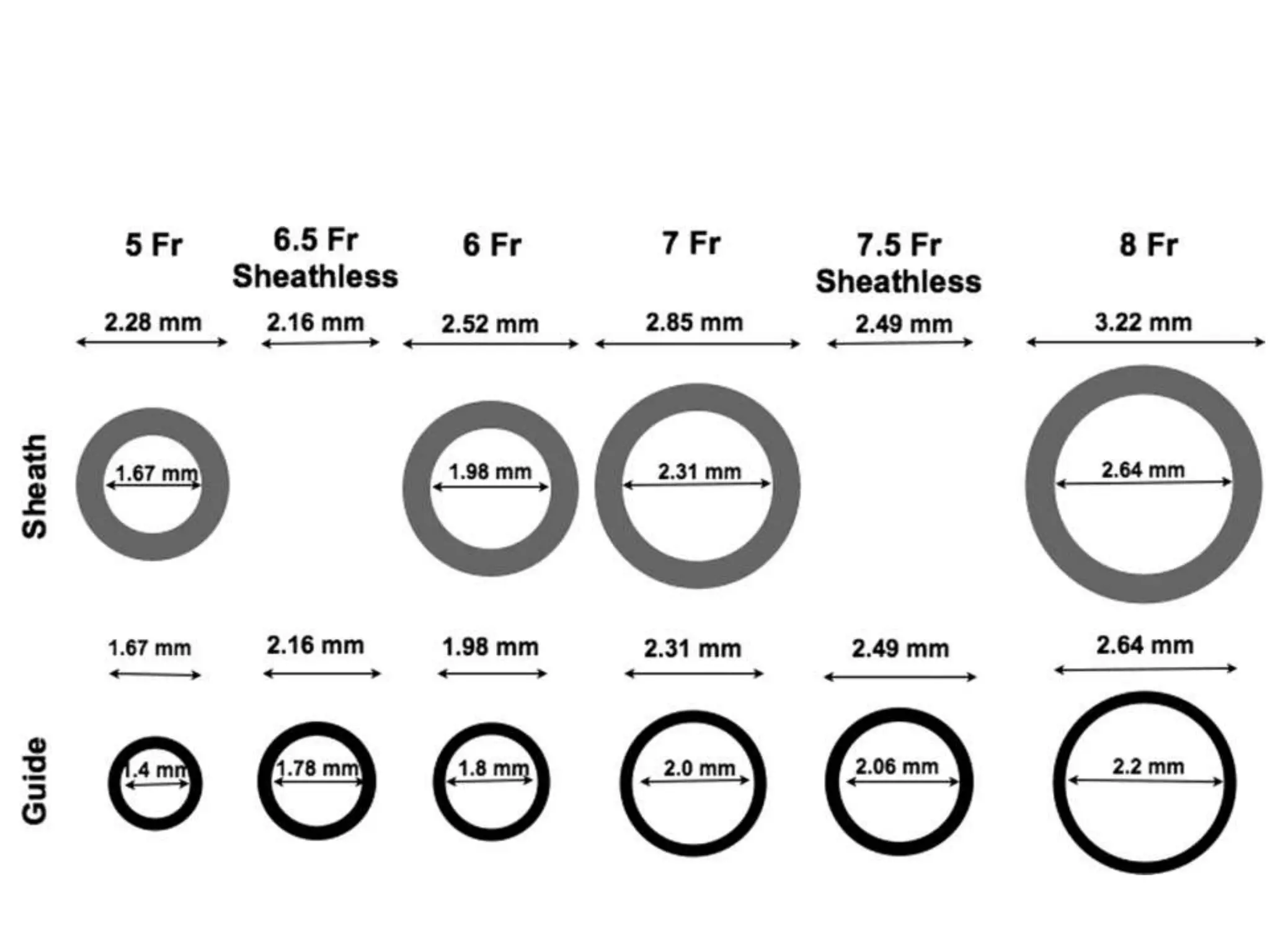
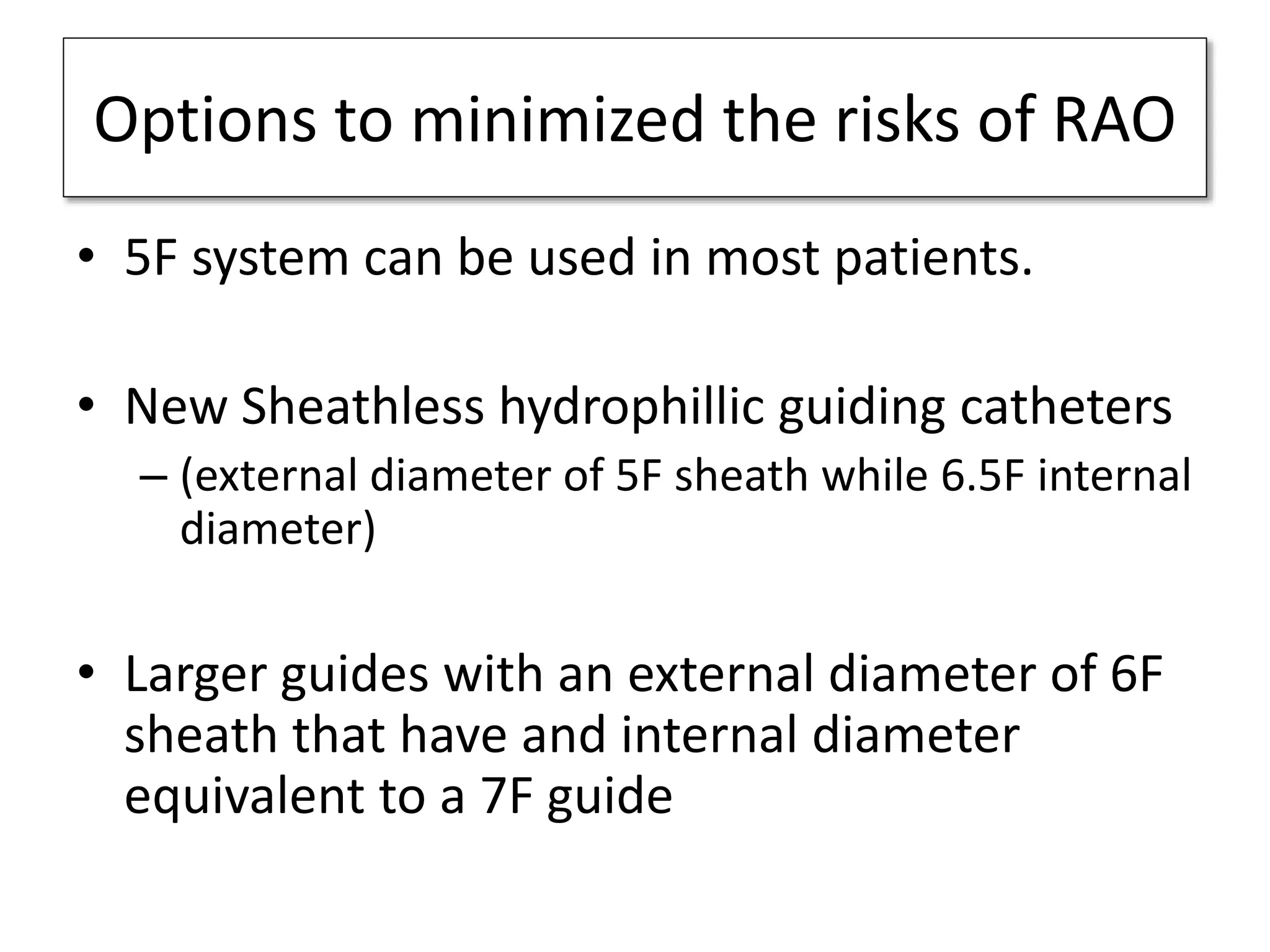
Options to minimized the risks of RAO
• 5F system can be used in most patients.
• New Sheathless hydrophillic guiding catheters
– (external diameter of 5F sheath while 6.5F internal
diameter)
• Larger guides with an external diameter of 6F
sheath that have and internal diameter
equivalent to a 7F guide
Patent Hemostasis
• Compressible
• But too aggressive compression
–  no flow state  thrombosis
• Predictor of RAO
– Absence of anterograde flow during hemostasis
Patent Hemostasis
• Conventional pressure application
– Versus
– PHOPHET trial
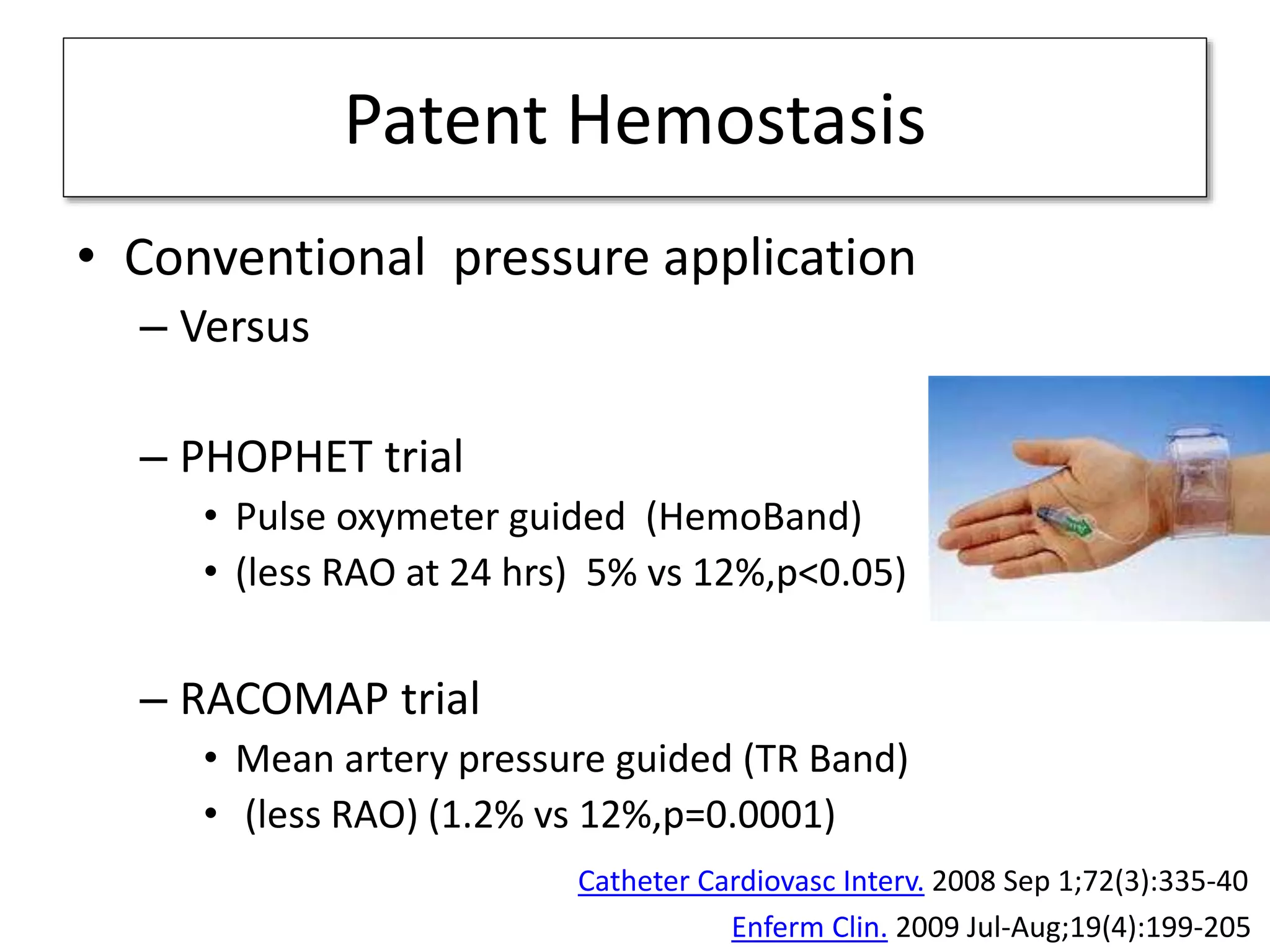
• Pulse oxymeter guided (HemoBand)
• (less RAO at 24 hrs) 5% vs 12%,p<0.05)
– RACOMAP trial
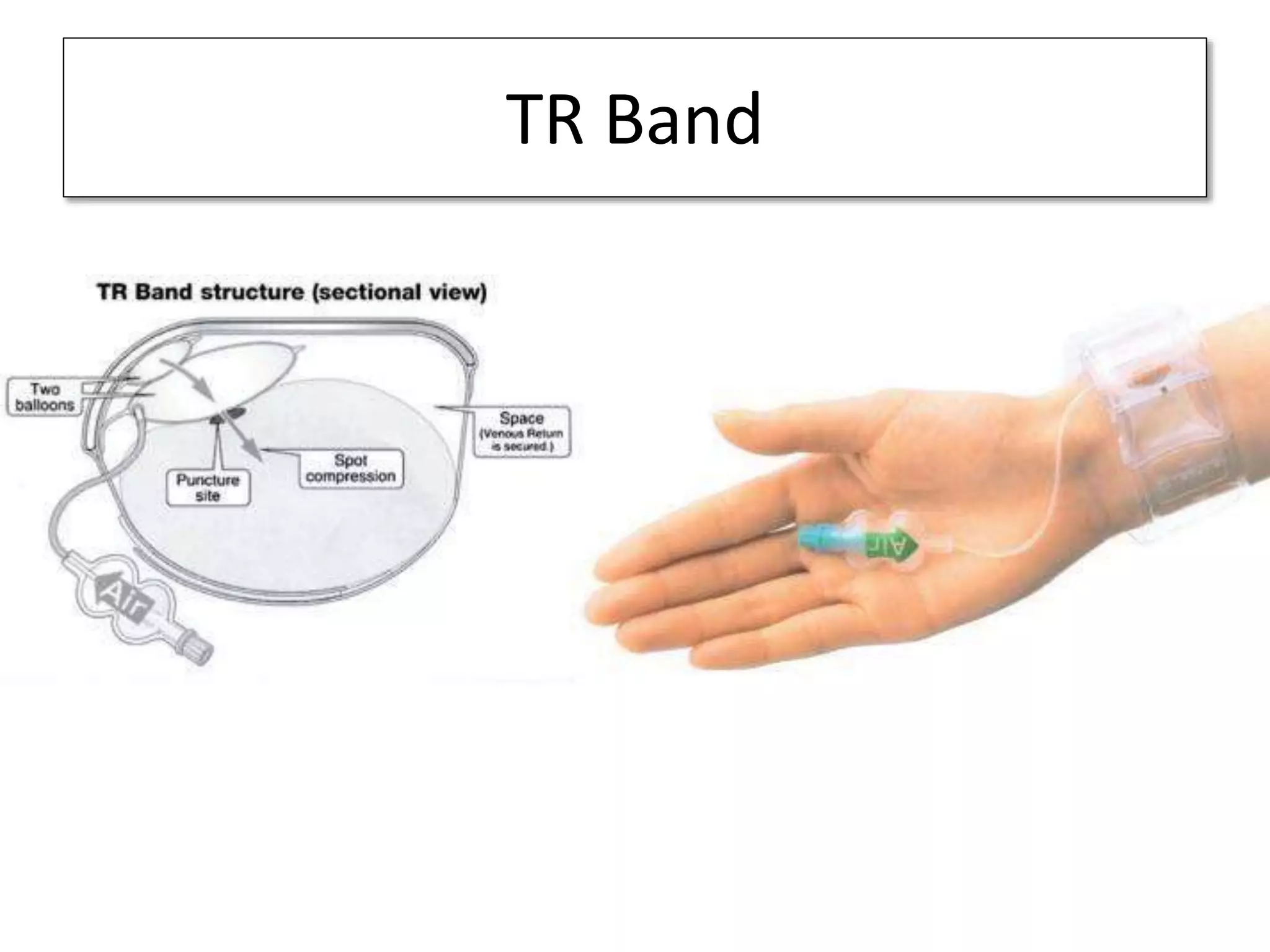
• Mean artery pressure guided (TR Band)
• (less RAO) (1.2% vs 12%,p=0.0001)
Catheter Cardiovasc Interv. 2008 Sep 1;72(3):335-40
Enferm Clin. 2009 Jul-Aug;19(4):199-205
TR Band
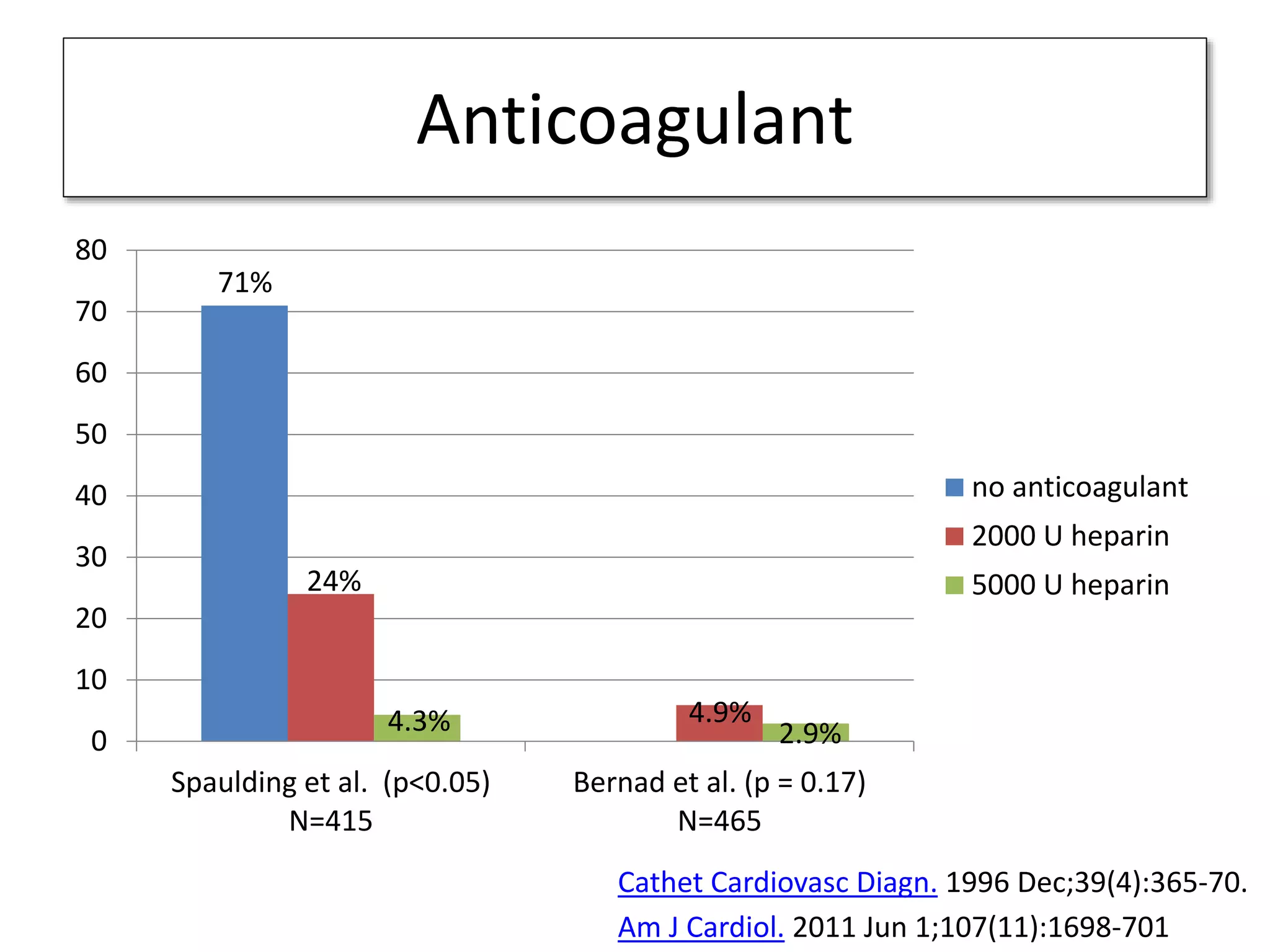
Anticoagulation
• Minimize the risk of the RAO
• Based on observational data because of no
RCT.
• Heparin (Current practice 2000-5000 U of
heparin)
Anticoagulant
0
10
20
30
40
50
60
70
80
Spaulding et al. (p<0.05)
N=415
Bernad et al. (p = 0.17)
N=465
no anticoagulant
2000 U heparin
5000 U heparin
71%
24%
4.3% 4.9%
2.9%
Cathet Cardiovasc Diagn. 1996 Dec;39(4):365-70.
Am J Cardiol. 2011 Jun 1;107(11):1698-701
Date of download:
6/10/2014
Copyright © The American College of Cardiology.
All rights reserved.
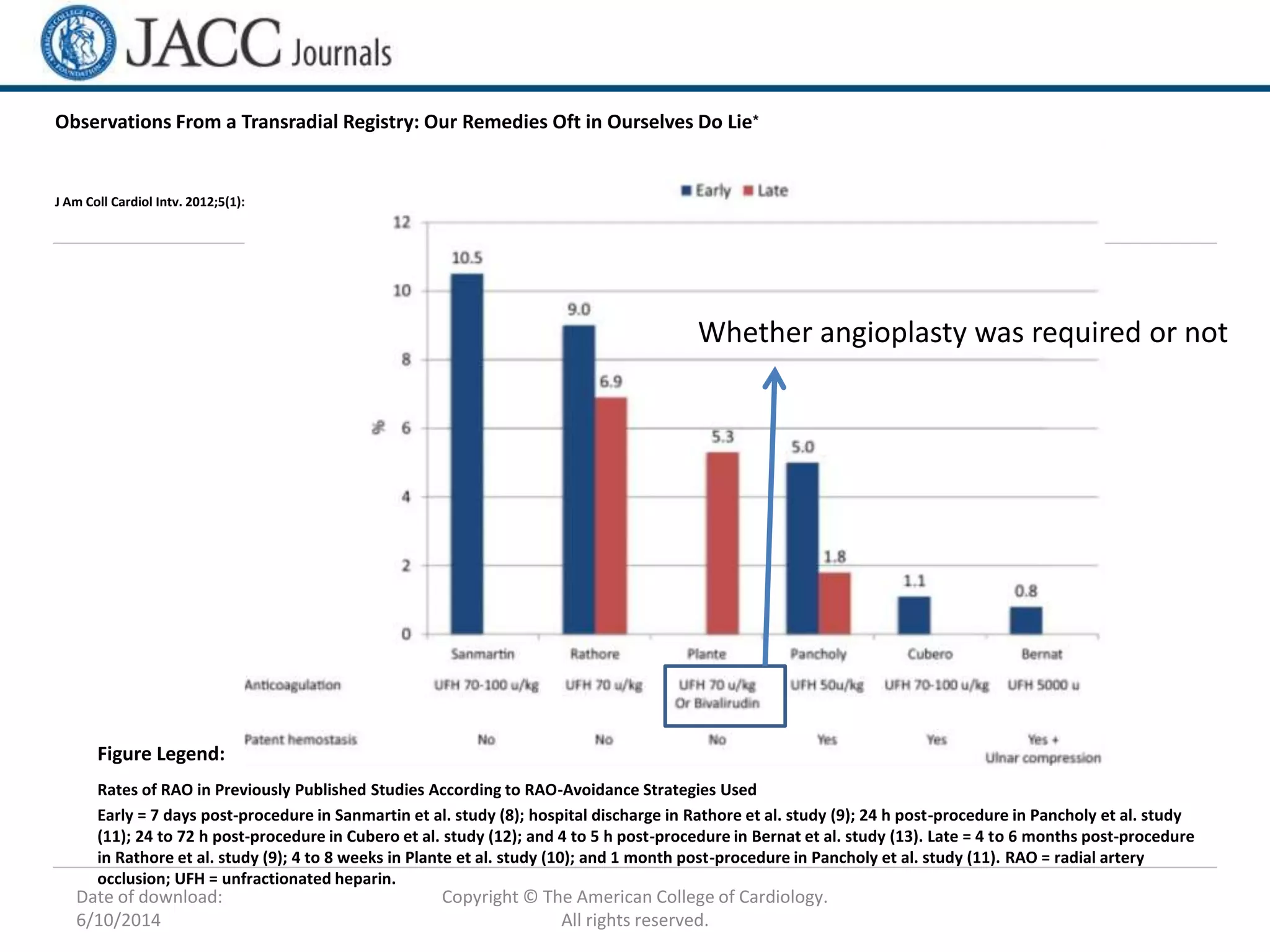
Observations From a Transradial Registry: Our Remedies Oft in Ourselves Do Lie⁎
J Am Coll Cardiol Intv. 2012;5(1):44-46. doi:10.1016/j.jcin.2011.10.005
Rates of RAO in Previously Published Studies According to RAO-Avoidance Strategies Used
Early = 7 days post-procedure in Sanmartin et al. study (8); hospital discharge in Rathore et al. study (9); 24 h post-procedure in Pancholy et al. study
(11); 24 to 72 h post-procedure in Cubero et al. study (12); and 4 to 5 h post-procedure in Bernat et al. study (13). Late = 4 to 6 months post-procedure
in Rathore et al. study (9); 4 to 8 weeks in Plante et al. study (10); and 1 month post-procedure in Pancholy et al. study (11). RAO = radial artery
occlusion; UFH = unfractionated heparin.
Figure Legend:
Whether angioplasty was required or not
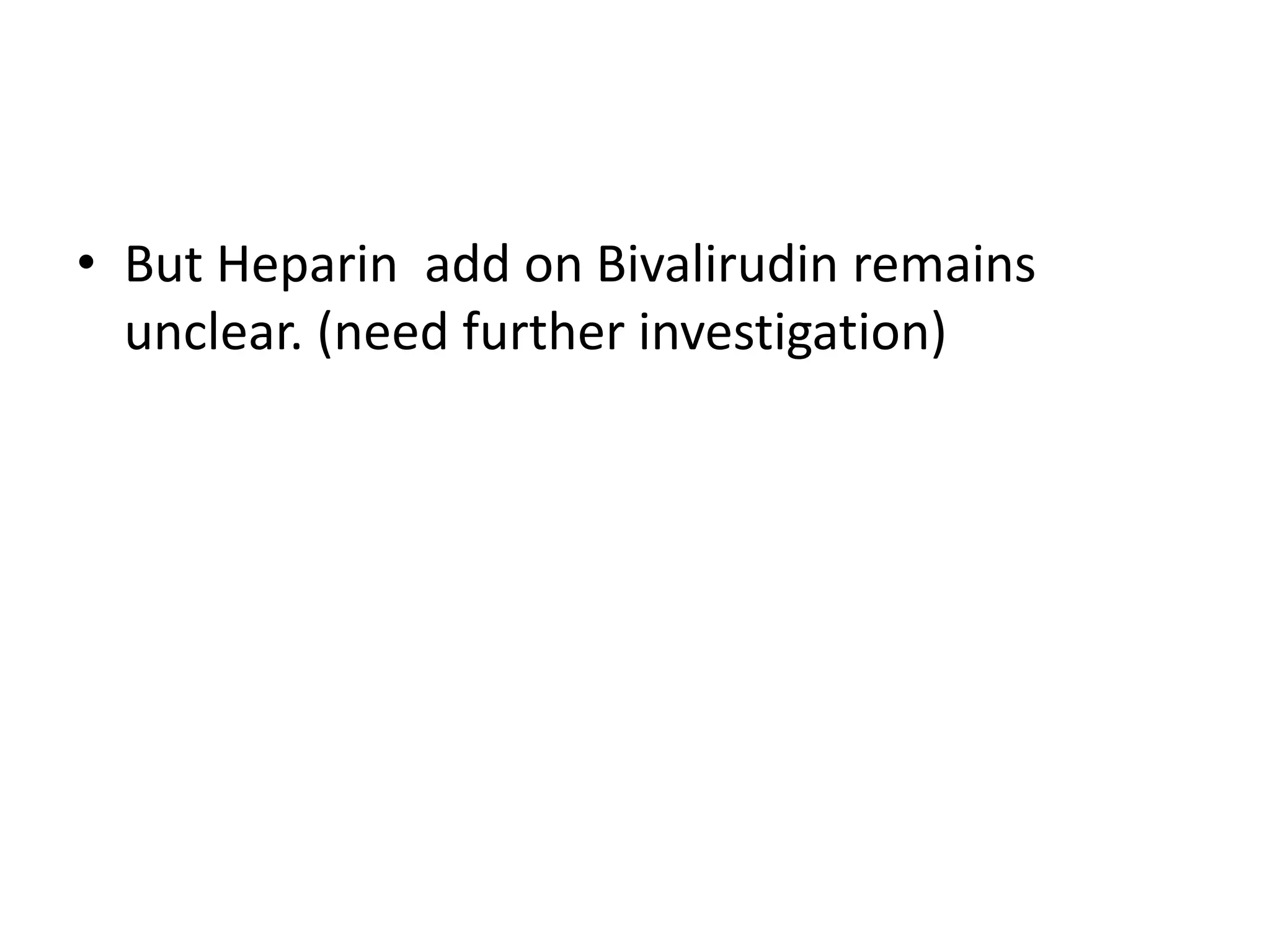
• But Heparin add on Bivalirudin remains
unclear. (need further investigation)
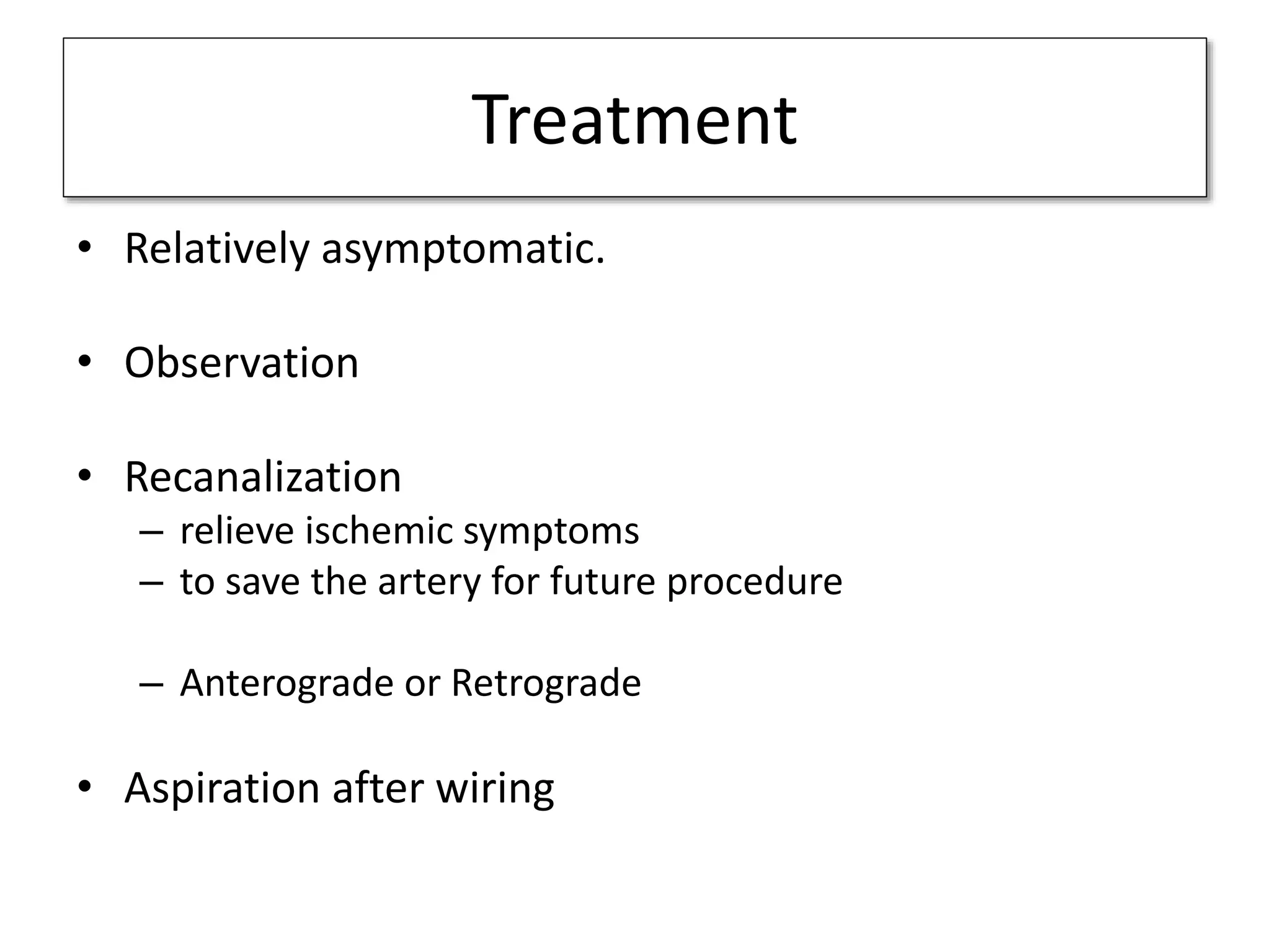
Treatment
• Relatively asymptomatic.
• Observation
• Recanalization
– relieve ischemic symptoms
– to save the artery for future procedure
– Anterograde or Retrograde
• Aspiration after wiring
Conclusions
• Occurs in 1-10%
• Mechanism : Thrombosis
• Strategies for minimized RAO
– Small Sheaths or Sheathless
– Non occlusive hemostasis
– anticoagulation
Thankyou

Radial artery patency after transradial catheterization

  • 1.
    Radial Artery PatencyAfter Transradial Catheterization Mark A Kotowycz,MD , MBA , FRCPC Vladimir Dzavik , MD , FRCPC ,FAHA Presented by Piti Niyomsirivanich , MD. Cardiovascular Fellowship Maharat nakhonratchasima hospital
  • 2.
    Introduction • Transradial Catheterization –Reduce major bleeding – More QOL questionaires score – Earlier ambulation – Same day hospital discharge after PCI – Decrease Cost
  • 3.
    Radial artery occlusion •1-10% of cases • Usually clinically silent due to dual blood supply • And usually overlooked > 50% doesn’t routinely access • But once the artery occluded cannot be used as – access site for the future catheterization – as an arterial conduit for bypass surgery
  • 4.
    Pathophysiology • Thrombotic process –reduced with anticoagulant – radial artery thrombus • (vascular ultrasound , angiography ) • Local endothelial injury after sheath insertion • Cessation of blood flow • Tend to occure early after transradial catheterization 50% spontaneous recanalization within 1-3 months
  • 5.
    Negative effects radialstructural and function • Structure – 67% intimal tear – 36% medial dissections immediately – Small lumen area in repeated more than the 1st time • Intimal hyperplasia • Intima-media thickness • Function – Decrease response to NTG
  • 6.
    Negative effects radialstructural and function • Structure – 67% intimal tear – 36% medial dissections immediately – Small lumen area in repeated more than the 1st time • Intimal hyperplasia • Intima-media thickness • Function – Decrease response to NTG  repeated radial access site failure  reduced graft patency in patient undergoing bypass surgery with radial artery conduits.
  • 7.
    Clinical Presentation Usually Subclinicaldue to ulnar collateral circulation
  • 8.
    • efficacy andsafety – transradial versus femoral approach Radial % Femoral % HR 95% CI P Major Vascular Access site Complications 1.4 3.7 0.37 0.27-0.52 < 0.0001 Other Definition of Major Bleeding TIMI Non- CABG Major bleeding 0.5 0.5 1.0 0.53-1.09 1.00 Acuity Non- CABG Major bleeding 1.9 4.5 4.5 0.32-0.57 < 0.0001 The Lancet, Volume 377, Issue 9775, Pages 1409 - 1420, 23 April 2011 RIVAL Study
  • 11.
    • efficacy andsafety – transradial versus femoral approach Radial % Femoral % HR 95% CI P Major Vascular Access site Complications 1.4 3.7 0.37 0.27-0.52 < 0.0001 Other Definition of Major Bleeding TIMI Non- CABG Major bleeding 0.5 0.5 1.0 0.53-1.09 1.00 Acuity Non- CABG Major bleeding 1.9 4.5 4.5 0.32-0.57 < 0.0001 The Lancet, Volume 377, Issue 9775, Pages 1409 - 1420, 23 April 2011 RIVAL Study
  • 12.
    In summary FromRIVAL Study • no difference in rates of composite – Death. – myocardial infarction. – Stroke. – major bleeding between access strategies. • But – radial access decreased major vascular complications. The Lancet, Volume 377, Issue 9775, Pages 1409 - 1420, 23 April 2011
  • 13.
    Physical examination • Weakor absent radial pulse. • But may have a palpable pulse from collateral ulnar (retrograde filling) • Thus : Dx of RAO should not depend on presence or absence pulse.
  • 14.
    Natural History 71 %improved 20 % diffuse stenosis 60 % partial or complete recanalization Long term (3 months) American Journal of Cardiology Volume 83, Issue 2 , Pages 180-186, 15 January 1999 N=162 routine Ultrasound at Day 2 after transradial catheterization
  • 15.
    Natural History Catheterization andCardiovascular Diagnosis Volume 40, Issue 2, pages 156–158, February 1997 N=563 with a normal Allen test evaluate by U/S RAO 5.3% No complication 47% spontaneous recanalization follow-up (1 months)
  • 16.
    Assessing Dual HandCirculation • Modified Allen Test
  • 17.
    Assessing Dual HandCirculation • Plethysomography and pulse oximetry (barbeau test) No single case observed of hand ischemia in 7000 patients
  • 18.
    Assessing Dual HandCirculation • Duplex ultrasounography (most accurate way)
  • 19.
    Predictors of RAO •Diameter of the sheath • Postprocedure compression time • Presence of anterograde flow during hemostasis • Use of anticoagulation
  • 20.
    Sheath size • Oversizedof Sheath –  vascular remodeling – Thrombosis 250 patients under going PCI Pretreated with NO Journal of the Society for Cardiac Angiography & Interventions [1999, 46(2):173-178] 6F or larger inserted S-A ratio > 1  RAO 13% S-A ratio < 1  RAO 4% (P=0.01)
  • 21.
    Sheath size 171 patients undergoing PCI 6 F Sheath 5 F Sheath RAO 1.1% in 5F group RAO 5.9% in 6F group NAUSICA trial (Ongoing) patients under going PCI Randomized 4F Sheath 6F Sheath RAO 1-month follow-up Catheterization and Cardiovascular Interventions Volume 57, Issue 2, pages 172–176, October 2002 P = 0.08 NCT00815997
  • 22.
    Predict radial arterysize ?? • Associations between radial artery diameter – BW , Ht. Surface area  weak correlation and less predictable J INVASIVE CARDIOL 2013;25(7):353-357
  • 24.
    Options to minimizedthe risks of RAO • 5F system can be used in most patients. • New Sheathless hydrophillic guiding catheters – (external diameter of 5F sheath while 6.5F internal diameter) • Larger guides with an external diameter of 6F sheath that have and internal diameter equivalent to a 7F guide
  • 25.
    Patent Hemostasis • Compressible •But too aggressive compression –  no flow state  thrombosis • Predictor of RAO – Absence of anterograde flow during hemostasis
  • 26.
    Patent Hemostasis • Conventionalpressure application – Versus – PHOPHET trial • Pulse oxymeter guided (HemoBand) • (less RAO at 24 hrs) 5% vs 12%,p<0.05) – RACOMAP trial • Mean artery pressure guided (TR Band) • (less RAO) (1.2% vs 12%,p=0.0001) Catheter Cardiovasc Interv. 2008 Sep 1;72(3):335-40 Enferm Clin. 2009 Jul-Aug;19(4):199-205
  • 27.
  • 28.
    Anticoagulation • Minimize therisk of the RAO • Based on observational data because of no RCT. • Heparin (Current practice 2000-5000 U of heparin)
  • 29.
    Anticoagulant 0 10 20 30 40 50 60 70 80 Spaulding et al.(p<0.05) N=415 Bernad et al. (p = 0.17) N=465 no anticoagulant 2000 U heparin 5000 U heparin 71% 24% 4.3% 4.9% 2.9% Cathet Cardiovasc Diagn. 1996 Dec;39(4):365-70. Am J Cardiol. 2011 Jun 1;107(11):1698-701
  • 30.
    Date of download: 6/10/2014 Copyright© The American College of Cardiology. All rights reserved. Observations From a Transradial Registry: Our Remedies Oft in Ourselves Do Lie⁎ J Am Coll Cardiol Intv. 2012;5(1):44-46. doi:10.1016/j.jcin.2011.10.005 Rates of RAO in Previously Published Studies According to RAO-Avoidance Strategies Used Early = 7 days post-procedure in Sanmartin et al. study (8); hospital discharge in Rathore et al. study (9); 24 h post-procedure in Pancholy et al. study (11); 24 to 72 h post-procedure in Cubero et al. study (12); and 4 to 5 h post-procedure in Bernat et al. study (13). Late = 4 to 6 months post-procedure in Rathore et al. study (9); 4 to 8 weeks in Plante et al. study (10); and 1 month post-procedure in Pancholy et al. study (11). RAO = radial artery occlusion; UFH = unfractionated heparin. Figure Legend: Whether angioplasty was required or not
  • 31.
    • But Heparinadd on Bivalirudin remains unclear. (need further investigation)
  • 32.
    Treatment • Relatively asymptomatic. •Observation • Recanalization – relieve ischemic symptoms – to save the artery for future procedure – Anterograde or Retrograde • Aspiration after wiring
  • 33.
    Conclusions • Occurs in1-10% • Mechanism : Thrombosis • Strategies for minimized RAO – Small Sheaths or Sheathless – Non occlusive hemostasis – anticoagulation
  • 34.