Radial approach and learning curve: 
myth or reality? 
Robert J Applegate, M.D. 
Professor of Internal Medicine-Cardiology
Disclosures 
Advisory Boards Abbott Vascular 
Research Grants Abbott Vascular 
Serruys, PW. PCR 2010 
The Medicines Company 
Wake Forest School of Medicine AimRADIAL 2014
The learning curve for radial artery procedures: 
historical perspective 
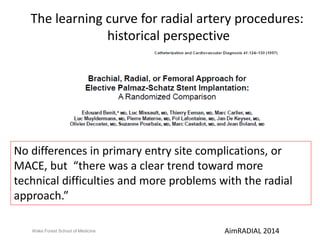
No differences in primary entry site complications, or 
MACE, but โ€œthere was a clear trend toward more 
technical difficulties and more problems with the radial 
approach.โ€ 
Wake Forest School of Medicine AimRADIAL 2014
The learning curve for radial artery procedures: 
historical perspective 
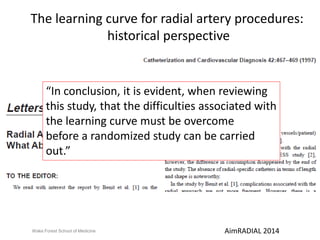
โ€œIn conclusion, it is evident, when reviewing 
this study, that the difficulties associated with 
the learning curve must be overcome 
before a randomized study can be carried 
out.โ€ 
Wake Forest School of Medicine AimRADIAL 2014
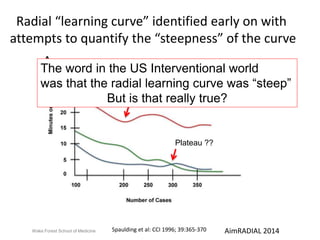
Radial โ€œlearning curveโ€ identified early on with 
attempts to quantify the โ€œsteepnessโ€ of the curve 
The word in the US Interventional world 
was that the radial learning curve was โ€œsteepโ€ 
But Inflection is that ?? 
really true? 
Plateau ?? 
Spaulding et al: CCI 1996; 39:365-370 
Wake Forest School of Medicine AimRADIAL 2014
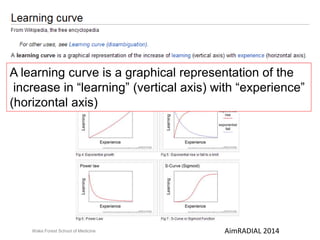
A learning curve is a graphical representation of the 
increase in โ€œlearningโ€ (vertical axis) with โ€œexperienceโ€ 
(horizontal axis) 
The first person to describe the learning curve was Hermann Ebbinghaus in 1885, in 
the field of the psychology of learning 
Wake Forest School of Medicine AimRADIAL 2014
The learning curve for radial artery procedures: 
The learning curve and outcomes 
โ€ข Defining โ€œlearningโ€ is not simple, procedural metrics often 
become โ€œoutcome metricโ€ of learning curve assessment 
โ€ข Complex interaction of factors that influence the learning curve 
โ€ข Establishing causality between individual learning curve 
metric and outcome can be challenging 
Wake Forest School of Medicine AimRADIAL 2014
The US adoption of radial artery procedures 
โ€ข Increases in radial procedures a consequence of entry of 
fellowship trained Cardiologists, as well as post graduate 
training of practicing Cardiologists. 
โ€ข So, evaluation of the learning curve needs to address 
outcomes from both fellowship training and post 
graduate training 
Wake Forest School of Medicine AimRADIAL 2014
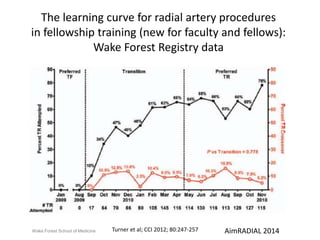
The learning curve for radial artery procedures 
in fellowship training (new for faculty and fellows): 
Wake Forest Registry data 
Wake Forest School of Medicine Turner et al; CCI 2012; 80:247-257 AimRADIAL 2014
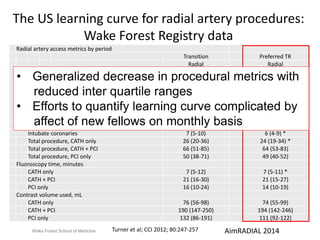
The US learning curve for radial artery procedures: 
Wake Forest Registry data 
Radial artery access metrics by period 
Transition Preferred TR 
Radial Radial 
Metric (N = 610) (N = 897) 
โ€ข Generalized decrease in procedural metrics with 
Access reduced site crossover, n (%) inter quartile ranges 
57 (9.3%) 80 (8.9%) 
Sheath size, Fr 
CATH only 5.0 (0.2) 5.0 (0.1) 
PCI 6.0 (0.4) 5.7 (0.5) * 
โ€ข Efforts to quantify learning curve complicated by 
Procedure time intervals, minutes 
affect of new fellows on monthly basis 
Sheath insertion 5 (3-10) 5 (3-9) * 
Intubate coronaries 7 (5-10) 6 (4-9) * 
Total procedure, CATH only 26 (20-36) 24 (19-34) * 
Total procedure, CATH + PCI 66 (51-85) 64 (53-83) 
Total procedure, PCI only 50 (38-71) 49 (40-52) 
Fluoroscopy time, minutes 
CATH only 7 (5-12) 7 (5-11) * 
CATH + PCI 21 (16-30) 21 (15-27) 
PCI only 16 (10-24) 14 (10-19) 
Contrast volume used, mL 
CATH only 76 (56-98) 74 (55-99) 
CATH + PCI 190 (147-250) 194 (142-246) 
PCI only 132 (86-191) 111 (92-122) 
Turner et al; CCI 2012; 80:247-257 
Wake Forest School of Medicine AimRADIAL 2014
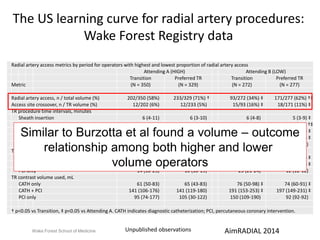
The US learning curve for radial artery procedures: 
Wake Forest Registry data 
Radial artery access metrics by period for operators with highest and lowest proportion of radial artery access 
Attending A (HIGH) Attending B (LOW) 
Transition Preferred TR Transition Preferred TR 
Metric (N = 350) (N = 329) (N = 272) (N = 277) 
Radial artery access, n / total volume (%) 202/350 (58%) 233/329 (71%) โ€  93/272 (34%) โ€ก 171/277 (62%) โ€ โ€ก 
Access site crossover, n / TR volume (%) 12/202 (6%) 12/233 (5%) 15/93 (16%) โ€ก 18/171 (11%) โ€ก 
TR procedure time intervals, minutes 
Sheath insertion 6 (4-11) 6 (3-10) 6 (4-8) 5 (3-9) โ€ก 
Intubate coronaries 6 (4-8) 5 (4-7) โ€  8 (5-13) โ€ก 6 (5-9) โ€ โ€ก 
Total Similar procedure, CATH to only Burzotta et 24 al (17-33) found 20 a (16-volume 28) โ€  29 โ€“ (21-outcome 
37) โ€ก 25 (21-35) โ€ก 
Total procedure, CATH + PCI 61 (47-74) 53 (41-66) โ€  72 (52-95) 68 (59-89) โ€ก 
Total procedure, PCI only 50 (43-62) 51 (28-52) 39 (36-41) 40 (40-40) 
relationship among both higher and lower 
TR fluoroscopy time, minutes 
CATH only 5 (4-8) 5 (3-7) โ€  9 (6-15) โ€ก 8 (6-13) โ€ก 
CATH + PCI 18 (12-26) 15 (11-19) โ€  26 (20-39) โ€ก 22 (16-29) โ€ก 
PCI only 14 (10-23) 16 (10-19) 23 (21-24) 12 (12-12) 
TR contrast volume used, mL 
volume operators 
CATH only 61 (50-83) 65 (43-83) 76 (50-98) โ€ก 74 (60-91) โ€ก 
CATH + PCI 141 (106-176) 141 (119-180) 191 (153-253) โ€ก 197 (149-231) โ€ก 
PCI only 95 (74-177) 105 (30-122) 150 (109-190) 92 (92-92) 
โ€  p<0.05 vs Transition, โ€ก p<0.05 vs Attending A. CATH indicates diagnostic catheterization; PCI, percutaneous coronary intervention. 
Wake Forest School of Medicine Unpublished observations AimRADIAL 2014
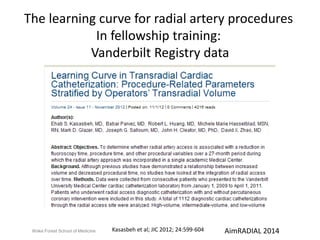
The learning curve for radial artery procedures 
In fellowship training: 
Vanderbilt Registry data 
Kasasbeh et al; JIC 2012; 24:599-604 
Wake Forest School of Medicine AimRADIAL 2014
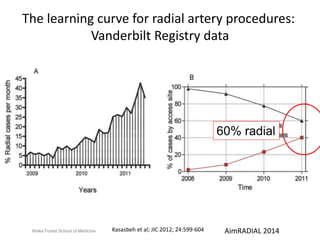
The learning curve for radial artery procedures: 
Vanderbilt Registry data 
60% radial 
Wake Forest School of Medicine Kasasbeh et al; JIC 2012; 24:599-604 AimRADIAL 2014
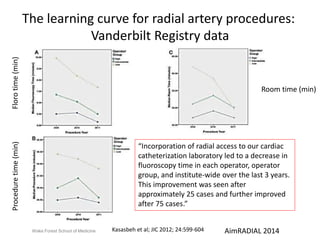
The learning curve for radial artery procedures: 
Vanderbilt Registry data 
Room time (min) 
Wake Forest School of Medicine Kasasbeh et al; JIC 2012; 24:599-604 AimRADIAL 2014 
Procedure time (min) Floro time (min) 
โ€œIncorporation of radial access to our cardiac 
catheterization laboratory led to a decrease in 
fluoroscopy time in each operator, operator 
group, and institute-wide over the last 3 years. 
This improvement was seen after 
approximately 25 cases and further improved 
after 75 cases.โ€
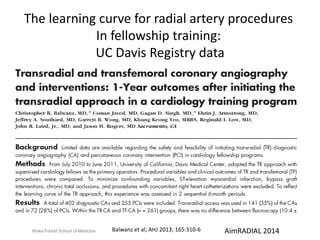
The learning curve for radial artery procedures 
In fellowship training: 
UC Davis Registry data 
Balwanz et al; AHJ 2013; 165:310-6 
Wake Forest School of Medicine AimRADIAL 2014
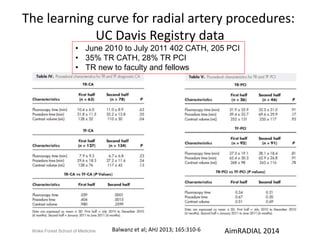
The learning curve for radial artery procedures: 
UC Davis Registry data 
โ€ข June 2010 to July 2011 402 CATH, 205 PCI 
โ€ข 35% TR CATH, 28% TR PCI 
โ€ข TR new to faculty and fellows 
Balwanz et al; AHJ 2013; 165:310-6 
Wake Forest School of Medicine AimRADIAL 2014
The learning curve for radial artery procedures: 
UC Davis Registry data 
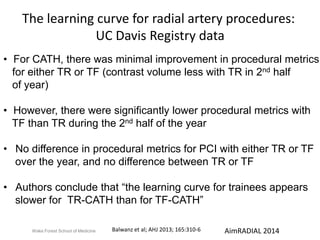
โ€ข For CATH, there was minimal improvement in procedural metrics 
for either TR or TF (contrast volume less with TR in 2nd half 
of year) 
โ€ข However, there were significantly lower procedural metrics with 
TF than TR during the 2nd half of the year 
โ€ข No difference in procedural metrics for PCI with either TR or TF 
over the year, and no difference between TR or TF 
โ€ข Authors conclude that โ€œthe learning curve for trainees appears 
slower for TR-CATH than for TF-CATHโ€ 
Balwanz et al; AHJ 2013; 165:310-6 
Wake Forest School of Medicine AimRADIAL 2014
Post graduate learning curve assessment 
Wake Forest School of Medicine Hess et al Circ 2014; 129:2277-86 AimRADIAL 2014
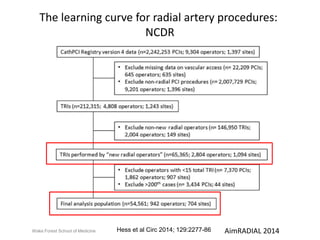
The learning curve for radial artery procedures: 
NCDR 
Hess et al Circ 2014; 129:2277-86 
Wake Forest School of Medicine AimRADIAL 2014
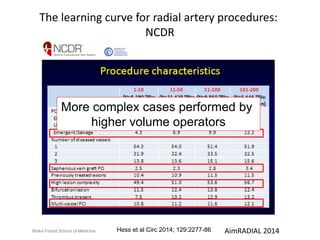
The learning curve for radial artery procedures: 
NCDR 
More complex cases performed by 
higher volume operators 
Hess et al Circ 2014; 129:2277-86 
Wake Forest School of Medicine AimRADIAL 2014
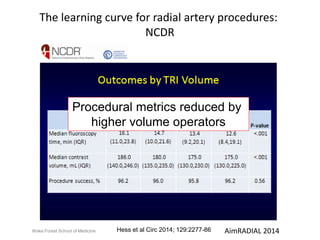
The learning curve for radial artery procedures: 
NCDR 
Procedural metrics reduced by 
higher volume operators 
Hess et al Circ 2014; 129:2277-86 
Wake Forest School of Medicine AimRADIAL 2014
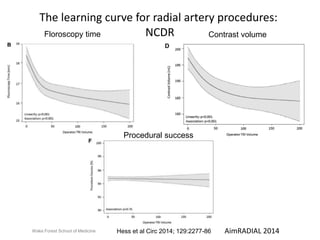
The learning curve for radial artery procedures: 
NCDR 
Floroscopy time Contrast volume 
Procedural success 
Wake Forest School of Medicine Hess et al Circ 2014; 129:2277-86 
AimRADIAL 2014
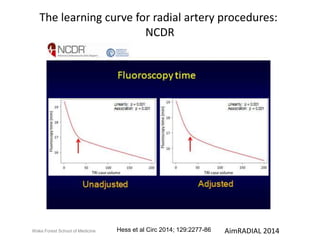
The learning curve for radial artery procedures: 
NCDR 
Hess et al Circ 2014; 129:2277-86 
Wake Forest School of Medicine AimRADIAL 2014
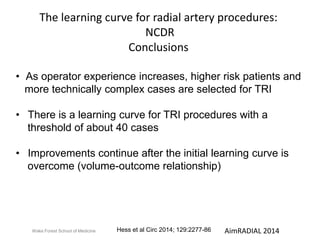
The learning curve for radial artery procedures: 
NCDR 
Conclusions 
โ€ข As operator experience increases, higher risk patients and 
more technically complex cases are selected for TRI 
โ€ข There is a learning curve for TRI procedures with a 
threshold of about 40 cases 
โ€ข Improvements continue after the initial learning curve is 
overcome (volume-outcome relationship) 
Hess et al Circ 2014; 129:2277-86 
Wake Forest School of Medicine AimRADIAL 2014
The learning curve for radial artery procedures: 
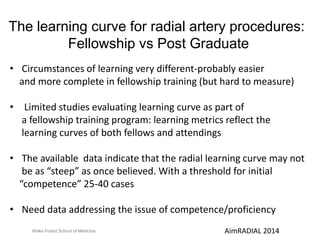
Fellowship vs Post Graduate 
โ€ข Circumstances of learning very different-probably easier 
and more complete in fellowship training (but hard to measure) 
โ€ข Limited studies evaluating learning curve as part of 
a fellowship training program: learning metrics reflect the 
learning curves of both fellows and attendings 
โ€ข The available data indicate that the radial learning curve may not 
be as โ€œsteepโ€ as once believed. With a threshold for initial 
โ€œcompetenceโ€ 25-40 cases 
โ€ข Need data addressing the issue of competence/proficiency 
Wake Forest School of Medicine AimRADIAL 2014
The learning curve for radial artery procedures: 
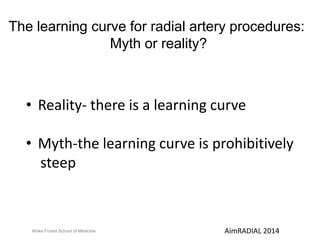
Myth or reality? 
โ€ข Reality- there is a learning curve 
โ€ข Myth-the learning curve is prohibitively 
steep 
Wake Forest School of Medicine AimRADIAL 2014
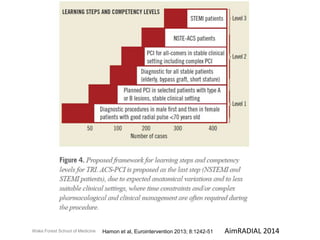
Wake Forest School of Medicine Hamon et al, Eurointervention 2013; 8:1242-51 AimRADIAL 2014

Applegate RJ - AIMRADIAL 2014 - Learning curve

  • 1.
    Radial approach andlearning curve: myth or reality? Robert J Applegate, M.D. Professor of Internal Medicine-Cardiology
  • 2.
    Disclosures Advisory BoardsAbbott Vascular Research Grants Abbott Vascular Serruys, PW. PCR 2010 The Medicines Company Wake Forest School of Medicine AimRADIAL 2014
  • 3.
    The learning curvefor radial artery procedures: historical perspective No differences in primary entry site complications, or MACE, but โ€œthere was a clear trend toward more technical difficulties and more problems with the radial approach.โ€ Wake Forest School of Medicine AimRADIAL 2014
  • 4.
    The learning curvefor radial artery procedures: historical perspective โ€œIn conclusion, it is evident, when reviewing this study, that the difficulties associated with the learning curve must be overcome before a randomized study can be carried out.โ€ Wake Forest School of Medicine AimRADIAL 2014
  • 5.
    Radial โ€œlearning curveโ€identified early on with attempts to quantify the โ€œsteepnessโ€ of the curve The word in the US Interventional world was that the radial learning curve was โ€œsteepโ€ But Inflection is that ?? really true? Plateau ?? Spaulding et al: CCI 1996; 39:365-370 Wake Forest School of Medicine AimRADIAL 2014
  • 6.
    A learning curveis a graphical representation of the increase in โ€œlearningโ€ (vertical axis) with โ€œexperienceโ€ (horizontal axis) The first person to describe the learning curve was Hermann Ebbinghaus in 1885, in the field of the psychology of learning Wake Forest School of Medicine AimRADIAL 2014
  • 7.
    The learning curvefor radial artery procedures: The learning curve and outcomes โ€ข Defining โ€œlearningโ€ is not simple, procedural metrics often become โ€œoutcome metricโ€ of learning curve assessment โ€ข Complex interaction of factors that influence the learning curve โ€ข Establishing causality between individual learning curve metric and outcome can be challenging Wake Forest School of Medicine AimRADIAL 2014
  • 8.
    The US adoptionof radial artery procedures โ€ข Increases in radial procedures a consequence of entry of fellowship trained Cardiologists, as well as post graduate training of practicing Cardiologists. โ€ข So, evaluation of the learning curve needs to address outcomes from both fellowship training and post graduate training Wake Forest School of Medicine AimRADIAL 2014
  • 9.
    The learning curvefor radial artery procedures in fellowship training (new for faculty and fellows): Wake Forest Registry data Wake Forest School of Medicine Turner et al; CCI 2012; 80:247-257 AimRADIAL 2014
  • 10.
    The US learningcurve for radial artery procedures: Wake Forest Registry data Radial artery access metrics by period Transition Preferred TR Radial Radial Metric (N = 610) (N = 897) โ€ข Generalized decrease in procedural metrics with Access reduced site crossover, n (%) inter quartile ranges 57 (9.3%) 80 (8.9%) Sheath size, Fr CATH only 5.0 (0.2) 5.0 (0.1) PCI 6.0 (0.4) 5.7 (0.5) * โ€ข Efforts to quantify learning curve complicated by Procedure time intervals, minutes affect of new fellows on monthly basis Sheath insertion 5 (3-10) 5 (3-9) * Intubate coronaries 7 (5-10) 6 (4-9) * Total procedure, CATH only 26 (20-36) 24 (19-34) * Total procedure, CATH + PCI 66 (51-85) 64 (53-83) Total procedure, PCI only 50 (38-71) 49 (40-52) Fluoroscopy time, minutes CATH only 7 (5-12) 7 (5-11) * CATH + PCI 21 (16-30) 21 (15-27) PCI only 16 (10-24) 14 (10-19) Contrast volume used, mL CATH only 76 (56-98) 74 (55-99) CATH + PCI 190 (147-250) 194 (142-246) PCI only 132 (86-191) 111 (92-122) Turner et al; CCI 2012; 80:247-257 Wake Forest School of Medicine AimRADIAL 2014
  • 11.
    The US learningcurve for radial artery procedures: Wake Forest Registry data Radial artery access metrics by period for operators with highest and lowest proportion of radial artery access Attending A (HIGH) Attending B (LOW) Transition Preferred TR Transition Preferred TR Metric (N = 350) (N = 329) (N = 272) (N = 277) Radial artery access, n / total volume (%) 202/350 (58%) 233/329 (71%) โ€  93/272 (34%) โ€ก 171/277 (62%) โ€ โ€ก Access site crossover, n / TR volume (%) 12/202 (6%) 12/233 (5%) 15/93 (16%) โ€ก 18/171 (11%) โ€ก TR procedure time intervals, minutes Sheath insertion 6 (4-11) 6 (3-10) 6 (4-8) 5 (3-9) โ€ก Intubate coronaries 6 (4-8) 5 (4-7) โ€  8 (5-13) โ€ก 6 (5-9) โ€ โ€ก Total Similar procedure, CATH to only Burzotta et 24 al (17-33) found 20 a (16-volume 28) โ€  29 โ€“ (21-outcome 37) โ€ก 25 (21-35) โ€ก Total procedure, CATH + PCI 61 (47-74) 53 (41-66) โ€  72 (52-95) 68 (59-89) โ€ก Total procedure, PCI only 50 (43-62) 51 (28-52) 39 (36-41) 40 (40-40) relationship among both higher and lower TR fluoroscopy time, minutes CATH only 5 (4-8) 5 (3-7) โ€  9 (6-15) โ€ก 8 (6-13) โ€ก CATH + PCI 18 (12-26) 15 (11-19) โ€  26 (20-39) โ€ก 22 (16-29) โ€ก PCI only 14 (10-23) 16 (10-19) 23 (21-24) 12 (12-12) TR contrast volume used, mL volume operators CATH only 61 (50-83) 65 (43-83) 76 (50-98) โ€ก 74 (60-91) โ€ก CATH + PCI 141 (106-176) 141 (119-180) 191 (153-253) โ€ก 197 (149-231) โ€ก PCI only 95 (74-177) 105 (30-122) 150 (109-190) 92 (92-92) โ€  p<0.05 vs Transition, โ€ก p<0.05 vs Attending A. CATH indicates diagnostic catheterization; PCI, percutaneous coronary intervention. Wake Forest School of Medicine Unpublished observations AimRADIAL 2014
  • 12.
    The learning curvefor radial artery procedures In fellowship training: Vanderbilt Registry data Kasasbeh et al; JIC 2012; 24:599-604 Wake Forest School of Medicine AimRADIAL 2014
  • 13.
    The learning curvefor radial artery procedures: Vanderbilt Registry data 60% radial Wake Forest School of Medicine Kasasbeh et al; JIC 2012; 24:599-604 AimRADIAL 2014
  • 14.
    The learning curvefor radial artery procedures: Vanderbilt Registry data Room time (min) Wake Forest School of Medicine Kasasbeh et al; JIC 2012; 24:599-604 AimRADIAL 2014 Procedure time (min) Floro time (min) โ€œIncorporation of radial access to our cardiac catheterization laboratory led to a decrease in fluoroscopy time in each operator, operator group, and institute-wide over the last 3 years. This improvement was seen after approximately 25 cases and further improved after 75 cases.โ€
  • 15.
    The learning curvefor radial artery procedures In fellowship training: UC Davis Registry data Balwanz et al; AHJ 2013; 165:310-6 Wake Forest School of Medicine AimRADIAL 2014
  • 16.
    The learning curvefor radial artery procedures: UC Davis Registry data โ€ข June 2010 to July 2011 402 CATH, 205 PCI โ€ข 35% TR CATH, 28% TR PCI โ€ข TR new to faculty and fellows Balwanz et al; AHJ 2013; 165:310-6 Wake Forest School of Medicine AimRADIAL 2014
  • 17.
    The learning curvefor radial artery procedures: UC Davis Registry data โ€ข For CATH, there was minimal improvement in procedural metrics for either TR or TF (contrast volume less with TR in 2nd half of year) โ€ข However, there were significantly lower procedural metrics with TF than TR during the 2nd half of the year โ€ข No difference in procedural metrics for PCI with either TR or TF over the year, and no difference between TR or TF โ€ข Authors conclude that โ€œthe learning curve for trainees appears slower for TR-CATH than for TF-CATHโ€ Balwanz et al; AHJ 2013; 165:310-6 Wake Forest School of Medicine AimRADIAL 2014
  • 18.
    Post graduate learningcurve assessment Wake Forest School of Medicine Hess et al Circ 2014; 129:2277-86 AimRADIAL 2014
  • 19.
    The learning curvefor radial artery procedures: NCDR Hess et al Circ 2014; 129:2277-86 Wake Forest School of Medicine AimRADIAL 2014
  • 20.
    The learning curvefor radial artery procedures: NCDR More complex cases performed by higher volume operators Hess et al Circ 2014; 129:2277-86 Wake Forest School of Medicine AimRADIAL 2014
  • 21.
    The learning curvefor radial artery procedures: NCDR Procedural metrics reduced by higher volume operators Hess et al Circ 2014; 129:2277-86 Wake Forest School of Medicine AimRADIAL 2014
  • 22.
    The learning curvefor radial artery procedures: NCDR Floroscopy time Contrast volume Procedural success Wake Forest School of Medicine Hess et al Circ 2014; 129:2277-86 AimRADIAL 2014
  • 23.
    The learning curvefor radial artery procedures: NCDR Hess et al Circ 2014; 129:2277-86 Wake Forest School of Medicine AimRADIAL 2014
  • 24.
    The learning curvefor radial artery procedures: NCDR Conclusions โ€ข As operator experience increases, higher risk patients and more technically complex cases are selected for TRI โ€ข There is a learning curve for TRI procedures with a threshold of about 40 cases โ€ข Improvements continue after the initial learning curve is overcome (volume-outcome relationship) Hess et al Circ 2014; 129:2277-86 Wake Forest School of Medicine AimRADIAL 2014
  • 25.
    The learning curvefor radial artery procedures: Fellowship vs Post Graduate โ€ข Circumstances of learning very different-probably easier and more complete in fellowship training (but hard to measure) โ€ข Limited studies evaluating learning curve as part of a fellowship training program: learning metrics reflect the learning curves of both fellows and attendings โ€ข The available data indicate that the radial learning curve may not be as โ€œsteepโ€ as once believed. With a threshold for initial โ€œcompetenceโ€ 25-40 cases โ€ข Need data addressing the issue of competence/proficiency Wake Forest School of Medicine AimRADIAL 2014
  • 26.
    The learning curvefor radial artery procedures: Myth or reality? โ€ข Reality- there is a learning curve โ€ข Myth-the learning curve is prohibitively steep Wake Forest School of Medicine AimRADIAL 2014
  • 27.
    Wake Forest Schoolof Medicine Hamon et al, Eurointervention 2013; 8:1242-51 AimRADIAL 2014
  • 28.
    Wake Forest Schoolof Medicine Hamon et al, Eurointervention 2013; 8:1242-51 AimRADIAL 2014