RADIALISTS PERFORM BETTER 
FEMORAL PCI 
Jim Nolan 
University Hospital of North Staffordshire
WHY DOESN’T EVERYBODY USE 
RADIAL ACCESS 
• Learning curve 
• Extended Procedural duration 
• Increased nursing input 
• Patient preference 
• Impaired Procedural success and applicability 
• Increased cost of radial specific kit 
• Radiation exposure 
• If they do they will lose the ability to do safe TFA
RADIAL ENVIRONMENT 
• Small calibre vessel 
• Spasm risk 
• Anatomical variation 
• Advanced guide catheter techniques 
• Skilled high volume TRA operators are 
highly proficient interventionists ( as are 
their teams )
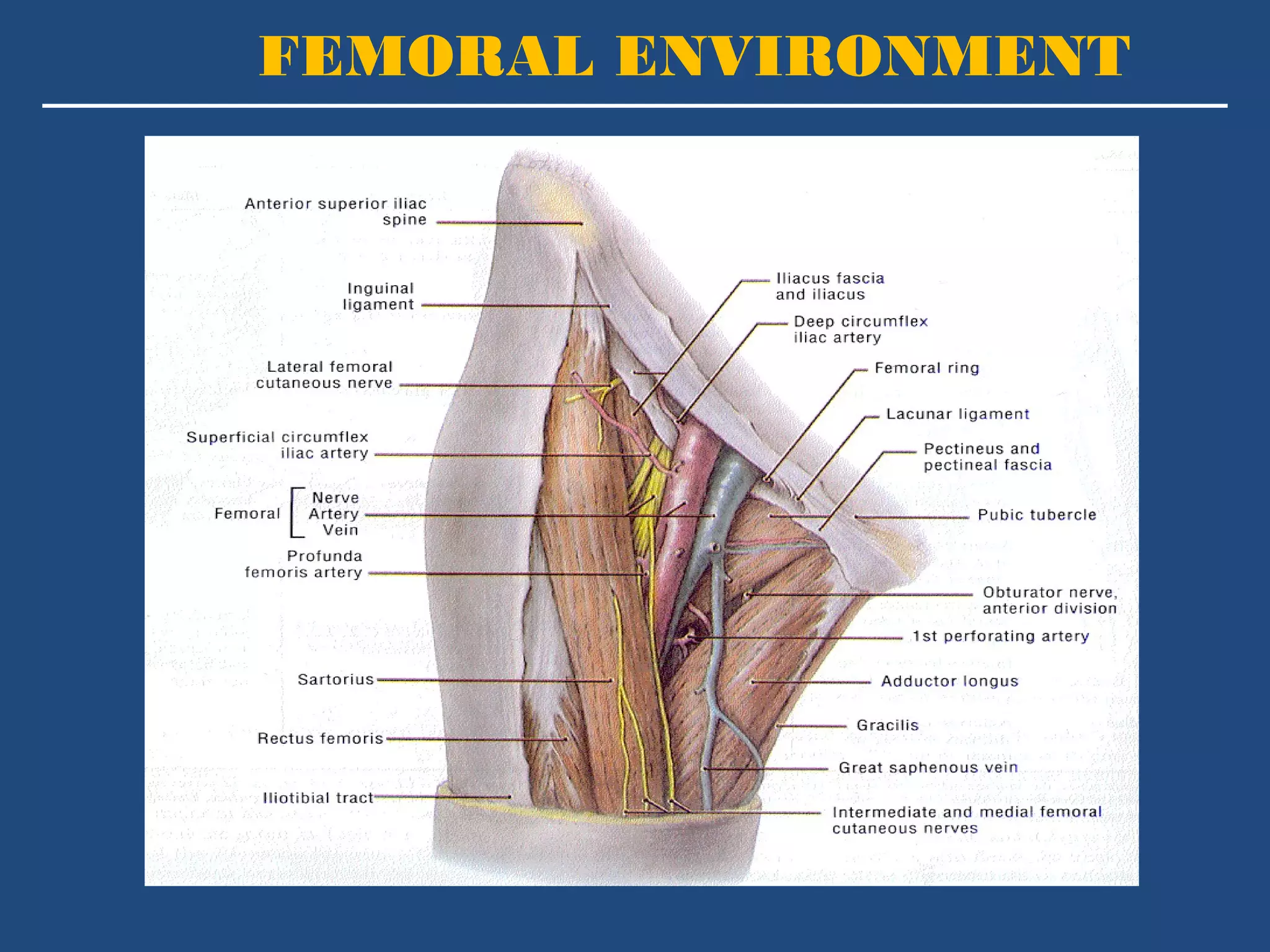
FEMORAL ENVIRONMENT
FACTORS THAT MAY ACT TO INCREASE TFA 
COMPLICATIONS IN RADIAL CENTERS 
• Fewer TFA procedures 
• Reduced exposure to technique for 
operators in training and daily practice 
• Reduced institutional experience with post 
TFA care
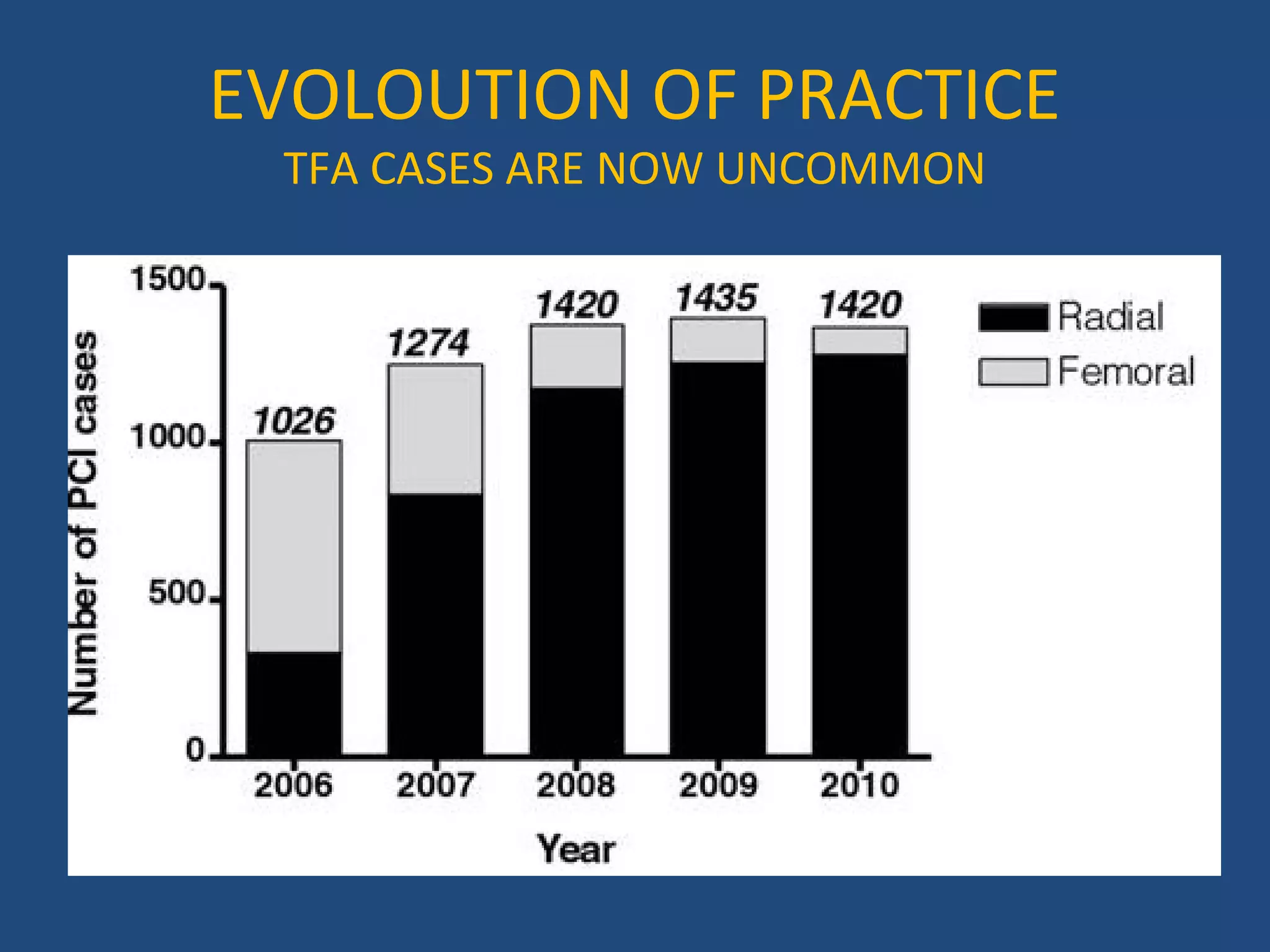
EVOLOUTION OF PRACTICE 
TFA CASES ARE NOW UNCOMMON
FACTORS THAT MAY ACT TO REDUCE 
TFA COMPLICATIONS IN A RADIAL 
CENTER 
•When a TRA operator has to perform a TFA 
case it is done with maximum attention to 
puncture, haemostasis and aftercare 
•TRA operators performing TFA frequently 
use guidance for the puncture 
•Limited use of VCDs
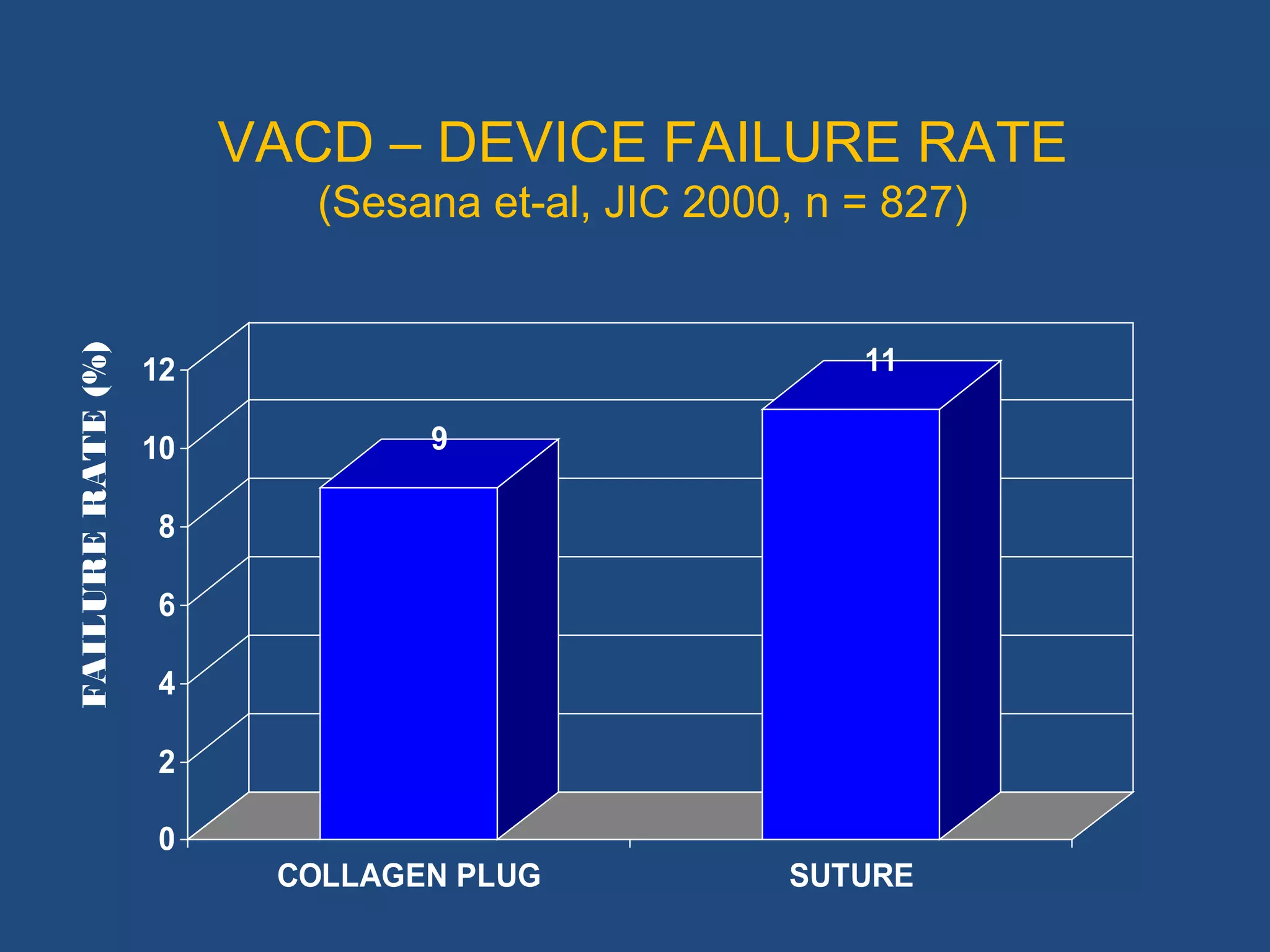
VACD – DEVICE FAILURE RATE 
(Sesana et-al, JIC 2000, n = 827) 
(%) 
RATE 9 
FAILURE COLLAGEN PLUG SUTURE 11 
12 
10 
8 
6 
4 
2 
0
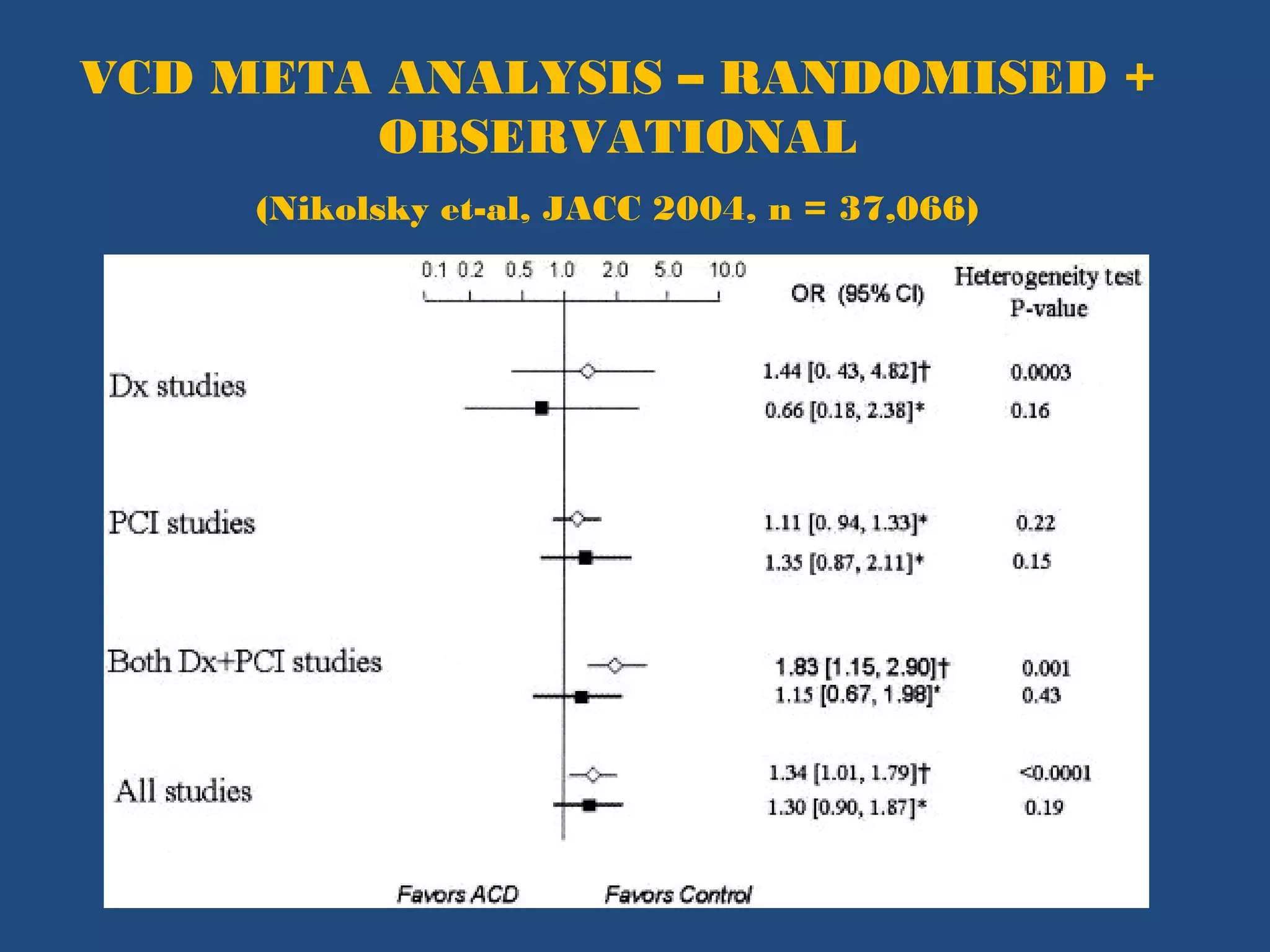
VCD META ANALYSIS – RANDOMISED + 
OBSERVATIONAL 
(Nikolsky et-al, JACC 2004, n = 37,066)
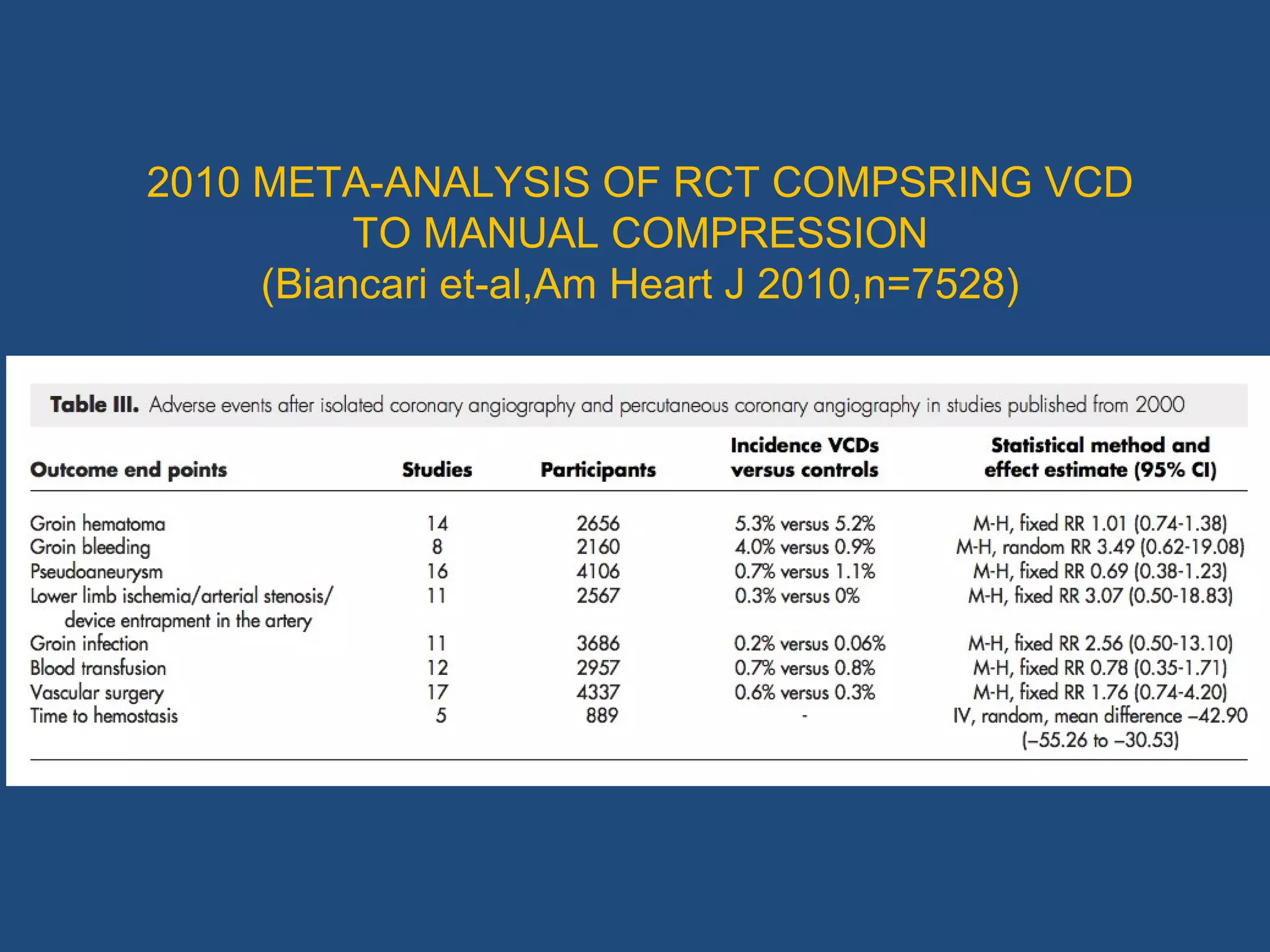
2010 META-ANALYSIS OF RCT COMPSRING VCD 
TO MANUAL COMPRESSION 
(Biancari et-al,Am Heart J 2010,n=7528)
HOW CAN WE INVESTIGATE THE 
SAFETY OF TFA IN RADIAL 
CENTERS
PATIENTS UNDERGOING PCI FROM 
THE FEMORAL ROUTE BY DEFAULT 
RADIAL OPERATORS 
Ihsan M. Rafie, MD; Muez M. Uddin, MD; Nicholas Ossei-Gerning, MD; Richard A. Anderson, MD; Timothy D. 
Kinnaird*, MD 
Department of Cardiology, University Hospital of Wales, Cardiff, United Kingdom 
Eurointervention 2014
CARDIFF STUDY 
• 1352 PCI procedures performed by default 
radial operators over 12 month period 
• TFA used when operator felt it to be 
technically and clinically appropriate ( skilled 
TFA operators) 
• ACUITY based definition of TFA related 
complications ( included haematomas that 
were not associated with Hb fall and required 
no intervention) 
• TFA utilised in 351 (25.2%) cases
WHAT TYPE OF PATIENT HAD TFA IN 
THE CARDIFF STUDY 
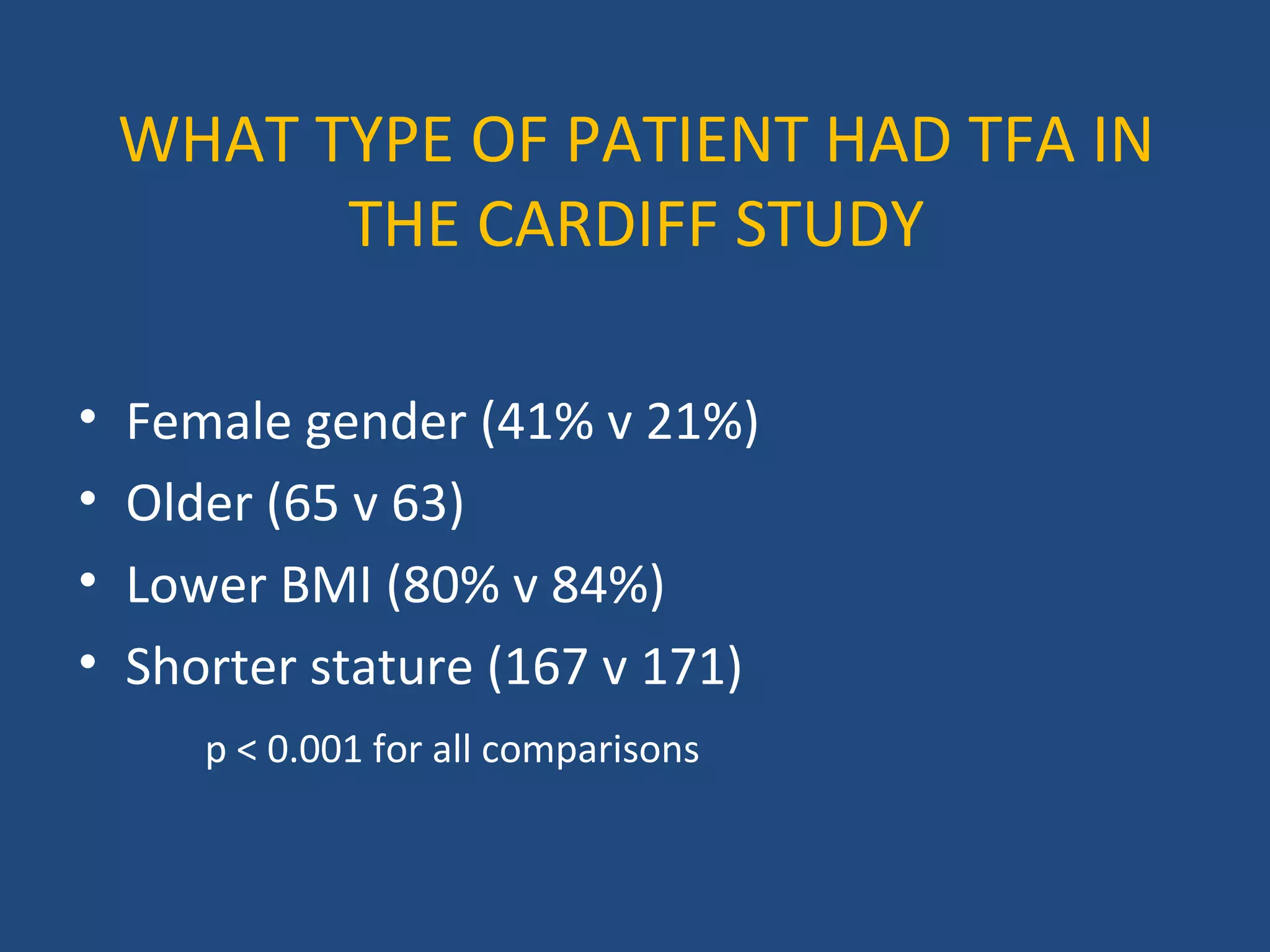
• Female gender (41% v 21%) 
• Older (65 v 63) 
• Lower BMI (80% v 84%) 
• Shorter stature (167 v 171) 
p < 0.001 for all comparisons
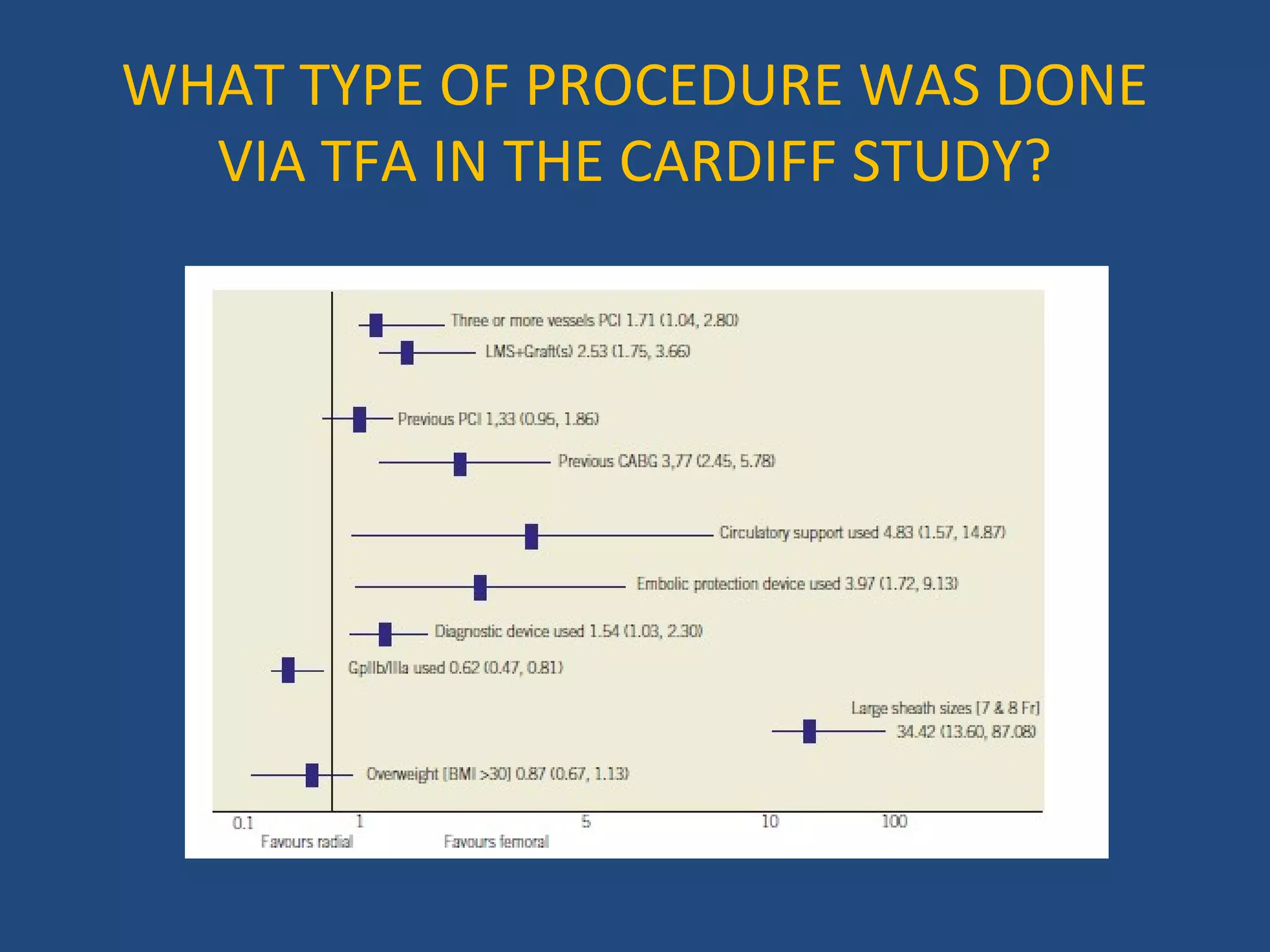
WHAT TYPE OF PROCEDURE WAS DONE 
VIA TFA IN THE CARDIFF STUDY?
RESULTS IN TFA CASES 
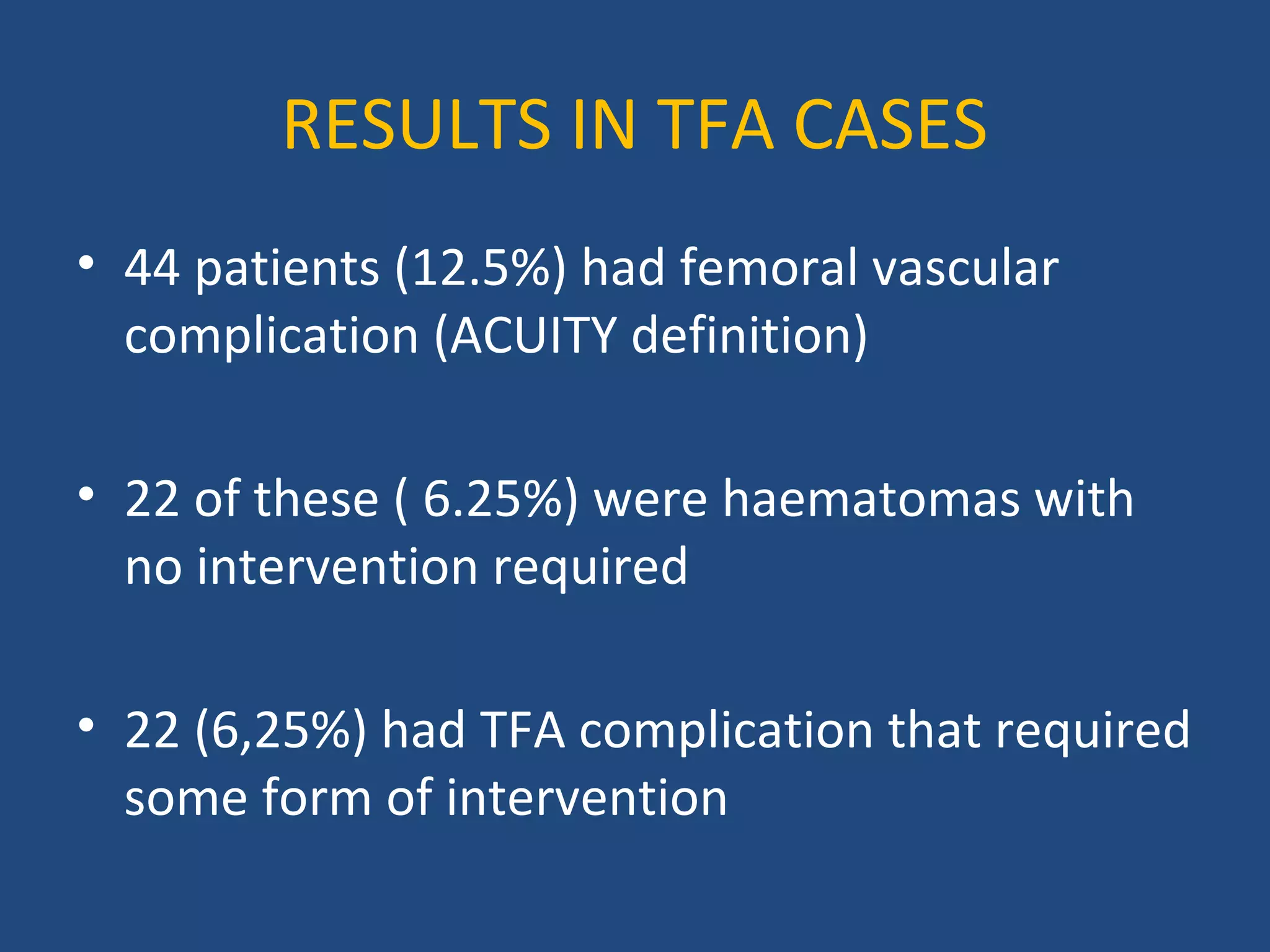
• 44 patients (12.5%) had femoral vascular 
complication (ACUITY definition) 
• 22 of these ( 6.25%) were haematomas with 
no intervention required 
• 22 (6,25%) had TFA complication that required 
some form of intervention
The use of radial access decreases the risk of 
vascular access-site-related complications at a 
patient level but is associated with an 
increased risk at a population level: the radial 
paradox 
Lorenzo Azzalini, MD, MSc; E. Marc Jolicoeur*, MD, MSc, MHS 
Interventional Cardiology Division, Dept. of Medicine, Montreal Heart 
Institute, Université de Montréal, Montréal, QC, Canada
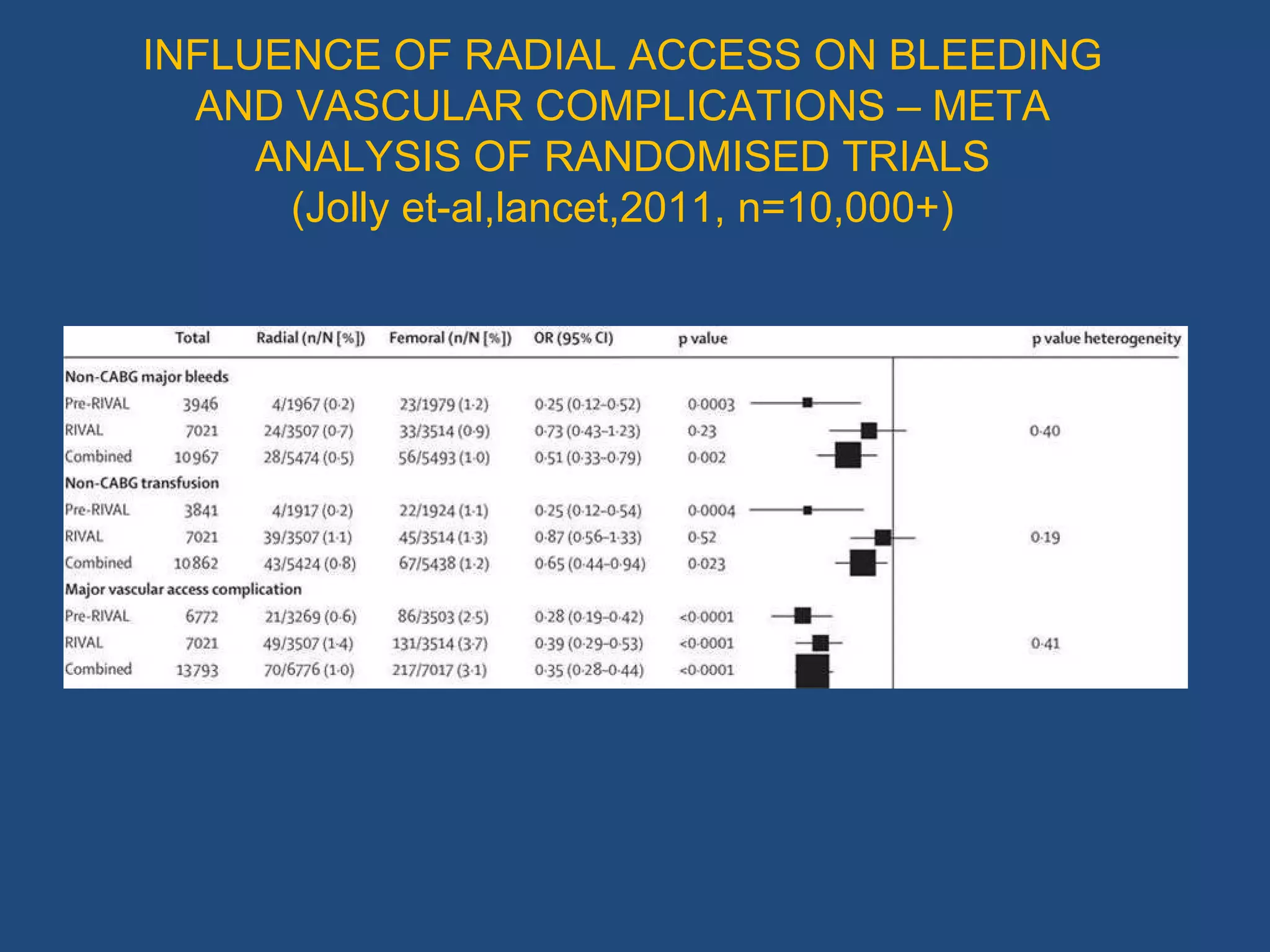
INFLUENCE OF RADIAL ACCESS ON BLEEDING 
AND VASCULAR COMPLICATIONS – META 
ANALYSIS OF RANDOMISED TRIALS 
(Jolly et-al,lancet,2011, n=10,000+)
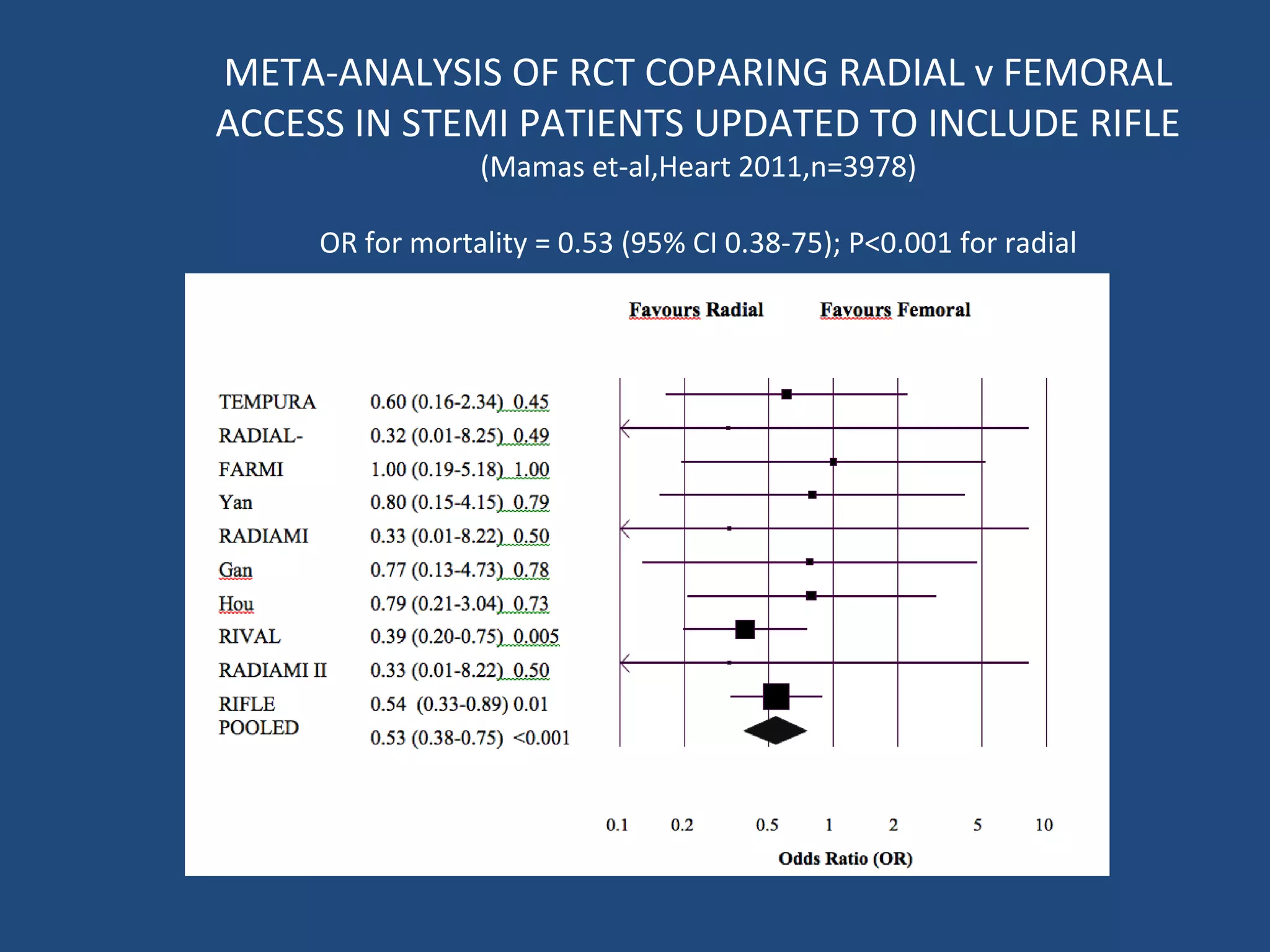
META-ANALYSIS OF RCT COPARING RADIAL v FEMORAL 
ACCESS IN STEMI PATIENTS UPDATED TO INCLUDE RIFLE 
(Mamas et-al,Heart 2011,n=3978) 
OR for mortality = 0.53 (95% CI 0.38-75); P<0.001 for radial
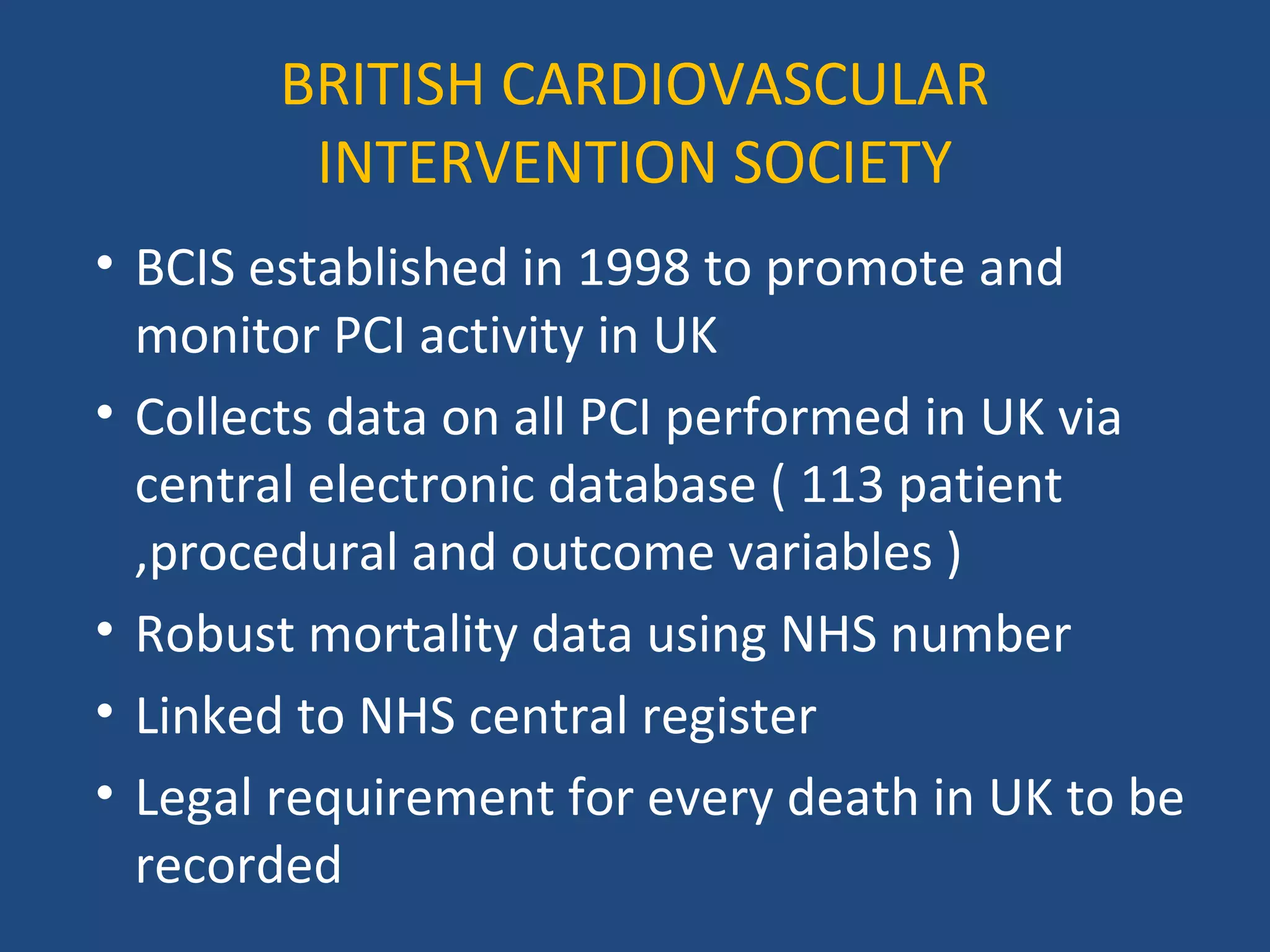
BRITISH CARDIOVASCULAR 
INTERVENTION SOCIETY 
• BCIS established in 1998 to promote and 
monitor PCI activity in UK 
• Collects data on all PCI performed in UK via 
central electronic database ( 113 patient 
,procedural and outcome variables ) 
• Robust mortality data using NHS number 
• Linked to NHS central register 
• Legal requirement for every death in UK to be 
recorded
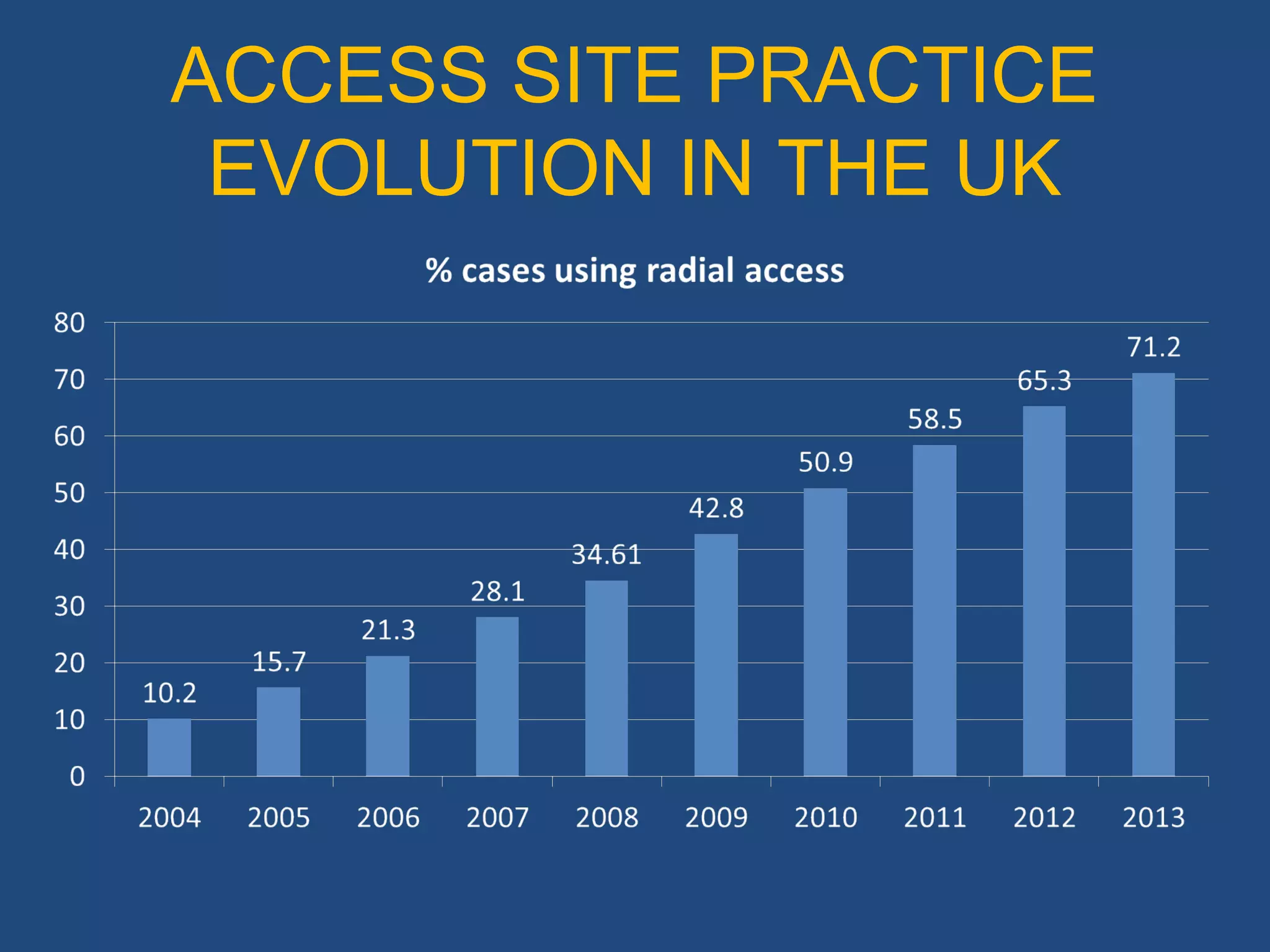
ACCESS SITE PRACTICE 
EVOLUTION IN THE UK
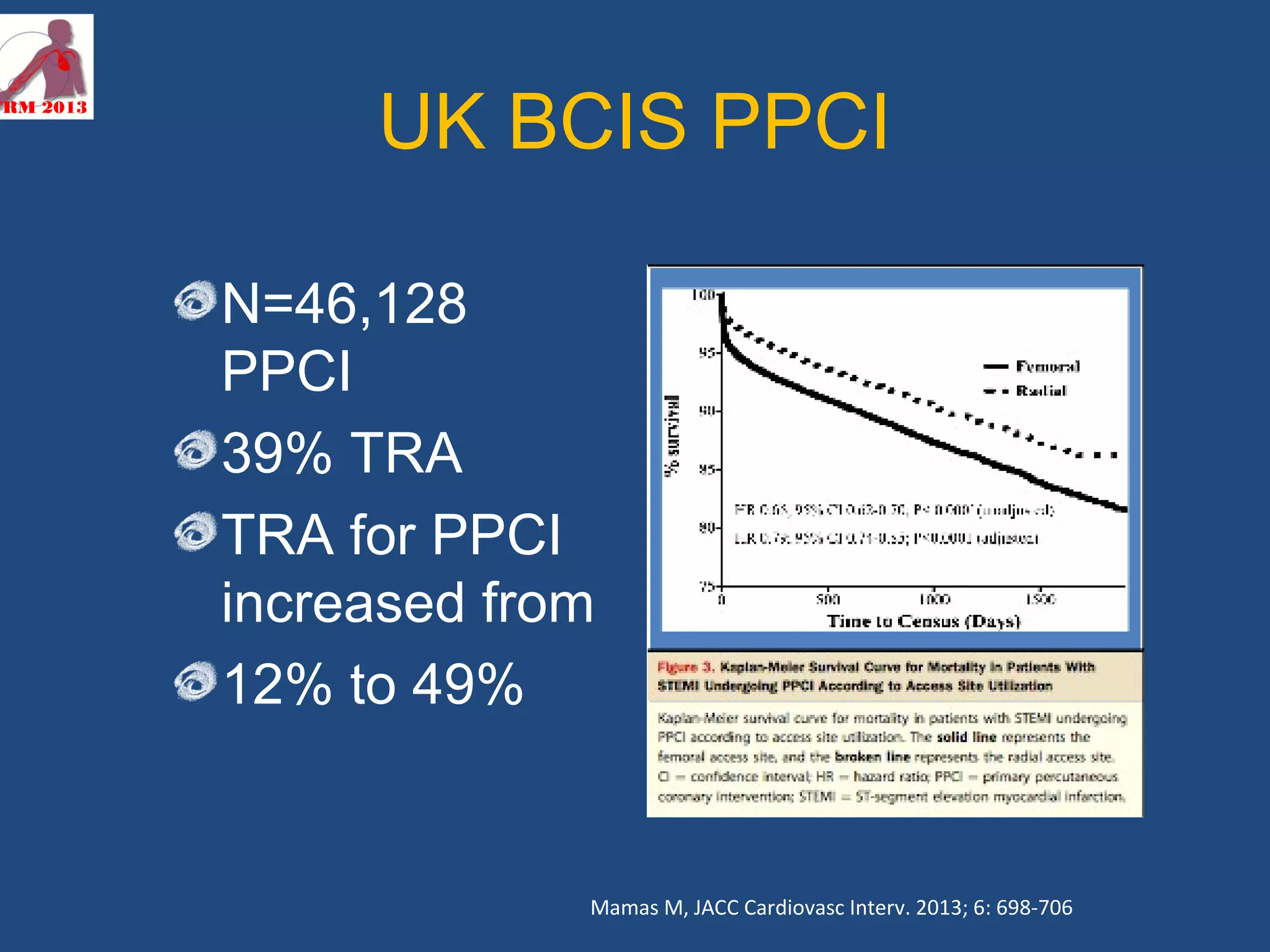
UK BCIS PPCI 
N=46,128 
PPCI 
39% TRA 
TRA for PPCI 
increased from 
12% to 49% 
Mamas M, JACC Cardiovasc Interv. 2013; 6: 698-706 
TRM 2013
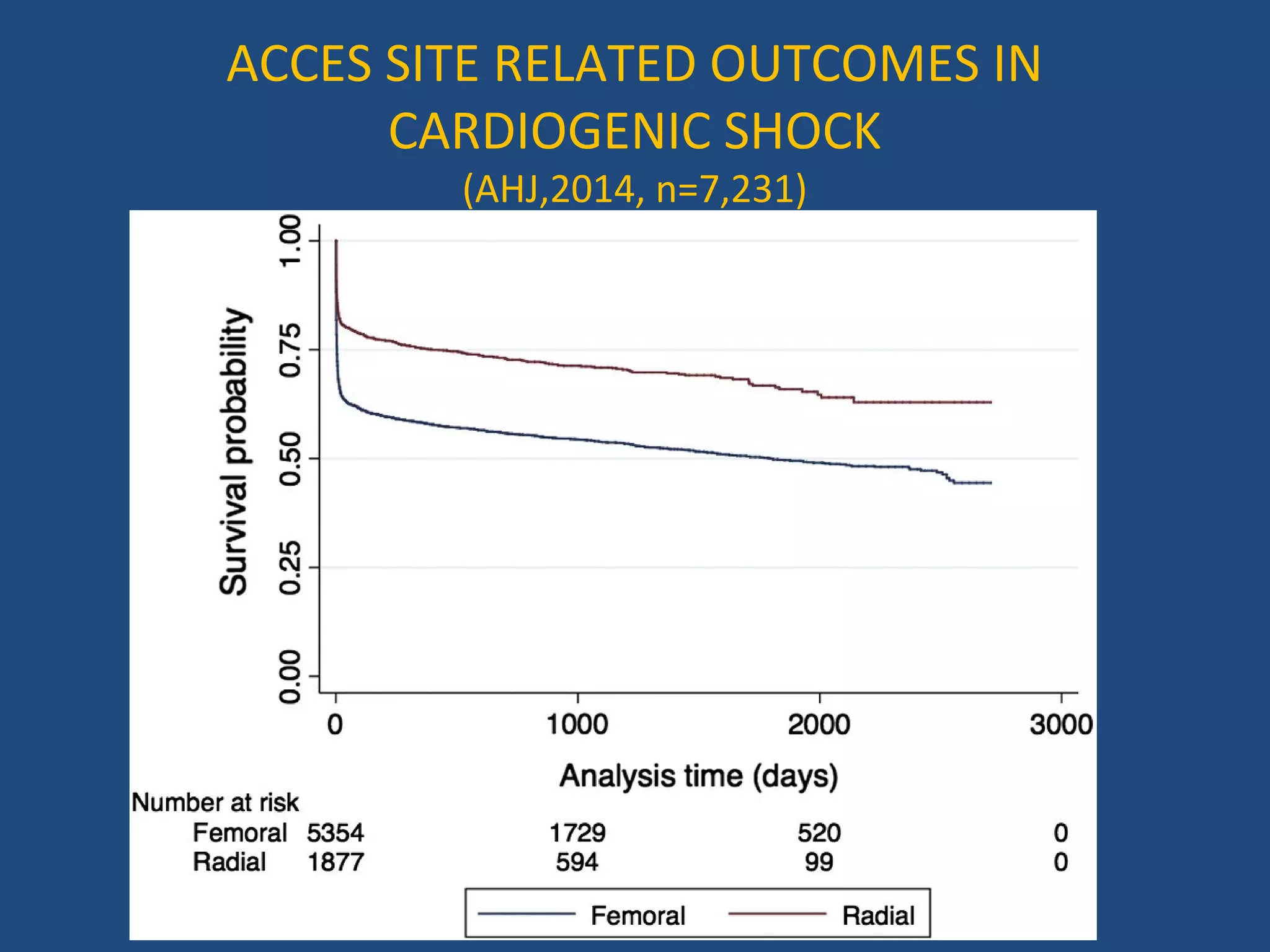
ACCES SITE RELATED OUTCOMES IN 
CARDIOGENIC SHOCK 
(AHJ,2014, n=7,231)
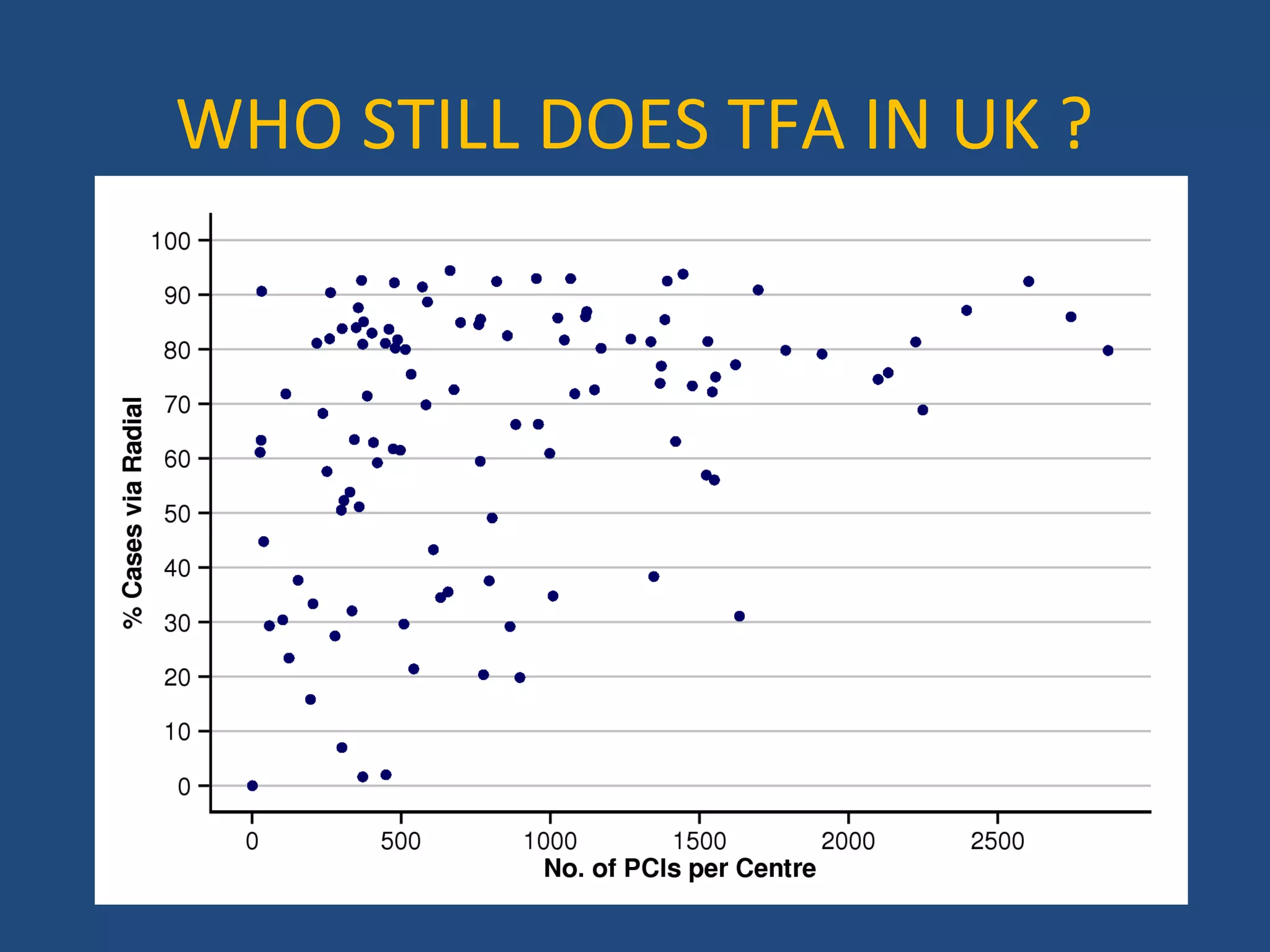
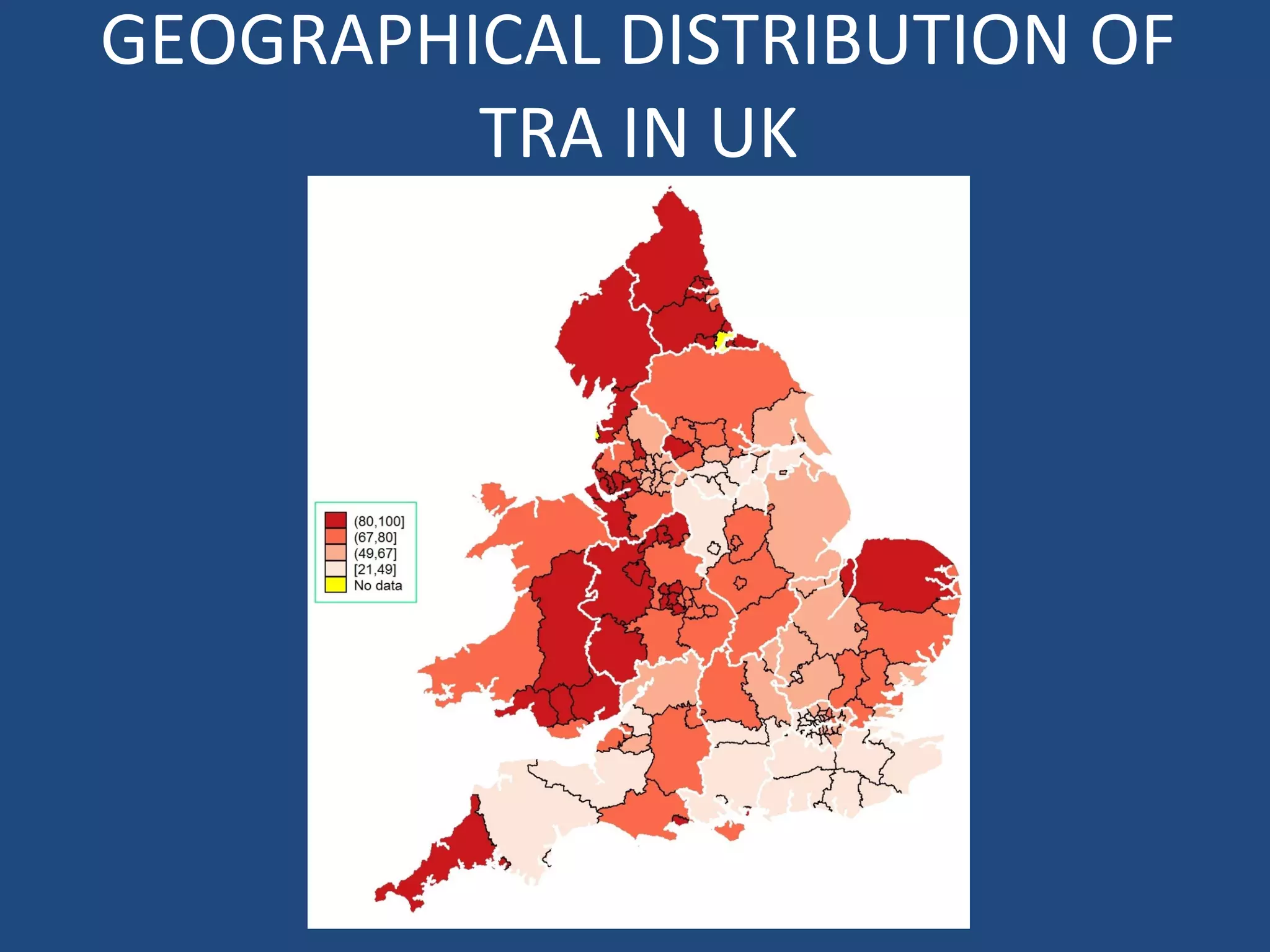
WHO STILL DOES TFA IN UK ?
GEOGRAPHICAL DISTRIBUTION OF 
TRA IN UK
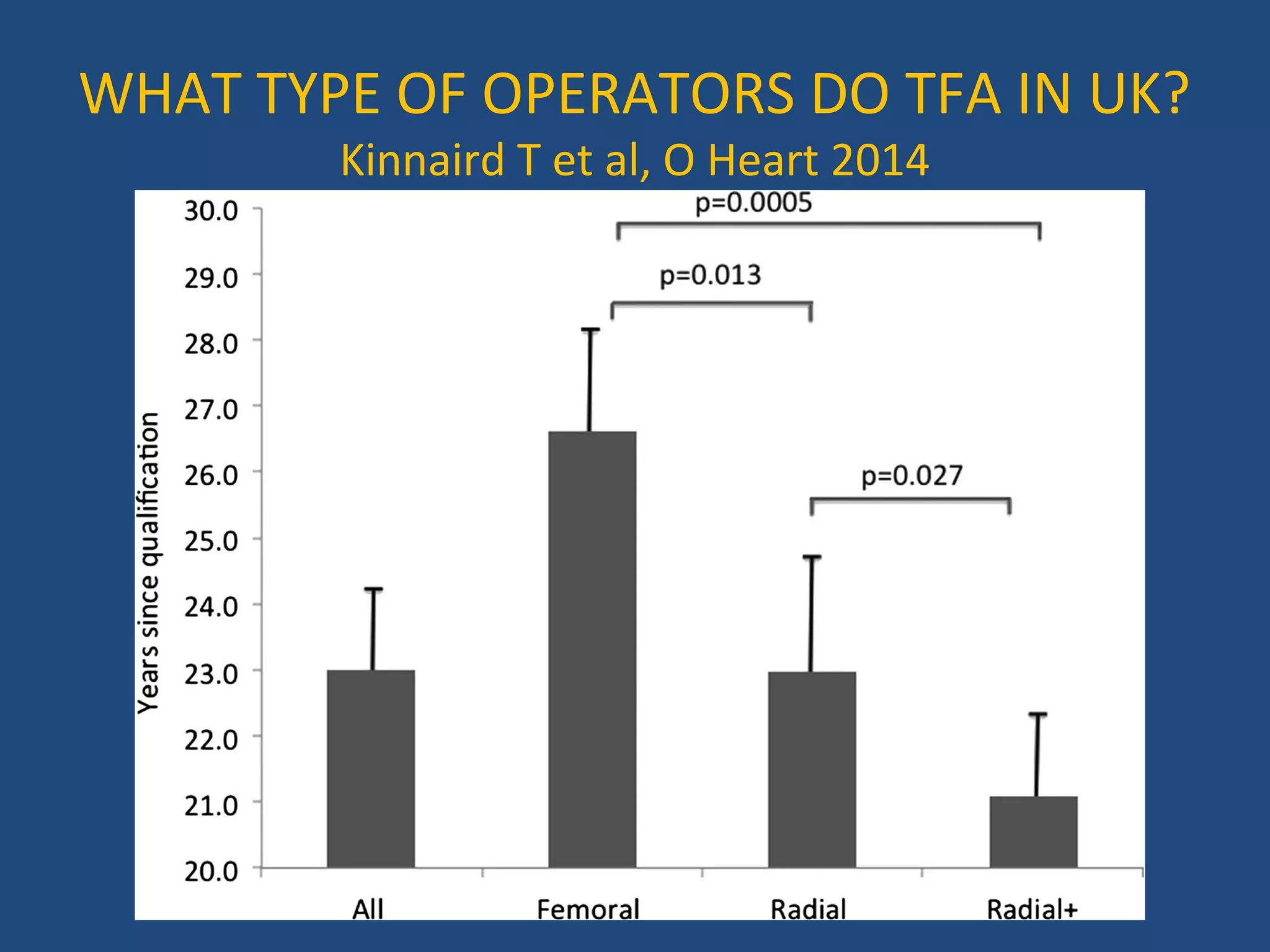
WHAT TYPE OF OPERATORS DO TFA IN UK? 
Kinnaird T et al, O Heart 2014
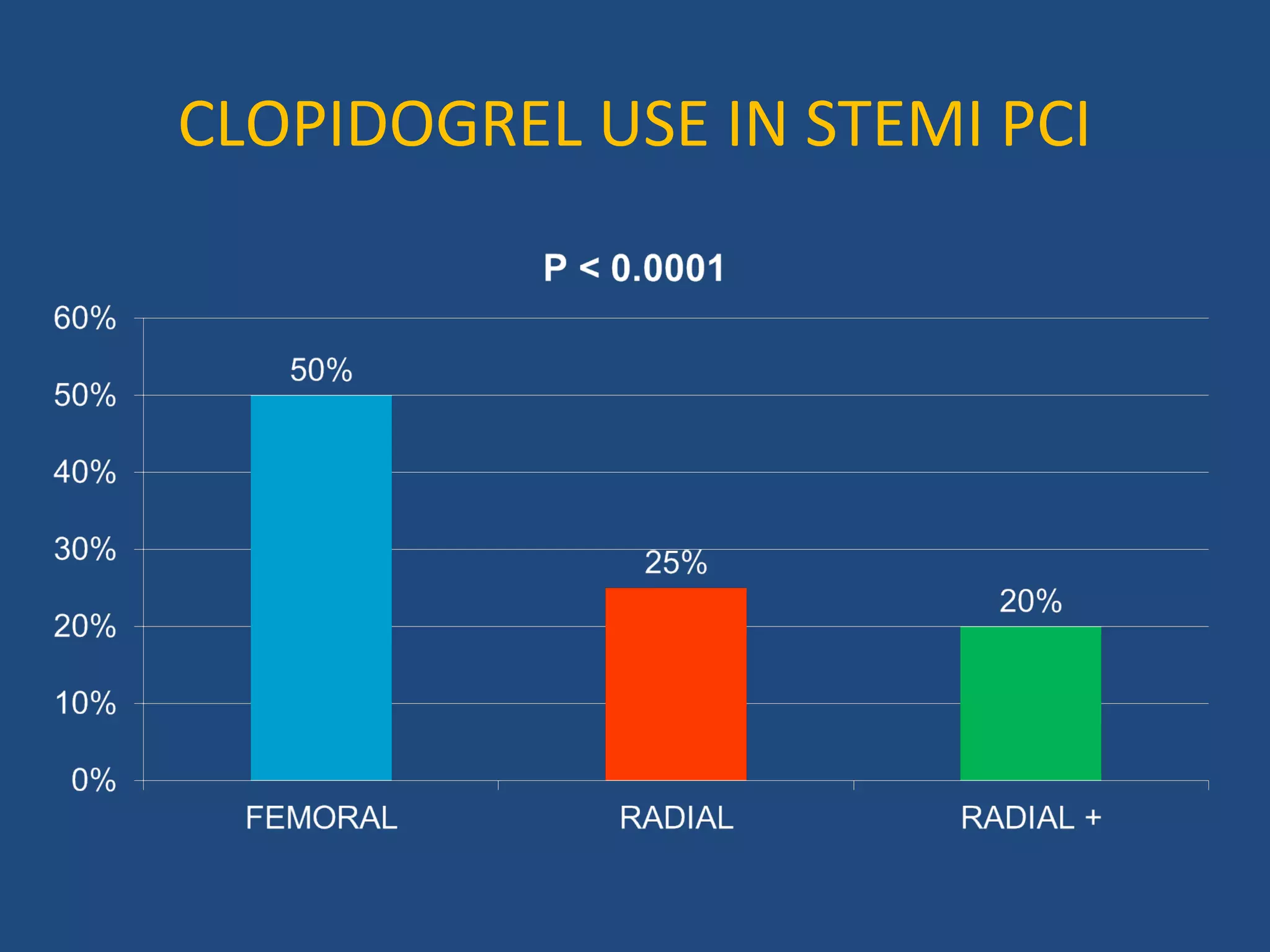
CLOPIDOGREL USE IN STEMI PCI
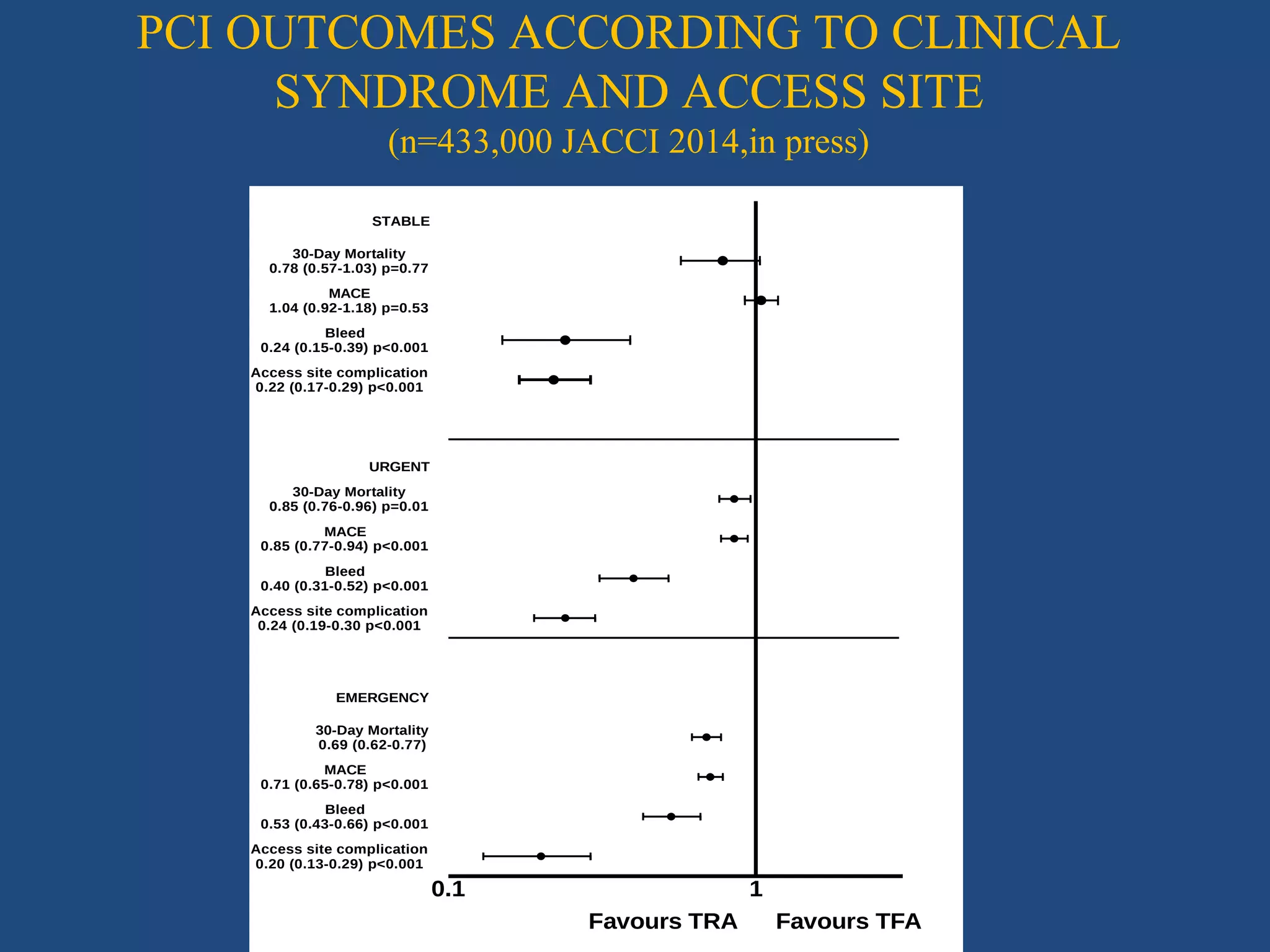
PCI OUTCOMES ACCORDING TO CLINICAL 
SYNDROME AND ACCESS SITE 
(n=433,000 JACCI 2014,in press) 
0.1 1 
Favours TRA Favours TFA 
STABLE 
30-Day Mortality 
0.78 (0.57-1.03) p=0.77 
MACE 
1.04 (0.92-1.18) p=0.53 
Bleed 
0.24 (0.15-0.39) p<0.001 
Access site complication 
0.22 (0.17-0.29) p<0.001 
URGENT 
30-Day Mortality 
0.85 (0.76-0.96) p=0.01 
MACE 
0.85 (0.77-0.94) p<0.001 
Bleed 
0.40 (0.31-0.52) p<0.001 
Access site complication 
0.24 (0.19-0.30 p<0.001 
EMERGENCY 
30-Day Mortality 
0.69 (0.62-0.77) 
MACE 
0.71 (0.65-0.78) p<0.001 
Bleed 
0.53 (0.43-0.66) p<0.001 
Access site complication 
0.20 (0.13-0.29) p<0.001 
Figure 3. Forest plot of log odds ratio of outcomes following 
multivariate logistic regression
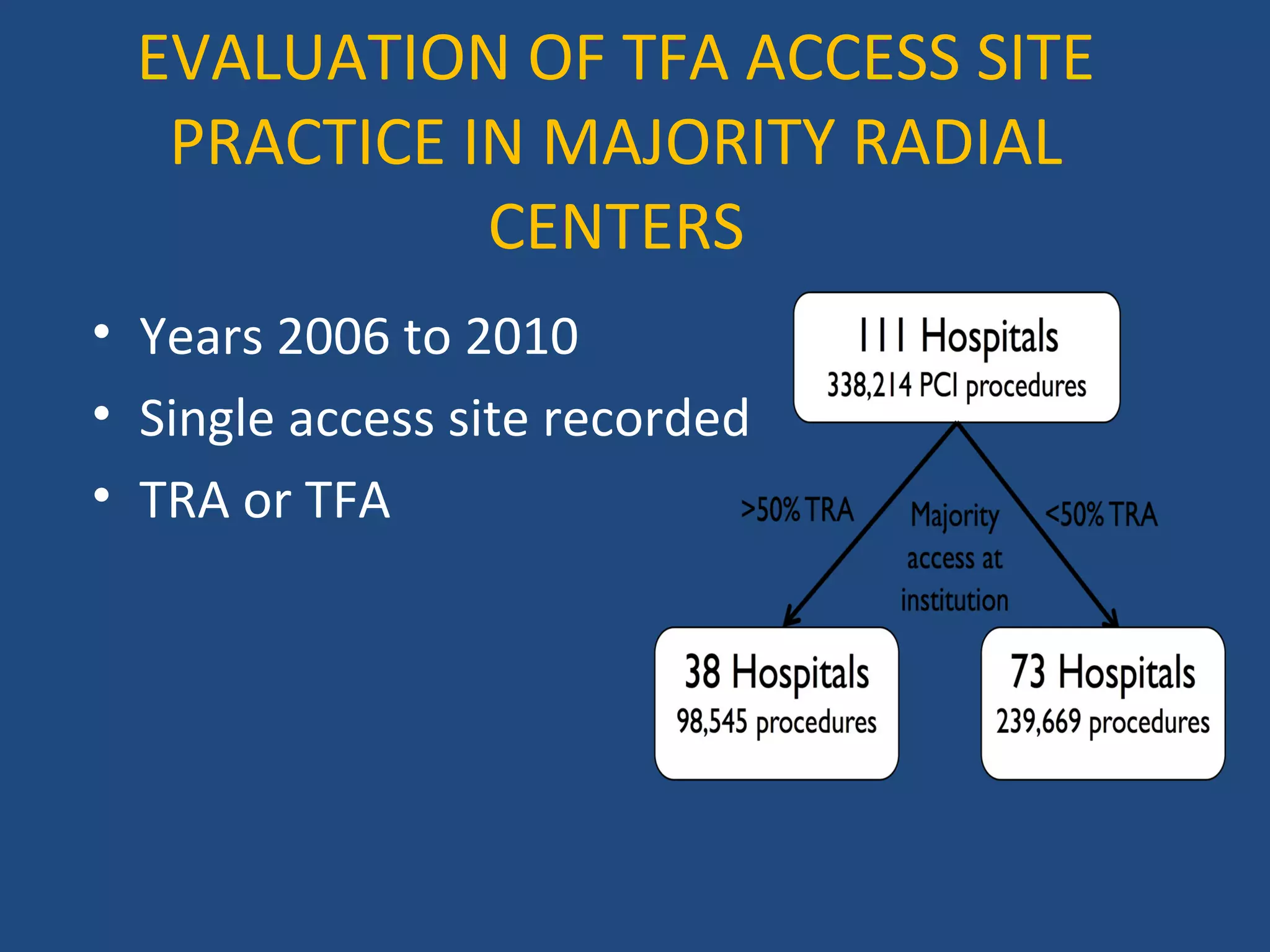
EVALUATION OF TFA ACCESS SITE 
PRACTICE IN MAJORITY RADIAL 
CENTERS 
• Years 2006 to 2010 
• Single access site recorded 
• TRA or TFA
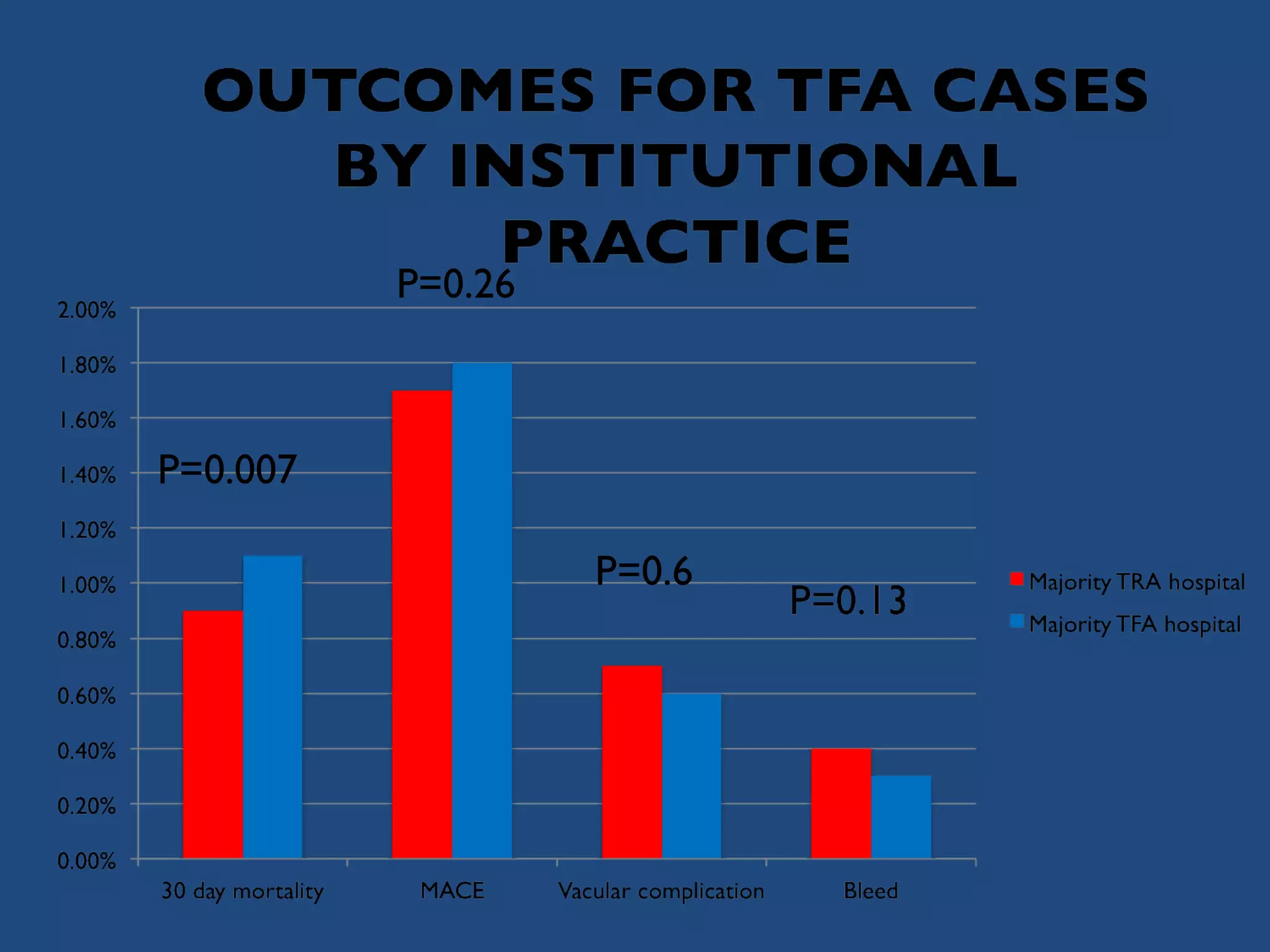
P=0.007 
P=0.26 
P=0.6
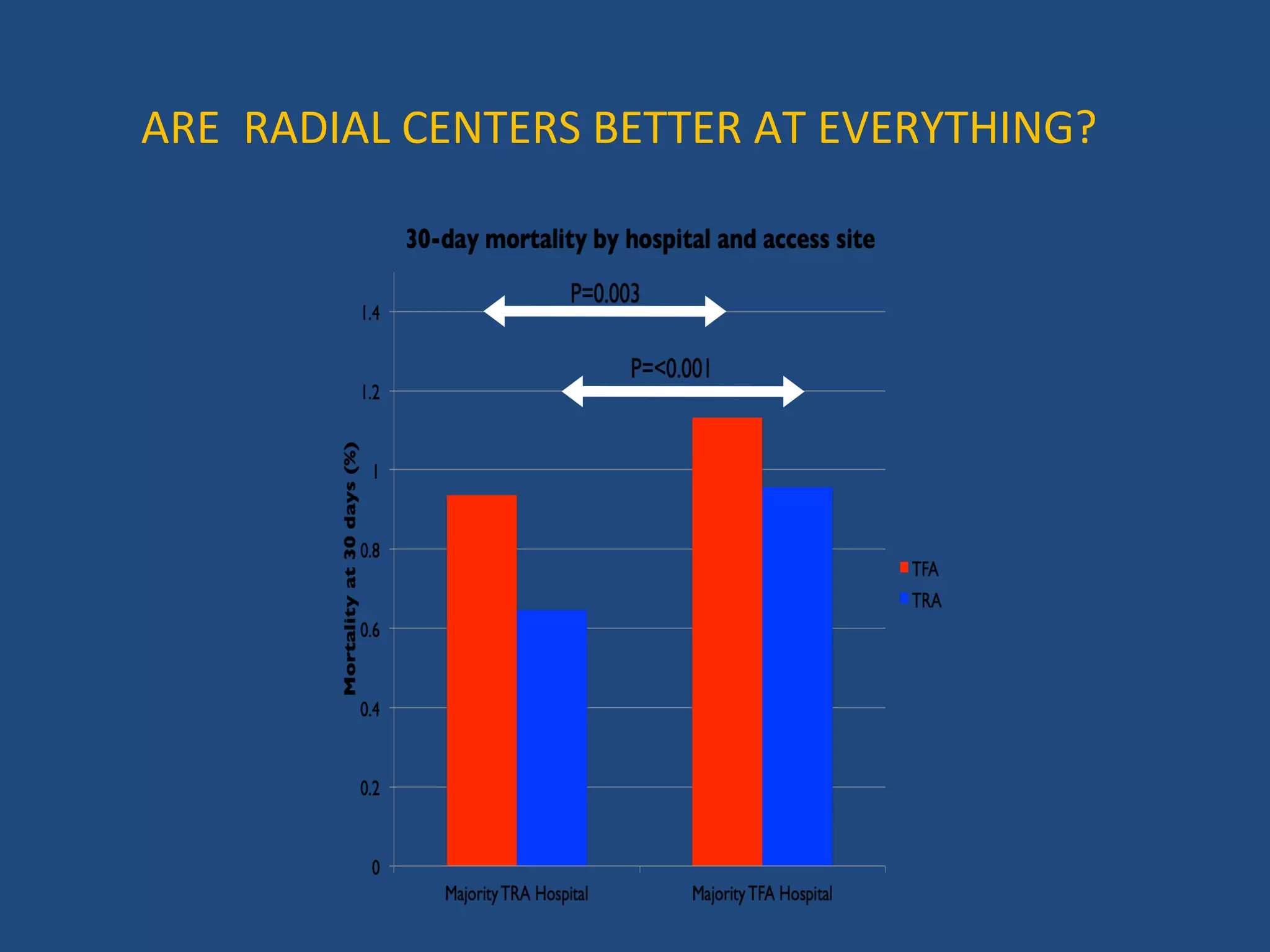
ARE RADIAL CENTERS BETTER AT EVERYTHING?
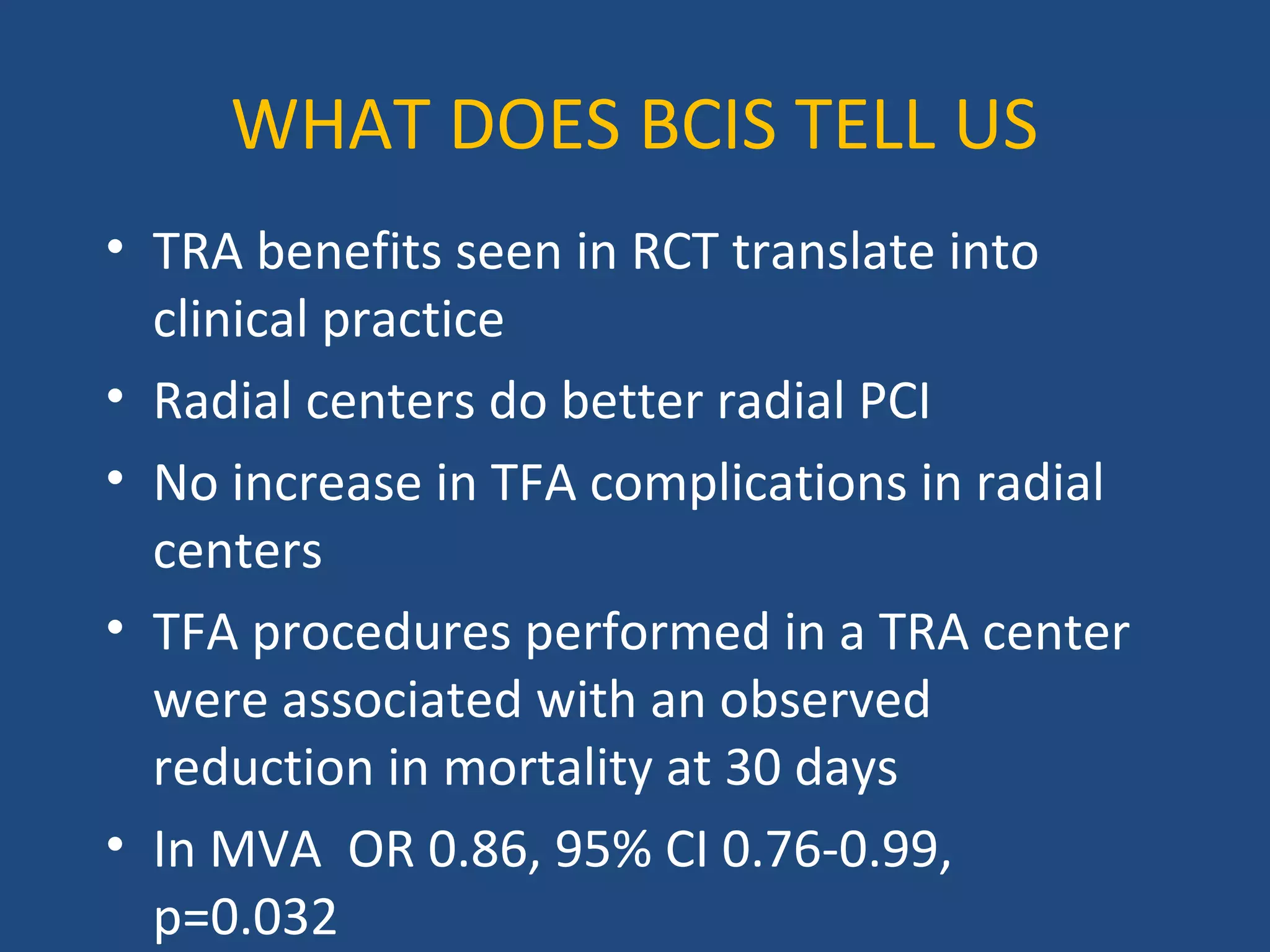
WHAT DOES BCIS TELL US 
• TRA benefits seen in RCT translate into 
clinical practice 
• Radial centers do better radial PCI 
• No increase in TFA complications in radial 
centers 
• TFA procedures performed in a TRA center 
were associated with an observed 
reduction in mortality at 30 days 
• In MVA OR 0.86, 95% CI 0.76-0.99, 
p=0.032
Limitations 
• Observational data 
• Unmeasured confounders 
• Data collected in an evolutionary period 
(operators have TFA background) 
• May not apply to TFA cases in very high 
volume TRA centers ( case mix effects )
CONCLUSIONS 
• Radial centres do better femoral PCI 
• Radial centres do better radial PCI 
• Radial centres do better PCI

Nolan J - AIMRADIAL 2014 - Radialists and femoral access

  • 1.
    RADIALISTS PERFORM BETTER FEMORAL PCI Jim Nolan University Hospital of North Staffordshire
  • 2.
    WHY DOESN’T EVERYBODYUSE RADIAL ACCESS • Learning curve • Extended Procedural duration • Increased nursing input • Patient preference • Impaired Procedural success and applicability • Increased cost of radial specific kit • Radiation exposure • If they do they will lose the ability to do safe TFA
  • 3.
    RADIAL ENVIRONMENT •Small calibre vessel • Spasm risk • Anatomical variation • Advanced guide catheter techniques • Skilled high volume TRA operators are highly proficient interventionists ( as are their teams )
  • 4.
  • 5.
    FACTORS THAT MAYACT TO INCREASE TFA COMPLICATIONS IN RADIAL CENTERS • Fewer TFA procedures • Reduced exposure to technique for operators in training and daily practice • Reduced institutional experience with post TFA care
  • 6.
    EVOLOUTION OF PRACTICE TFA CASES ARE NOW UNCOMMON
  • 7.
    FACTORS THAT MAYACT TO REDUCE TFA COMPLICATIONS IN A RADIAL CENTER •When a TRA operator has to perform a TFA case it is done with maximum attention to puncture, haemostasis and aftercare •TRA operators performing TFA frequently use guidance for the puncture •Limited use of VCDs
  • 8.
    VACD – DEVICEFAILURE RATE (Sesana et-al, JIC 2000, n = 827) (%) RATE 9 FAILURE COLLAGEN PLUG SUTURE 11 12 10 8 6 4 2 0
  • 9.
    VCD META ANALYSIS– RANDOMISED + OBSERVATIONAL (Nikolsky et-al, JACC 2004, n = 37,066)
  • 10.
    2010 META-ANALYSIS OFRCT COMPSRING VCD TO MANUAL COMPRESSION (Biancari et-al,Am Heart J 2010,n=7528)
  • 11.
    HOW CAN WEINVESTIGATE THE SAFETY OF TFA IN RADIAL CENTERS
  • 12.
    PATIENTS UNDERGOING PCIFROM THE FEMORAL ROUTE BY DEFAULT RADIAL OPERATORS Ihsan M. Rafie, MD; Muez M. Uddin, MD; Nicholas Ossei-Gerning, MD; Richard A. Anderson, MD; Timothy D. Kinnaird*, MD Department of Cardiology, University Hospital of Wales, Cardiff, United Kingdom Eurointervention 2014
  • 13.
    CARDIFF STUDY •1352 PCI procedures performed by default radial operators over 12 month period • TFA used when operator felt it to be technically and clinically appropriate ( skilled TFA operators) • ACUITY based definition of TFA related complications ( included haematomas that were not associated with Hb fall and required no intervention) • TFA utilised in 351 (25.2%) cases
  • 14.
    WHAT TYPE OFPATIENT HAD TFA IN THE CARDIFF STUDY • Female gender (41% v 21%) • Older (65 v 63) • Lower BMI (80% v 84%) • Shorter stature (167 v 171) p < 0.001 for all comparisons
  • 15.
    WHAT TYPE OFPROCEDURE WAS DONE VIA TFA IN THE CARDIFF STUDY?
  • 16.
    RESULTS IN TFACASES • 44 patients (12.5%) had femoral vascular complication (ACUITY definition) • 22 of these ( 6.25%) were haematomas with no intervention required • 22 (6,25%) had TFA complication that required some form of intervention
  • 17.
    The use ofradial access decreases the risk of vascular access-site-related complications at a patient level but is associated with an increased risk at a population level: the radial paradox Lorenzo Azzalini, MD, MSc; E. Marc Jolicoeur*, MD, MSc, MHS Interventional Cardiology Division, Dept. of Medicine, Montreal Heart Institute, Université de Montréal, Montréal, QC, Canada
  • 18.
    INFLUENCE OF RADIALACCESS ON BLEEDING AND VASCULAR COMPLICATIONS – META ANALYSIS OF RANDOMISED TRIALS (Jolly et-al,lancet,2011, n=10,000+)
  • 19.
    META-ANALYSIS OF RCTCOPARING RADIAL v FEMORAL ACCESS IN STEMI PATIENTS UPDATED TO INCLUDE RIFLE (Mamas et-al,Heart 2011,n=3978) OR for mortality = 0.53 (95% CI 0.38-75); P<0.001 for radial
  • 20.
    BRITISH CARDIOVASCULAR INTERVENTIONSOCIETY • BCIS established in 1998 to promote and monitor PCI activity in UK • Collects data on all PCI performed in UK via central electronic database ( 113 patient ,procedural and outcome variables ) • Robust mortality data using NHS number • Linked to NHS central register • Legal requirement for every death in UK to be recorded
  • 21.
    ACCESS SITE PRACTICE EVOLUTION IN THE UK
  • 22.
    UK BCIS PPCI N=46,128 PPCI 39% TRA TRA for PPCI increased from 12% to 49% Mamas M, JACC Cardiovasc Interv. 2013; 6: 698-706 TRM 2013
  • 23.
    ACCES SITE RELATEDOUTCOMES IN CARDIOGENIC SHOCK (AHJ,2014, n=7,231)
  • 24.
    WHO STILL DOESTFA IN UK ?
  • 25.
  • 26.
    WHAT TYPE OFOPERATORS DO TFA IN UK? Kinnaird T et al, O Heart 2014
  • 27.
  • 28.
    PCI OUTCOMES ACCORDINGTO CLINICAL SYNDROME AND ACCESS SITE (n=433,000 JACCI 2014,in press) 0.1 1 Favours TRA Favours TFA STABLE 30-Day Mortality 0.78 (0.57-1.03) p=0.77 MACE 1.04 (0.92-1.18) p=0.53 Bleed 0.24 (0.15-0.39) p<0.001 Access site complication 0.22 (0.17-0.29) p<0.001 URGENT 30-Day Mortality 0.85 (0.76-0.96) p=0.01 MACE 0.85 (0.77-0.94) p<0.001 Bleed 0.40 (0.31-0.52) p<0.001 Access site complication 0.24 (0.19-0.30 p<0.001 EMERGENCY 30-Day Mortality 0.69 (0.62-0.77) MACE 0.71 (0.65-0.78) p<0.001 Bleed 0.53 (0.43-0.66) p<0.001 Access site complication 0.20 (0.13-0.29) p<0.001 Figure 3. Forest plot of log odds ratio of outcomes following multivariate logistic regression
  • 29.
    EVALUATION OF TFAACCESS SITE PRACTICE IN MAJORITY RADIAL CENTERS • Years 2006 to 2010 • Single access site recorded • TRA or TFA
  • 30.
  • 31.
    ARE RADIAL CENTERSBETTER AT EVERYTHING?
  • 32.
    WHAT DOES BCISTELL US • TRA benefits seen in RCT translate into clinical practice • Radial centers do better radial PCI • No increase in TFA complications in radial centers • TFA procedures performed in a TRA center were associated with an observed reduction in mortality at 30 days • In MVA OR 0.86, 95% CI 0.76-0.99, p=0.032
  • 33.
    Limitations • Observationaldata • Unmeasured confounders • Data collected in an evolutionary period (operators have TFA background) • May not apply to TFA cases in very high volume TRA centers ( case mix effects )
  • 34.
    CONCLUSIONS • Radialcentres do better femoral PCI • Radial centres do better radial PCI • Radial centres do better PCI

Editor's Notes

  • #23 over 46 thousand PPCI procedures with a documented single access site overall 39% TRA....Increased from 12 % to almost 50% over 4 years Those done radially had better MACE free survival as illustrated in the unadjusted kaplan meier curve here