Risk 
of 
microemboliza0on 
during 
diagnos0c 
coronary 
angiography: 
comparison 
between 
single 
and 
double 
catheter 
strategy 
Andrea Pacchioni, Bernhard Reimers 
Cardiology Department, Ospedale Civile, Mirano, Venice 
AIMRADIAL 2014 - Chicago
Is 
there 
a 
risk 
of 
microemboliza0on 
during 
diagnos0c 
coronary 
angiography? 
Andrea Pacchioni, Bernhard Reimers 
Cardiology Department, Ospedale Civile, Mirano, Venice 
AIMRADIAL 2014 - Chicago
right radial 
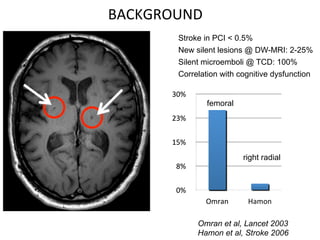
BACKGROUND 
Stroke in PCI < 0.5% 
New silent lesions @ DW-MRI: 2-25% 
Silent microemboli @ TCD: 100% 
Correlation with cognitive dysfunction 
femoral 
right radial 
right radial 
Omran et al, Lancet 2003 
Hamon et al, Stroke 2006 
30% 
23% 
15% 
8% 
0% 
Omran Hamon
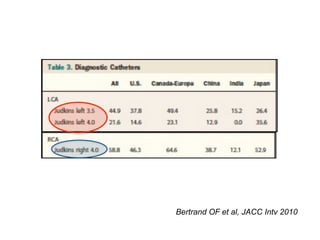
Bertrand OF et al, JACC Intv 2010
BACKGROUND 
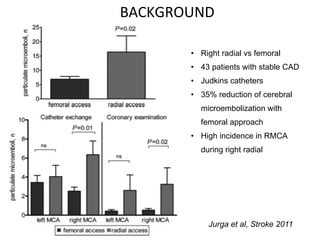
• Right radial vs femoral 
• 43 patients with stable CAD 
• Judkins catheters 
• 35% reduction of cerebral 
microembolization with 
femoral approach 
• High incidence in RMCA 
during right radial 
Jurga et al, Stroke 2011
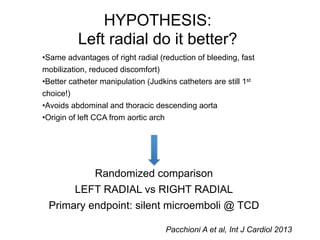
HYPOTHESIS: 
Left radial do it better? 
•Same advantages of right radial (reduction of bleeding, fast 
mobilization, reduced discomfort) 
•Better catheter manipulation (Judkins catheters are still 1st 
choice!) 
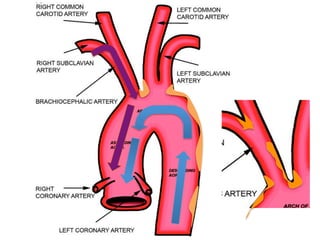
•Avoids abdominal and thoracic descending aorta 
•Origin of left CCA from aortic arch 
Randomized comparison 
LEFT RADIAL vs RIGHT RADIAL 
Primary endpoint: silent microemboli @ TCD 
Pacchioni A et al, Int J Cardiol 2013
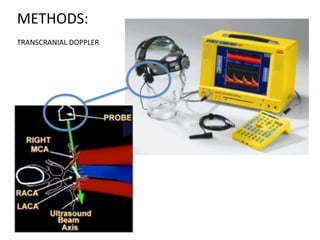
METHODS: 
TRANSCRANIAL 
DOPPLER
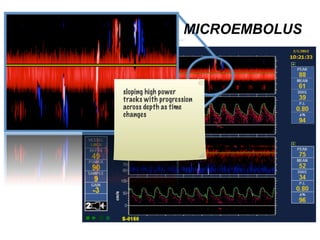
MICROEMBOLUS 
sloping high power 
tracks with progression 
across depth as time 
changes
METHODS: 
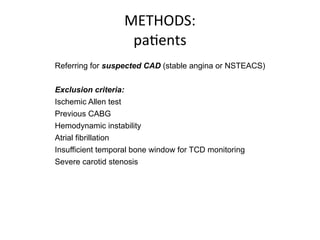
paBents 
Referring for suspected CAD (stable angina or NSTEACS) 
Exclusion criteria: 
Ischemic Allen test 
Previous CABG 
Hemodynamic instability 
Atrial fibrillation 
Insufficient temporal bone window for TCD monitoring 
Severe carotid stenosis
METHODS: 
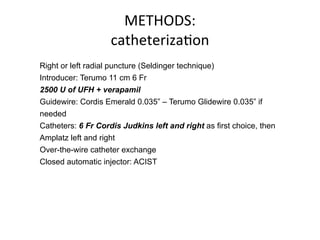
catheterizaBon 
Right or left radial puncture (Seldinger technique) 
Introducer: Terumo 11 cm 6 Fr 
2500 U of UFH + verapamil 
Guidewire: Cordis Emerald 0.035” – Terumo Glidewire 0.035” if 
needed 
Catheters: 6 Fr Cordis Judkins left and right as first choice, then 
Amplatz left and right 
Over-the-wire catheter exchange 
Closed automatic injector: ACIST
METHODS: 
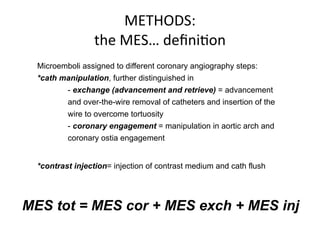
the 
MES… 
definiBon 
Microemboli assigned to different coronary angiography steps: 
*cath manipulation, further distinguished in 
- exchange (advancement and retrieve) = advancement 
and over-the-wire removal of catheters and insertion of the 
wire to overcome tortuosity 
- coronary engagement = manipulation in aortic arch and 
coronary ostia engagement 
*contrast injection= injection of contrast medium and cath flush 
MES tot = MES cor + MES exch + MES inj
METHODS: 
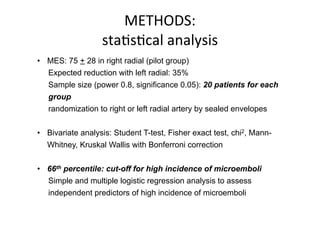
staBsBcal 
analysis 
• MES: 75 + 28 in right radial (pilot group) 
Expected reduction with left radial: 35% 
Sample size (power 0.8, significance 0.05): 20 patients for each 
group 
randomization to right or left radial artery by sealed envelopes 
• Bivariate analysis: Student T-test, Fisher exact test, chi2, Mann- 
Whitney, Kruskal Wallis with Bonferroni correction 
• 66th percentile: cut-off for high incidence of microemboli 
Simple and multiple logistic regression analysis to assess 
independent predictors of high incidence of microemboli
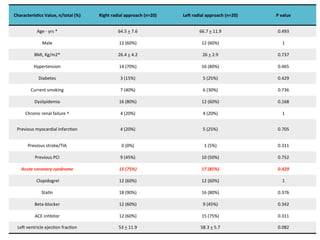
Characteris0cs 
Value, 
n/total 
(%) Right 
radial 
approach 
(n=20) LeH 
radial 
approach 
(n=20) P 
value 
Age 
-­‐ 
yrs 
* 64.5 
+ 
7.6 66.7 
+ 
11.9 0.493 
Male 12 
(60%) 12 
(60%) 1 
BMI, 
Kg/m2* 26.4 
+ 
4.2 26 
+ 
2.9 0.737 
Hypertension 14 
(70%) 16 
(80%) 0.465 
Diabetes 3 
(15%) 5 
(25%) 0.429 
Current 
smoking 7 
(40%) 6 
(30%) 0.736 
Dyslipidemia 16 
(80%) 12 
(60%) 0.168 
Chronic 
renal 
failure 
† 4 
(20%) 4 
(20%) 1 
Previous 
myocardial 
infarcBon 4 
(20%) 5 
(25%) 0.705 
Previous 
stroke/TIA 0 
(0%) 1 
(5%) 0.311 
Previous 
PCI 9 
(45%) 10 
(50%) 0.752 
Acute 
coronary 
syndrome 15 
(75%) 17 
(85%) 0.429 
Clopidogrel 
12 
(60%) 12 
(60%) 1 
StaBn 
18 
(90%) 16 
(80%) 0.376 
Beta-­‐blocker 
12 
(60%) 9 
(45%) 0.342 
ACE 
inhbitor 
12 
(60%) 15 
(75%) 0.311 
Leb 
ventricle 
ejecBon 
fracBon 53 
+ 
11.9 58.3 
+ 
5.7 0.082
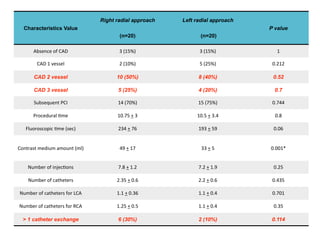
Characteristics Value 
Right radial approach 
(n=20) 
Left radial approach 
(n=20) 
P value 
Absence 
of 
CAD 3 
(15%) 3 
(15%) 1 
CAD 
1 
vessel 2 
(10%) 5 
(25%) 0.212 
CAD 2 vessel 10 (50%) 8 (40%) 0.52 
CAD 3 vessel 5 (25%) 4 (20%) 0.7 
Subsequent 
PCI 14 
(70%) 15 
(75%) 0.744 
Procedural 
Bme 10.75 
+ 
3 10.5 
+ 
3.4 0.8 
Fluoroscopic 
Bme 
(sec) 234 
+ 
76 193 
+ 
59 0.06 
Contrast 
medium 
amount 
(ml) 49 
+ 
17 33 
+ 
5 0.001* 
Number 
of 
injecBons 7.8 
+ 
1.2 7.2 
+ 
1.9 0.25 
Number 
of 
catheters 2.35 
+ 
0.6 2.2 
+ 
0.6 0.435 
Number 
of 
catheters 
for 
LCA 1.1 
+ 
0.36 1.1 
+ 
0.4 0.701 
Number 
of 
catheters 
for 
RCA 1.25 
+ 
0.5 1.1 
+ 
0.4 0.35 
> 1 catheter exchange 6 (30%) 2 (10%) 0.114
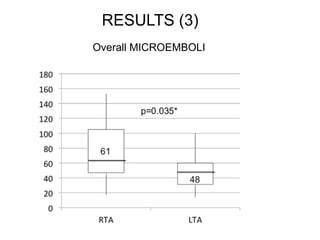
RESULTS (3) 
Overall MICROEMBOLI
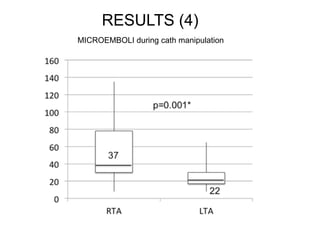
RESULTS (4) 
MICROEMBOLI during cath manipulation
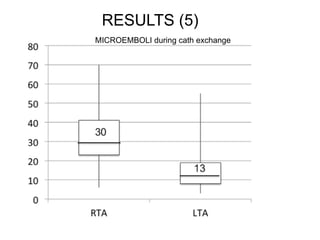
RESULTS (5) 
MICROEMBOLI during cath exchange
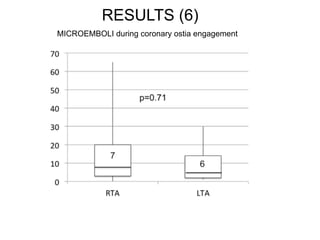
RESULTS (6) 
MICROEMBOLI during coronary ostia engagement
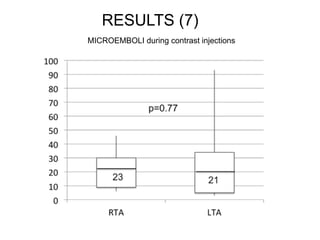
RESULTS (7) 
MICROEMBOLI during contrast injections
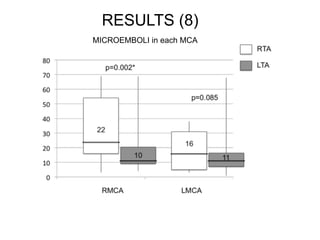
RESULTS (8) 
MICROEMBOLI in each MCA
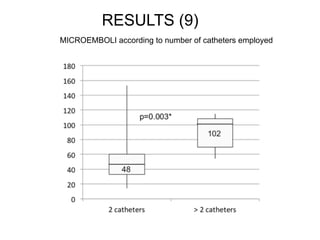
RESULTS (9) 
MICROEMBOLI according to number of catheters employed
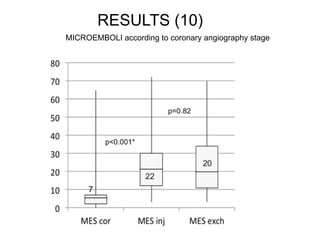
RESULTS (10) 
MICROEMBOLI according to coronary angiography stage
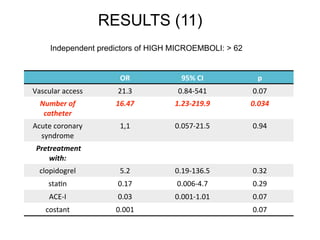
RESULTS (11) 
Independent predictors of HIGH MICROEMBOLI: > 62 
OR 95% 
CI p 
Vascular 
access 21.3 0.84-­‐541 0.07 
Number 
of 
catheter 
16.47 1.23-­‐219.9 0.034 
Acute 
coronary 
syndrome 
1,1 0.057-­‐21.5 0.94 
Pretreatment 
with: 
clopidogrel 5.2 0.19-­‐136.5 0.32 
staBn 0.17 0.006-­‐4.7 0.29 
ACE-­‐I 0.03 0.001-­‐1.01 0.07 
costant 0.001 0.07
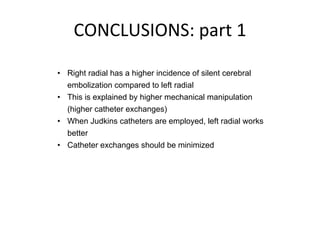
CONCLUSIONS: 
part 
1 
• Right radial has a higher incidence of silent cerebral 
embolization compared to left radial 
• This is explained by higher mechanical manipulation 
(higher catheter exchanges) 
• When Judkins catheters are employed, left radial works 
better 
• Catheter exchanges should be minimized
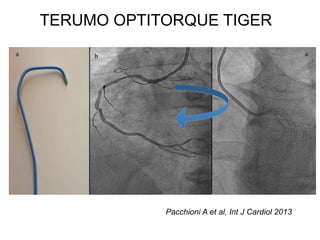
TERUMO OPTITORQUE TIGER 
Pacchioni A et al, Int J Cardiol 2013
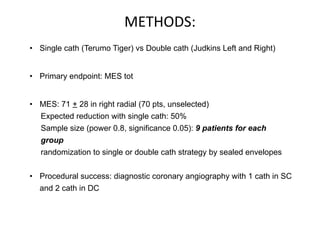
METHODS: 
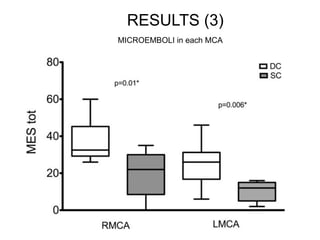
• Single cath (Terumo Tiger) vs Double cath (Judkins Left and Right) 
• Primary endpoint: MES tot 
• MES: 71 + 28 in right radial (70 pts, unselected) 
Expected reduction with single cath: 50% 
Sample size (power 0.8, significance 0.05): 9 patients for each 
group 
randomization to single or double cath strategy by sealed envelopes 
• Procedural success: diagnostic coronary angiography with 1 cath in SC 
and 2 cath in DC
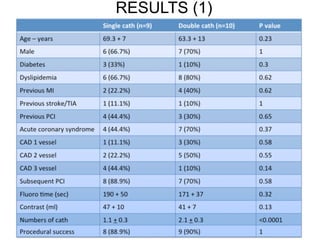
RESULTS (1)
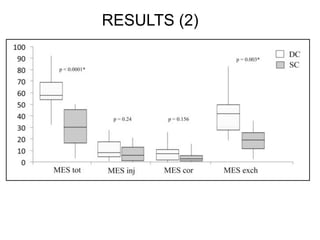
RESULTS (2)
RESULTS (3) 
MICROEMBOLI in each MCA
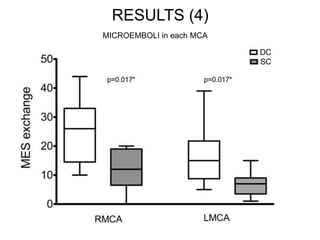
RESULTS (4) 
MICROEMBOLI in each MCA
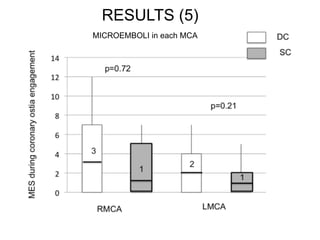
RESULTS (5) 
MICROEMBOLI in each MCA
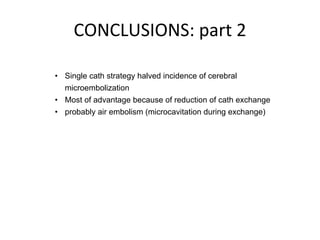
CONCLUSIONS: 
part 
2 
• Single cath strategy halved incidence of cerebral 
microembolization 
• Most of advantage because of reduction of cath exchange 
• probably air embolism (microcavitation during exchange)
LIMITATIONS: 
• No info about posterior circulation 
• High incidence of microemboli compared to other studies (high 
prevalence of ACS and multivessel CAD) 
• Microemboli are clinically silent, not all microemboli result in 
MRI lesions (fortunately!), weak correlation with clinical events 
• However, microemboli have been used as surrogate for 
cerebral embolism to compare protection systems in CAS trial 
• Extremely useful as model for mechanisms of cerebral 
embolism 
• Larger sample to be an exhaustive model
Pacchioni A - AIMRADIAL 2014 - Cerebral microembolism

Pacchioni A - AIMRADIAL 2014 - Cerebral microembolism

  • 1.
    Risk of microemboliza0on during diagnos0c coronary angiography: comparison between single and double catheter strategy Andrea Pacchioni, Bernhard Reimers Cardiology Department, Ospedale Civile, Mirano, Venice AIMRADIAL 2014 - Chicago
  • 2.
    Is there a risk of microemboliza0on during diagnos0c coronary angiography? Andrea Pacchioni, Bernhard Reimers Cardiology Department, Ospedale Civile, Mirano, Venice AIMRADIAL 2014 - Chicago
  • 3.
    right radial BACKGROUND Stroke in PCI < 0.5% New silent lesions @ DW-MRI: 2-25% Silent microemboli @ TCD: 100% Correlation with cognitive dysfunction femoral right radial right radial Omran et al, Lancet 2003 Hamon et al, Stroke 2006 30% 23% 15% 8% 0% Omran Hamon
  • 8.
    Bertrand OF etal, JACC Intv 2010
  • 9.
    BACKGROUND • Rightradial vs femoral • 43 patients with stable CAD • Judkins catheters • 35% reduction of cerebral microembolization with femoral approach • High incidence in RMCA during right radial Jurga et al, Stroke 2011
  • 10.
    HYPOTHESIS: Left radialdo it better? •Same advantages of right radial (reduction of bleeding, fast mobilization, reduced discomfort) •Better catheter manipulation (Judkins catheters are still 1st choice!) •Avoids abdominal and thoracic descending aorta •Origin of left CCA from aortic arch Randomized comparison LEFT RADIAL vs RIGHT RADIAL Primary endpoint: silent microemboli @ TCD Pacchioni A et al, Int J Cardiol 2013
  • 11.
  • 12.
    MICROEMBOLUS sloping highpower tracks with progression across depth as time changes
  • 13.
    METHODS: paBents Referringfor suspected CAD (stable angina or NSTEACS) Exclusion criteria: Ischemic Allen test Previous CABG Hemodynamic instability Atrial fibrillation Insufficient temporal bone window for TCD monitoring Severe carotid stenosis
  • 14.
    METHODS: catheterizaBon Rightor left radial puncture (Seldinger technique) Introducer: Terumo 11 cm 6 Fr 2500 U of UFH + verapamil Guidewire: Cordis Emerald 0.035” – Terumo Glidewire 0.035” if needed Catheters: 6 Fr Cordis Judkins left and right as first choice, then Amplatz left and right Over-the-wire catheter exchange Closed automatic injector: ACIST
  • 15.
    METHODS: the MES… definiBon Microemboli assigned to different coronary angiography steps: *cath manipulation, further distinguished in - exchange (advancement and retrieve) = advancement and over-the-wire removal of catheters and insertion of the wire to overcome tortuosity - coronary engagement = manipulation in aortic arch and coronary ostia engagement *contrast injection= injection of contrast medium and cath flush MES tot = MES cor + MES exch + MES inj
  • 16.
    METHODS: staBsBcal analysis • MES: 75 + 28 in right radial (pilot group) Expected reduction with left radial: 35% Sample size (power 0.8, significance 0.05): 20 patients for each group randomization to right or left radial artery by sealed envelopes • Bivariate analysis: Student T-test, Fisher exact test, chi2, Mann- Whitney, Kruskal Wallis with Bonferroni correction • 66th percentile: cut-off for high incidence of microemboli Simple and multiple logistic regression analysis to assess independent predictors of high incidence of microemboli
  • 17.
    Characteris0cs Value, n/total (%) Right radial approach (n=20) LeH radial approach (n=20) P value Age -­‐ yrs * 64.5 + 7.6 66.7 + 11.9 0.493 Male 12 (60%) 12 (60%) 1 BMI, Kg/m2* 26.4 + 4.2 26 + 2.9 0.737 Hypertension 14 (70%) 16 (80%) 0.465 Diabetes 3 (15%) 5 (25%) 0.429 Current smoking 7 (40%) 6 (30%) 0.736 Dyslipidemia 16 (80%) 12 (60%) 0.168 Chronic renal failure † 4 (20%) 4 (20%) 1 Previous myocardial infarcBon 4 (20%) 5 (25%) 0.705 Previous stroke/TIA 0 (0%) 1 (5%) 0.311 Previous PCI 9 (45%) 10 (50%) 0.752 Acute coronary syndrome 15 (75%) 17 (85%) 0.429 Clopidogrel 12 (60%) 12 (60%) 1 StaBn 18 (90%) 16 (80%) 0.376 Beta-­‐blocker 12 (60%) 9 (45%) 0.342 ACE inhbitor 12 (60%) 15 (75%) 0.311 Leb ventricle ejecBon fracBon 53 + 11.9 58.3 + 5.7 0.082
  • 18.
    Characteristics Value Rightradial approach (n=20) Left radial approach (n=20) P value Absence of CAD 3 (15%) 3 (15%) 1 CAD 1 vessel 2 (10%) 5 (25%) 0.212 CAD 2 vessel 10 (50%) 8 (40%) 0.52 CAD 3 vessel 5 (25%) 4 (20%) 0.7 Subsequent PCI 14 (70%) 15 (75%) 0.744 Procedural Bme 10.75 + 3 10.5 + 3.4 0.8 Fluoroscopic Bme (sec) 234 + 76 193 + 59 0.06 Contrast medium amount (ml) 49 + 17 33 + 5 0.001* Number of injecBons 7.8 + 1.2 7.2 + 1.9 0.25 Number of catheters 2.35 + 0.6 2.2 + 0.6 0.435 Number of catheters for LCA 1.1 + 0.36 1.1 + 0.4 0.701 Number of catheters for RCA 1.25 + 0.5 1.1 + 0.4 0.35 > 1 catheter exchange 6 (30%) 2 (10%) 0.114
  • 19.
  • 20.
    RESULTS (4) MICROEMBOLIduring cath manipulation
  • 21.
    RESULTS (5) MICROEMBOLIduring cath exchange
  • 22.
    RESULTS (6) MICROEMBOLIduring coronary ostia engagement
  • 23.
    RESULTS (7) MICROEMBOLIduring contrast injections
  • 24.
  • 25.
    RESULTS (9) MICROEMBOLIaccording to number of catheters employed
  • 26.
    RESULTS (10) MICROEMBOLIaccording to coronary angiography stage
  • 27.
    RESULTS (11) Independentpredictors of HIGH MICROEMBOLI: > 62 OR 95% CI p Vascular access 21.3 0.84-­‐541 0.07 Number of catheter 16.47 1.23-­‐219.9 0.034 Acute coronary syndrome 1,1 0.057-­‐21.5 0.94 Pretreatment with: clopidogrel 5.2 0.19-­‐136.5 0.32 staBn 0.17 0.006-­‐4.7 0.29 ACE-­‐I 0.03 0.001-­‐1.01 0.07 costant 0.001 0.07
  • 28.
    CONCLUSIONS: part 1 • Right radial has a higher incidence of silent cerebral embolization compared to left radial • This is explained by higher mechanical manipulation (higher catheter exchanges) • When Judkins catheters are employed, left radial works better • Catheter exchanges should be minimized
  • 29.
    TERUMO OPTITORQUE TIGER Pacchioni A et al, Int J Cardiol 2013
  • 30.
    METHODS: • Singlecath (Terumo Tiger) vs Double cath (Judkins Left and Right) • Primary endpoint: MES tot • MES: 71 + 28 in right radial (70 pts, unselected) Expected reduction with single cath: 50% Sample size (power 0.8, significance 0.05): 9 patients for each group randomization to single or double cath strategy by sealed envelopes • Procedural success: diagnostic coronary angiography with 1 cath in SC and 2 cath in DC
  • 31.
  • 32.
  • 33.
  • 34.
  • 35.
  • 36.
    CONCLUSIONS: part 2 • Single cath strategy halved incidence of cerebral microembolization • Most of advantage because of reduction of cath exchange • probably air embolism (microcavitation during exchange)
  • 37.
    LIMITATIONS: • Noinfo about posterior circulation • High incidence of microemboli compared to other studies (high prevalence of ACS and multivessel CAD) • Microemboli are clinically silent, not all microemboli result in MRI lesions (fortunately!), weak correlation with clinical events • However, microemboli have been used as surrogate for cerebral embolism to compare protection systems in CAS trial • Extremely useful as model for mechanisms of cerebral embolism • Larger sample to be an exhaustive model