A SEMINAR ON RADIOIMMUNOASSAY Guided by:  Preseanted by- Mr. J.D.Patel   Patel Akshay Dept. of Q.A.  M.pharm (sem-I) NOOTAN PHARMACY COLLEGE,VISNAGAR.
Introduction: An immunoassay is a test that uses antibody and antigen complexes as a means of generating a measurable result.  An antibody: antigen complex is also known as an immune-complex. Immunoassays are different from other types of laboratory tests, such as colorimetric tests, because they use antibody: antigen complexes to generate a signal that can be measured.   In contrast, most routine clinical chemistry tests utilize chemical reactions between the reagent (a solution of chemicals or other agents) and patient sample to generate a test result.
Principle: Uses an immune reaction [Antigen – Antibody reaction] to  estimate a ligand  Ag + Ag* + Ab    AgAb + Ag*Ab + Ag + Ag* Unbound Ag* and Ag washed out  Radioactivity of bound residue measured Ligand conc is inversely related to radioactivity  [Ag : ligand to be measured ; Ag* radiolabelled ligand]
What  is a label? All immunoassays require the use of labeled material in order to measure the amount of antigen or antibody present.  A label is a molecule that will react as part of the assay, so a change in signal can be measured in the blood:reagent solution. Examples of a label include- a radioactive compound,  an enzyme that causes a change of color in a solution, a substance that produces light.
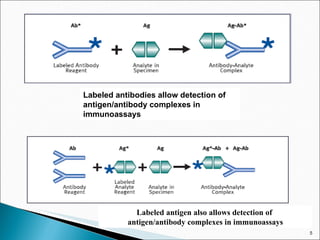
Labeled antibodies allow detection of antigen/antibody complexes in immunoassays Labeled antigen also allows detection of  antigen/antibody complexes in immunoassays
Classification of immunoassays: Competitive & Non-competitive  immunoassays. 2.Homogeneous & Heterogeneous  immunoassays. 3.Limited reagent assays & Excess reagent  assays.
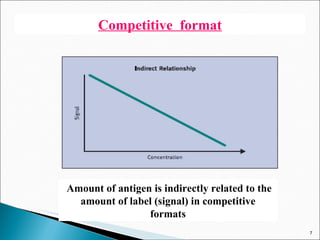
Competitive  format Amount of antigen is indirectly related to the amount of label (signal) in competitive formats
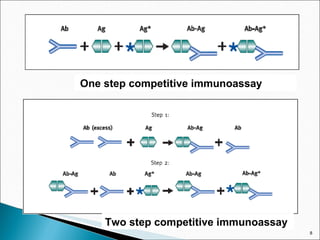
One step competitive immunoassay   Two step competitive immunoassay
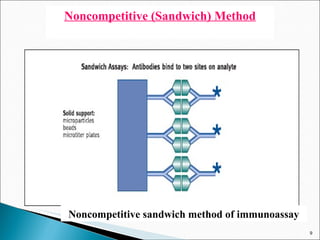
Noncompetitive (Sandwich) Method Noncompetitive sandwich method of immunoassay
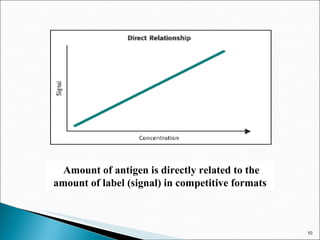
Amount of antigen is directly related to the amount of label (signal) in competitive formats
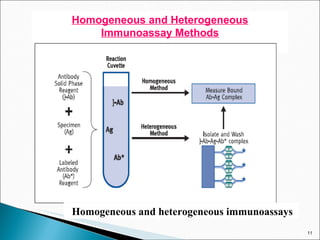
Homogeneous and Heterogeneous Immunoassay Methods Homogeneous and heterogeneous immunoassays
Limited reagent assay: Many conventional RIAs follow limited reagent assay protocols. The following scheme depicts the AgAb reaction: Ag AgAb + Ab   Ag* Ag*Ab With limited amount of Ab, the unlabeled antigen (analyte) competes  with the labeled antigen Ag* for limited binding sites. Bound fraction [AgAb] is separated from free [Ab], and the signal  [Ag*Ab] complex i.e. the Ab fraction not occupied by the analyte is  measured. The amount of analyte is inversely proportional to the bound [Ag*Ab]  complex in a hyperbolic function.
Excess-Reagent assay This protocol is utilized by- 1. Immunoradiometric Assays (IRMA). 2. Two-site or sandwich Assays. Here the excess Ab is labeled.(In case of sandwich assay an excess amount of first Ab used to capture analyte from sample matrix, and a labeled second Ab provides the signal for quantitation.) IRMA : Ag + Ab*  AgAb* Sandwich assay:  Ag + Ab1  Ag-Ab1 + Ab2*    Ab1-Ag-Ab2* Bound fraction is separated from free; the signal [AgAb*] or [Ag-Ab1-Ab2*] complex is measured. The amount of analyte is proportional to the bound complex in a hyperbolic function.
General procedure for RIA: A known quantity of an antigen is made radioactive, frequently by labeling it with gamma-radioactive isotopes of iodine attached to tyrosine.  This radiolabeled antigen is then mixed with a known amount of antibody for that antigen, and as a result, the two chemically bind to one another.  Then, a sample of serum from a patient containing an unknown quantity of that same antigen is added. This causes the unlabeled (or "cold") antigen from the serum to compete with the radiolabeled antigen for antibody binding sites.
the concentration of "cold" antigen is increased, more of it binds to the antibody, displacAs ing the radiolabeled variant, and reducing the ratio of antibody-bound radio labeled antigen to free radio labeled antigen.  The radioactivity falls because unlabelled antigen dilute it . The count obtained from the radioactivity are used to determine the hapten concentration in the sample, the interpretetion being done on the stnadard curve.
Preparation & characterisation of the Antigen [Ligand to be analysed]  Radiolabelling of the Antigen Preparation of the Specific Antibody Development of Assay System
Antigens prepared by..  Synthesis of the molecule  Isolation from natural sources Radiolabelling [Tagging procedure] 3  H  14  C  125  I are used as radioactive tags Antigens are tagged to  3  H  14  C  125  Tagging should NOT  affect  Antigenic specificity &   Antigenic activity  !
Antigen injected intradermally into rabbits or guinea pigs    antibody production Antibodies recovered from the serum Some ligands are not Antigenic  Hormones, Steroids, Drugs     HAPTENS Eg:  Gastrin, Morphine,  Haptens conjugated to albumin    antigenic
Add  known amounts  of the test sample +  labelled antigen into the microtitre wells Incubate    allow the reaction to reach completion Decant & wash  contents of the well    removes all unbound antigens Radioactivity remaining in the Microtitre wells measured by a Counter [GM counter , Scintillation counter etc] Intensity of radioactivity is inversely correlated with the conc of antigens in the test sample Sensitive to very low conc of antigens
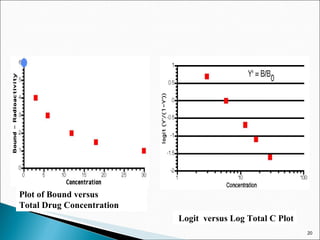
Plot of Bound versus  Total Drug Concentration Logit  versus Log Total C Plot
1)Centrifuge  :  swing bucket rotor :  1200-2500 rpm. Fixed angle head rotor :  3500-4000 rpm. 2) Radioactive counter A) gamma counter : which is used for agmma energy emiting isotopes. E.g. 125 I . B) scintilation counter : It is used for beta energy emitting isotopes . Eg. Tritium 3H and 14 C isotopes.
Advantages Highly specific:  Immune reactions are specific High sensitivity : Immune reactions are sensitive Disadvantages  Radiation hazards: Uses radiolabelled reagents Requires specially trained persons Labs require special license to handle radioactive material Requires special arrangements for  Requisition, storage of  radioactive material  radioactive waste disposal.
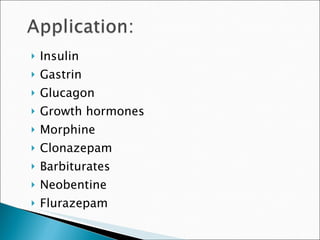
Insulin Gastrin Glucagon Growth hormones Morphine  Clonazepam Barbiturates Neobentine  Flurazepam
THANK YOU …

RIA ppt akshay patel

  • 1.
    A SEMINAR ONRADIOIMMUNOASSAY Guided by: Preseanted by- Mr. J.D.Patel Patel Akshay Dept. of Q.A. M.pharm (sem-I) NOOTAN PHARMACY COLLEGE,VISNAGAR.
  • 2.
    Introduction: An immunoassayis a test that uses antibody and antigen complexes as a means of generating a measurable result. An antibody: antigen complex is also known as an immune-complex. Immunoassays are different from other types of laboratory tests, such as colorimetric tests, because they use antibody: antigen complexes to generate a signal that can be measured. In contrast, most routine clinical chemistry tests utilize chemical reactions between the reagent (a solution of chemicals or other agents) and patient sample to generate a test result.
  • 3.
    Principle: Uses animmune reaction [Antigen – Antibody reaction] to estimate a ligand Ag + Ag* + Ab  AgAb + Ag*Ab + Ag + Ag* Unbound Ag* and Ag washed out Radioactivity of bound residue measured Ligand conc is inversely related to radioactivity [Ag : ligand to be measured ; Ag* radiolabelled ligand]
  • 4.
    What isa label? All immunoassays require the use of labeled material in order to measure the amount of antigen or antibody present. A label is a molecule that will react as part of the assay, so a change in signal can be measured in the blood:reagent solution. Examples of a label include- a radioactive compound, an enzyme that causes a change of color in a solution, a substance that produces light.
  • 5.
    Labeled antibodies allowdetection of antigen/antibody complexes in immunoassays Labeled antigen also allows detection of antigen/antibody complexes in immunoassays
  • 6.
    Classification of immunoassays:Competitive & Non-competitive immunoassays. 2.Homogeneous & Heterogeneous immunoassays. 3.Limited reagent assays & Excess reagent assays.
  • 7.
    Competitive formatAmount of antigen is indirectly related to the amount of label (signal) in competitive formats
  • 8.
    One step competitiveimmunoassay Two step competitive immunoassay
  • 9.
    Noncompetitive (Sandwich) MethodNoncompetitive sandwich method of immunoassay
  • 10.
    Amount of antigenis directly related to the amount of label (signal) in competitive formats
  • 11.
    Homogeneous and HeterogeneousImmunoassay Methods Homogeneous and heterogeneous immunoassays
  • 12.
    Limited reagent assay:Many conventional RIAs follow limited reagent assay protocols. The following scheme depicts the AgAb reaction: Ag AgAb + Ab Ag* Ag*Ab With limited amount of Ab, the unlabeled antigen (analyte) competes with the labeled antigen Ag* for limited binding sites. Bound fraction [AgAb] is separated from free [Ab], and the signal [Ag*Ab] complex i.e. the Ab fraction not occupied by the analyte is measured. The amount of analyte is inversely proportional to the bound [Ag*Ab] complex in a hyperbolic function.
  • 13.
    Excess-Reagent assay Thisprotocol is utilized by- 1. Immunoradiometric Assays (IRMA). 2. Two-site or sandwich Assays. Here the excess Ab is labeled.(In case of sandwich assay an excess amount of first Ab used to capture analyte from sample matrix, and a labeled second Ab provides the signal for quantitation.) IRMA : Ag + Ab* AgAb* Sandwich assay: Ag + Ab1 Ag-Ab1 + Ab2* Ab1-Ag-Ab2* Bound fraction is separated from free; the signal [AgAb*] or [Ag-Ab1-Ab2*] complex is measured. The amount of analyte is proportional to the bound complex in a hyperbolic function.
  • 14.
    General procedure forRIA: A known quantity of an antigen is made radioactive, frequently by labeling it with gamma-radioactive isotopes of iodine attached to tyrosine. This radiolabeled antigen is then mixed with a known amount of antibody for that antigen, and as a result, the two chemically bind to one another. Then, a sample of serum from a patient containing an unknown quantity of that same antigen is added. This causes the unlabeled (or "cold") antigen from the serum to compete with the radiolabeled antigen for antibody binding sites.
  • 15.
    the concentration of"cold" antigen is increased, more of it binds to the antibody, displacAs ing the radiolabeled variant, and reducing the ratio of antibody-bound radio labeled antigen to free radio labeled antigen. The radioactivity falls because unlabelled antigen dilute it . The count obtained from the radioactivity are used to determine the hapten concentration in the sample, the interpretetion being done on the stnadard curve.
  • 16.
    Preparation & characterisationof the Antigen [Ligand to be analysed] Radiolabelling of the Antigen Preparation of the Specific Antibody Development of Assay System
  • 17.
    Antigens prepared by.. Synthesis of the molecule Isolation from natural sources Radiolabelling [Tagging procedure] 3 H 14 C 125 I are used as radioactive tags Antigens are tagged to 3 H 14 C 125 Tagging should NOT affect Antigenic specificity & Antigenic activity !
  • 18.
    Antigen injected intradermallyinto rabbits or guinea pigs  antibody production Antibodies recovered from the serum Some ligands are not Antigenic Hormones, Steroids, Drugs  HAPTENS Eg: Gastrin, Morphine, Haptens conjugated to albumin  antigenic
  • 19.
    Add knownamounts of the test sample + labelled antigen into the microtitre wells Incubate  allow the reaction to reach completion Decant & wash contents of the well  removes all unbound antigens Radioactivity remaining in the Microtitre wells measured by a Counter [GM counter , Scintillation counter etc] Intensity of radioactivity is inversely correlated with the conc of antigens in the test sample Sensitive to very low conc of antigens
  • 20.
    Plot of Boundversus Total Drug Concentration Logit versus Log Total C Plot
  • 21.
    1)Centrifuge : swing bucket rotor : 1200-2500 rpm. Fixed angle head rotor : 3500-4000 rpm. 2) Radioactive counter A) gamma counter : which is used for agmma energy emiting isotopes. E.g. 125 I . B) scintilation counter : It is used for beta energy emitting isotopes . Eg. Tritium 3H and 14 C isotopes.
  • 22.
    Advantages Highly specific: Immune reactions are specific High sensitivity : Immune reactions are sensitive Disadvantages Radiation hazards: Uses radiolabelled reagents Requires specially trained persons Labs require special license to handle radioactive material Requires special arrangements for Requisition, storage of radioactive material radioactive waste disposal.
  • 23.
    Insulin Gastrin GlucagonGrowth hormones Morphine Clonazepam Barbiturates Neobentine Flurazepam
  • 24.

Editor's Notes

  • #2 RIA of some drugs 30/09/2009