IMMUNOASSAY OF DIGOXIN AND INSULIN
• Prepared by :Bharti
• Submitted to :Ritu Joshi(Associate professor)
• M.PHARMACY(Pharmacology)
• Ch. Devi. Lal college of pharmacy
Immunoassay
 Immunoassay is an analytical method based on the
specific immuno- reaction between the antibody(Ab)
and antigen(Ag) for the determination of the amount
of reactant in the solution. An antigen-antibody
complex is known as an immuno-complex.
 An immune assay is a test that uses antibody and
antigen complexes as a means of generating a
measurable result.
Antibodies:
 Antibodies are also known as Immunoglobulin, Y-shaped molecules
of glycoproteins manufactured by the body that help fight against
foreign substances called antigens.
 They have high specificity and affinity towards
the antigen.
 There are two types of antibodies.
Monoclonal and Polyclonal
ANTIGENS:
• Antigens are any substances that stimulate the immune to produce
antibodies Antigens can be Bacteria, viruses, or fungi that cause
infection or disease.
• The area of antigen where the antibody binds is called an epitope.
Labels:
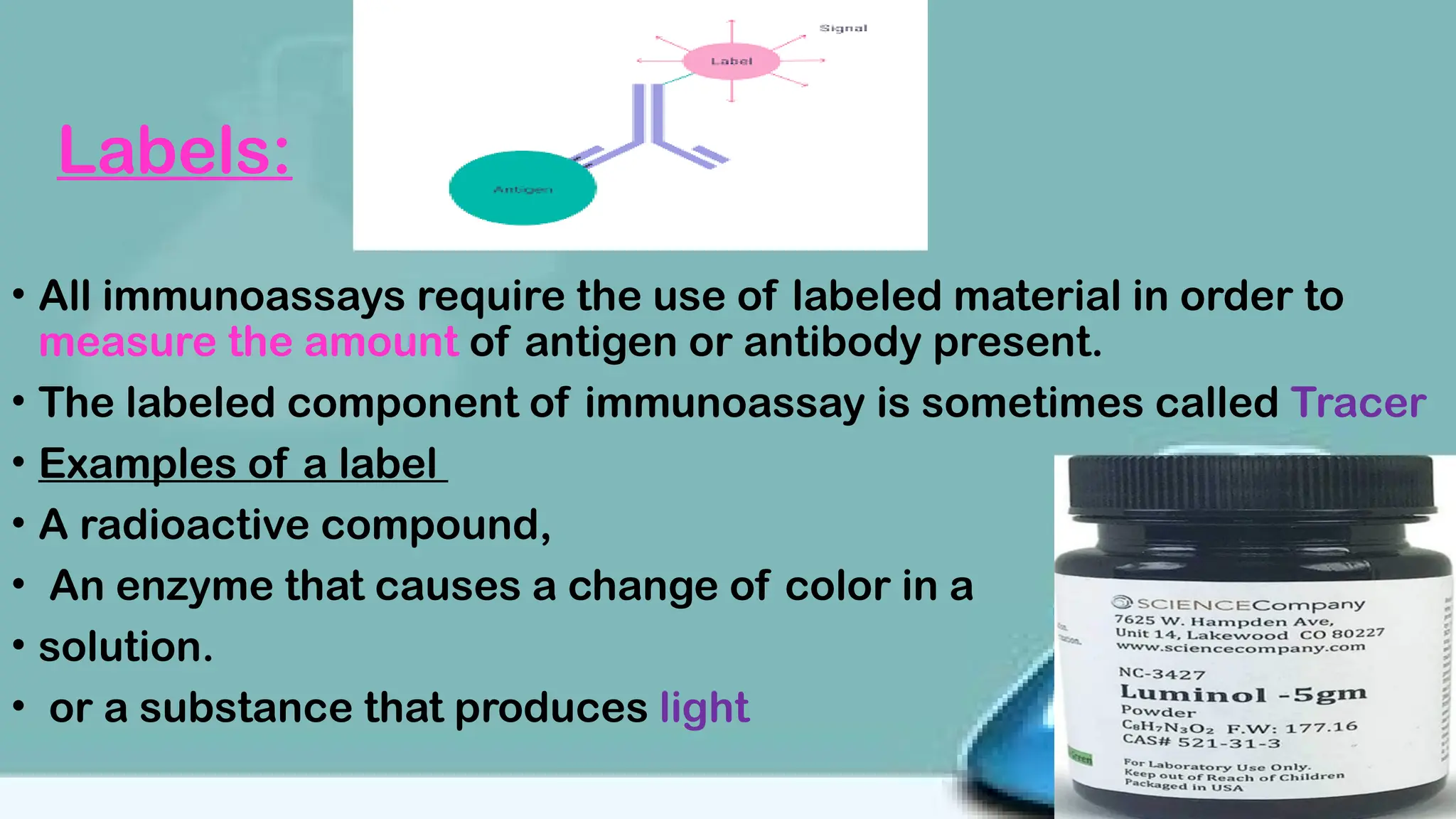
• All immunoassays require the use of labeled material in order to
measure the amount of antigen or antibody present.
• The labeled component of immunoassay is sometimes called Tracer
• Examples of a label
• A radioactive compound,
• An enzyme that causes a change of color in a
• solution.
• or a substance that produces light
SEPARATION METRICES
• They are used for the separation of the immune complexes that
formed as a result of immune analytical reactions including
polyethylene, glycol, charcoal, a second antibody, microbeads, or the
most useful 96- well microwell plate; each well of the plate serves as
a separate reaction tube.
• One component of the reaction(antibody or analyte) is coated onto
the surface of the bottom of the plate wells and the immune complex
is formed on the surface of the wells.
DIGOXIN
Digoxin is the primary cardiac glycoside extracted from
the foxglove plant, Digitalis lanate.
It is used in the:
• treatment of CHF because of its inotropic effects on the
myocardium.
• treatment of atrial fibrillation because of its
chronotropic effects. treatment of atrial flutter because
of its positive inotropic effects. treatment paroxysmal
atrial tachycardia because of its positive inotropic
effects.
Pharmacological Class :- Cardiac Glycoside
Therapeutic Class :- Inotrope, antiarrhythmic
NEED OF IMMUNOASSAY OF DIGOXIN
• Digoxin has a narrow range of safe and effective
concentrations in serum. Although the therapeutic and
toxic concentrations overlap, measurement of digoxin
levels helps to maintain effective concentrations and to
diagnose and prevent overdosage.
• Monitoring serum digoxin concentrations, along with
careful clinical assessment, is the most effective means
of ensuring safe and effective therapy for several
reasons:
• Studies have shown a relationship between serum
digoxin concentrations and clinical signs of toxicity.
• Clinical manifestations of digoxin toxicity (cardiac
disturbances, gastrointestinal problems, and central
nervous system disorders) can mimic those of disease
processes.
• Concomitant use of other drugs, particularly quinidine,
can markedly alter serum digoxin concentrations
Analytical methods for immunoassay of Digoxin
• Radioimmunoassay (RIA)
• Enzyme Immunoassay ( EIA)
• Fluorescence Polarisation Immunoassay (FPIA)
• Enzyme Multiplied Immunoassay (EMIT)
Radioimmunoassay (RIA)
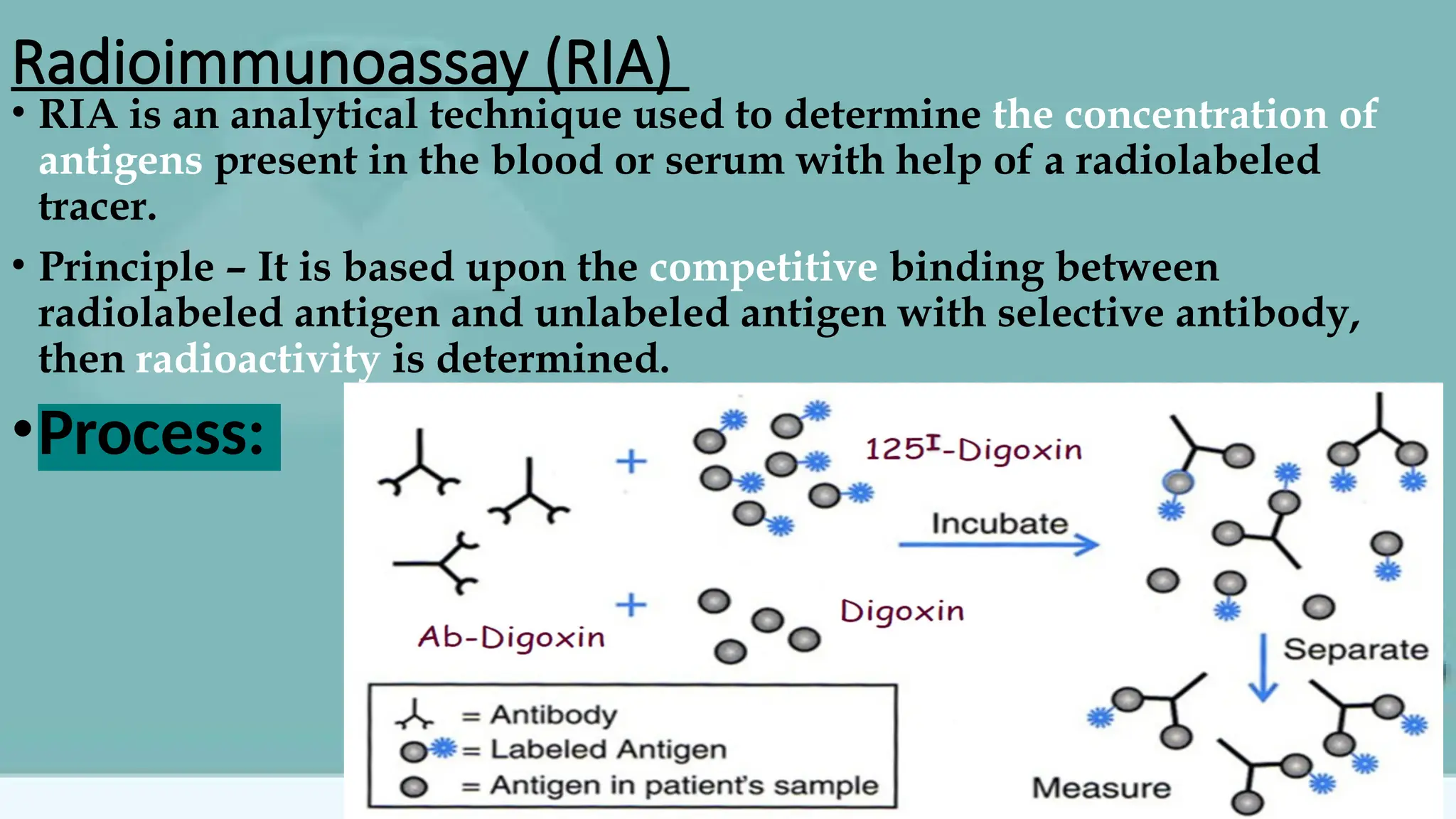
• RIA is an analytical technique used to determine the concentration of
antigens present in the blood or serum with help of a radiolabeled
tracer.
• Principle – It is based upon the competitive binding between
radiolabeled antigen and unlabeled antigen with selective antibody,
then radioactivity is determined.
•Process:
Enzyme Immunoassay ( EIA)
• The general principle of this technique is based on the binding of conjugated
enzyme molecules with specific antibodies to detect and quantify the presence
of either antigens or antibodies in the test sample.
• In this method, the label on the tracer is an enzyme.
• The catalytic properties of enzymes allow the detection and quantitation of
small quantities of the drug.
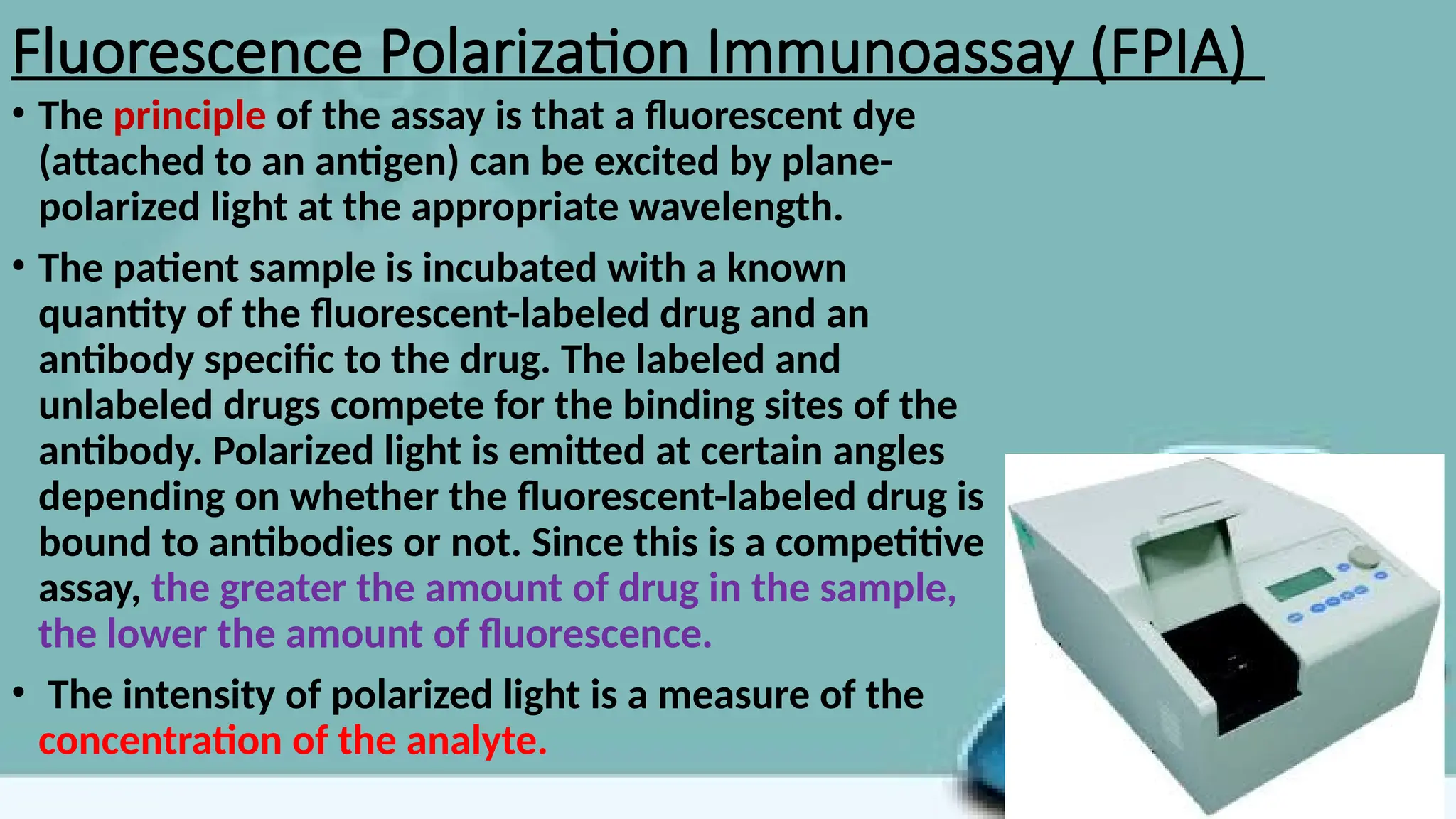
Fluorescence Polarization Immunoassay (FPIA)
• The principle of the assay is that a fluorescent dye
(attached to an antigen) can be excited by plane-
polarized light at the appropriate wavelength.
• The patient sample is incubated with a known
quantity of the fluorescent-labeled drug and an
antibody specific to the drug. The labeled and
unlabeled drugs compete for the binding sites of the
antibody. Polarized light is emitted at certain angles
depending on whether the fluorescent-labeled drug is
bound to antibodies or not. Since this is a competitive
assay, the greater the amount of drug in the sample,
the lower the amount of fluorescence.
• The intensity of polarized light is a measure of the
concentration of the analyte.
FPIA
The general procedure of Immunoassay of Digoxin
Specimen Collection and Preparation :
• Each assay requires serum or plasma.
• Sample volume is instrument-dependent.
• Use fresh samples. If samples are to be tested within 8 hours of collection,
they may be stored at room temperature (20–25°C).
• For transporting, maintain the sample temperature at 2–8°C. Samples can be
stored refrigerated at 2–8°C for up to 7 days or stored frozen (- 20°C) for up to
6 months. Repeated freeze-thaw cycles should be avoided.
• If the samples contain particulate matter, or fibrous material then Vigorously
mix the sample in a vortex for at least 30 seconds or Centrifuge the sample at
≥2000 rpm for 15 minutes.
•Reagents:
• Sample( serum containing digoxin)
• Digoxin tracer reagent( digoxin-HRP in a buffer dye)
• Rabbit serum antibody(digoxin-ab)
• Washing buffer
• Signal agent( luminol in buffer)
Procedure:
1. 96-well microplate
2. Add 0.025ml (25μl) of the appropriate serum specimen into the assigned well.
3. Add 0.050 ml (50μl) of Digoxin Enzyme Reagent( HRP) to all the wells.
4. Swirl the microplate gently for 20-30 seconds to mix.
5. Add 0.050 ml (50μl) Digoxin antibody( rabbit serum) to all wells
6. Swirl the microplate gently for 20-30 seconds to mix.
7. Cover and incubate for 30 minutes at room temperature.
8. Add 0.350ml (350μl) of washing buffer & wash for 3 times.
9. Add 0.100 ml (100μl) of working signal reagent to all wells.
10. DO NOT SHAKE THE PLATE AFTER THIS ADDITION.
11. Incubate at room temperature for fifteen (15) minutes.
12. Read the relative light unit with a chemiluminescence microplate reader.
13. The results should be read within thirty (30) minutes of adding the signal reagent.
IMMUNOASSAY OF INSULIN:
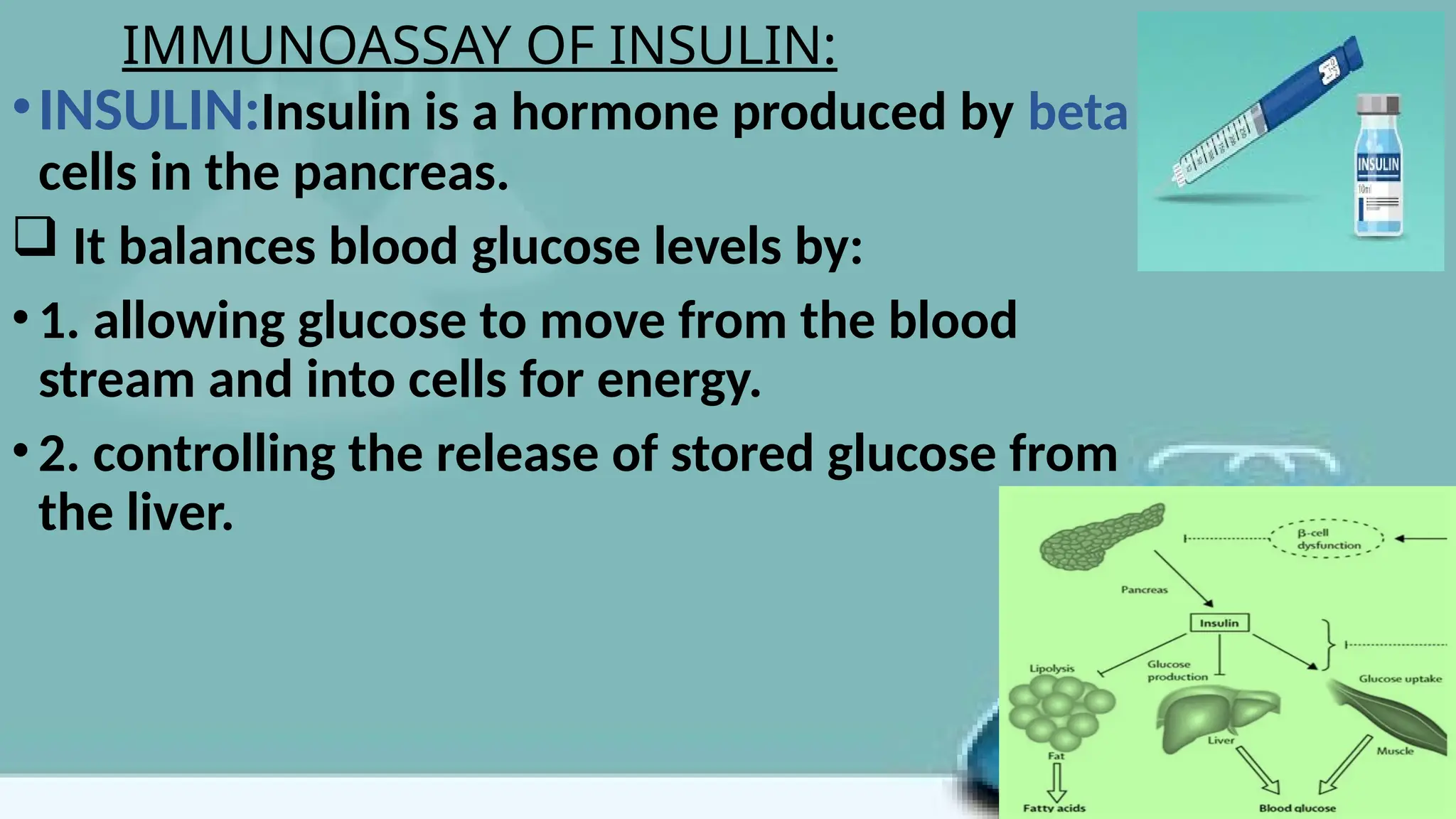
•INSULIN:Insulin is a hormone produced by beta
cells in the pancreas.
 It balances blood glucose levels by:
•1. allowing glucose to move from the blood
stream and into cells for energy.
•2. controlling the release of stored glucose from
the liver.
Radioimmunoassay for insulin
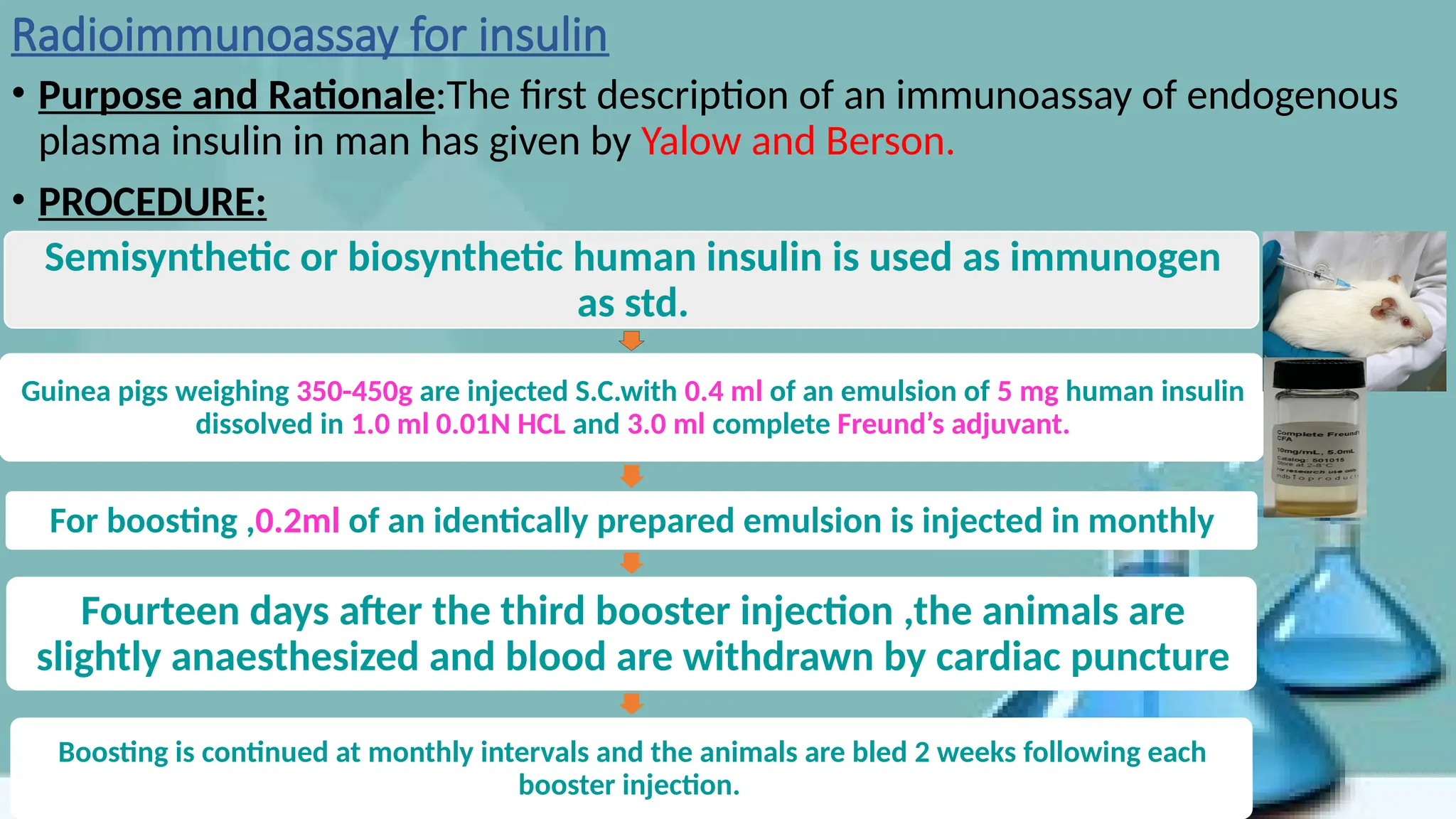
• Purpose and Rationale:The first description of an immunoassay of endogenous
plasma insulin in man has given by Yalow and Berson.
• PROCEDURE:
Semisynthetic or biosynthetic human insulin is used as immunogen
as std.
Guinea pigs weighing 350-450g are injected S.C.with 0.4 ml of an emulsion of 5 mg human insulin
dissolved in 1.0 ml 0.01N HCL and 3.0 ml complete Freund’s adjuvant.
For boosting ,0.2ml of an identically prepared emulsion is injected in monthly
Fourteen days after the third booster injection ,the animals are
slightly anaesthesized and blood are withdrawn by cardiac puncture
Boosting is continued at monthly intervals and the animals are bled 2 weeks following each
booster injection.
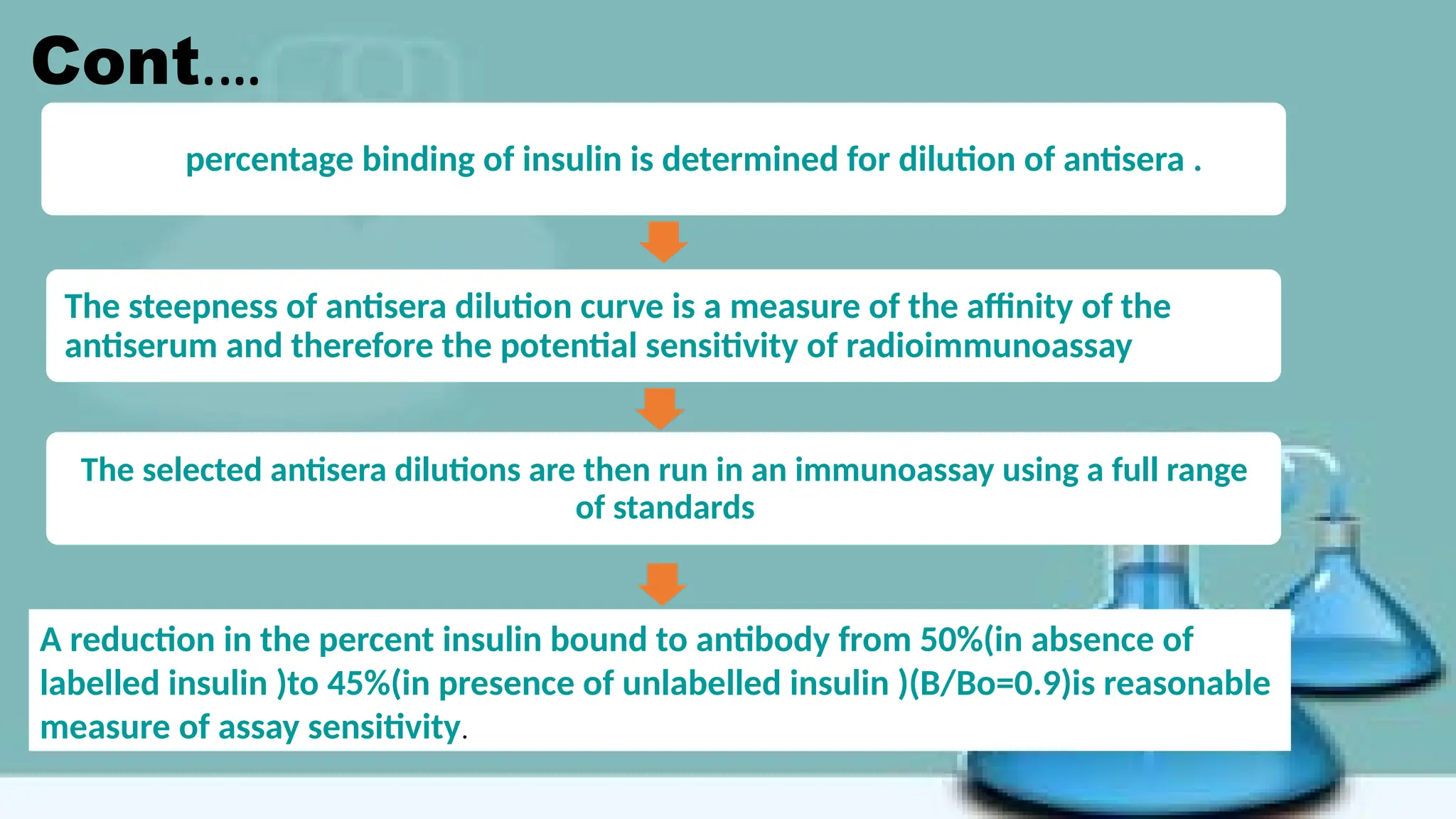
Cont.…
The percentage binding of insulin is determined for dilution of antisera .
The steepness of antisera dilution curve is a measure of the affinity of the
antiserum and therefore the potential sensitivity of radioimmunoassay
The selected antisera dilutions are then run in an immunoassay using a full range
of standards
A reduction in the percent insulin bound to antibody from 50%(in absence of
labelled insulin )to 45%(in presence of unlabelled insulin )(B/Bo=0.9)is reasonable
measure of assay sensitivity.
THANKYOU ……………..
Prepared by : Bharti

Presentation on immunoassay of insulin and digitalis. by Bharti

  • 1.
    IMMUNOASSAY OF DIGOXINAND INSULIN • Prepared by :Bharti • Submitted to :Ritu Joshi(Associate professor) • M.PHARMACY(Pharmacology) • Ch. Devi. Lal college of pharmacy
  • 2.
    Immunoassay  Immunoassay isan analytical method based on the specific immuno- reaction between the antibody(Ab) and antigen(Ag) for the determination of the amount of reactant in the solution. An antigen-antibody complex is known as an immuno-complex.  An immune assay is a test that uses antibody and antigen complexes as a means of generating a measurable result.
  • 3.
    Antibodies:  Antibodies arealso known as Immunoglobulin, Y-shaped molecules of glycoproteins manufactured by the body that help fight against foreign substances called antigens.  They have high specificity and affinity towards the antigen.  There are two types of antibodies. Monoclonal and Polyclonal
  • 4.
    ANTIGENS: • Antigens areany substances that stimulate the immune to produce antibodies Antigens can be Bacteria, viruses, or fungi that cause infection or disease. • The area of antigen where the antibody binds is called an epitope.
  • 5.
    Labels: • All immunoassaysrequire the use of labeled material in order to measure the amount of antigen or antibody present. • The labeled component of immunoassay is sometimes called Tracer • Examples of a label • A radioactive compound, • An enzyme that causes a change of color in a • solution. • or a substance that produces light
  • 6.
    SEPARATION METRICES • Theyare used for the separation of the immune complexes that formed as a result of immune analytical reactions including polyethylene, glycol, charcoal, a second antibody, microbeads, or the most useful 96- well microwell plate; each well of the plate serves as a separate reaction tube. • One component of the reaction(antibody or analyte) is coated onto the surface of the bottom of the plate wells and the immune complex is formed on the surface of the wells.
  • 7.
    DIGOXIN Digoxin is theprimary cardiac glycoside extracted from the foxglove plant, Digitalis lanate. It is used in the: • treatment of CHF because of its inotropic effects on the myocardium. • treatment of atrial fibrillation because of its chronotropic effects. treatment of atrial flutter because of its positive inotropic effects. treatment paroxysmal atrial tachycardia because of its positive inotropic effects. Pharmacological Class :- Cardiac Glycoside Therapeutic Class :- Inotrope, antiarrhythmic
  • 8.
    NEED OF IMMUNOASSAYOF DIGOXIN • Digoxin has a narrow range of safe and effective concentrations in serum. Although the therapeutic and toxic concentrations overlap, measurement of digoxin levels helps to maintain effective concentrations and to diagnose and prevent overdosage. • Monitoring serum digoxin concentrations, along with careful clinical assessment, is the most effective means of ensuring safe and effective therapy for several reasons: • Studies have shown a relationship between serum digoxin concentrations and clinical signs of toxicity. • Clinical manifestations of digoxin toxicity (cardiac disturbances, gastrointestinal problems, and central nervous system disorders) can mimic those of disease processes. • Concomitant use of other drugs, particularly quinidine, can markedly alter serum digoxin concentrations
  • 9.
    Analytical methods forimmunoassay of Digoxin • Radioimmunoassay (RIA) • Enzyme Immunoassay ( EIA) • Fluorescence Polarisation Immunoassay (FPIA) • Enzyme Multiplied Immunoassay (EMIT)
  • 10.
    Radioimmunoassay (RIA) • RIAis an analytical technique used to determine the concentration of antigens present in the blood or serum with help of a radiolabeled tracer. • Principle – It is based upon the competitive binding between radiolabeled antigen and unlabeled antigen with selective antibody, then radioactivity is determined. •Process:
  • 11.
    Enzyme Immunoassay (EIA) • The general principle of this technique is based on the binding of conjugated enzyme molecules with specific antibodies to detect and quantify the presence of either antigens or antibodies in the test sample. • In this method, the label on the tracer is an enzyme. • The catalytic properties of enzymes allow the detection and quantitation of small quantities of the drug.
  • 12.
    Fluorescence Polarization Immunoassay(FPIA) • The principle of the assay is that a fluorescent dye (attached to an antigen) can be excited by plane- polarized light at the appropriate wavelength. • The patient sample is incubated with a known quantity of the fluorescent-labeled drug and an antibody specific to the drug. The labeled and unlabeled drugs compete for the binding sites of the antibody. Polarized light is emitted at certain angles depending on whether the fluorescent-labeled drug is bound to antibodies or not. Since this is a competitive assay, the greater the amount of drug in the sample, the lower the amount of fluorescence. • The intensity of polarized light is a measure of the concentration of the analyte.
  • 13.
  • 14.
    The general procedureof Immunoassay of Digoxin Specimen Collection and Preparation : • Each assay requires serum or plasma. • Sample volume is instrument-dependent. • Use fresh samples. If samples are to be tested within 8 hours of collection, they may be stored at room temperature (20–25°C). • For transporting, maintain the sample temperature at 2–8°C. Samples can be stored refrigerated at 2–8°C for up to 7 days or stored frozen (- 20°C) for up to 6 months. Repeated freeze-thaw cycles should be avoided. • If the samples contain particulate matter, or fibrous material then Vigorously mix the sample in a vortex for at least 30 seconds or Centrifuge the sample at ≥2000 rpm for 15 minutes.
  • 15.
    •Reagents: • Sample( serumcontaining digoxin) • Digoxin tracer reagent( digoxin-HRP in a buffer dye) • Rabbit serum antibody(digoxin-ab) • Washing buffer • Signal agent( luminol in buffer)
  • 16.
    Procedure: 1. 96-well microplate 2.Add 0.025ml (25μl) of the appropriate serum specimen into the assigned well. 3. Add 0.050 ml (50μl) of Digoxin Enzyme Reagent( HRP) to all the wells. 4. Swirl the microplate gently for 20-30 seconds to mix. 5. Add 0.050 ml (50μl) Digoxin antibody( rabbit serum) to all wells 6. Swirl the microplate gently for 20-30 seconds to mix. 7. Cover and incubate for 30 minutes at room temperature. 8. Add 0.350ml (350μl) of washing buffer & wash for 3 times. 9. Add 0.100 ml (100μl) of working signal reagent to all wells. 10. DO NOT SHAKE THE PLATE AFTER THIS ADDITION. 11. Incubate at room temperature for fifteen (15) minutes. 12. Read the relative light unit with a chemiluminescence microplate reader. 13. The results should be read within thirty (30) minutes of adding the signal reagent.
  • 17.
    IMMUNOASSAY OF INSULIN: •INSULIN:Insulinis a hormone produced by beta cells in the pancreas.  It balances blood glucose levels by: •1. allowing glucose to move from the blood stream and into cells for energy. •2. controlling the release of stored glucose from the liver.
  • 18.
    Radioimmunoassay for insulin •Purpose and Rationale:The first description of an immunoassay of endogenous plasma insulin in man has given by Yalow and Berson. • PROCEDURE: Semisynthetic or biosynthetic human insulin is used as immunogen as std. Guinea pigs weighing 350-450g are injected S.C.with 0.4 ml of an emulsion of 5 mg human insulin dissolved in 1.0 ml 0.01N HCL and 3.0 ml complete Freund’s adjuvant. For boosting ,0.2ml of an identically prepared emulsion is injected in monthly Fourteen days after the third booster injection ,the animals are slightly anaesthesized and blood are withdrawn by cardiac puncture Boosting is continued at monthly intervals and the animals are bled 2 weeks following each booster injection.
  • 19.
    Cont.… The percentage bindingof insulin is determined for dilution of antisera . The steepness of antisera dilution curve is a measure of the affinity of the antiserum and therefore the potential sensitivity of radioimmunoassay The selected antisera dilutions are then run in an immunoassay using a full range of standards A reduction in the percent insulin bound to antibody from 50%(in absence of labelled insulin )to 45%(in presence of unlabelled insulin )(B/Bo=0.9)is reasonable measure of assay sensitivity.
  • 20.