- S U M A N A R A S H I D N A S E E R I ( B P T )
Rhematoid Arthritis
 Rheumatoid Arthritis is a chronic systematic
inflammatory disease predominately affecting
diarthrodial joints and frequently a variety of other
organs.
 Female>Male
 Genetic and autoimmune factors are mainly
responsible for the initiation of disease process
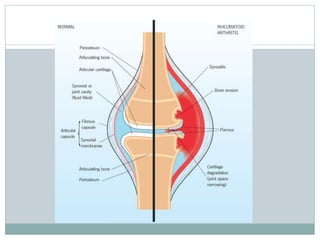
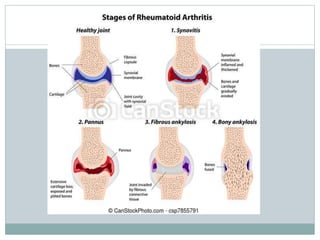
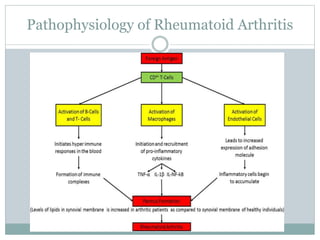
Pathophysiology of Rheumatoid Arthritis
Clinical Features
 1.Small joints of hand-pain/stiffness>HR
 2.The pattern of joint involvement is typically
polyarticular
interphalangeal(PIP),metacarpophalangeal(MCP),wr
ist,elbow,shoulder,knee,ankle,MTP joints and
cervical spine.
 3.The distal interphalangeal (DIP)joints of the
fingers are usually spared.
 4.Fever/malaise/headache
 Joint swelling/tenderness
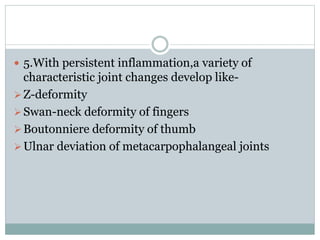
 5.With persistent inflammation,a variety of
characteristic joint changes develop like-
Z-deformity
Swan-neck deformity of fingers
Boutonniere deformity of thumb
Ulnar deviation of metacarpophalangeal joints
DIAGNOSTIC INVESTIGATIONS
 CLINICAL
 MRI
 ULTRASOUND
 X-RAYS
 CT-SCAN
 Synovial fluid aspiration
 Anaemia,raised ESR
 Serological tests
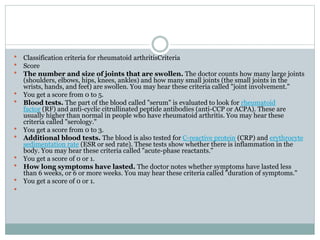
 Classification criteria for rheumatoid arthritisCriteria
 Score
 The number and size of joints that are swollen. The doctor counts how many large joints
(shoulders, elbows, hips, knees, ankles) and how many small joints (the small joints in the
wrists, hands, and feet) are swollen. You may hear these criteria called "joint involvement."
 You get a score from 0 to 5.
 Blood tests. The part of the blood called "serum" is evaluated to look for rheumatoid
factor (RF) and anti-cyclic citrullinated peptide antibodies (anti-CCP or ACPA). These are
usually higher than normal in people who have rheumatoid arthritis. You may hear these
criteria called "serology."
 You get a score from 0 to 3.
 Additional blood tests. The blood is also tested for C-reactive protein (CRP) and erythrocyte
sedimentation rate (ESR or sed rate). These tests show whether there is inflammation in the
body. You may hear these criteria called "acute-phase reactants."
 You get a score of 0 or 1.
 How long symptoms have lasted. The doctor notes whether symptoms have lasted less
than 6 weeks, or 6 or more weeks. You may hear these criteria called "duration of symptoms."
 You get a score of 0 or 1.

TREATMENT
 Treatment
 There is no cure for rheumatoid arthritis. But clinical studies indicate that remission of symptoms is more
likely when treatment begins early with medications known as disease-modifying antirheumatic drugs
(DMARDs).
 Medications
 The types of medications recommended by your doctor will depend on the severity of your symptoms and how
long you've had rheumatoid arthritis.
 NSAIDs. Nonsteroidal anti-inflammatory drugs (NSAIDs) can relieve pain and reduce inflammation. Over-
the-counter NSAIDs include ibuprofen (Advil, Motrin IB, others) and naproxen sodium (Aleve).
Stronger NSAIDs are available by prescription. Side effects may include stomach irritation, heart problems
and kidney damage.
 Steroids. Corticosteroid medications, such as prednisone, reduce inflammation and pain and slow joint
damage. Side effects may include thinning of bones, weight gain and diabetes. Doctors often prescribe a
corticosteroid to relieve symptoms quickly, with the goal of gradually tapering off the medication.
 Conventional DMARDs. These drugs can slow the progression of rheumatoid arthritis and save the joints
and other tissues from permanent damage. Common DMARDs include methotrexate (Trexall, Otrexup,
others), leflunomide (Arava), hydroxychloroquine (Plaquenil) and sulfasalazine (Azulfidine). Side effects vary
but may include liver damage and severe lung infections.
 Biologic agents. Also known as biologic response modifiers, this newer class of DMARDs includes abatacept
(Orencia), adalimumab (Humira), anakinra (Kineret), certolizumab (Cimzia), etanercept (Enbrel), golimumab
(Simponi), infliximab (Remicade), rituximab (Rituxan), sarilumab (Kevzara) and tocilizumab (Actemra).
 Biologic DMARDs are usually most effective when paired with a conventional DMARD, such as methotrexate.
This type of drug also increases the risk of infections.
 Targeted synthetic DMARDs. Baricitinib (Olumiant), tofacitinib (Xeljanz) and upadacitinib (Rinvoq) may
be used if conventional DMARDs and biologics haven't been effective. Higher doses of tofacitinib can increase
the risk of blood clots in the lungs, serious heart-related events and cancer.
 Therapy
 Your doctor may refer you to a physical or occupational
therapist who can teach you exercises to help keep your
joints flexible. The therapist may also suggest new ways
to do daily tasks that will be easier on your joints. For
example, you may want to pick up an object using your
forearms.
 Assistive devices can make it easier to avoid stressing
your painful joints. For instance, a kitchen knife
equipped with a hand grip helps protect your finger and
wrist joints. Certain tools, such as buttonhooks, can
make it easier to get dressed. Catalogs and medical
supply stores are good places to look for ideas.
 Surgery
 If medications fail to prevent or slow joint damage, you and your doctor may
consider surgery to repair damaged joints. Surgery may help restore your ability to
use your joint. It can also reduce pain and improve function.
 Rheumatoid arthritis surgery may involve one or more of the following procedures:
 Synovectomy. Surgery to remove the inflamed lining of the joint (synovium) can
help reduce pain and improve the joint's flexibility.
 Tendon repair. Inflammation and joint damage may cause tendons around your
joint to loosen or rupture. Your surgeon may be able to repair the tendons around
your joint.
 Joint fusion. Surgically fusing a joint may be recommended to stabilize or realign
a joint and for pain relief when a joint replacement isn't an option.
 Total joint replacement. During joint replacement surgery, your surgeon
removes the damaged parts of your joint and inserts a prosthesis made of metal and
plastic.
 Surgery carries a risk of bleeding, infection and pain. Discuss the benefits and risks
with your doctor.
 Lifestyle and home remedies
 Products and Services
 You can take steps to care for your body if you have rheumatoid arthritis.
These self-care measures, when used along with your rheumatoid arthritis
medications, can help you manage your signs and symptoms:
 Exercise regularly. Gentle exercise can help strengthen the muscles
around your joints, and it can help reduce fatigue you might feel. Check
with your doctor before you start exercising. If you're just getting started,
begin by taking a walk. Avoid exercising tender, injured or severely
inflamed joints.
 Apply heat or cold. Heat can help ease your pain and relax tense, painful
muscles. Cold may dull the sensation of pain. Cold also has a numbing
effect and can reduce swelling.
 Relax. Find ways to cope with pain by reducing stress in your life.
Techniques such as guided imagery, deep breathing and muscle relaxation
can all be used to control pain
 Risk factors
 Factors that may increase your risk of rheumatoid arthritis include:
 Your sex. Women are more likely than men to develop rheumatoid
arthritis.
 Age. Rheumatoid arthritis can occur at any age, but it most
commonly begins in middle age.
 Family history. If a member of your family has rheumatoid
arthritis, you may have an increased risk of the disease.
 Smoking. Cigarette smoking increases your risk of developing
rheumatoid arthritis, particularly if you have a genetic
predisposition for developing the disease. Smoking also appears to
be associated with greater disease severity.
 Excess weight. People who are overweight appear to be at a
somewhat higher risk of developing rheumatoid arthritis.
COMPLICATIONS
 Complications
 Rheumatoid arthritis increases your risk of developing:
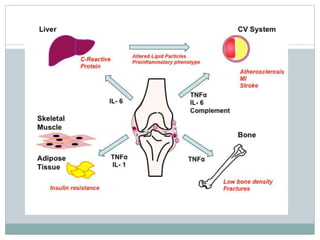
 Osteoporosis. Rheumatoid arthritis itself, along with some medications used for treating rheumatoid
arthritis, can increase your risk of osteoporosis — a condition that weakens your bones and makes them more
prone to fracture.
 Rheumatoid nodules. These firm bumps of tissue most commonly form around pressure points, such as
the elbows. However, these nodules can form anywhere in the body, including the heart and lungs.
 Dry eyes and mouth. People who have rheumatoid arthritis are much more likely to develop Sjogren's
syndrome, a disorder that decreases the amount of moisture in the eyes and mouth.
 Infections. Rheumatoid arthritis itself and many of the medications used to combat it can impair the
immune system, leading to increased infections. Protect yourself with vaccinations to prevent diseases such as
influenza, pneumonia, shingles and COVID-19.
 Abnormal body composition. The proportion of fat to lean mass is often higher in people who have
rheumatoid arthritis, even in those who have a normal body mass index (BMI).
 Carpal tunnel syndrome. If rheumatoid arthritis affects your wrists, the inflammation can compress the
nerve that serves most of your hand and fingers.
 Heart problems. Rheumatoid arthritis can increase your risk of hardened and blocked arteries, as well as
inflammation of the sac that encloses your heart.
 Lung disease. People with rheumatoid arthritis have an increased risk of inflammation and scarring of the
lung tissues, which can lead to progressive shortness of breath.
 Lymphoma. Rheumatoid arthritis increases the risk of lymphoma, a group of blood cancers that develop in
the lymph system.
Rhematoid arthritis

Rhematoid arthritis

  • 1.
    - S UM A N A R A S H I D N A S E E R I ( B P T ) Rhematoid Arthritis
  • 2.
     Rheumatoid Arthritisis a chronic systematic inflammatory disease predominately affecting diarthrodial joints and frequently a variety of other organs.  Female>Male  Genetic and autoimmune factors are mainly responsible for the initiation of disease process
  • 6.
  • 8.
    Clinical Features  1.Smalljoints of hand-pain/stiffness>HR  2.The pattern of joint involvement is typically polyarticular interphalangeal(PIP),metacarpophalangeal(MCP),wr ist,elbow,shoulder,knee,ankle,MTP joints and cervical spine.  3.The distal interphalangeal (DIP)joints of the fingers are usually spared.  4.Fever/malaise/headache  Joint swelling/tenderness
  • 9.
     5.With persistentinflammation,a variety of characteristic joint changes develop like- Z-deformity Swan-neck deformity of fingers Boutonniere deformity of thumb Ulnar deviation of metacarpophalangeal joints
  • 10.
    DIAGNOSTIC INVESTIGATIONS  CLINICAL MRI  ULTRASOUND  X-RAYS  CT-SCAN  Synovial fluid aspiration  Anaemia,raised ESR  Serological tests
  • 11.
     Classification criteriafor rheumatoid arthritisCriteria  Score  The number and size of joints that are swollen. The doctor counts how many large joints (shoulders, elbows, hips, knees, ankles) and how many small joints (the small joints in the wrists, hands, and feet) are swollen. You may hear these criteria called "joint involvement."  You get a score from 0 to 5.  Blood tests. The part of the blood called "serum" is evaluated to look for rheumatoid factor (RF) and anti-cyclic citrullinated peptide antibodies (anti-CCP or ACPA). These are usually higher than normal in people who have rheumatoid arthritis. You may hear these criteria called "serology."  You get a score from 0 to 3.  Additional blood tests. The blood is also tested for C-reactive protein (CRP) and erythrocyte sedimentation rate (ESR or sed rate). These tests show whether there is inflammation in the body. You may hear these criteria called "acute-phase reactants."  You get a score of 0 or 1.  How long symptoms have lasted. The doctor notes whether symptoms have lasted less than 6 weeks, or 6 or more weeks. You may hear these criteria called "duration of symptoms."  You get a score of 0 or 1. 
  • 12.
    TREATMENT  Treatment  Thereis no cure for rheumatoid arthritis. But clinical studies indicate that remission of symptoms is more likely when treatment begins early with medications known as disease-modifying antirheumatic drugs (DMARDs).  Medications  The types of medications recommended by your doctor will depend on the severity of your symptoms and how long you've had rheumatoid arthritis.  NSAIDs. Nonsteroidal anti-inflammatory drugs (NSAIDs) can relieve pain and reduce inflammation. Over- the-counter NSAIDs include ibuprofen (Advil, Motrin IB, others) and naproxen sodium (Aleve). Stronger NSAIDs are available by prescription. Side effects may include stomach irritation, heart problems and kidney damage.  Steroids. Corticosteroid medications, such as prednisone, reduce inflammation and pain and slow joint damage. Side effects may include thinning of bones, weight gain and diabetes. Doctors often prescribe a corticosteroid to relieve symptoms quickly, with the goal of gradually tapering off the medication.  Conventional DMARDs. These drugs can slow the progression of rheumatoid arthritis and save the joints and other tissues from permanent damage. Common DMARDs include methotrexate (Trexall, Otrexup, others), leflunomide (Arava), hydroxychloroquine (Plaquenil) and sulfasalazine (Azulfidine). Side effects vary but may include liver damage and severe lung infections.  Biologic agents. Also known as biologic response modifiers, this newer class of DMARDs includes abatacept (Orencia), adalimumab (Humira), anakinra (Kineret), certolizumab (Cimzia), etanercept (Enbrel), golimumab (Simponi), infliximab (Remicade), rituximab (Rituxan), sarilumab (Kevzara) and tocilizumab (Actemra).  Biologic DMARDs are usually most effective when paired with a conventional DMARD, such as methotrexate. This type of drug also increases the risk of infections.  Targeted synthetic DMARDs. Baricitinib (Olumiant), tofacitinib (Xeljanz) and upadacitinib (Rinvoq) may be used if conventional DMARDs and biologics haven't been effective. Higher doses of tofacitinib can increase the risk of blood clots in the lungs, serious heart-related events and cancer.
  • 13.
     Therapy  Yourdoctor may refer you to a physical or occupational therapist who can teach you exercises to help keep your joints flexible. The therapist may also suggest new ways to do daily tasks that will be easier on your joints. For example, you may want to pick up an object using your forearms.  Assistive devices can make it easier to avoid stressing your painful joints. For instance, a kitchen knife equipped with a hand grip helps protect your finger and wrist joints. Certain tools, such as buttonhooks, can make it easier to get dressed. Catalogs and medical supply stores are good places to look for ideas.
  • 14.
     Surgery  Ifmedications fail to prevent or slow joint damage, you and your doctor may consider surgery to repair damaged joints. Surgery may help restore your ability to use your joint. It can also reduce pain and improve function.  Rheumatoid arthritis surgery may involve one or more of the following procedures:  Synovectomy. Surgery to remove the inflamed lining of the joint (synovium) can help reduce pain and improve the joint's flexibility.  Tendon repair. Inflammation and joint damage may cause tendons around your joint to loosen or rupture. Your surgeon may be able to repair the tendons around your joint.  Joint fusion. Surgically fusing a joint may be recommended to stabilize or realign a joint and for pain relief when a joint replacement isn't an option.  Total joint replacement. During joint replacement surgery, your surgeon removes the damaged parts of your joint and inserts a prosthesis made of metal and plastic.  Surgery carries a risk of bleeding, infection and pain. Discuss the benefits and risks with your doctor.
  • 15.
     Lifestyle andhome remedies  Products and Services  You can take steps to care for your body if you have rheumatoid arthritis. These self-care measures, when used along with your rheumatoid arthritis medications, can help you manage your signs and symptoms:  Exercise regularly. Gentle exercise can help strengthen the muscles around your joints, and it can help reduce fatigue you might feel. Check with your doctor before you start exercising. If you're just getting started, begin by taking a walk. Avoid exercising tender, injured or severely inflamed joints.  Apply heat or cold. Heat can help ease your pain and relax tense, painful muscles. Cold may dull the sensation of pain. Cold also has a numbing effect and can reduce swelling.  Relax. Find ways to cope with pain by reducing stress in your life. Techniques such as guided imagery, deep breathing and muscle relaxation can all be used to control pain
  • 16.
     Risk factors Factors that may increase your risk of rheumatoid arthritis include:  Your sex. Women are more likely than men to develop rheumatoid arthritis.  Age. Rheumatoid arthritis can occur at any age, but it most commonly begins in middle age.  Family history. If a member of your family has rheumatoid arthritis, you may have an increased risk of the disease.  Smoking. Cigarette smoking increases your risk of developing rheumatoid arthritis, particularly if you have a genetic predisposition for developing the disease. Smoking also appears to be associated with greater disease severity.  Excess weight. People who are overweight appear to be at a somewhat higher risk of developing rheumatoid arthritis.
  • 17.
    COMPLICATIONS  Complications  Rheumatoidarthritis increases your risk of developing:  Osteoporosis. Rheumatoid arthritis itself, along with some medications used for treating rheumatoid arthritis, can increase your risk of osteoporosis — a condition that weakens your bones and makes them more prone to fracture.  Rheumatoid nodules. These firm bumps of tissue most commonly form around pressure points, such as the elbows. However, these nodules can form anywhere in the body, including the heart and lungs.  Dry eyes and mouth. People who have rheumatoid arthritis are much more likely to develop Sjogren's syndrome, a disorder that decreases the amount of moisture in the eyes and mouth.  Infections. Rheumatoid arthritis itself and many of the medications used to combat it can impair the immune system, leading to increased infections. Protect yourself with vaccinations to prevent diseases such as influenza, pneumonia, shingles and COVID-19.  Abnormal body composition. The proportion of fat to lean mass is often higher in people who have rheumatoid arthritis, even in those who have a normal body mass index (BMI).  Carpal tunnel syndrome. If rheumatoid arthritis affects your wrists, the inflammation can compress the nerve that serves most of your hand and fingers.  Heart problems. Rheumatoid arthritis can increase your risk of hardened and blocked arteries, as well as inflammation of the sac that encloses your heart.  Lung disease. People with rheumatoid arthritis have an increased risk of inflammation and scarring of the lung tissues, which can lead to progressive shortness of breath.  Lymphoma. Rheumatoid arthritis increases the risk of lymphoma, a group of blood cancers that develop in the lymph system.