Presented by: Mahesh
Dayyala
Jan 21,2020
Rheumatoid Arthritis (RA)
 Chronic, systemic disease
 Inflammation of connective tissue in the
diarthrodial (synovial) joint
 Periods of remissions & exacerbation
 Extraarticular manifestations
 Worldwide, the annual incidence of RA is
approximately 3 cases per 10,000 population
 The prevalence rate is approximately 1%,
increasing with age and peaking between the ages
of 35 and 50 years.
 RA affects all populations, though it is much more
prevalent in some groups (eg, 5-6% in some Native
American groups) and much less prevalent in
others (eg, black persons from the Caribbean
Etiology
 Gender- Women before the menopause are
affected three times more often than men with an
equal sex incidence thereafter suggesting an
aetiological role for sex hormones.
 Familial -There is an increased incidence in those
with a family history of RA.
 Genetic factors - Human leucocyte antigen (HLA)-
DR4 and HLA-DRB1* 0404/0401 confer
susceptibility to RA and are associated with
development of more severe erosive disease.
Etiology & Pathophysiology
 Cause – unknown
 Autoimmune – most widely accepted theory
 Antigen/abnormal Immunoglobulin G (IgG)
 Presence of autoantibodies –
rheumatoid factor
 IgG + rheumatoid factor form deposits on synovial
membranes & articular cartilage
 Inflammation results – pannus (granulation tissue at the joint margins)
– articular cartilage destruction
Rheumatoid Arthritis
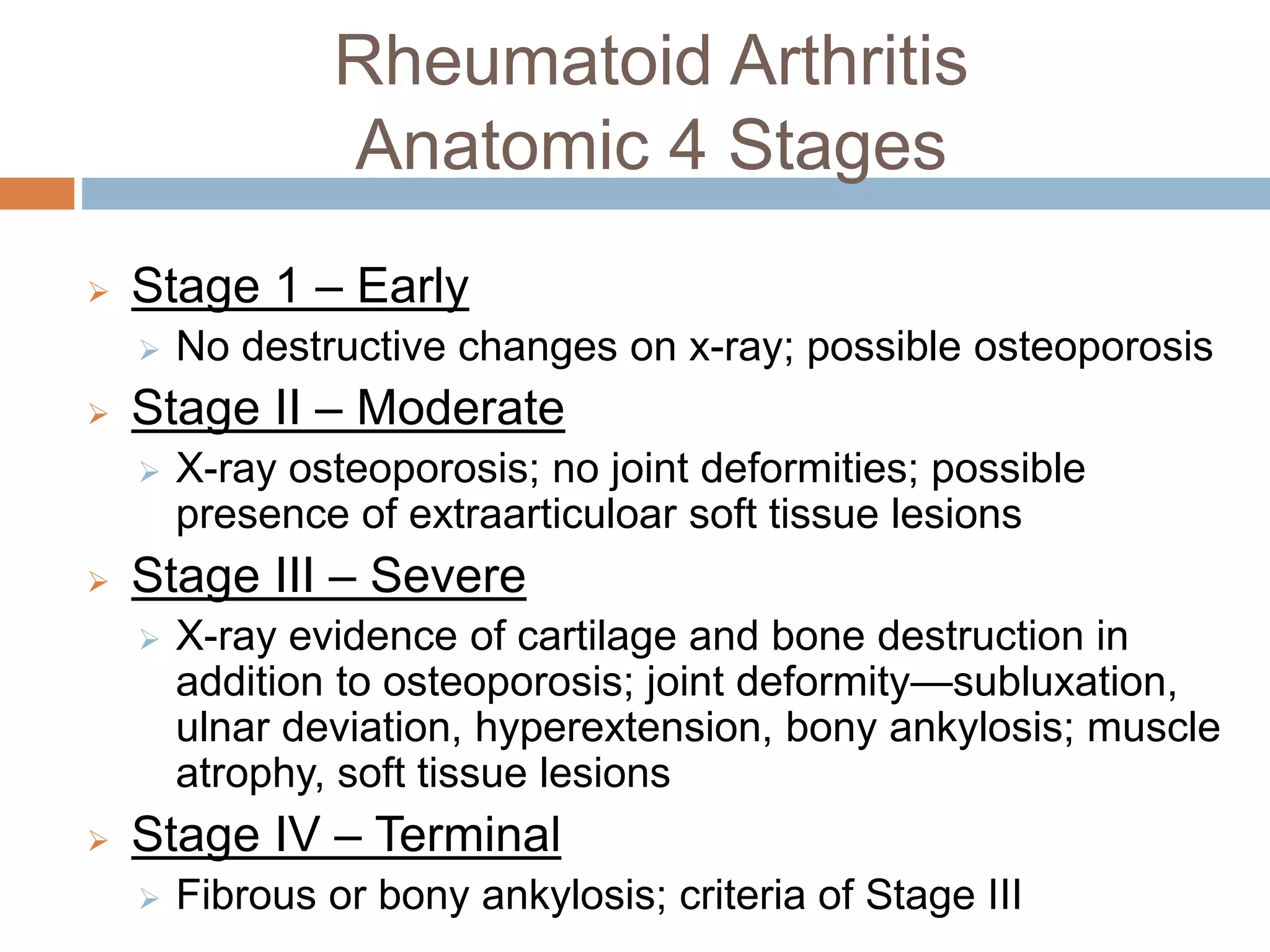
Anatomic 4 Stages
 Stage 1 – Early
 No destructive changes on x-ray; possible osteoporosis
 Stage II – Moderate
 X-ray osteoporosis; no joint deformities; possible
presence of extraarticuloar soft tissue lesions
 Stage III – Severe
 X-ray evidence of cartilage and bone destruction in
addition to osteoporosis; joint deformity—subluxation,
ulnar deviation, hyperextension, bony ankylosis; muscle
atrophy, soft tissue lesions
 Stage IV – Terminal
 Fibrous or bony ankylosis; criteria of Stage III
Clinical Manifestations
 Insidious – fatigue, anorexia, weight loss,
generalized stiffness
 Joints
 Stiffness becomes localized—pain, edema, limited
motion, inflammation, joints warm to touch, fingers—
spindle shaped
 “Morning Stiffness” – 60+ mins to several hours
depending on disease progression
Extraarticular Manifestations
 Systemic – Fever, Fatigue, Weight loss.
 Eyes- Scleritis, Scleromalacia perforans (perforation of
the eye) .
 Neurological- Carpal tunnel syndrome, Atlantoaxial
subluxation, Cord compression.
 Haematological- Lymphadenopathy, Felty’s syndrome
(rheumatoid arthritis, splenomegaly, neutropenia),
Anaemia (chronic disease, NSAIDinduced,
gastrointestinal blood loss, haemolysis, hypersplenism),
Thrombocytosis.
 Pulmonary - Pleural effusion, Lung fibrosis,
Rheumatoid nodules, Rheumatoid pneumoconiosis.
 Heart and peripheral vessels – Pericarditis,
Pericardial effusion, Raynaud’s syndrome.
 Vasculitis - Leg ulcers, Nail fold infarcts, Gangrene
of fingers and toes.
 Kidneys - Amyloidosis causes the nephrotic
syndrome and renal failure.
Diagnosis
 Blood count- usually a normochromic,
normocytic anaemia, ESR and CRP are raised .
 Serum autoantibodies - Anti-CCP has high
specificity (90%) and, Rheumatoid factor is
positive in 70% of cases sensitivity (80%) for RA.
 X-ray- joint narrowing, erosions at the joint
margins.
 Synovial fluid - high neutrophil count in
Diagnosis Criteria for RA
Treatment
 The goals in the management of RA are:
1. To prevent or control joint damage.
2. To prevent loss of function.
3. To decrease pain .
4. To maintain the patient’s quality of life.
5. To avoid or minimize adverse effects of treatment.
6. Preservation of muscle and joint function.
7. Return to a desirable and productive life.
Pharmacological Treatment
 There are four types of medications
used to treat RA: –
1. Non-steroidal anti-inflammatory
drugs (NSAIDs)
2. Corticosteroids.
3. Disease-modifying anti-rheumatic
drugs(DMARDS).
4. Biologic Response Modifiers
NSAIDS
 Nonsteroidal anti-inflammatory drugs
(NSAIDs) can relieve pain and reduce
inflammation.
 NSAIDs include ibuprofen and naproxen
sodium .
 Side effects may include stomach irritation,
heart problems and kidney damage.
Corticosteroids
 Corticosteroid reduce inflammation and pain
and slow joint damage.
 Hydrocortisone, prednisone, betamethasone,
dexa-methasone •
 Side effects may include thinning of bones,
weight gain, diabetes, increased blood
pressure, depression, mood swings,.
 Physicians often prescribe a corticosteroid to
relieve acute symptoms, with the goal of
gradually tapering off the medication.
Disease-modifying
antirheumatic drugs (DMARDs)
 These drugs can slow the progression of
rheumatoid arthritis and save the joints and other
tissues from permanent damage.
 Slow acting, take 6wks to 6 months to show the
effects.
 Common DMARDs include methotrexate
,leflunomide , hydroxychloroquine and
sulfasalazine.
 Side effects vary but may include liver damage,
Biologic agents
 Also known as biologic response modifiers, this
newer class of DMARDs includes abatacept ,
adalimumab , anakinra , baricitinib, certolizumab,
etanercept , golimumab, infliximab , rituximab,
tofacitinib.
 These drugs can target parts of the immune
system that trigger inflammation that causes joint
and tissue damage.
 These types of drugs also increase the risk of
infections.
 In people with rheumatoid arthritis, higher doses
of tofacitinib can increase the risk of blood clots in
the lungs.
 Biologic DMARDs are usually most effective when
Surgery
 If medications fail to prevent or slow joint damage,
surgery can help to repair damaged joints. Surgery
may help restore ability to use joint. It can also
reduce pain and improve function.
 Rheumatoid arthritis surgery may involve one or
more of the following procedures:
 Synovectomy.
 Tendon repair.
 Joint fusion.
 Total joint replacement
Guidelines for management
 In its 2015 revised guidelines for the management of
RA, the American College of Rheumatology (ACR)
included the following recommendations for treatment
early RA:
 A treat-to-target stategy should be used regardless of
disease activity. (Strong recommendation)
 Low disease activity: DMARD monotherapy over double o
triple therapy. MTCX is the preferred DMARD.(Strong
recommendation)
 Moderate or high disease activity: DMARD monotherapy
over double or triple therapy. (Conditional recommendatio
 Moderate /high disease activity despite DMARD
 Moderate or high disease activity: DMARD
monotherapy over double or triple
therapy. (Conditional recommendation)
 Moderate /high disease activity despite
DMARD monotherapy: Combination
DMARDs or a tumor necrosis factor (TNF)
inhibitor or a non-TNF biologic agent (Strong
recommendation)
Rheumatoid Arthritis
 Rest alternating with activity as tolerated --
Energy conservation
 Joint protection
 Time-saving joint protective devices
 Heat / Cold Therapy – relieve stiffness, pain,
and muscle spasm
 Exercise –individualized –Aquatic Therapy
 Psychological Therapy – individual & family
support system
References
 Rheumatoid Arthritis. (2019, November 12).
Retrieved January 24, 2020, from
https://emedicine.medscape.com/article/33171
5-overview
 Majithia V, Geraci SA (2007).Rheumatoid
arthritis: diagnosis and management.
 Westwood OM, Nelson PN, Hay FC (April
2006). Rheumatoid factors: what's new.
Rheumatology (Oxford) page no: 379–85.
Rheumatoid arthritis

Rheumatoid arthritis

  • 1.
  • 2.
    Rheumatoid Arthritis (RA) Chronic, systemic disease  Inflammation of connective tissue in the diarthrodial (synovial) joint  Periods of remissions & exacerbation  Extraarticular manifestations
  • 3.
     Worldwide, theannual incidence of RA is approximately 3 cases per 10,000 population  The prevalence rate is approximately 1%, increasing with age and peaking between the ages of 35 and 50 years.  RA affects all populations, though it is much more prevalent in some groups (eg, 5-6% in some Native American groups) and much less prevalent in others (eg, black persons from the Caribbean
  • 4.
    Etiology  Gender- Womenbefore the menopause are affected three times more often than men with an equal sex incidence thereafter suggesting an aetiological role for sex hormones.  Familial -There is an increased incidence in those with a family history of RA.  Genetic factors - Human leucocyte antigen (HLA)- DR4 and HLA-DRB1* 0404/0401 confer susceptibility to RA and are associated with development of more severe erosive disease.
  • 5.
    Etiology & Pathophysiology Cause – unknown  Autoimmune – most widely accepted theory  Antigen/abnormal Immunoglobulin G (IgG)  Presence of autoantibodies – rheumatoid factor  IgG + rheumatoid factor form deposits on synovial membranes & articular cartilage  Inflammation results – pannus (granulation tissue at the joint margins) – articular cartilage destruction
  • 8.
  • 10.
    Rheumatoid Arthritis Anatomic 4Stages  Stage 1 – Early  No destructive changes on x-ray; possible osteoporosis  Stage II – Moderate  X-ray osteoporosis; no joint deformities; possible presence of extraarticuloar soft tissue lesions  Stage III – Severe  X-ray evidence of cartilage and bone destruction in addition to osteoporosis; joint deformity—subluxation, ulnar deviation, hyperextension, bony ankylosis; muscle atrophy, soft tissue lesions  Stage IV – Terminal  Fibrous or bony ankylosis; criteria of Stage III
  • 11.
    Clinical Manifestations  Insidious– fatigue, anorexia, weight loss, generalized stiffness  Joints  Stiffness becomes localized—pain, edema, limited motion, inflammation, joints warm to touch, fingers— spindle shaped  “Morning Stiffness” – 60+ mins to several hours depending on disease progression
  • 13.
    Extraarticular Manifestations  Systemic– Fever, Fatigue, Weight loss.  Eyes- Scleritis, Scleromalacia perforans (perforation of the eye) .  Neurological- Carpal tunnel syndrome, Atlantoaxial subluxation, Cord compression.  Haematological- Lymphadenopathy, Felty’s syndrome (rheumatoid arthritis, splenomegaly, neutropenia), Anaemia (chronic disease, NSAIDinduced, gastrointestinal blood loss, haemolysis, hypersplenism), Thrombocytosis.
  • 14.
     Pulmonary -Pleural effusion, Lung fibrosis, Rheumatoid nodules, Rheumatoid pneumoconiosis.  Heart and peripheral vessels – Pericarditis, Pericardial effusion, Raynaud’s syndrome.  Vasculitis - Leg ulcers, Nail fold infarcts, Gangrene of fingers and toes.  Kidneys - Amyloidosis causes the nephrotic syndrome and renal failure.
  • 16.
    Diagnosis  Blood count-usually a normochromic, normocytic anaemia, ESR and CRP are raised .  Serum autoantibodies - Anti-CCP has high specificity (90%) and, Rheumatoid factor is positive in 70% of cases sensitivity (80%) for RA.  X-ray- joint narrowing, erosions at the joint margins.  Synovial fluid - high neutrophil count in
  • 18.
  • 19.
    Treatment  The goalsin the management of RA are: 1. To prevent or control joint damage. 2. To prevent loss of function. 3. To decrease pain . 4. To maintain the patient’s quality of life. 5. To avoid or minimize adverse effects of treatment. 6. Preservation of muscle and joint function. 7. Return to a desirable and productive life.
  • 20.
    Pharmacological Treatment  Thereare four types of medications used to treat RA: – 1. Non-steroidal anti-inflammatory drugs (NSAIDs) 2. Corticosteroids. 3. Disease-modifying anti-rheumatic drugs(DMARDS). 4. Biologic Response Modifiers
  • 21.
    NSAIDS  Nonsteroidal anti-inflammatorydrugs (NSAIDs) can relieve pain and reduce inflammation.  NSAIDs include ibuprofen and naproxen sodium .  Side effects may include stomach irritation, heart problems and kidney damage.
  • 22.
    Corticosteroids  Corticosteroid reduceinflammation and pain and slow joint damage.  Hydrocortisone, prednisone, betamethasone, dexa-methasone •  Side effects may include thinning of bones, weight gain, diabetes, increased blood pressure, depression, mood swings,.  Physicians often prescribe a corticosteroid to relieve acute symptoms, with the goal of gradually tapering off the medication.
  • 23.
    Disease-modifying antirheumatic drugs (DMARDs) These drugs can slow the progression of rheumatoid arthritis and save the joints and other tissues from permanent damage.  Slow acting, take 6wks to 6 months to show the effects.  Common DMARDs include methotrexate ,leflunomide , hydroxychloroquine and sulfasalazine.  Side effects vary but may include liver damage,
  • 24.
    Biologic agents  Alsoknown as biologic response modifiers, this newer class of DMARDs includes abatacept , adalimumab , anakinra , baricitinib, certolizumab, etanercept , golimumab, infliximab , rituximab, tofacitinib.  These drugs can target parts of the immune system that trigger inflammation that causes joint and tissue damage.  These types of drugs also increase the risk of infections.  In people with rheumatoid arthritis, higher doses of tofacitinib can increase the risk of blood clots in the lungs.  Biologic DMARDs are usually most effective when
  • 25.
    Surgery  If medicationsfail to prevent or slow joint damage, surgery can help to repair damaged joints. Surgery may help restore ability to use joint. It can also reduce pain and improve function.  Rheumatoid arthritis surgery may involve one or more of the following procedures:  Synovectomy.  Tendon repair.  Joint fusion.  Total joint replacement
  • 26.
    Guidelines for management In its 2015 revised guidelines for the management of RA, the American College of Rheumatology (ACR) included the following recommendations for treatment early RA:  A treat-to-target stategy should be used regardless of disease activity. (Strong recommendation)  Low disease activity: DMARD monotherapy over double o triple therapy. MTCX is the preferred DMARD.(Strong recommendation)  Moderate or high disease activity: DMARD monotherapy over double or triple therapy. (Conditional recommendatio  Moderate /high disease activity despite DMARD
  • 27.
     Moderate orhigh disease activity: DMARD monotherapy over double or triple therapy. (Conditional recommendation)  Moderate /high disease activity despite DMARD monotherapy: Combination DMARDs or a tumor necrosis factor (TNF) inhibitor or a non-TNF biologic agent (Strong recommendation)
  • 28.
    Rheumatoid Arthritis  Restalternating with activity as tolerated -- Energy conservation  Joint protection  Time-saving joint protective devices  Heat / Cold Therapy – relieve stiffness, pain, and muscle spasm  Exercise –individualized –Aquatic Therapy  Psychological Therapy – individual & family support system
  • 30.
    References  Rheumatoid Arthritis.(2019, November 12). Retrieved January 24, 2020, from https://emedicine.medscape.com/article/33171 5-overview  Majithia V, Geraci SA (2007).Rheumatoid arthritis: diagnosis and management.  Westwood OM, Nelson PN, Hay FC (April 2006). Rheumatoid factors: what's new. Rheumatology (Oxford) page no: 379–85.