FIGURES OF SPEECH - these
forms of expressions are used to
convey meaning or heighten effect,
often by comparing or identifying
one thing with another that has
meaning or connotation familiar to
the reader or listener.
SIMILE – a comparison
between two unlike objects
by using like or as.
His mind is like a sponge.
METAPHOR- an indirect
comparison of unlike objects
She is a phantom of delight.
PERSONIFICATION – the giving of
human characteristics & capabilities
to nonhuman things such as
inanimate objects, abstract ideas, or
animals
The clouds cried a torrent of
tears.
APOSTROPHE – an address
to the absent as if present or
to the inanimate as if human
“O wind, if winter comes,
can spring be far behind?”
IRONY – the opposite of what
is expected is what happens
To cry like a baby, that’s a
fine way for a man to act.
OXYMORON – the combining of
contraries to portray a particular
image or to produce a striking
effect.
Parting is such a sweet
sorrow.
HYPERBOLE – the use of
excessive exaggeration for effect
Waves mountain high broke
over the reef
PARADOX – uses a phrase or
statement that on surface
seems contradictory, but makes
some kind of emotional sense.
Let us go to war for peace.
ANTITHESIS – a contrast of
words or ideas.
She looks like an innocent
flower but watch out for the
serpent under it.
METONYMY – substitutes a word
that closely relates to a person or
thing
Have you no respect for
gray hairs?
SYNECDOCHE – uses a part to
represent the whole
No busy hand provoke a tear
No roving foot shall crush thee
here.
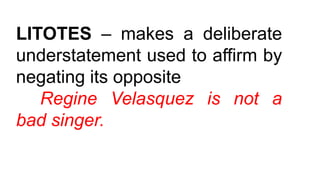
LITOTES – makes a deliberate
understatement used to affirm by
negating its opposite
Regine Velasquez is not a
bad singer.
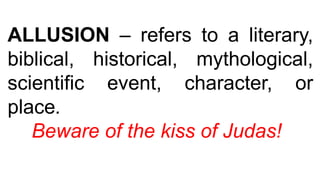
ALLUSION – refers to a literary,
biblical, historical, mythological,
scientific event, character, or
place.
Beware of the kiss of Judas!
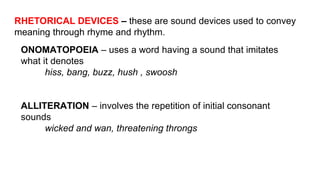
RHETORICAL DEVICES – these are sound devices used to convey
meaning through rhyme and rhythm.
ONOMATOPOEIA – uses a word having a sound that imitates
what it denotes
hiss, bang, buzz, hush , swoosh
ALLITERATION – involves the repetition of initial consonant
sounds
wicked and wan, threatening throngs
RHETORICAL DEVICES –
these are sound devices
used to convey meaning
through rhyme and rhythm.
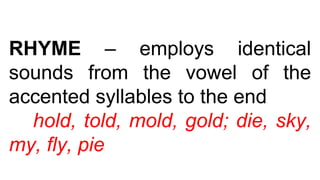
RHYME – employs identical
sounds from the vowel of the
accented syllables to the end
hold, told, mold, gold; die, sky,
my, fly, pie
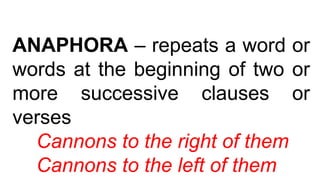
ANAPHORA – repeats a word or
words at the beginning of two or
more successive clauses or
verses
Cannons to the right of them
Cannons to the left of them
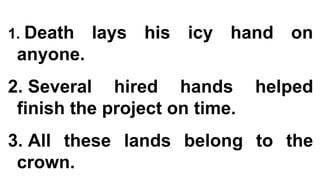
1. Death lays his icy hand on
anyone.
2. Several hired hands helped
finish the project on time.
3. All these lands belong to the
crown.
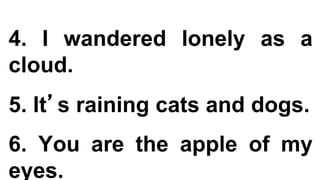
4. I wandered lonely as a
cloud.
5. It’s raining cats and dogs.
6. You are the apple of my
eyes.
7. Break, break, break, on thy cold grey
stones, O Sea!
8. For everything there is a season… a
time to be born, and a time to die.
9. A slumber did my spirit seal.
10. Progress is slow over the cold
plateau.

Figurative Language Creative Writi.pptx

  • 1.
    FIGURES OF SPEECH- these forms of expressions are used to convey meaning or heighten effect, often by comparing or identifying one thing with another that has meaning or connotation familiar to the reader or listener.
  • 2.
    SIMILE – acomparison between two unlike objects by using like or as. His mind is like a sponge.
  • 3.
    METAPHOR- an indirect comparisonof unlike objects She is a phantom of delight.
  • 4.
    PERSONIFICATION – thegiving of human characteristics & capabilities to nonhuman things such as inanimate objects, abstract ideas, or animals The clouds cried a torrent of tears.
  • 5.
    APOSTROPHE – anaddress to the absent as if present or to the inanimate as if human “O wind, if winter comes, can spring be far behind?”
  • 6.
    IRONY – theopposite of what is expected is what happens To cry like a baby, that’s a fine way for a man to act.
  • 7.
    OXYMORON – thecombining of contraries to portray a particular image or to produce a striking effect. Parting is such a sweet sorrow.
  • 8.
    HYPERBOLE – theuse of excessive exaggeration for effect Waves mountain high broke over the reef
  • 9.
    PARADOX – usesa phrase or statement that on surface seems contradictory, but makes some kind of emotional sense. Let us go to war for peace.
  • 10.
    ANTITHESIS – acontrast of words or ideas. She looks like an innocent flower but watch out for the serpent under it.
  • 11.
    METONYMY – substitutesa word that closely relates to a person or thing Have you no respect for gray hairs?
  • 12.
    SYNECDOCHE – usesa part to represent the whole No busy hand provoke a tear No roving foot shall crush thee here.
  • 13.
    LITOTES – makesa deliberate understatement used to affirm by negating its opposite Regine Velasquez is not a bad singer.
  • 14.
    ALLUSION – refersto a literary, biblical, historical, mythological, scientific event, character, or place. Beware of the kiss of Judas!
  • 15.
    RHETORICAL DEVICES –these are sound devices used to convey meaning through rhyme and rhythm. ONOMATOPOEIA – uses a word having a sound that imitates what it denotes hiss, bang, buzz, hush , swoosh ALLITERATION – involves the repetition of initial consonant sounds wicked and wan, threatening throngs
  • 16.
    RHETORICAL DEVICES – theseare sound devices used to convey meaning through rhyme and rhythm.
  • 17.
    RHYME – employsidentical sounds from the vowel of the accented syllables to the end hold, told, mold, gold; die, sky, my, fly, pie
  • 18.
    ANAPHORA – repeatsa word or words at the beginning of two or more successive clauses or verses Cannons to the right of them Cannons to the left of them
  • 19.
    1. Death layshis icy hand on anyone. 2. Several hired hands helped finish the project on time. 3. All these lands belong to the crown.
  • 20.
    4. I wanderedlonely as a cloud. 5. It’s raining cats and dogs. 6. You are the apple of my eyes.
  • 21.
    7. Break, break,break, on thy cold grey stones, O Sea! 8. For everything there is a season… a time to be born, and a time to die. 9. A slumber did my spirit seal. 10. Progress is slow over the cold plateau.