Rhetorical Devices
Introduction
• An overly simple definition of ‘rhetoric’ is ‘the
  study of persuasion.’ I recommend
  persuading people with evidence; however,
  there are means of convincing people that are
  unrelated to evidence. In this slideshow, I’ll
  consider a few so that you can be on the
  lookout for them.
Euphemisms
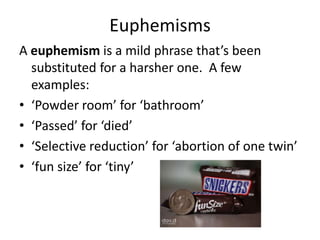
A euphemism is a mild phrase that’s been
  substituted for a harsher one. A few
  examples:
• ‘Powder room’ for ‘bathroom’
• ‘Passed’ for ‘died’
• ‘Selective reduction’ for ‘abortion of one twin’
• ‘fun size’ for ‘tiny’
Dysphemisms
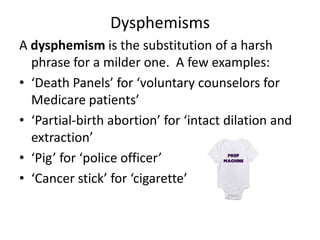
A dysphemism is the substitution of a harsh
  phrase for a milder one. A few examples:
• ‘Death Panels’ for ‘voluntary counselors for
  Medicare patients’
• ‘Partial-birth abortion’ for ‘intact dilation and
  extraction’
• ‘Pig’ for ‘police officer’
• ‘Cancer stick’ for ‘cigarette’
Hedges
A hedge is a way of trivializing a claim so that it
  still seems significant. Some examples:
• ‘Some doctors recommend colon cleansing.’
• ‘Possibly you’ve never had a better massage.’
• ‘Get up to 50% off.’
• You could earn as much as $15 per hour.’
• Can You OPEN THIS ENVELOPE FOR a Chance at
  $25,000?
Downplayers
A downplayer is a phrase added to a sentence
  that doesn’t change its literal meaning but
  does change the attitude listeners take to it.
• She’s just another idealistic new hire.
• He’s the so-called leader of the company.
• It costs a mere $60 per month.
Implying Without Saying
• There are many ways of communicating something
  without explicitly saying it. Sometimes this is obvious.
• If you ask me how the class did on the midterm and I
  say ‘some of you did well,’ that communicates that
  some of you did not do well. However, what I said
  doesn’t logically imply that; I could deny it by adding
  something like ‘in fact, all of you did well.’
• Some non-explicit communication comes from
  exploiting conventions of conversation. On the slides
  to follow, I’ll consider some other, less-obvious forms
  of insinuation.
Significant Mention
Mentioning something without
  saying it can leave the
  impression that it’s been
  said. For example:
• A candidate in a debate: “At
  least I don’t have a drug
  problem.” (Insinuates that
  the opponent does)
• On the package of a device
  not recommended for
  glassware: “Fits better in
  glasses!” (Insinuates that it
  is designed for use in
  glasses)
Loaded Question
A question that presupposes something will
  seem to imply it no matter the answer to the
  question. For example,
• “How long have you held that mistaken view?”
• “Have you given up shoplifting?”
• “What part of America do you hate the
  most?”
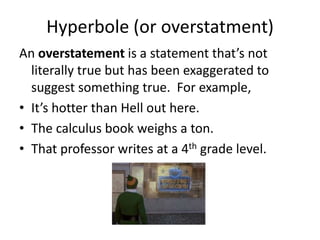
Hyperbole (or overstatment)
An overstatement is a statement that’s not
  literally true but has been exaggerated to
  suggest something true. For example,
• It’s hotter than Hell out here.
• The calculus book weighs a ton.
• That professor writes at a 4th grade level.
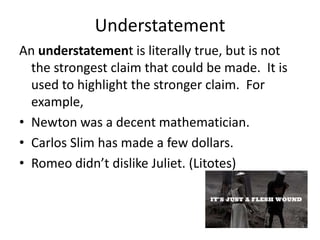
Understatement
An understatement is literally true, but is not
  the strongest claim that could be made. It is
  used to highlight the stronger claim. For
  example,
• Newton was a decent mathematician.
• Carlos Slim has made a few dollars.
• Romeo didn’t dislike Juliet. (Litotes)
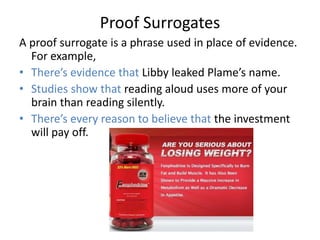
Proof Surrogates
A proof surrogate is a phrase used in place of evidence.
  For example,
• There’s evidence that Libby leaked Plame’s name.
• Studies show that reading aloud uses more of your
  brain than reading silently.
• There’s every reason to believe that the investment
  will pay off.
Repetition
• A claim repeated is more memorable (and can
  seem truer) than an unrepeated claim.
• Advertisements frequently use the technique.
  Contrast the overt repetition from this famously
  annoying (and surprisingly successful) Head On
  ad with the more subtle repetition from this
  CarMax ad. Both repeatedly suggest that product
  is easy to use.
• Repetition appears in some religious ceremonies.
  You needn’t watch all 18 minutes to notice the
  repetition in this presentation of the Roman
  Catholic rosary prayer.
Images
• Pictures are often used as a substitute for evidence.
  Instances abound. Note that not every use of an
  image is a dirty trick. Many uses are appropriate (like
  two of the three instances below) but they are rarely
  evidence.

Rhetorical devices

  • 1.
  • 2.
    Introduction • An overlysimple definition of ‘rhetoric’ is ‘the study of persuasion.’ I recommend persuading people with evidence; however, there are means of convincing people that are unrelated to evidence. In this slideshow, I’ll consider a few so that you can be on the lookout for them.
  • 3.
    Euphemisms A euphemism isa mild phrase that’s been substituted for a harsher one. A few examples: • ‘Powder room’ for ‘bathroom’ • ‘Passed’ for ‘died’ • ‘Selective reduction’ for ‘abortion of one twin’ • ‘fun size’ for ‘tiny’
  • 4.
    Dysphemisms A dysphemism isthe substitution of a harsh phrase for a milder one. A few examples: • ‘Death Panels’ for ‘voluntary counselors for Medicare patients’ • ‘Partial-birth abortion’ for ‘intact dilation and extraction’ • ‘Pig’ for ‘police officer’ • ‘Cancer stick’ for ‘cigarette’
  • 5.
    Hedges A hedge isa way of trivializing a claim so that it still seems significant. Some examples: • ‘Some doctors recommend colon cleansing.’ • ‘Possibly you’ve never had a better massage.’ • ‘Get up to 50% off.’ • You could earn as much as $15 per hour.’ • Can You OPEN THIS ENVELOPE FOR a Chance at $25,000?
  • 6.
    Downplayers A downplayer isa phrase added to a sentence that doesn’t change its literal meaning but does change the attitude listeners take to it. • She’s just another idealistic new hire. • He’s the so-called leader of the company. • It costs a mere $60 per month.
  • 7.
    Implying Without Saying •There are many ways of communicating something without explicitly saying it. Sometimes this is obvious. • If you ask me how the class did on the midterm and I say ‘some of you did well,’ that communicates that some of you did not do well. However, what I said doesn’t logically imply that; I could deny it by adding something like ‘in fact, all of you did well.’ • Some non-explicit communication comes from exploiting conventions of conversation. On the slides to follow, I’ll consider some other, less-obvious forms of insinuation.
  • 8.
    Significant Mention Mentioning somethingwithout saying it can leave the impression that it’s been said. For example: • A candidate in a debate: “At least I don’t have a drug problem.” (Insinuates that the opponent does) • On the package of a device not recommended for glassware: “Fits better in glasses!” (Insinuates that it is designed for use in glasses)
  • 9.
    Loaded Question A questionthat presupposes something will seem to imply it no matter the answer to the question. For example, • “How long have you held that mistaken view?” • “Have you given up shoplifting?” • “What part of America do you hate the most?”
  • 10.
    Hyperbole (or overstatment) Anoverstatement is a statement that’s not literally true but has been exaggerated to suggest something true. For example, • It’s hotter than Hell out here. • The calculus book weighs a ton. • That professor writes at a 4th grade level.
  • 11.
    Understatement An understatement isliterally true, but is not the strongest claim that could be made. It is used to highlight the stronger claim. For example, • Newton was a decent mathematician. • Carlos Slim has made a few dollars. • Romeo didn’t dislike Juliet. (Litotes)
  • 12.
    Proof Surrogates A proofsurrogate is a phrase used in place of evidence. For example, • There’s evidence that Libby leaked Plame’s name. • Studies show that reading aloud uses more of your brain than reading silently. • There’s every reason to believe that the investment will pay off.
  • 13.
    Repetition • A claimrepeated is more memorable (and can seem truer) than an unrepeated claim. • Advertisements frequently use the technique. Contrast the overt repetition from this famously annoying (and surprisingly successful) Head On ad with the more subtle repetition from this CarMax ad. Both repeatedly suggest that product is easy to use. • Repetition appears in some religious ceremonies. You needn’t watch all 18 minutes to notice the repetition in this presentation of the Roman Catholic rosary prayer.
  • 14.
    Images • Pictures areoften used as a substitute for evidence. Instances abound. Note that not every use of an image is a dirty trick. Many uses are appropriate (like two of the three instances below) but they are rarely evidence.