BBM 303
BUSINESS COMMUNICATION (III)
TOPIC
“PARAGRAPH WRITING”
Presented by:
Faiza siddiqui
Gariima satsangi
WHAT IS PARAGRAPH?
A paragraph is a basic unit of organization in writing in which a group of
related sentences develops one main idea.
A paragraph is a group of sentences that tells about one subject or area.
 Each sentence in a paragraph must give information about the topic
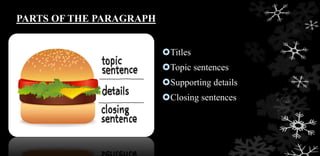
PARTS OF THE PARAGRAPH
Titles
Topic sentences
Supporting details
Closing sentences
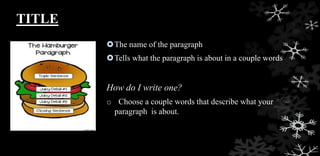
TITLE
The name of the paragraph
Tells what the paragraph is about in a couple words
How do I write one?
o Choose a couple words that describe what your
paragraph is about.
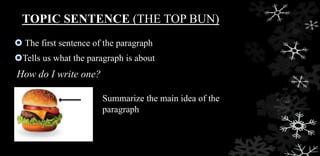
TOPIC SENTENCE (THE TOP BUN)
 The first sentence of the paragraph
Tells us what the paragraph is about
How do I write one?
Summarize the main idea of the
paragraph
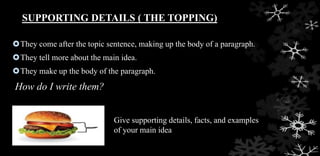
SUPPORTING DETAILS ( THE TOPPING)
They come after the topic sentence, making up the body of a paragraph.
They tell more about the main idea.
They make up the body of the paragraph.
How do I write them?
Give supporting details, facts, and examples
of your main idea
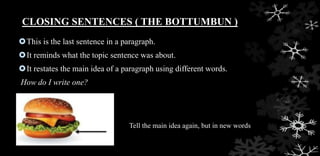
CLOSING SENTENCES ( THE BOTTUMBUN )
This is the last sentence in a paragraph.
It reminds what the topic sentence was about.
It restates the main idea of a paragraph using different words.
How do I write one?
Tell the main idea again, but in new words
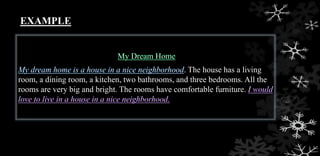
EXAMPLE
. The house has a living
room, a dining room, a kitchen, two bathrooms, and three bedrooms. All the
rooms are very big and bright. The rooms have comfortable furniture.
QUALITIES OF GOOD PARAGRAPH
1. Unity : Unity in the paragraph means oneness of idea. A good paragraph possesses unity
when
all the sentences develop the main idea.
Coherence :The word "coherence" derived from "cohere" literally means "to hold together".
a coherent paragraph contains sentences that are logically arranged and that flow smoothl
Emphasis: Emphasis is concerned with how important the ideas can be made prominent.
Like (1) position in the paragraph, (2) proportion in discussion, (3) the use of parallel
grammatical structures,
TYPES OF PARAGRAPH
WRITING
TYPES OF PARAGRAPH
 Descriptive Paragraphs : This type of paragraph describes something and shows the reader
what a thing or a person is like.
 Narrative Paragraphs: This type of paragraph tells a story. There's a sequence of action or
there's a clear beginning, middle, and end to the paragraph.
 Expository Paragraphs: This type of paragraph explains something or provides instruction.
 Persuasive Paragraphs: This type of paragraph tries to get the reader to accept a particular
point of view or understand the writer's position. It often requires the collection of facts and
research. tries to convince the audience.
 Argumentative Paragraphs : An argument paragraph presents a point of view, and
provides evidence to support the position taken by the writer.
 Classification Paragraphs: In this type of paragraph, separate items are grouped together
according to shared characteristics.
 Compare or Contrast Paragraph : Compare focuses on similarities. Contrast focuses on
differences. This paragraph is used to examine the similarities and differences and is also
useful for literature reviews and reports.
 Definition Paragraph: It is used when you need to define a concept, and demonstrate and
understanding of how it relates to a particular context or discipline.
 Illustration Paragraphs: It is used when you need to clarify a particular idea by offering
specific examples and showing how they relate to your main point.
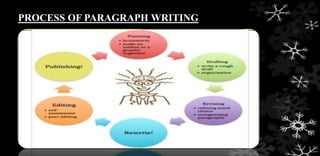
PROCESS OF PARAGRAPH WRITING
Words are a lens to focus one’s mind
- Ayn Rand

English ppt

  • 1.
    BBM 303 BUSINESS COMMUNICATION(III) TOPIC “PARAGRAPH WRITING” Presented by: Faiza siddiqui Gariima satsangi
  • 2.
    WHAT IS PARAGRAPH? Aparagraph is a basic unit of organization in writing in which a group of related sentences develops one main idea. A paragraph is a group of sentences that tells about one subject or area.  Each sentence in a paragraph must give information about the topic
  • 3.
    PARTS OF THEPARAGRAPH Titles Topic sentences Supporting details Closing sentences
  • 4.
    TITLE The name ofthe paragraph Tells what the paragraph is about in a couple words How do I write one? o Choose a couple words that describe what your paragraph is about.
  • 5.
    TOPIC SENTENCE (THETOP BUN)  The first sentence of the paragraph Tells us what the paragraph is about How do I write one? Summarize the main idea of the paragraph
  • 6.
    SUPPORTING DETAILS (THE TOPPING) They come after the topic sentence, making up the body of a paragraph. They tell more about the main idea. They make up the body of the paragraph. How do I write them? Give supporting details, facts, and examples of your main idea
  • 7.
    CLOSING SENTENCES (THE BOTTUMBUN ) This is the last sentence in a paragraph. It reminds what the topic sentence was about. It restates the main idea of a paragraph using different words. How do I write one? Tell the main idea again, but in new words
  • 8.
    EXAMPLE . The househas a living room, a dining room, a kitchen, two bathrooms, and three bedrooms. All the rooms are very big and bright. The rooms have comfortable furniture.
  • 9.
    QUALITIES OF GOODPARAGRAPH 1. Unity : Unity in the paragraph means oneness of idea. A good paragraph possesses unity when all the sentences develop the main idea. Coherence :The word "coherence" derived from "cohere" literally means "to hold together". a coherent paragraph contains sentences that are logically arranged and that flow smoothl Emphasis: Emphasis is concerned with how important the ideas can be made prominent. Like (1) position in the paragraph, (2) proportion in discussion, (3) the use of parallel grammatical structures,
  • 10.
  • 11.
    TYPES OF PARAGRAPH Descriptive Paragraphs : This type of paragraph describes something and shows the reader what a thing or a person is like.  Narrative Paragraphs: This type of paragraph tells a story. There's a sequence of action or there's a clear beginning, middle, and end to the paragraph.  Expository Paragraphs: This type of paragraph explains something or provides instruction.  Persuasive Paragraphs: This type of paragraph tries to get the reader to accept a particular point of view or understand the writer's position. It often requires the collection of facts and research. tries to convince the audience.
  • 12.
     Argumentative Paragraphs: An argument paragraph presents a point of view, and provides evidence to support the position taken by the writer.  Classification Paragraphs: In this type of paragraph, separate items are grouped together according to shared characteristics.  Compare or Contrast Paragraph : Compare focuses on similarities. Contrast focuses on differences. This paragraph is used to examine the similarities and differences and is also useful for literature reviews and reports.  Definition Paragraph: It is used when you need to define a concept, and demonstrate and understanding of how it relates to a particular context or discipline.  Illustration Paragraphs: It is used when you need to clarify a particular idea by offering specific examples and showing how they relate to your main point.
  • 13.
  • 14.
    Words are alens to focus one’s mind - Ayn Rand