A figure of speech is figurative language in the form of a
single word or phrase. It can be a special repetition, arrangement or
omission of words with literal meaning, or a phrase with a specialized
meaning not based on the literal meaning of the words. There are
mainly five figures of
speech: simile, metaphor, hyperbole, personification andsynecdoche.
Figures of speech often provide emphasis, freshness of expression,
or clarity. However, clarity may also suffer from their use, as any
figure of speech introduces an ambiguity between literal and
figurative interpretation. A figure of speech is sometimes called
a rhetorical figure or a locution.
Rhetoric originated as the study of the ways in which a source text
can be transformed to suit the goals of the person reusing the
material. For this goal, classical rhetoricdetected four fundamental
operations[1]
that can be used to transform a sentence or a larger
portion of a text: expansion, abridgement, switching, transferring and
so on.
Examples[edit]
Figures of speech come in many varieties. The aim is to use the
language inventively to accentuate the effect of what is being said. A
few examples follow:
• "Around the rugged rocks the ragged rascal ran" is an example
of alliteration, where the consonant r is used repeatedly.
Whereas, "Sister Suzy sewing socks for soldiers" is a particular
form of alliteration called sibilance, because it repeats the
letter s.
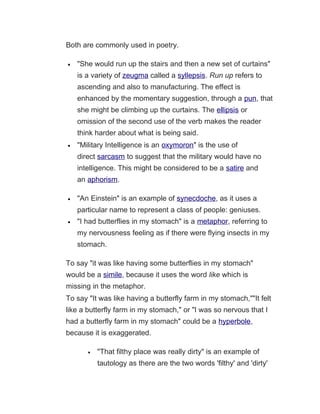
Both are commonly used in poetry.
• "She would run up the stairs and then a new set of curtains"
is a variety of zeugma called a syllepsis. Run up refers to
ascending and also to manufacturing. The effect is
enhanced by the momentary suggestion, through a pun, that
she might be climbing up the curtains. The ellipsis or
omission of the second use of the verb makes the reader
think harder about what is being said.
• "Military Intelligence is an oxymoron" is the use of
direct sarcasm to suggest that the military would have no
intelligence. This might be considered to be a satire and
an aphorism.
• "An Einstein" is an example of synecdoche, as it uses a
particular name to represent a class of people: geniuses.
• "I had butterflies in my stomach" is a metaphor, referring to
my nervousness feeling as if there were flying insects in my
stomach.
To say "it was like having some butterflies in my stomach"
would be a simile, because it uses the word like which is
missing in the metaphor.
To say "It was like having a butterfly farm in my stomach,""It felt
like a butterfly farm in my stomach," or "I was so nervous that I
had a butterfly farm in my stomach" could be a hyperbole,
because it is exaggerated.
• "That filthy place was really dirty" is an example of
tautology as there are the two words 'filthy' and 'dirty'
having almost the same meaning and are repeated so
as to make the text more emphasising.
Scholars of classical Western rhetoric have divided
figures of speech into two main categories: schemes and
tropes. Schemes(from the Greek sch maē , form or
shape) are figures of speech that change the ordinary or
expected pattern of words. For example, the phrase,
"John, my best friend" uses the scheme known
as apposition. Tropes (from the Greek trepein, to turn)
change the general meaning of words. An example of a
trope is irony, which is the use of words to convey the
opposite of their usual meaning ("For Brutus is an
honorable man; / So are they all, all honorable men").
During the Renaissance, scholars meticulously
enumerated and classified figures of speech. Henry
Peacham, for example, in his The Garden of
Eloquence (1577), enumerated 184 different figures of
speech. Professor Robert DiYanni, in his book "Literature
– Reading Fiction, Poetry, Drama and the
Essay" [5]
wrote: "Rhetoricians have catalogued more
than 250 differentfigures of speech, expressions or ways
of using words in a nonliteral sense.".
For simplicity, this article divides the figures between
schemes and tropes, but does not further sub-classify
them (e.g., "Figures of Disorder"). Within each category,
words are listed alphabetically. Most entries link to a
page that provides greater detail and relevant examples,
but a short definition is placed here for convenience.
Some of those listed may be considered rhetorical
devices, which are similar in many ways.
Schemes[edit]
This section needs additional
citations
for verification. Please
help improve this article by adding
citations to reliable sources.
Unsourced material may be
challenged and removed. (June
2013)
Main article: Scheme (linguistics)
• accumulation: Accumulating arguments in a concise
forceful manner.
• adnomination: Repetition of words with the same root
word.
• alliteration: Series of words that begin with the same
consonant sound.
• adynaton: hyperbole taken to such extreme lengths
insinuating a complete impossibility.
• anacoluthon: Transposition of clauses to achieve an
unnatural order in a sentence.
• anadiplosis: Repetition of a word at the end of a
clause and then at the beginning of its succeeding
clause.
• anaphora: Repetition of the same word or set of
words in a paragraph.
• anastrophe: Changing the object, subject and verb
order in a clause.
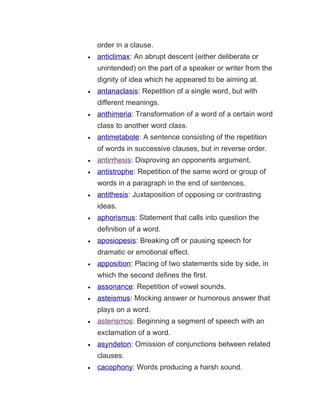
• anticlimax: An abrupt descent (either deliberate or
unintended) on the part of a speaker or writer from the
dignity of idea which he appeared to be aiming at.
• antanaclasis: Repetition of a single word, but with
different meanings.
• anthimeria: Transformation of a word of a certain word
class to another word class.
• antimetabole: A sentence consisting of the repetition
of words in successive clauses, but in reverse order.
• antirrhesis: Disproving an opponents argument.
• antistrophe: Repetition of the same word or group of
words in a paragraph in the end of sentences.
• antithesis: Juxtaposition of opposing or contrasting
ideas.
• aphorismus: Statement that calls into question the
definition of a word.
• aposiopesis: Breaking off or pausing speech for
dramatic or emotional effect.
• apposition: Placing of two statements side by side, in
which the second defines the first.
• assonance: Repetition of vowel sounds.
• asteismus: Mocking answer or humorous answer that
plays on a word.
• asterismos: Beginning a segment of speech with an
exclamation of a word.
• asyndeton: Omission of conjunctions between related
clauses.
• cacophony: Words producing a harsh sound.
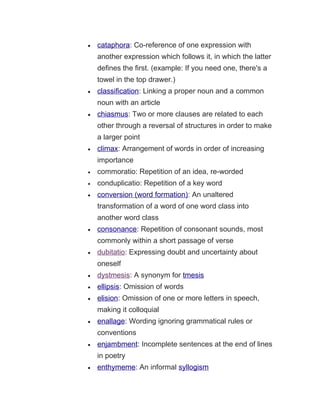
• cataphora: Co-reference of one expression with
another expression which follows it, in which the latter
defines the first. (example: If you need one, there's a
towel in the top drawer.)
• classification: Linking a proper noun and a common
noun with an article
• chiasmus: Two or more clauses are related to each
other through a reversal of structures in order to make
a larger point
• climax: Arrangement of words in order of increasing
importance
• commoratio: Repetition of an idea, re-worded
• conduplicatio: Repetition of a key word
• conversion (word formation): An unaltered
transformation of a word of one word class into
another word class
• consonance: Repetition of consonant sounds, most
commonly within a short passage of verse
• dubitatio: Expressing doubt and uncertainty about
oneself
• dystmesis: A synonym for tmesis
• ellipsis: Omission of words
• elision: Omission of one or more letters in speech,
making it colloquial
• enallage: Wording ignoring grammatical rules or
conventions
• enjambment: Incomplete sentences at the end of lines
in poetry
• enthymeme: An informal syllogism
• epanalepsis: Ending sentences with their beginning.
• epanodos: Word repetition.[6][7][8]
• epistrophe: (also known as antistrophe) Repetition of
the same word or group of words at the end of
successive clauses. The counterpart of anaphora
• epizeuxis: Repetition of a single word, with no other
words in between
• euphony: Opposite of cacophony – i.e. pleasant
sounding
• half rhyme: Partially rhyming words
• hendiadys: Use of two nouns to express an idea when
it normally would consist of an adjective and a noun
• hendiatris: Use of three nouns to express one idea
• homeoptoton: ending the last parts of words with the
same syllable or letter.[9]
• homographs: Words we write identically but which
have a differing meaning
• homoioteleuton: Multiple words with the same ending
• homonyms: Words that are identical with each other
in pronunciation and spelling, but different in meaning
• homophones: Words that are identical with each other
in pronunciation, but different in meaning
• homeoteleuton: Words with the same ending
• hypallage: A transferred epitaph from a conventional
choice of wording.[10]
• hyperbaton: Two ordinary associated words are
detached.[11][12]
The term may also be used more
generally for all different figures of speech which
transpose natural word order in sentences.[12]
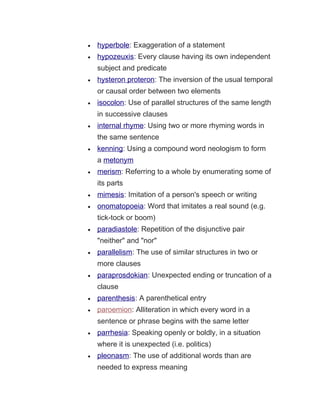
• hyperbole: Exaggeration of a statement
• hypozeuxis: Every clause having its own independent
subject and predicate
• hysteron proteron: The inversion of the usual temporal
or causal order between two elements
• isocolon: Use of parallel structures of the same length
in successive clauses
• internal rhyme: Using two or more rhyming words in
the same sentence
• kenning: Using a compound word neologism to form
a metonym
• merism: Referring to a whole by enumerating some of
its parts
• mimesis: Imitation of a person's speech or writing
• onomatopoeia: Word that imitates a real sound (e.g.
tick-tock or boom)
• paradiastole: Repetition of the disjunctive pair
"neither" and "nor"
• parallelism: The use of similar structures in two or
more clauses
• paraprosdokian: Unexpected ending or truncation of a
clause
• parenthesis: A parenthetical entry
• paroemion: Alliteration in which every word in a
sentence or phrase begins with the same letter
• parrhesia: Speaking openly or boldly, in a situation
where it is unexpected (i.e. politics)
• pleonasm: The use of additional words than are
needed to express meaning
• polyptoton: Repetition of words derived from the same
root
• polysyndeton: Close repetition of conjunctions
• pun: When a word or phrase is used in two(or more)
different senses
• rhythm: A synonym for parallelism[13]
• sibilance: Repetition of letter 's', it is a form
of alliteration
• sine dicendo: An inherently superfluous statement,
the truth value of which can easily be taken for
granted (e.g. 'It's always in the last place you look.')
• solecism: Trespassing grammatical and syntactical
rules
• spoonerism: Switching place of syllables within two
words in a sentence yielding amusement
• superlative: Declaring something the best within its
class i.e. the ugliest, the most precious
• synathroesmus: Agglomeration of adjectives to
describe something or someone
• syncope: Omission of parts of a word or phrase
• symploce: Simultaneous use of anaphora and
epistrophe: the repetition of the same word or group
of words at the beginning and the end of successive
clauses
• synchysis: Words that are intentionally scattered to
create perplexment
• synesis: Agreement of words according to the sense,
and not the grammatical form
• synecdoche: Referring to a part by its whole or vice
versa
• synonymia: Use of two or more synonyms in the
same clause or sentence
• tautology: Redundancy due to superfluous
qualification; saying the same thing twice
• tmesis: Insertions of content within a compound word
• zeugma: The using of one verb for two or more
actions
Tropes[edit]
Main article: Trope (linguistics)
• accismus: expressing the want of something by
denying it[14]
• allegory: Extended metaphor in which a symbolic
story is told
• allusion: Covert reference to another work of literature
or art
• ambiguity: Phrasing which can have two meanings
• anacoenosis: Posing a question to an audience, often
with the implication that it shares a common interest
with the speaker
• analogy: A comparison
• anapodoton: Leaving a common known saying
unfinished
• antanaclasis: A form of pun in which a word is
repeated in two different senses
• anthimeria: Transformating a word's word class
• anthropomorphism: Ascribing human characteristics
to something that is not human, such as an animal or
a god (seezoomorphism)
• antimetabole: Repetition of words in successive
clauses, but in switched order
• antiphrasis: A name or a phrase used ironically.
• antistasis: Repetition of a word in a different sense.
• antonomasia: Substitution of a proper name for a
phrase or vice versa
• aphorism: Briefly phrased, easily memorable
statement of a truth or opinion, an adage
• apologia: Justifying one's actions
• aporia: Faked or sincere puzzled questioning
• apophasis: (Invoking) an idea by denying its
(invocation)
• appositive: Insertion of a parenthetical entry
• apostrophe: Directing the attention away from the
audience to an absent third party, often in the form of
a personified abstraction or inanimate object.
• archaism: Use of an obsolete, archaic word (a word
used in olden language, e.g. Shakespeare's
language)
• auxesis: Form of hyperbole, in which a more
important sounding word is used in place of a more
descriptive term
• bathos: Pompous speech with a ludicrously mundane
worded anti-climax
• burlesque metaphor: An amusing, overstated or
grotesque comparison or example.
• catachresis: Blatant misuse of words or phrases.
• categoria: Candidly revealing an opponent's
weakness
• cliché: Overused phrase or theme
• circumlocution: Talking around a topic by substituting
or adding words, as in euphemism or periphrasis
• commiseration: Evoking pity in the audience
• congeries: Accumulation of synonymous or different
words or phrases together forming a single message
• correctio: Linguistic device used for correcting one's
mistakes, a form of which is epanorthosis
• dehortatio: discouraging advice given with seeming
sagacity
• denominatio: Another word for metonymy
• diatyposis: The act of giving counsel
• double negative: Grammar construction that can be
used as an expression and it is the repetition of
negative words
• dirimens copulatio: Juxtaposition of two ideas with a
similar message
• distinctio: Defining or specifying the meaning of a
word or phrase you use
• dysphemism: Substitution of a harsher, more
offensive, or more disagreeable term for another.
Opposite of euphemism
• dubitatio: Expressing doubt over one's ability to hold
speeches, or doubt over other ability
• ekphrasis: Lively describing something you see, often
a painting
• epanorthosis: Immediate and emphatic self-
correction, often following a slip of the tongue
• encomium: A speech consisting of praise; a eulogy
• enumeratio: A sort of amplification and accumulation
in which specific aspects are added up to make a
point
• epicrisis: Mentioning a saying and then commenting
on it
• epiplexis: Rhetorical question displaying disapproval
or debunks
• epitrope: Initially pretending to agree with an opposing
debater or invite one to do something
• erotema: Synonym for rhetorical question
• erotesis: Rhetorical question asked in confident
expectation of a negative answer
• euphemism: Substitution of a less offensive or more
agreeable term for another
• grandiloquence: Pompous speech
• exclamation: A loud calling or crying out
• humour: Provoking laughter and providing
amusement
• hyperbaton: Words that naturally belong together
separated from each other for emphasis or effect
• hyperbole: Use of exaggerated terms for emphasis
• hypocatastasis: An implication or declaration of
resemblance that does not directly name both terms
• hypophora: Answering one's own rhetorical
question at length
• hysteron proteron: Reversal of anticipated order of
events; a form of hyperbaton
• innuendo: Having a hidden meaning in a sentence
that makes sense whether it is detected or not
• invective: The act of insulting
• inversion: A reversal of normal word order, especially
the placement of a verb ahead of the subject (subject-
verb inversion).
• imperative sentence: The urging to do something
• irony: Use of word in a way that conveys a meaning
opposite to its usual meaning
• kataphora: Repetition of a cohesive device at the end
• litotes: Emphasizing the magnitude of a statement by
denying its opposite
• malapropism: Using a word through confusion with a
word that sounds similar
• meiosis: Use of understatement, usually to diminish
the importance of something
• merism: Referring to a whole by enumerating some of
its parts
• metalepsis: Figurative speech is used in a new
context
• metaphor: Figurative language
• metonymy: A thing or concept is called not by its own
name but rather by the name of something associated
in meaning with that thing or concept
• neologism: The use of a word or term that has
recently been created, or has been in use for a short
time. Opposite ofarchaism
• non sequitur: Statement that bears no relationship to
the context preceding
• occupatio: Mentioning something by reportedly not
mentioning it
• onomatopoeia: Words that sound like their meaning
• oxymoron: Using two terms together, that normally
contradict each other
• par'hyponoian: Replacing in a phrase or text a second
part, that would have been logically expected.
• parable: Extended metaphor told as an anecdote to
illustrate or teach a moral lesson
• paradiastole: Making a euphemism out of what
usually is considered adversive
• paradox: Use of apparently contradictory ideas to
point out some underlying truth
• paradiastole: Extenuating a vice in order to flatter or
soothe
• paraprosdokian: Phrase in which the latter part
causes a rethinking or reframing of the beginning
• paralipsis: Drawing attention to something while
pretending to pass it over
• parody: Humouristic imitation
• paronomasia: Pun, in which similar sounding words
but words having a different meaning are used
• pathetic fallacy: Ascribing human conduct and
feelings to nature
• periphrasis: A synonym for circumlocution
• personification/prosopopoeia/anthropomorphism:
Attributing or applying human qualities to inanimate
objects, animals, or natural phenomena
• pleonasm: The use of more words than is necessary
for clear expression
• praeteritio: Another word for paralipsis
• procatalepsis: Refuting anticipated objections as part
of the main argument
• proslepsis: Extreme form of paralipsis in which the
speaker provides great detail while feigning to pass
over a topic
• prothesis: Adding a syllable to the beginning of a word
• proverb: Succinct or pithy, often metaphorical,
expression of wisdom commonly believed to be true
• pun: Play on words that will have two meanings
• rhetorical question: Asking a question as a way of
asserting something. Asking a question which already
has the answer hidden in it. Or asking a question not
for the sake of getting an answer but for asserting
something (or as in a poem for creating a poetic
effect)
• satire: Humoristic criticism of society
• sensory detail imagery: sight, sound, taste, touch,
smell
• sesquipedalianism: use of long and obscure words
• simile: Comparison between two things
using like or as
• snowclone: Alteration of cliché or phrasal template
• style: how information is presented
• superlative: Saying that something is the best of
something or has the most of some quality, e.g. the
ugliest, the most precious etc.
• syllepsis: The use of a word in its figurative and literal
sense at the same time or a single word used in
relation to two other parts of a sentence although the
word grammatically or logically applies to only one
• syncatabasis (condescension, accommodation):
adaptation of style to the level of the audience
• synchoresis: A concession made for the purpose of
retorting with greater force.
• synecdoche: Form of metonymy, referring to a part by
its whole, or a whole by its part
• synesthesia: Description of one kind of sense
impression by using words that normally describe
another.
• tautology: Superfluous repetition of the same sense in
different words Example: The children gathered in a
round circle
• transferred epithet: A synonym for hypallage.
• truism: a self-evident statement
• tricolon diminuens: Combination of three elements,
each decreasing in size
• tricolon crescens: Combination of three elements,
each increasing in size
• verbal paradox: Paradox specified to language
• zeugma: Use of a single verb to describe two or more
actions
• zoomorphism: Applying animal characteristics to
humans or gods
1
Alliteration
This is a very common figure of speech that involves
using words that begin with the same sound.
For instance, “Sally sells sea shells by the seashore”
is alliteration – and try saying it fast to see how
difficult it is! It is often used in advertising slogans to
create something catchy that more people will
remember.
2
Anaphora
This figure of speech uses a specific clause at the
beginning of each sentence or point to make a
statement.
For instance: “Good night and good luck” is an
example of the beginning word being the same. The
more it is used, the more of an emotional effect is can
evoke among those who are listening. Another
example is "Mad world! Mad kings! Mad composition!"
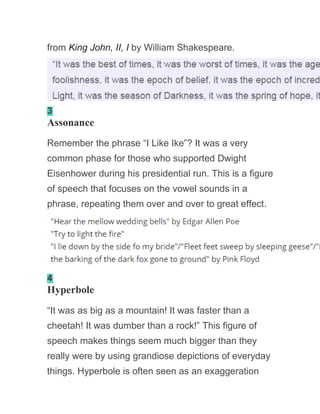
from King John, II, I by William Shakespeare.
3
Assonance
Remember the phrase “I Like Ike”? It was a very
common phase for those who supported Dwight
Eisenhower during his presidential run. This is a figure
of speech that focuses on the vowel sounds in a
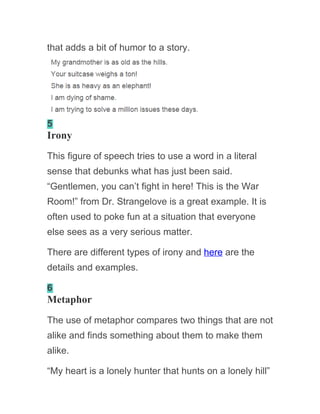
phrase, repeating them over and over to great effect.
4
Hyperbole
“It was as big as a mountain! It was faster than a
cheetah! It was dumber than a rock!” This figure of
speech makes things seem much bigger than they
really were by using grandiose depictions of everyday
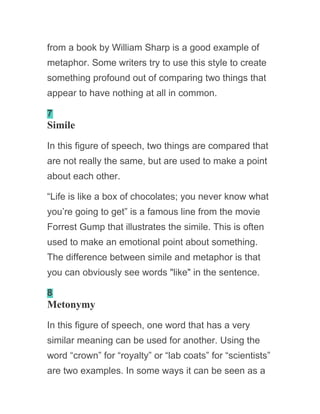
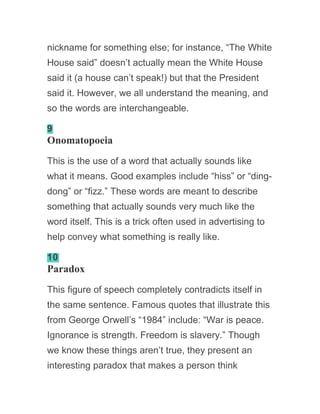
things. Hyperbole is often seen as an exaggeration
that adds a bit of humor to a story.
5
Irony
This figure of speech tries to use a word in a literal
sense that debunks what has just been said.
“Gentlemen, you can’t fight in here! This is the War
Room!” from Dr. Strangelove is a great example. It is
often used to poke fun at a situation that everyone
else sees as a very serious matter.
There are different types of irony and here are the
details and examples.
6
Metaphor
The use of metaphor compares two things that are not
alike and finds something about them to make them
alike.
“My heart is a lonely hunter that hunts on a lonely hill”
from a book by William Sharp is a good example of
metaphor. Some writers try to use this style to create
something profound out of comparing two things that
appear to have nothing at all in common.
7
Simile
In this figure of speech, two things are compared that
are not really the same, but are used to make a point
about each other.
“Life is like a box of chocolates; you never know what
you’re going to get” is a famous line from the movie
Forrest Gump that illustrates the simile. This is often
used to make an emotional point about something.
The difference between simile and metaphor is that
you can obviously see words "like" in the sentence.
8
Metonymy
In this figure of speech, one word that has a very
similar meaning can be used for another. Using the
word “crown” for “royalty” or “lab coats” for “scientists”
are two examples. In some ways it can be seen as a
nickname for something else; for instance, “The White
House said” doesn’t actually mean the White House
said it (a house can’t speak!) but that the President
said it. However, we all understand the meaning, and
so the words are interchangeable.
9
Onomatopoeia
This is the use of a word that actually sounds like
what it means. Good examples include “hiss” or “ding-
dong” or “fizz.” These words are meant to describe
something that actually sounds very much like the
word itself. This is a trick often used in advertising to
help convey what something is really like.
10
Paradox
This figure of speech completely contradicts itself in
the same sentence. Famous quotes that illustrate this
from George Orwell’s “1984” include: “War is peace.
Ignorance is strength. Freedom is slavery.” Though
we know these things aren’t true, they present an
interesting paradox that makes a person think
seriously about what they have just read or heard.
11
Personification
This is a way of giving an inanimate object the
qualities of a living thing. “The tree quaked with fear
as the wind approached” is an example; “The sun
smiled down on her” is another. This can sometimes
be used to invoke an emotional response to
something by making it more personable, friendly and
relatable.
12
Pun
This play on words uses different senses of the word,
or different sounds that make up the word, to create
something fun and interesting. For instance: “I would
like to go to Holland some day. Wooden shoe?” is a
pun that actually means “wouldn’t you?” Sometimes
puns are so subtle that they can be tough to pick up
unless you are really listening for them.
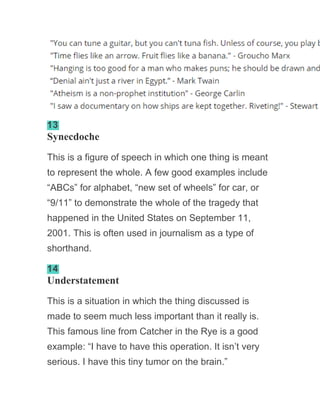
13
Synecdoche
This is a figure of speech in which one thing is meant
to represent the whole. A few good examples include
“ABCs” for alphabet, “new set of wheels” for car, or
“9/11” to demonstrate the whole of the tragedy that
happened in the United States on September 11,
2001. This is often used in journalism as a type of
shorthand.
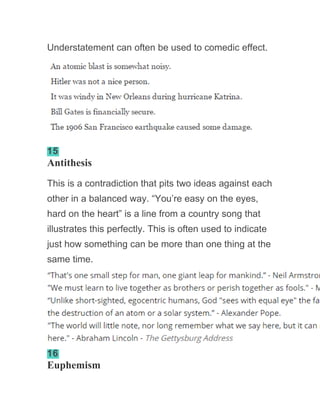
14
Understatement
This is a situation in which the thing discussed is
made to seem much less important than it really is.
This famous line from Catcher in the Rye is a good
example: “I have to have this operation. It isn’t very
serious. I have this tiny tumor on the brain.”
Understatement can often be used to comedic effect.
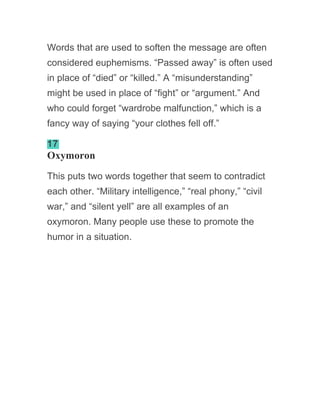
15
Antithesis
This is a contradiction that pits two ideas against each
other in a balanced way. “You’re easy on the eyes,
hard on the heart” is a line from a country song that
illustrates this perfectly. This is often used to indicate
just how something can be more than one thing at the
same time.
16
Euphemism
Words that are used to soften the message are often
considered euphemisms. “Passed away” is often used
in place of “died” or “killed.” A “misunderstanding”
might be used in place of “fight” or “argument.” And
who could forget “wardrobe malfunction,” which is a
fancy way of saying “your clothes fell off.”
17
Oxymoron
This puts two words together that seem to contradict
each other. “Military intelligence,” “real phony,” “civil
war,” and “silent yell” are all examples of an
oxymoron. Many people use these to promote the
humor in a situation.

Figure speech

  • 1.
    A figure ofspeech is figurative language in the form of a single word or phrase. It can be a special repetition, arrangement or omission of words with literal meaning, or a phrase with a specialized meaning not based on the literal meaning of the words. There are mainly five figures of speech: simile, metaphor, hyperbole, personification andsynecdoche. Figures of speech often provide emphasis, freshness of expression, or clarity. However, clarity may also suffer from their use, as any figure of speech introduces an ambiguity between literal and figurative interpretation. A figure of speech is sometimes called a rhetorical figure or a locution. Rhetoric originated as the study of the ways in which a source text can be transformed to suit the goals of the person reusing the material. For this goal, classical rhetoricdetected four fundamental operations[1] that can be used to transform a sentence or a larger portion of a text: expansion, abridgement, switching, transferring and so on. Examples[edit] Figures of speech come in many varieties. The aim is to use the language inventively to accentuate the effect of what is being said. A few examples follow: • "Around the rugged rocks the ragged rascal ran" is an example of alliteration, where the consonant r is used repeatedly. Whereas, "Sister Suzy sewing socks for soldiers" is a particular form of alliteration called sibilance, because it repeats the letter s.
  • 2.
    Both are commonlyused in poetry. • "She would run up the stairs and then a new set of curtains" is a variety of zeugma called a syllepsis. Run up refers to ascending and also to manufacturing. The effect is enhanced by the momentary suggestion, through a pun, that she might be climbing up the curtains. The ellipsis or omission of the second use of the verb makes the reader think harder about what is being said. • "Military Intelligence is an oxymoron" is the use of direct sarcasm to suggest that the military would have no intelligence. This might be considered to be a satire and an aphorism. • "An Einstein" is an example of synecdoche, as it uses a particular name to represent a class of people: geniuses. • "I had butterflies in my stomach" is a metaphor, referring to my nervousness feeling as if there were flying insects in my stomach. To say "it was like having some butterflies in my stomach" would be a simile, because it uses the word like which is missing in the metaphor. To say "It was like having a butterfly farm in my stomach,""It felt like a butterfly farm in my stomach," or "I was so nervous that I had a butterfly farm in my stomach" could be a hyperbole, because it is exaggerated. • "That filthy place was really dirty" is an example of tautology as there are the two words 'filthy' and 'dirty'
  • 3.
    having almost thesame meaning and are repeated so as to make the text more emphasising. Scholars of classical Western rhetoric have divided figures of speech into two main categories: schemes and tropes. Schemes(from the Greek sch maē , form or shape) are figures of speech that change the ordinary or expected pattern of words. For example, the phrase, "John, my best friend" uses the scheme known as apposition. Tropes (from the Greek trepein, to turn) change the general meaning of words. An example of a trope is irony, which is the use of words to convey the opposite of their usual meaning ("For Brutus is an honorable man; / So are they all, all honorable men"). During the Renaissance, scholars meticulously enumerated and classified figures of speech. Henry Peacham, for example, in his The Garden of Eloquence (1577), enumerated 184 different figures of speech. Professor Robert DiYanni, in his book "Literature – Reading Fiction, Poetry, Drama and the Essay" [5] wrote: "Rhetoricians have catalogued more than 250 differentfigures of speech, expressions or ways of using words in a nonliteral sense.". For simplicity, this article divides the figures between schemes and tropes, but does not further sub-classify them (e.g., "Figures of Disorder"). Within each category, words are listed alphabetically. Most entries link to a page that provides greater detail and relevant examples, but a short definition is placed here for convenience.
  • 4.
    Some of thoselisted may be considered rhetorical devices, which are similar in many ways. Schemes[edit] This section needs additional citations for verification. Please help improve this article by adding citations to reliable sources. Unsourced material may be challenged and removed. (June 2013) Main article: Scheme (linguistics) • accumulation: Accumulating arguments in a concise forceful manner. • adnomination: Repetition of words with the same root word. • alliteration: Series of words that begin with the same consonant sound. • adynaton: hyperbole taken to such extreme lengths insinuating a complete impossibility. • anacoluthon: Transposition of clauses to achieve an unnatural order in a sentence. • anadiplosis: Repetition of a word at the end of a clause and then at the beginning of its succeeding clause. • anaphora: Repetition of the same word or set of words in a paragraph. • anastrophe: Changing the object, subject and verb
  • 5.
    order in aclause. • anticlimax: An abrupt descent (either deliberate or unintended) on the part of a speaker or writer from the dignity of idea which he appeared to be aiming at. • antanaclasis: Repetition of a single word, but with different meanings. • anthimeria: Transformation of a word of a certain word class to another word class. • antimetabole: A sentence consisting of the repetition of words in successive clauses, but in reverse order. • antirrhesis: Disproving an opponents argument. • antistrophe: Repetition of the same word or group of words in a paragraph in the end of sentences. • antithesis: Juxtaposition of opposing or contrasting ideas. • aphorismus: Statement that calls into question the definition of a word. • aposiopesis: Breaking off or pausing speech for dramatic or emotional effect. • apposition: Placing of two statements side by side, in which the second defines the first. • assonance: Repetition of vowel sounds. • asteismus: Mocking answer or humorous answer that plays on a word. • asterismos: Beginning a segment of speech with an exclamation of a word. • asyndeton: Omission of conjunctions between related clauses. • cacophony: Words producing a harsh sound.
  • 6.
    • cataphora: Co-referenceof one expression with another expression which follows it, in which the latter defines the first. (example: If you need one, there's a towel in the top drawer.) • classification: Linking a proper noun and a common noun with an article • chiasmus: Two or more clauses are related to each other through a reversal of structures in order to make a larger point • climax: Arrangement of words in order of increasing importance • commoratio: Repetition of an idea, re-worded • conduplicatio: Repetition of a key word • conversion (word formation): An unaltered transformation of a word of one word class into another word class • consonance: Repetition of consonant sounds, most commonly within a short passage of verse • dubitatio: Expressing doubt and uncertainty about oneself • dystmesis: A synonym for tmesis • ellipsis: Omission of words • elision: Omission of one or more letters in speech, making it colloquial • enallage: Wording ignoring grammatical rules or conventions • enjambment: Incomplete sentences at the end of lines in poetry • enthymeme: An informal syllogism
  • 7.
    • epanalepsis: Endingsentences with their beginning. • epanodos: Word repetition.[6][7][8] • epistrophe: (also known as antistrophe) Repetition of the same word or group of words at the end of successive clauses. The counterpart of anaphora • epizeuxis: Repetition of a single word, with no other words in between • euphony: Opposite of cacophony – i.e. pleasant sounding • half rhyme: Partially rhyming words • hendiadys: Use of two nouns to express an idea when it normally would consist of an adjective and a noun • hendiatris: Use of three nouns to express one idea • homeoptoton: ending the last parts of words with the same syllable or letter.[9] • homographs: Words we write identically but which have a differing meaning • homoioteleuton: Multiple words with the same ending • homonyms: Words that are identical with each other in pronunciation and spelling, but different in meaning • homophones: Words that are identical with each other in pronunciation, but different in meaning • homeoteleuton: Words with the same ending • hypallage: A transferred epitaph from a conventional choice of wording.[10] • hyperbaton: Two ordinary associated words are detached.[11][12] The term may also be used more generally for all different figures of speech which transpose natural word order in sentences.[12]
  • 8.
    • hyperbole: Exaggerationof a statement • hypozeuxis: Every clause having its own independent subject and predicate • hysteron proteron: The inversion of the usual temporal or causal order between two elements • isocolon: Use of parallel structures of the same length in successive clauses • internal rhyme: Using two or more rhyming words in the same sentence • kenning: Using a compound word neologism to form a metonym • merism: Referring to a whole by enumerating some of its parts • mimesis: Imitation of a person's speech or writing • onomatopoeia: Word that imitates a real sound (e.g. tick-tock or boom) • paradiastole: Repetition of the disjunctive pair "neither" and "nor" • parallelism: The use of similar structures in two or more clauses • paraprosdokian: Unexpected ending or truncation of a clause • parenthesis: A parenthetical entry • paroemion: Alliteration in which every word in a sentence or phrase begins with the same letter • parrhesia: Speaking openly or boldly, in a situation where it is unexpected (i.e. politics) • pleonasm: The use of additional words than are needed to express meaning
  • 9.
    • polyptoton: Repetitionof words derived from the same root • polysyndeton: Close repetition of conjunctions • pun: When a word or phrase is used in two(or more) different senses • rhythm: A synonym for parallelism[13] • sibilance: Repetition of letter 's', it is a form of alliteration • sine dicendo: An inherently superfluous statement, the truth value of which can easily be taken for granted (e.g. 'It's always in the last place you look.') • solecism: Trespassing grammatical and syntactical rules • spoonerism: Switching place of syllables within two words in a sentence yielding amusement • superlative: Declaring something the best within its class i.e. the ugliest, the most precious • synathroesmus: Agglomeration of adjectives to describe something or someone • syncope: Omission of parts of a word or phrase • symploce: Simultaneous use of anaphora and epistrophe: the repetition of the same word or group of words at the beginning and the end of successive clauses • synchysis: Words that are intentionally scattered to create perplexment • synesis: Agreement of words according to the sense, and not the grammatical form • synecdoche: Referring to a part by its whole or vice
  • 10.
    versa • synonymia: Useof two or more synonyms in the same clause or sentence • tautology: Redundancy due to superfluous qualification; saying the same thing twice • tmesis: Insertions of content within a compound word • zeugma: The using of one verb for two or more actions Tropes[edit] Main article: Trope (linguistics) • accismus: expressing the want of something by denying it[14] • allegory: Extended metaphor in which a symbolic story is told • allusion: Covert reference to another work of literature or art • ambiguity: Phrasing which can have two meanings • anacoenosis: Posing a question to an audience, often with the implication that it shares a common interest with the speaker • analogy: A comparison • anapodoton: Leaving a common known saying unfinished • antanaclasis: A form of pun in which a word is repeated in two different senses • anthimeria: Transformating a word's word class • anthropomorphism: Ascribing human characteristics to something that is not human, such as an animal or
  • 11.
    a god (seezoomorphism) •antimetabole: Repetition of words in successive clauses, but in switched order • antiphrasis: A name or a phrase used ironically. • antistasis: Repetition of a word in a different sense. • antonomasia: Substitution of a proper name for a phrase or vice versa • aphorism: Briefly phrased, easily memorable statement of a truth or opinion, an adage • apologia: Justifying one's actions • aporia: Faked or sincere puzzled questioning • apophasis: (Invoking) an idea by denying its (invocation) • appositive: Insertion of a parenthetical entry • apostrophe: Directing the attention away from the audience to an absent third party, often in the form of a personified abstraction or inanimate object. • archaism: Use of an obsolete, archaic word (a word used in olden language, e.g. Shakespeare's language) • auxesis: Form of hyperbole, in which a more important sounding word is used in place of a more descriptive term • bathos: Pompous speech with a ludicrously mundane worded anti-climax • burlesque metaphor: An amusing, overstated or grotesque comparison or example. • catachresis: Blatant misuse of words or phrases. • categoria: Candidly revealing an opponent's
  • 12.
    weakness • cliché: Overusedphrase or theme • circumlocution: Talking around a topic by substituting or adding words, as in euphemism or periphrasis • commiseration: Evoking pity in the audience • congeries: Accumulation of synonymous or different words or phrases together forming a single message • correctio: Linguistic device used for correcting one's mistakes, a form of which is epanorthosis • dehortatio: discouraging advice given with seeming sagacity • denominatio: Another word for metonymy • diatyposis: The act of giving counsel • double negative: Grammar construction that can be used as an expression and it is the repetition of negative words • dirimens copulatio: Juxtaposition of two ideas with a similar message • distinctio: Defining or specifying the meaning of a word or phrase you use • dysphemism: Substitution of a harsher, more offensive, or more disagreeable term for another. Opposite of euphemism • dubitatio: Expressing doubt over one's ability to hold speeches, or doubt over other ability • ekphrasis: Lively describing something you see, often a painting • epanorthosis: Immediate and emphatic self- correction, often following a slip of the tongue
  • 13.
    • encomium: Aspeech consisting of praise; a eulogy • enumeratio: A sort of amplification and accumulation in which specific aspects are added up to make a point • epicrisis: Mentioning a saying and then commenting on it • epiplexis: Rhetorical question displaying disapproval or debunks • epitrope: Initially pretending to agree with an opposing debater or invite one to do something • erotema: Synonym for rhetorical question • erotesis: Rhetorical question asked in confident expectation of a negative answer • euphemism: Substitution of a less offensive or more agreeable term for another • grandiloquence: Pompous speech • exclamation: A loud calling or crying out • humour: Provoking laughter and providing amusement • hyperbaton: Words that naturally belong together separated from each other for emphasis or effect • hyperbole: Use of exaggerated terms for emphasis • hypocatastasis: An implication or declaration of resemblance that does not directly name both terms • hypophora: Answering one's own rhetorical question at length • hysteron proteron: Reversal of anticipated order of events; a form of hyperbaton • innuendo: Having a hidden meaning in a sentence
  • 14.
    that makes sensewhether it is detected or not • invective: The act of insulting • inversion: A reversal of normal word order, especially the placement of a verb ahead of the subject (subject- verb inversion). • imperative sentence: The urging to do something • irony: Use of word in a way that conveys a meaning opposite to its usual meaning • kataphora: Repetition of a cohesive device at the end • litotes: Emphasizing the magnitude of a statement by denying its opposite • malapropism: Using a word through confusion with a word that sounds similar • meiosis: Use of understatement, usually to diminish the importance of something • merism: Referring to a whole by enumerating some of its parts • metalepsis: Figurative speech is used in a new context • metaphor: Figurative language • metonymy: A thing or concept is called not by its own name but rather by the name of something associated in meaning with that thing or concept • neologism: The use of a word or term that has recently been created, or has been in use for a short time. Opposite ofarchaism • non sequitur: Statement that bears no relationship to the context preceding • occupatio: Mentioning something by reportedly not
  • 15.
    mentioning it • onomatopoeia:Words that sound like their meaning • oxymoron: Using two terms together, that normally contradict each other • par'hyponoian: Replacing in a phrase or text a second part, that would have been logically expected. • parable: Extended metaphor told as an anecdote to illustrate or teach a moral lesson • paradiastole: Making a euphemism out of what usually is considered adversive • paradox: Use of apparently contradictory ideas to point out some underlying truth • paradiastole: Extenuating a vice in order to flatter or soothe • paraprosdokian: Phrase in which the latter part causes a rethinking or reframing of the beginning • paralipsis: Drawing attention to something while pretending to pass it over • parody: Humouristic imitation • paronomasia: Pun, in which similar sounding words but words having a different meaning are used • pathetic fallacy: Ascribing human conduct and feelings to nature • periphrasis: A synonym for circumlocution • personification/prosopopoeia/anthropomorphism: Attributing or applying human qualities to inanimate objects, animals, or natural phenomena • pleonasm: The use of more words than is necessary for clear expression
  • 16.
    • praeteritio: Anotherword for paralipsis • procatalepsis: Refuting anticipated objections as part of the main argument • proslepsis: Extreme form of paralipsis in which the speaker provides great detail while feigning to pass over a topic • prothesis: Adding a syllable to the beginning of a word • proverb: Succinct or pithy, often metaphorical, expression of wisdom commonly believed to be true • pun: Play on words that will have two meanings • rhetorical question: Asking a question as a way of asserting something. Asking a question which already has the answer hidden in it. Or asking a question not for the sake of getting an answer but for asserting something (or as in a poem for creating a poetic effect) • satire: Humoristic criticism of society • sensory detail imagery: sight, sound, taste, touch, smell • sesquipedalianism: use of long and obscure words • simile: Comparison between two things using like or as • snowclone: Alteration of cliché or phrasal template • style: how information is presented • superlative: Saying that something is the best of something or has the most of some quality, e.g. the ugliest, the most precious etc. • syllepsis: The use of a word in its figurative and literal sense at the same time or a single word used in
  • 17.
    relation to twoother parts of a sentence although the word grammatically or logically applies to only one • syncatabasis (condescension, accommodation): adaptation of style to the level of the audience • synchoresis: A concession made for the purpose of retorting with greater force. • synecdoche: Form of metonymy, referring to a part by its whole, or a whole by its part • synesthesia: Description of one kind of sense impression by using words that normally describe another. • tautology: Superfluous repetition of the same sense in different words Example: The children gathered in a round circle • transferred epithet: A synonym for hypallage. • truism: a self-evident statement • tricolon diminuens: Combination of three elements, each decreasing in size • tricolon crescens: Combination of three elements, each increasing in size • verbal paradox: Paradox specified to language • zeugma: Use of a single verb to describe two or more actions • zoomorphism: Applying animal characteristics to humans or gods 1
  • 18.
    Alliteration This is avery common figure of speech that involves using words that begin with the same sound. For instance, “Sally sells sea shells by the seashore” is alliteration – and try saying it fast to see how difficult it is! It is often used in advertising slogans to create something catchy that more people will remember. 2 Anaphora This figure of speech uses a specific clause at the beginning of each sentence or point to make a statement. For instance: “Good night and good luck” is an example of the beginning word being the same. The more it is used, the more of an emotional effect is can evoke among those who are listening. Another example is "Mad world! Mad kings! Mad composition!"
  • 19.
    from King John,II, I by William Shakespeare. 3 Assonance Remember the phrase “I Like Ike”? It was a very common phase for those who supported Dwight Eisenhower during his presidential run. This is a figure of speech that focuses on the vowel sounds in a phrase, repeating them over and over to great effect. 4 Hyperbole “It was as big as a mountain! It was faster than a cheetah! It was dumber than a rock!” This figure of speech makes things seem much bigger than they really were by using grandiose depictions of everyday things. Hyperbole is often seen as an exaggeration
  • 20.
    that adds abit of humor to a story. 5 Irony This figure of speech tries to use a word in a literal sense that debunks what has just been said. “Gentlemen, you can’t fight in here! This is the War Room!” from Dr. Strangelove is a great example. It is often used to poke fun at a situation that everyone else sees as a very serious matter. There are different types of irony and here are the details and examples. 6 Metaphor The use of metaphor compares two things that are not alike and finds something about them to make them alike. “My heart is a lonely hunter that hunts on a lonely hill”
  • 21.
    from a bookby William Sharp is a good example of metaphor. Some writers try to use this style to create something profound out of comparing two things that appear to have nothing at all in common. 7 Simile In this figure of speech, two things are compared that are not really the same, but are used to make a point about each other. “Life is like a box of chocolates; you never know what you’re going to get” is a famous line from the movie Forrest Gump that illustrates the simile. This is often used to make an emotional point about something. The difference between simile and metaphor is that you can obviously see words "like" in the sentence. 8 Metonymy In this figure of speech, one word that has a very similar meaning can be used for another. Using the word “crown” for “royalty” or “lab coats” for “scientists” are two examples. In some ways it can be seen as a
  • 22.
    nickname for somethingelse; for instance, “The White House said” doesn’t actually mean the White House said it (a house can’t speak!) but that the President said it. However, we all understand the meaning, and so the words are interchangeable. 9 Onomatopoeia This is the use of a word that actually sounds like what it means. Good examples include “hiss” or “ding- dong” or “fizz.” These words are meant to describe something that actually sounds very much like the word itself. This is a trick often used in advertising to help convey what something is really like. 10 Paradox This figure of speech completely contradicts itself in the same sentence. Famous quotes that illustrate this from George Orwell’s “1984” include: “War is peace. Ignorance is strength. Freedom is slavery.” Though we know these things aren’t true, they present an interesting paradox that makes a person think
  • 23.
    seriously about whatthey have just read or heard. 11 Personification This is a way of giving an inanimate object the qualities of a living thing. “The tree quaked with fear as the wind approached” is an example; “The sun smiled down on her” is another. This can sometimes be used to invoke an emotional response to something by making it more personable, friendly and relatable. 12 Pun This play on words uses different senses of the word, or different sounds that make up the word, to create something fun and interesting. For instance: “I would like to go to Holland some day. Wooden shoe?” is a pun that actually means “wouldn’t you?” Sometimes puns are so subtle that they can be tough to pick up unless you are really listening for them.
  • 24.
    13 Synecdoche This is afigure of speech in which one thing is meant to represent the whole. A few good examples include “ABCs” for alphabet, “new set of wheels” for car, or “9/11” to demonstrate the whole of the tragedy that happened in the United States on September 11, 2001. This is often used in journalism as a type of shorthand. 14 Understatement This is a situation in which the thing discussed is made to seem much less important than it really is. This famous line from Catcher in the Rye is a good example: “I have to have this operation. It isn’t very serious. I have this tiny tumor on the brain.”
  • 25.
    Understatement can oftenbe used to comedic effect. 15 Antithesis This is a contradiction that pits two ideas against each other in a balanced way. “You’re easy on the eyes, hard on the heart” is a line from a country song that illustrates this perfectly. This is often used to indicate just how something can be more than one thing at the same time. 16 Euphemism
  • 26.
    Words that areused to soften the message are often considered euphemisms. “Passed away” is often used in place of “died” or “killed.” A “misunderstanding” might be used in place of “fight” or “argument.” And who could forget “wardrobe malfunction,” which is a fancy way of saying “your clothes fell off.” 17 Oxymoron This puts two words together that seem to contradict each other. “Military intelligence,” “real phony,” “civil war,” and “silent yell” are all examples of an oxymoron. Many people use these to promote the humor in a situation.