Value creation by
RFID
(Radio Frequency Identification)
By –
Archit Tiwari
Gaurav Deshmukh
Lalit Sharma
Lovedeep Singh
RFID ?
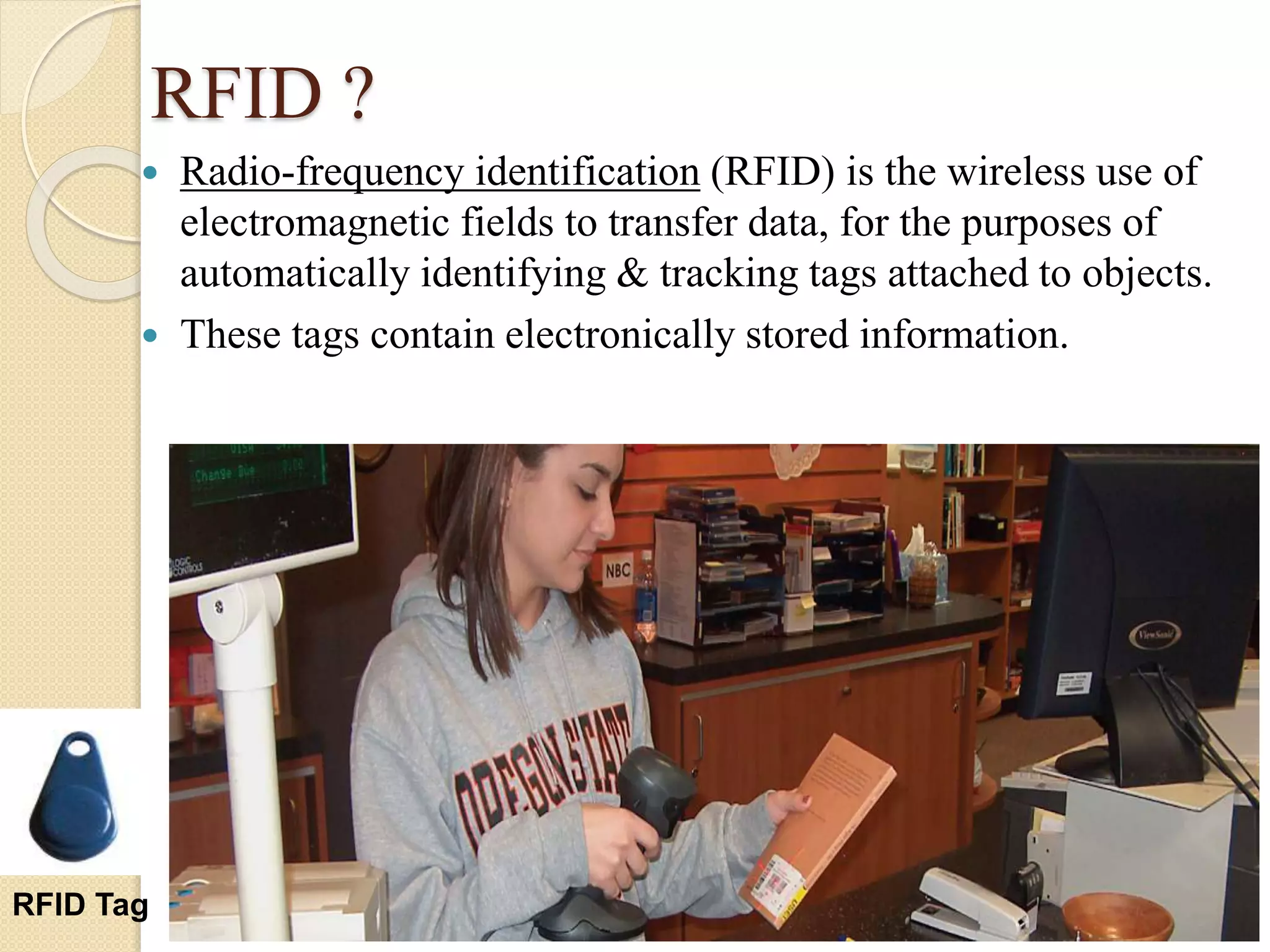
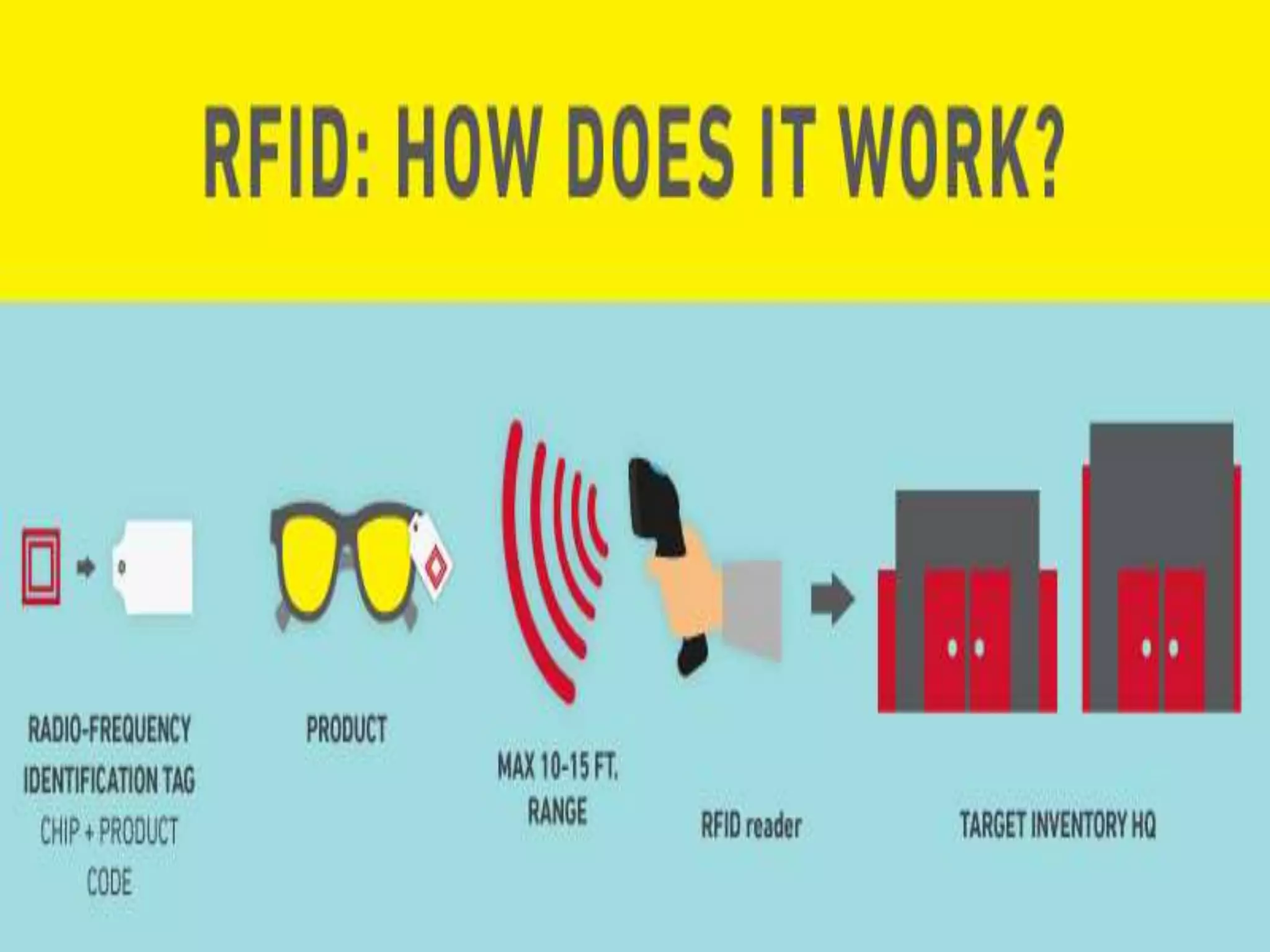
 Radio-frequency identification (RFID) is the wireless use of
electromagnetic fields to transfer data, for the purposes of
automatically identifying & tracking tags attached to objects.
 These tags contain electronically stored information.
RFID Tag
RFID
RFID Tag Attributes
•Active tag
•Passive tag
Value Addition -
RESHAPING OF A BUSINESS
MODEL:
 Instead of manual scanning of the products
bought at paying counter, automatic scanning
through RFID is a value addition. Through
reshaping, efficiency of business model can be
increased.
 RFID is also used to reduce failure rate,
shrinkage, operating stock and to enhance on-
time delivery, shipment quality and so forth.
This can be new ways to make money.
VALUE DELIVERANCE:
 A customer can get information about the existence
of a garment matching his style, size and color
requirements and if the desired garment exist, the
store’s clerk can precisely locate the garment for
him.
 If the garment is out of stock, customer can get
information with the help of RFID-enabled system
about the nearest store where the garment is
available.
Defence:
 RFID can make the battlefield safer for soldiers in
terms of identifying friendlies, specific units, weapons
and of course targeting enemies with minimum fallout.
 By having real time information to support and
enhance logistics and supply chain management in the
field.
Logistics:
 A reduction in the time required for workers to
search for containers stored within the yard when
they need to be inspected for clearance, or shipped
out from the container-freight station (CFS).
Agriculture:
Tracking the movements of animals via RFID is
probably one of the first areas where this
technology was used.
 Farm management systems can be extremely
expensive, but monitoring the health of animals
is essential for any modern day farmer.
 Ensuring the correct feed is provided to a
specific individual among a herd of hundreds
can be extremely time consuming. With RFID
this can be achieved automatically and cost
effectively, with information sent back to central
database in real time to show which animals are
healthy.
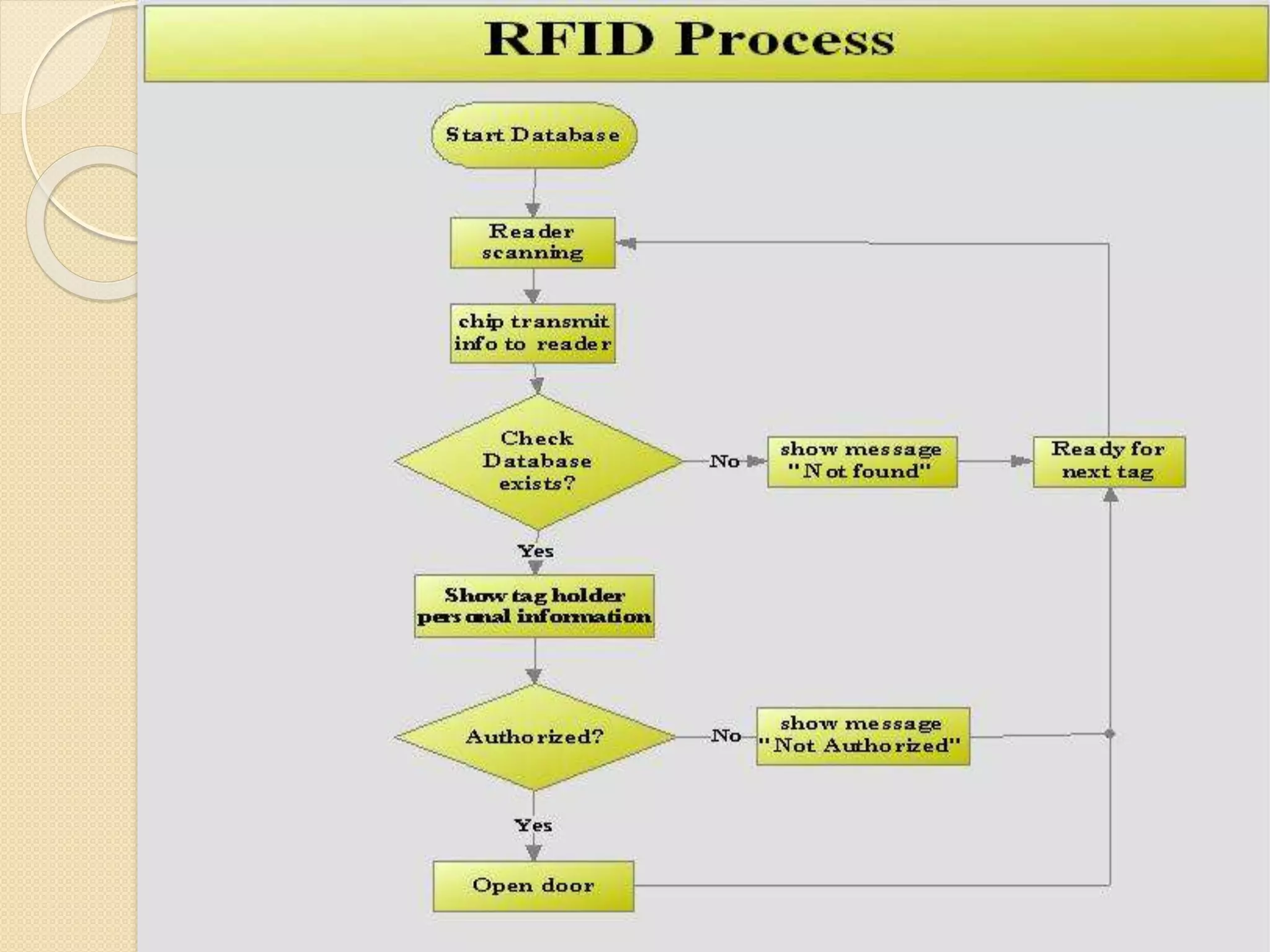
RFID Door Locks:
RFID, a database that contained user information,
model door, lcd display, a door lock, and small
switch circuit they designed a system that allows
registered users to unlock the door. By simply
waving the RFID tag in front of the RFID reader,
the reader sends the ID embedded in the tag to the
computer. Then the program checks to see if the ID
is in the database. If the ID is in the database, then
the lcd the door opens, and the lcd display displays
the user's name. If, on the other hand the ID is not
found the database, then the user is denide access,
and the lcd display display a message notifying the
user that he was denied access.
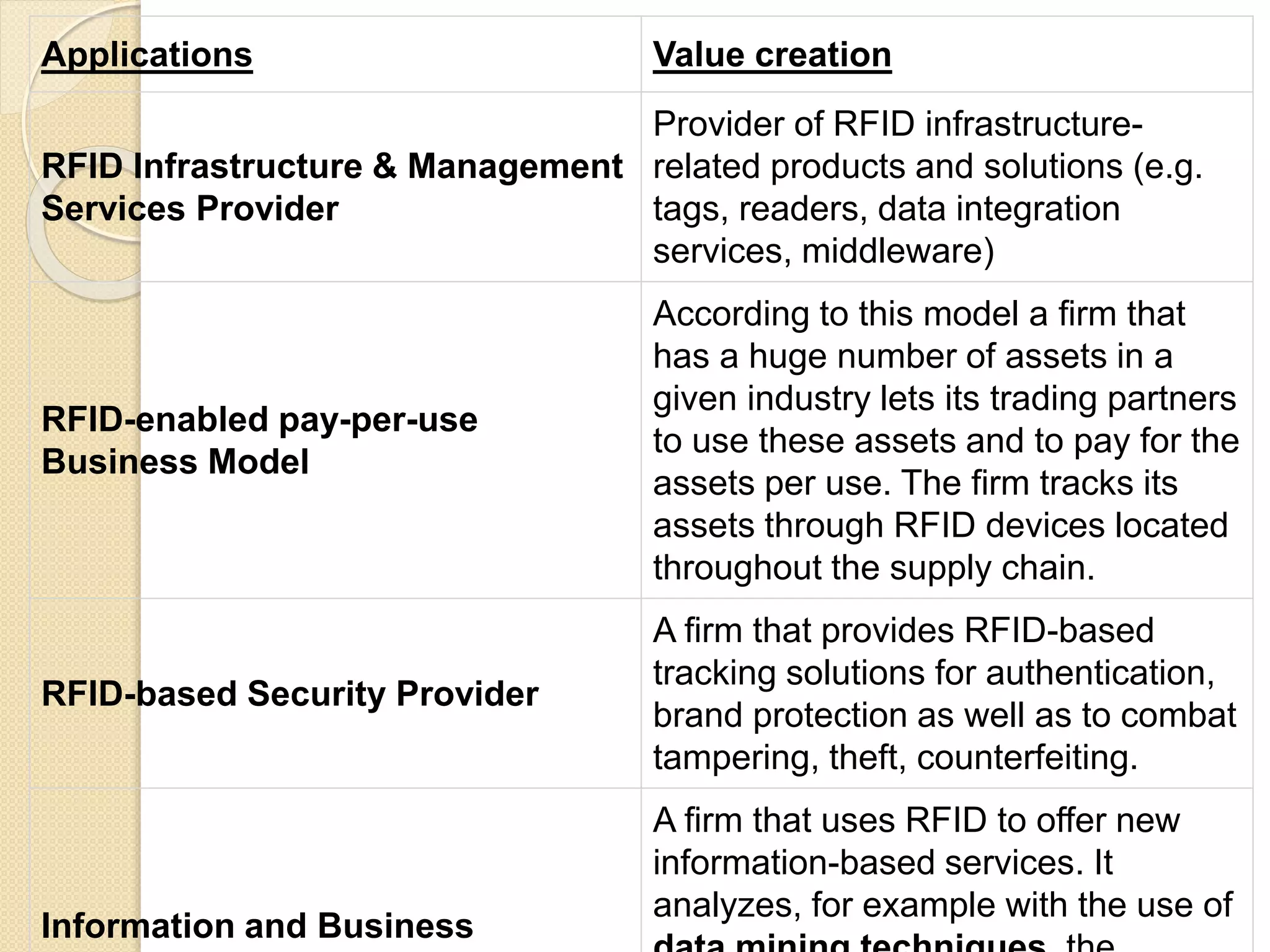
Applications Value creation
RFID Infrastructure & Management
Services Provider
Provider of RFID infrastructure-
related products and solutions (e.g.
tags, readers, data integration
services, middleware)
RFID-enabled pay-per-use
Business Model
According to this model a firm that
has a huge number of assets in a
given industry lets its trading partners
to use these assets and to pay for the
assets per use. The firm tracks its
assets through RFID devices located
throughout the supply chain.
RFID-based Security Provider
A firm that provides RFID-based
tracking solutions for authentication,
brand protection as well as to combat
tampering, theft, counterfeiting.
Information and Business
A firm that uses RFID to offer new
information-based services. It
analyzes, for example with the use of
Problems with RFID:
Some common problems with RFID are
Reader collision
- Reader collision occurs when the signals from two or
more readers overlap.
Systems must be carefully set up.
Tag collision
- Tag collision occurs when many tags are present in a
small area
Since the read time is very fast, it is easier for vendors
to develop systems that ensure that tags respond one
at a time.
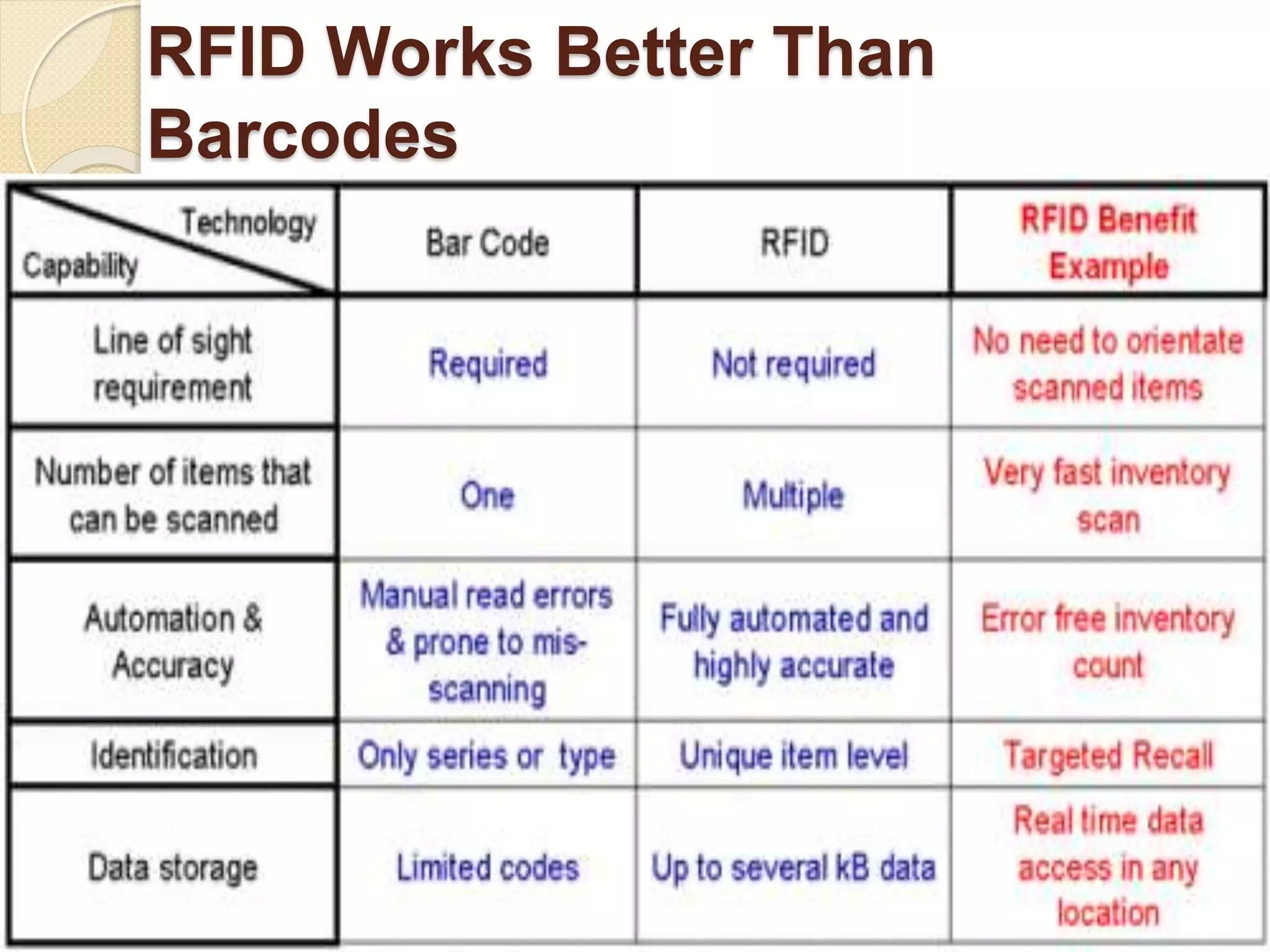
RFID Works Better Than
Barcodes
Rfid complete

Rfid complete

  • 1.
    Value creation by RFID (RadioFrequency Identification) By – Archit Tiwari Gaurav Deshmukh Lalit Sharma Lovedeep Singh
  • 2.
    RFID ?  Radio-frequencyidentification (RFID) is the wireless use of electromagnetic fields to transfer data, for the purposes of automatically identifying & tracking tags attached to objects.  These tags contain electronically stored information. RFID Tag
  • 4.
  • 5.
  • 7.
    Value Addition - RESHAPINGOF A BUSINESS MODEL:  Instead of manual scanning of the products bought at paying counter, automatic scanning through RFID is a value addition. Through reshaping, efficiency of business model can be increased.  RFID is also used to reduce failure rate, shrinkage, operating stock and to enhance on- time delivery, shipment quality and so forth. This can be new ways to make money.
  • 8.
    VALUE DELIVERANCE:  Acustomer can get information about the existence of a garment matching his style, size and color requirements and if the desired garment exist, the store’s clerk can precisely locate the garment for him.  If the garment is out of stock, customer can get information with the help of RFID-enabled system about the nearest store where the garment is available.
  • 9.
    Defence:  RFID canmake the battlefield safer for soldiers in terms of identifying friendlies, specific units, weapons and of course targeting enemies with minimum fallout.  By having real time information to support and enhance logistics and supply chain management in the field.
  • 10.
    Logistics:  A reductionin the time required for workers to search for containers stored within the yard when they need to be inspected for clearance, or shipped out from the container-freight station (CFS).
  • 11.
    Agriculture: Tracking the movementsof animals via RFID is probably one of the first areas where this technology was used.  Farm management systems can be extremely expensive, but monitoring the health of animals is essential for any modern day farmer.  Ensuring the correct feed is provided to a specific individual among a herd of hundreds can be extremely time consuming. With RFID this can be achieved automatically and cost effectively, with information sent back to central database in real time to show which animals are healthy.
  • 12.
    RFID Door Locks: RFID,a database that contained user information, model door, lcd display, a door lock, and small switch circuit they designed a system that allows registered users to unlock the door. By simply waving the RFID tag in front of the RFID reader, the reader sends the ID embedded in the tag to the computer. Then the program checks to see if the ID is in the database. If the ID is in the database, then the lcd the door opens, and the lcd display displays the user's name. If, on the other hand the ID is not found the database, then the user is denide access, and the lcd display display a message notifying the user that he was denied access.
  • 14.
    Applications Value creation RFIDInfrastructure & Management Services Provider Provider of RFID infrastructure- related products and solutions (e.g. tags, readers, data integration services, middleware) RFID-enabled pay-per-use Business Model According to this model a firm that has a huge number of assets in a given industry lets its trading partners to use these assets and to pay for the assets per use. The firm tracks its assets through RFID devices located throughout the supply chain. RFID-based Security Provider A firm that provides RFID-based tracking solutions for authentication, brand protection as well as to combat tampering, theft, counterfeiting. Information and Business A firm that uses RFID to offer new information-based services. It analyzes, for example with the use of
  • 15.
    Problems with RFID: Somecommon problems with RFID are Reader collision - Reader collision occurs when the signals from two or more readers overlap. Systems must be carefully set up. Tag collision - Tag collision occurs when many tags are present in a small area Since the read time is very fast, it is easier for vendors to develop systems that ensure that tags respond one at a time.
  • 16.
    RFID Works BetterThan Barcodes