optimal integrated operation
strategy for highway toll
collection system with
wireless technology
Agenda
 Goal
 Existing System
 Projected System
 Block Diagram
 Block Explanation
 Schematic
 Advantages
 Conclusion
 References
Goal
 Electronic toll collection (ETC), an adaptation of
military aims to eliminate the delay on toll roads by
collecting tolls electronically.
Existing System
 Entering data’s through manual
 It takes more time for further process
Projected System
 Vehicle takes less time for entering data as well as
pay
 Effective communication facilities
Block Diagram
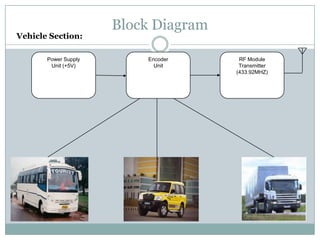
Power Supply
Unit (+5V)
RF Module
Transmitter
(433.92MHZ)
Encoder
Unit
Vehicle Section:
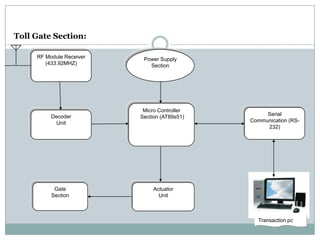
RF Module Receiver
(433.92MHZ)
Decoder
Unit
Micro Controller
Section (AT89s51)
Power Supply
Section
Actuator
Unit
Gate
Section
Serial
Communication (RS-
232)
Transaction pc
Toll Gate Section:
Block definition
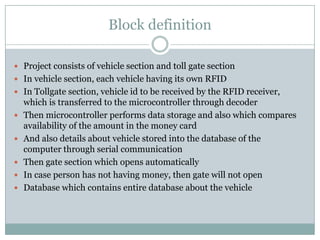
 Project consists of vehicle section and toll gate section
 In vehicle section, each vehicle having its own RFID
 In Tollgate section, vehicle id to be received by the RFID receiver,
which is transferred to the microcontroller through decoder
 Then microcontroller performs data storage and also which compares
availability of the amount in the money card
 And also details about vehicle stored into the database of the
computer through serial communication
 Then gate section which opens automatically
 In case person has not having money, then gate will not open
 Database which contains entire database about the vehicle
Hardware Tools
 Power Supply Unit
 Microcontroller AT89S51
 Encoder/Decoder
 RF module
 Serial communication RS232,Max232
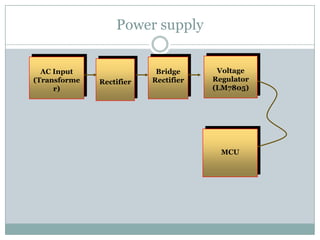
Power supply
AC Input
(Transforme
r)
Rectifier
Bridge
Rectifier
Voltage
Regulator
(LM7805)
MCU
Power Supply Circuit
VDD
VDD
C7
0.1 uF
JP2
220 VAC
1
2
- +
D1
1
4
3
2
U2
7805
1
3
2
VIN
GND
VOUT
C6
100 uF
C5
470 uF
R4
220 ohm
D2
LED
Power Supply
• The operation of power supply circuits built using filters, rectifiers, and
then voltage regulators. Starting with an AC voltage, a steady DC
voltage is obtained by rectifying the AC voltage
• Then filtering to a DC level, and finally, regulating to obtain a desired
fixed DC voltage.
• The regulation is usually obtained from an IC voltage regulator Unit,
which takes a DC voltage and provides a somewhat lower DC voltage,
Which remains the same even if the input DC voltage varies, or the
output Load connected to the DC voltage changes.
Need of Microcontroller
 A microcontroller (also MCU or µC) is a
functional computer system-on-a-chip. It
contains a processor core, memory, and
programmable input/output peripherals.
 Microcontrollers include an integrated CPU,
memory (a small amount of RAM, program
memory, or both) and peripherals capable of
input and output.
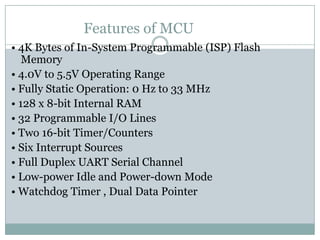
Features of MCU
• 4K Bytes of In-System Programmable (ISP) Flash
Memory
• 4.0V to 5.5V Operating Range
• Fully Static Operation: 0 Hz to 33 MHz
• 128 x 8-bit Internal RAM
• 32 Programmable I/O Lines
• Two 16-bit Timer/Counters
• Six Interrupt Sources
• Full Duplex UART Serial Channel
• Low-power Idle and Power-down Mode
• Watchdog Timer , Dual Data Pointer
Serial communication
 ATMEL microcontroller and write the code to initialize
the UART and use it to send and receive data
 Data you need to transmit and it will do the rest.
 It transmits data at standard speeds of 9600,19200 bps
etc
 The advantage of hardware UART is that you just need to
write the data to one of the registers of UART and your
done, you are free to do other things while UART is
transmitting the byte.
 UART automatically senses the start of transmission of
RX line and then inputs the whole byte and when it has
the byte it informs you(CPU) to read that data from one
of its registers
Voltages
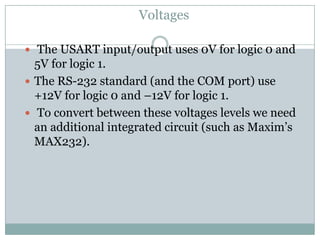
 The USART input/output uses 0V for logic 0 and
5V for logic 1.
 The RS-232 standard (and the COM port) use
+12V for logic 0 and –12V for logic 1.
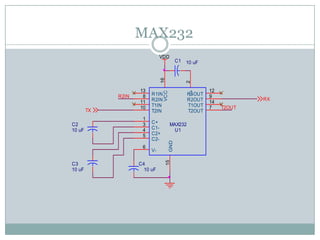
 To convert between these voltages levels we need
an additional integrated circuit (such as Maxim’s
MAX232).
MAX232
VDD
RX
TX
T2OUT
R2IN
U1
MAX232
13
8
11
10
1
3
4
5
2
6
12
9
14
7
16
15
R1IN
R2IN
T1IN
T2IN
C+
C1-
C2+
C2-
V+
V-
R1OUT
R2OUT
T1OUT
T2OUT
VCC
GND
C1 10 uF
C4
10 uF
C3
10 uF
C2
10 uF
RS232 pins
UART pins in AT89S51
 The UART always transmits data on pin P3.1/TX
 The UART always receives data on pin P3.0/RX
 The RS-232 standard defines lots of other signals
other than TX and RX used for handshaking.
RF TRANSMITTER
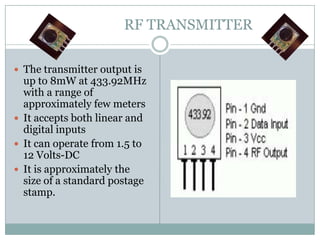
 The transmitter output is
up to 8mW at 433.92MHz
with a range of
approximately few meters
 It accepts both linear and
digital inputs
 It can operate from 1.5 to
12 Volts-DC
 It is approximately the
size of a standard postage
stamp.
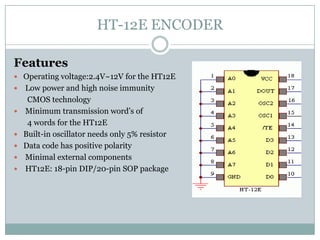
HT-12E ENCODER
Features
 Operating voltage:2.4V~12V for the HT12E
 Low power and high noise immunity
CMOS technology
 Minimum transmission word’s of
4 words for the HT12E
 Built-in oscillator needs only 5% resistor
 Data code has positive polarity
 Minimal external components
 HT12E: 18-pin DIP/20-pin SOP package
RF RECEIVER It also operates at
433.92MHz, and has a
sensitivity of 3uV.
 It operates from 4.5 to
5.5 volts-DC,
 It has both linear and
digital outputs.
HT12D DECODER
 Operating voltage: 2.4V~12V
 Low power and high noise immunity
 CMOS technology
 Low standby current
 Capable of decoding 12 bits of information
 Binary address setting
 Received codes are checked 3 times
 Address/Data number combination
 - HT12D: 8 address bits and 4 data bits
 Built-in oscillator needs only 5% resistor
 Valid transmission indicator
 Easy interface with an RF transmission medium
 Minimal external components
 Pair with Holtek's 212 series of encoders
 18-pin DIP, 20-pin SOP package
Software Tools
 Keil C compiler
 Orcad Tool for Circuit Design
 Flash programmer
Keil software
Flash Programmer
Advantages
 It helps in Time Management ie by avoiding long
wait on the high for the collection of toll bill .
Applications
 Tollgate
 License recognition
Conclusion
 By application of this project into real time we can
avoid malfunctions , Time maintenance system, and
long wait on the Highways can be avoided.
References through Books
 Council of Europe, “Legal, Operational And
Technical Standards For E-voting”,
Recommendation Rec(2004)1130th of September
2004, Council of Europe Publishing, 2004.
 Federal Election Commission, “Voting System
Standards.Volume I: Performance Standards”, U.S.
Federal Election Commission, 2002.

RFID Based Toll Gate System

  • 1.
    optimal integrated operation strategyfor highway toll collection system with wireless technology
  • 2.
    Agenda  Goal  ExistingSystem  Projected System  Block Diagram  Block Explanation  Schematic  Advantages  Conclusion  References
  • 3.
    Goal  Electronic tollcollection (ETC), an adaptation of military aims to eliminate the delay on toll roads by collecting tolls electronically.
  • 4.
    Existing System  Enteringdata’s through manual  It takes more time for further process
  • 5.
    Projected System  Vehicletakes less time for entering data as well as pay  Effective communication facilities
  • 6.
    Block Diagram Power Supply Unit(+5V) RF Module Transmitter (433.92MHZ) Encoder Unit Vehicle Section:
  • 7.
    RF Module Receiver (433.92MHZ) Decoder Unit MicroController Section (AT89s51) Power Supply Section Actuator Unit Gate Section Serial Communication (RS- 232) Transaction pc Toll Gate Section:
  • 8.
    Block definition  Projectconsists of vehicle section and toll gate section  In vehicle section, each vehicle having its own RFID  In Tollgate section, vehicle id to be received by the RFID receiver, which is transferred to the microcontroller through decoder  Then microcontroller performs data storage and also which compares availability of the amount in the money card  And also details about vehicle stored into the database of the computer through serial communication  Then gate section which opens automatically  In case person has not having money, then gate will not open  Database which contains entire database about the vehicle
  • 9.
    Hardware Tools  PowerSupply Unit  Microcontroller AT89S51  Encoder/Decoder  RF module  Serial communication RS232,Max232
  • 10.
  • 11.
    Power Supply Circuit VDD VDD C7 0.1uF JP2 220 VAC 1 2 - + D1 1 4 3 2 U2 7805 1 3 2 VIN GND VOUT C6 100 uF C5 470 uF R4 220 ohm D2 LED
  • 12.
    Power Supply • Theoperation of power supply circuits built using filters, rectifiers, and then voltage regulators. Starting with an AC voltage, a steady DC voltage is obtained by rectifying the AC voltage • Then filtering to a DC level, and finally, regulating to obtain a desired fixed DC voltage. • The regulation is usually obtained from an IC voltage regulator Unit, which takes a DC voltage and provides a somewhat lower DC voltage, Which remains the same even if the input DC voltage varies, or the output Load connected to the DC voltage changes.
  • 13.
    Need of Microcontroller A microcontroller (also MCU or µC) is a functional computer system-on-a-chip. It contains a processor core, memory, and programmable input/output peripherals.  Microcontrollers include an integrated CPU, memory (a small amount of RAM, program memory, or both) and peripherals capable of input and output.
  • 14.
    Features of MCU •4K Bytes of In-System Programmable (ISP) Flash Memory • 4.0V to 5.5V Operating Range • Fully Static Operation: 0 Hz to 33 MHz • 128 x 8-bit Internal RAM • 32 Programmable I/O Lines • Two 16-bit Timer/Counters • Six Interrupt Sources • Full Duplex UART Serial Channel • Low-power Idle and Power-down Mode • Watchdog Timer , Dual Data Pointer
  • 15.
    Serial communication  ATMELmicrocontroller and write the code to initialize the UART and use it to send and receive data  Data you need to transmit and it will do the rest.  It transmits data at standard speeds of 9600,19200 bps etc  The advantage of hardware UART is that you just need to write the data to one of the registers of UART and your done, you are free to do other things while UART is transmitting the byte.  UART automatically senses the start of transmission of RX line and then inputs the whole byte and when it has the byte it informs you(CPU) to read that data from one of its registers
  • 16.
    Voltages  The USARTinput/output uses 0V for logic 0 and 5V for logic 1.  The RS-232 standard (and the COM port) use +12V for logic 0 and –12V for logic 1.  To convert between these voltages levels we need an additional integrated circuit (such as Maxim’s MAX232).
  • 17.
  • 18.
  • 19.
    UART pins inAT89S51  The UART always transmits data on pin P3.1/TX  The UART always receives data on pin P3.0/RX  The RS-232 standard defines lots of other signals other than TX and RX used for handshaking.
  • 20.
    RF TRANSMITTER  Thetransmitter output is up to 8mW at 433.92MHz with a range of approximately few meters  It accepts both linear and digital inputs  It can operate from 1.5 to 12 Volts-DC  It is approximately the size of a standard postage stamp.
  • 21.
    HT-12E ENCODER Features  Operatingvoltage:2.4V~12V for the HT12E  Low power and high noise immunity CMOS technology  Minimum transmission word’s of 4 words for the HT12E  Built-in oscillator needs only 5% resistor  Data code has positive polarity  Minimal external components  HT12E: 18-pin DIP/20-pin SOP package
  • 22.
    RF RECEIVER Italso operates at 433.92MHz, and has a sensitivity of 3uV.  It operates from 4.5 to 5.5 volts-DC,  It has both linear and digital outputs.
  • 23.
    HT12D DECODER  Operatingvoltage: 2.4V~12V  Low power and high noise immunity  CMOS technology  Low standby current  Capable of decoding 12 bits of information  Binary address setting  Received codes are checked 3 times  Address/Data number combination  - HT12D: 8 address bits and 4 data bits  Built-in oscillator needs only 5% resistor  Valid transmission indicator  Easy interface with an RF transmission medium  Minimal external components  Pair with Holtek's 212 series of encoders  18-pin DIP, 20-pin SOP package
  • 24.
    Software Tools  KeilC compiler  Orcad Tool for Circuit Design  Flash programmer
  • 25.
  • 26.
  • 27.
    Advantages  It helpsin Time Management ie by avoiding long wait on the high for the collection of toll bill .
  • 28.
  • 29.
    Conclusion  By applicationof this project into real time we can avoid malfunctions , Time maintenance system, and long wait on the Highways can be avoided.
  • 30.
    References through Books Council of Europe, “Legal, Operational And Technical Standards For E-voting”, Recommendation Rec(2004)1130th of September 2004, Council of Europe Publishing, 2004.  Federal Election Commission, “Voting System Standards.Volume I: Performance Standards”, U.S. Federal Election Commission, 2002.