Contents
 History of networks
 Present scenario
 Invention of Li Fi
 Introduction
 Components of Li Fi
 Working of Li Fi
 Architecture of Li Fi
 Properties
 Issues with radio waves
 Li Fi Vs Wi Fi
 Advantages
 Disadvantages
 Application
 Conclusion
 Reference
History of Networks
 In the olden days, people formed a network in order to
transmit a piece of data from one place to another.
 With the advances in technology a new mode of networking
was developed by using the wires as a medium (wired
networking).
 As time passed the technology increased and we launched
satellites into space and thus were in a position to transmit
enormous amounts of data across various geographical
locations.
 Wireless networking gained a wide recognition and became
the most popular type of all networks .
Present scenario
 At present we have as many as 1.5 million
radio wave base stations across the globe.
 We also have close to 5 billion mobile
connections which transmit a data over
600TB.
 This penetration of mobile devices into our
lives has lead to a wide recognition of
WIFI technology.
Continued..
 At present the data transmission across the
globe is being done using radio wave range
of the electromagnetic spectrum.
 Whether we are using a wireless internet in
a coffee shop or mall, competing for
bandwidth at a conference or probably
stealing it from the guy next door.
 We often get frustrated because of the low
speeds.
Continued..
Also as more and more devices get connected
to the network, clogged airwaves are going to
make it.
Invention of lifi
 A German physicist, Harald Haas has
started working on transmission
of data using visible light back in
2004.
 In the year 2011 he first
introduced to the world this new technology,
LI FI in the TED talk show.
 He envisions a future where data for laptops
and other mobile devices is transmitted through
a light in a room.
Introduction to LI FI
 Li-Fi (light fidelity) is a wireless technology
that uses light emitting diodes for
transmission of data.
 It sends data through a LED light bulb that
varies in intensity faster than the human eye
can notice.
 It is the optical version of Wi-Fi.
 It uses light instead of radio waves to
transmit information.
Continued..
 Light has been around for millions of
years now and is a very cheap resource
unlike radio waves.
Components of LiFi
 A high bright white LED, which acts as
communication source.
 A silicon photodiode, which shows good
response to visible wavelength region
serving as receiving element.
Working of LiFi
 Li-Fi is implemented using white LED bulbs
at the transmitter.
 The operational is: if the LED is on a digital
1 is transmitted, if the LED is off then a
digital 0 is transmitted.
 They can be switched on and off in order to
transmit data continuously.
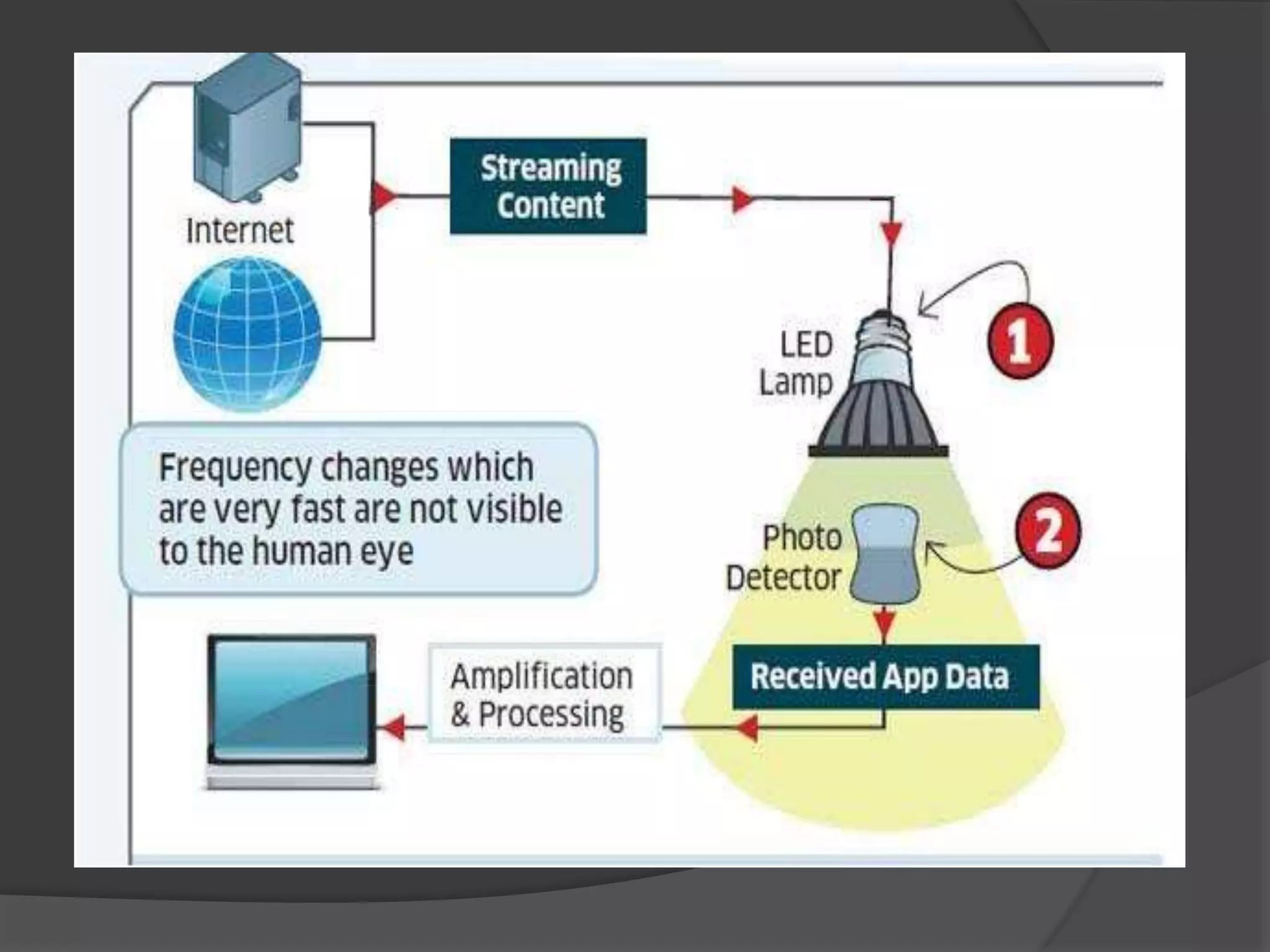
Architecture of LI FI
Continued..
 On one end all the data on the internet will
be streamed to a lamp driver.
 When the LED is turned on the microchip
converts this digital data in the form of light.
 On the other end this light is detected by
photo sensitive devices.
 Next this light is amplified and processed
and then fed to the device.
Properties
 Fast and subtle variation of light can also
transmit data with high speed.
 Any LED light set if used along with a
microchip inside it can used to detect the
variation in the light.
 Thus it helps in converting light into data in
its digital form.
 This is like sending a Morse code signal
using a torch but at a very fast speed.
Continued..
 The very high speed blinking of the light
enables the source to transmit data in a rapid
stream of binary code that, although
invisible to the naked eye, can be detected
by a light sensitive device.
 Thus every light emitting source can be
used as a hub for data transmission.
Issues with radio waves
 CAPACITY:
 The current system makes use of radio
waves.
 With the increasing number of mobile
connections the availability of the spectrum
is getting congested.
 Radio waves forms only a small fraction of
the entire EM spectrum thus making the
problem even worse.
Continued..
 EFFICIENCY:
 The current system is high on energy
consumption.
 For every unit of energy consumed the data
transmitted is relatively less.
 The data speeds in the current system can
only reach up to a few hundreds of megabits
per second.
Continued..
 AVAILABILITY:
 The availability of the radio waves is yet
another major issue now a days.
 These waves are not much available during
the flight travel.
 It is not advisable to use these devices to
places like petrol bunks.
Continued..
 SECURITY:
 These radio waves can easily penetrate
through the walls, thus letting anonymous
users to use the network.
 This can pose threat if the people with bad
intentions start using it.
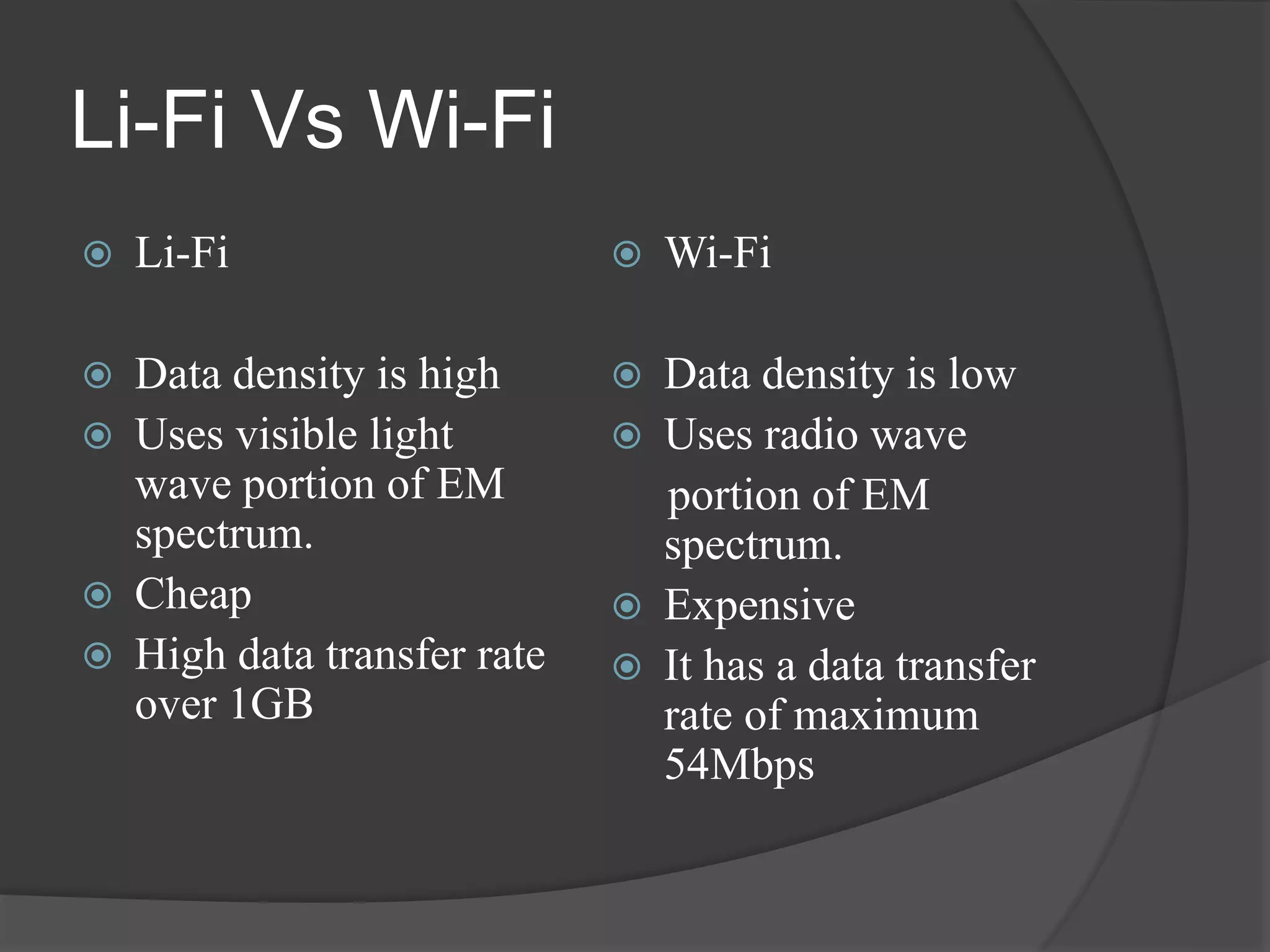
Li-Fi Vs Wi-Fi
 Li-Fi
 Data density is high
 Uses visible light
wave portion of EM
spectrum.
 Cheap
 High data transfer rate
over 1GB
 Wi-Fi
 Data density is low
 Uses radio wave
portion of EM
spectrum.
 Expensive
 It has a data transfer
rate of maximum
54Mbps
Advantages of LiFi
 Higher speed than WiFi.
 More secure as data cannot be intercepted
without a clear line of sight.
 It has10,000 times wider bandwidth.
 Availability is not an issue as light is present
everywhere.
 It consumes less energy and highly efficient.
 It can be used in the environments like
hospital, aircrafts.
Disadvantages
 Presence of light is essential.
 Works better with fluorescent light and
LEDs but very low efficiency with bulbs.
Applications
Some of the applications of Li-Fi are given
below:
 Airways
 Green information technology
 Free from frequency bandwidth problem
 Increase communication safety
 Multi user communication
 Lightings points used as hotspot
 Smarter power plants
 Under sea Awesomeness
Conclusion
 This may solve issues like shortage of radio
frequency bandwidth.
 It will allows internet where traditional radio
based wireless isn’t allowed.
 LI FI will make are lives more technology
driven in the near future.
 With its magic of light it can make our world a
greener, safer, cleaner and moreover a brighter
place to live.
References
 http://www.technewspaper.net/best-five-
benefits-of-li-fi-technology/
 http://www.youtube.com/watch?v=gjqSgsKbag
Qs
 http://en.wikipedia.org/wiki/Li-Fi
 http://www.ripublication.com/irph/ijict_spl/ijict
v4n16spl_11.pdf
 http://journal.rtmonline.in/vol21iss1/05297.pdf

Li fi ppt

  • 1.
    Contents  History ofnetworks  Present scenario  Invention of Li Fi  Introduction  Components of Li Fi  Working of Li Fi  Architecture of Li Fi  Properties  Issues with radio waves  Li Fi Vs Wi Fi  Advantages  Disadvantages  Application  Conclusion  Reference
  • 2.
    History of Networks In the olden days, people formed a network in order to transmit a piece of data from one place to another.  With the advances in technology a new mode of networking was developed by using the wires as a medium (wired networking).  As time passed the technology increased and we launched satellites into space and thus were in a position to transmit enormous amounts of data across various geographical locations.  Wireless networking gained a wide recognition and became the most popular type of all networks .
  • 3.
    Present scenario  Atpresent we have as many as 1.5 million radio wave base stations across the globe.  We also have close to 5 billion mobile connections which transmit a data over 600TB.  This penetration of mobile devices into our lives has lead to a wide recognition of WIFI technology.
  • 4.
    Continued..  At presentthe data transmission across the globe is being done using radio wave range of the electromagnetic spectrum.  Whether we are using a wireless internet in a coffee shop or mall, competing for bandwidth at a conference or probably stealing it from the guy next door.  We often get frustrated because of the low speeds.
  • 5.
    Continued.. Also as moreand more devices get connected to the network, clogged airwaves are going to make it.
  • 6.
    Invention of lifi A German physicist, Harald Haas has started working on transmission of data using visible light back in 2004.  In the year 2011 he first introduced to the world this new technology, LI FI in the TED talk show.  He envisions a future where data for laptops and other mobile devices is transmitted through a light in a room.
  • 7.
    Introduction to LIFI  Li-Fi (light fidelity) is a wireless technology that uses light emitting diodes for transmission of data.  It sends data through a LED light bulb that varies in intensity faster than the human eye can notice.  It is the optical version of Wi-Fi.  It uses light instead of radio waves to transmit information.
  • 8.
    Continued..  Light hasbeen around for millions of years now and is a very cheap resource unlike radio waves.
  • 9.
    Components of LiFi A high bright white LED, which acts as communication source.  A silicon photodiode, which shows good response to visible wavelength region serving as receiving element.
  • 11.
    Working of LiFi Li-Fi is implemented using white LED bulbs at the transmitter.  The operational is: if the LED is on a digital 1 is transmitted, if the LED is off then a digital 0 is transmitted.  They can be switched on and off in order to transmit data continuously.
  • 12.
  • 13.
    Continued..  On oneend all the data on the internet will be streamed to a lamp driver.  When the LED is turned on the microchip converts this digital data in the form of light.  On the other end this light is detected by photo sensitive devices.  Next this light is amplified and processed and then fed to the device.
  • 14.
    Properties  Fast andsubtle variation of light can also transmit data with high speed.  Any LED light set if used along with a microchip inside it can used to detect the variation in the light.  Thus it helps in converting light into data in its digital form.  This is like sending a Morse code signal using a torch but at a very fast speed.
  • 15.
    Continued..  The veryhigh speed blinking of the light enables the source to transmit data in a rapid stream of binary code that, although invisible to the naked eye, can be detected by a light sensitive device.  Thus every light emitting source can be used as a hub for data transmission.
  • 16.
    Issues with radiowaves  CAPACITY:  The current system makes use of radio waves.  With the increasing number of mobile connections the availability of the spectrum is getting congested.  Radio waves forms only a small fraction of the entire EM spectrum thus making the problem even worse.
  • 17.
    Continued..  EFFICIENCY:  Thecurrent system is high on energy consumption.  For every unit of energy consumed the data transmitted is relatively less.  The data speeds in the current system can only reach up to a few hundreds of megabits per second.
  • 18.
    Continued..  AVAILABILITY:  Theavailability of the radio waves is yet another major issue now a days.  These waves are not much available during the flight travel.  It is not advisable to use these devices to places like petrol bunks.
  • 19.
    Continued..  SECURITY:  Theseradio waves can easily penetrate through the walls, thus letting anonymous users to use the network.  This can pose threat if the people with bad intentions start using it.
  • 20.
    Li-Fi Vs Wi-Fi Li-Fi  Data density is high  Uses visible light wave portion of EM spectrum.  Cheap  High data transfer rate over 1GB  Wi-Fi  Data density is low  Uses radio wave portion of EM spectrum.  Expensive  It has a data transfer rate of maximum 54Mbps
  • 21.
    Advantages of LiFi Higher speed than WiFi.  More secure as data cannot be intercepted without a clear line of sight.  It has10,000 times wider bandwidth.  Availability is not an issue as light is present everywhere.  It consumes less energy and highly efficient.  It can be used in the environments like hospital, aircrafts.
  • 22.
    Disadvantages  Presence oflight is essential.  Works better with fluorescent light and LEDs but very low efficiency with bulbs.
  • 23.
    Applications Some of theapplications of Li-Fi are given below:  Airways  Green information technology  Free from frequency bandwidth problem  Increase communication safety  Multi user communication  Lightings points used as hotspot  Smarter power plants  Under sea Awesomeness
  • 24.
    Conclusion  This maysolve issues like shortage of radio frequency bandwidth.  It will allows internet where traditional radio based wireless isn’t allowed.  LI FI will make are lives more technology driven in the near future.  With its magic of light it can make our world a greener, safer, cleaner and moreover a brighter place to live.
  • 25.
    References  http://www.technewspaper.net/best-five- benefits-of-li-fi-technology/  http://www.youtube.com/watch?v=gjqSgsKbag Qs http://en.wikipedia.org/wiki/Li-Fi  http://www.ripublication.com/irph/ijict_spl/ijict v4n16spl_11.pdf  http://journal.rtmonline.in/vol21iss1/05297.pdf