 FLUIDMECHANICS
 GROUPNO: 9
 PREPAREDBY:
ENROLLMENTNO:141080119050
141080119052
141080119059
151083119013.
 MECHANICALBRANCH.
 Semester:4th(2nd year)
 TOPICNAME: REYLEIGH’SMETHOD,BUCKINGHAM π-
THEOREM.
INTRODUCTION
 It is method of dimensional analysis.
 This two methods is very important for
dimensional analysis.
(1).Rayleigh`s method
(2).Buckingham`s - theorem.
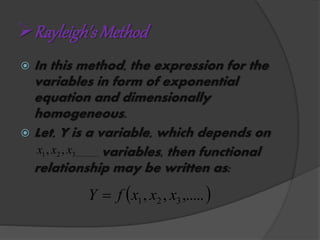
Rayleigh'sMethod
 In this method, the expression for the
variables in form of exponential
equation and dimensionally
homogeneous.
 Let, Y is a variable, which depends on
variables, then functional
relationship may be written as:
.............321 ,, xxx
 ,.....,, 321 xxxfY 
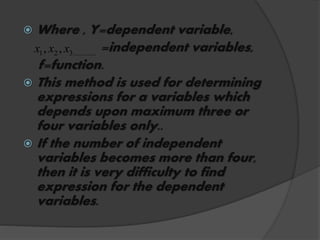
 Where , Y=dependent variable,
=independent variables,
f=function.
 This method is used for determining
expressions for a variables which
depends upon maximum three or
four variables only..
 If the number of independent
variables becomes more than four,
then it is very difficulty to find
expression for the dependent
variables.
.............321 ,, xxx
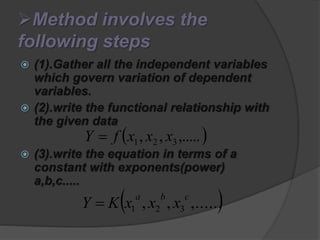
Method involves the
following steps
 (1).Gather all the independent variables
which govern variation of dependent
variables.
 (2).write the functional relationship with
the given data
 (3).write the equation in terms of a
constant with exponents(power)
a,b,c.....
 ,.....,, 321 xxxfY 
 ,......,, 321
cba
xxxKY 
where , K is a dimensionless co-
efficient and a,b,c....are the arbitrary
powers.
 (4).Apply principal of dimensional
homogeneity, and put the
dimensions(M,L,T) of variables on
both sides of equation.
 (5).find out the values of exponents
(a,b,c,...) by obtaining simultaneous
equation.
 (6).put the value of exponents (a,b,c...)
in the main equation and form the
dimensionless parameter by
grouping the variables with similar
exponents..
Buckingham’s π-Theorem
 This method is minimized difficulties
of Rayleigh's theorem....
 It states, "If there are n numbers of
variables (dependent and
independent variables) in the physical
phenomenon and if these variables m
numbers of fundamental dimensions
(M,L,T), then the variables may be
grouped into (n-m) dimensionless
terms”
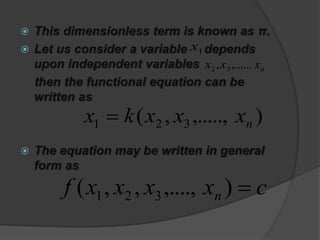
 This dimensionless term is known as π.
 Let us consider a variable depends
upon independent variables
then the functional equation can be
written as
 The equation may be written in general
form as
1x
nxxx ,......, 32
),.....,,( 321 nxxxkx 
cxxxxf n ),....,,,( 321
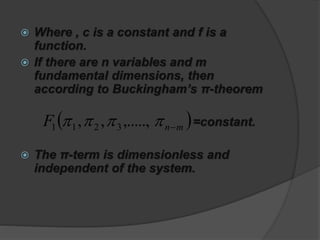
 Where , c is a constant and f is a
function.
 If there are n variables and m
fundamental dimensions, then
according to Buckingham’s π-theorem
=constant.
 The π-term is dimensionless and
independent of the system.
 mnF  ,.....,,, 3211
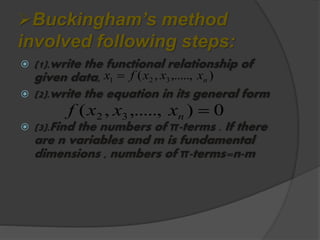
Buckingham’s method
involved following steps:
 (1).write the functional relationship of
given data,
 (2).write the equation in its general form
 (3).Find the numbers of π-terms . If there
are n variables and m is fundamental
dimensions , numbers of π-terms=n-m
),.....,,( 321 nxxxfx 
0),.....,,( 32 nxxxf
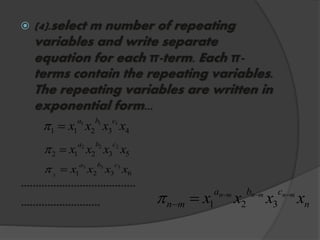
 (4).select m number of repeating
variables and write separate
equation for each π-term. Each π-
terms contain the repeating variables.
The repeating variables are written in
exponential form...
.......................................
...........................
43211
111
xxxx
cba

53212
222
xxxx
cba

6321
333
3
xxxx
cba

n
cba
mn xxxx mnmnmn 
 321
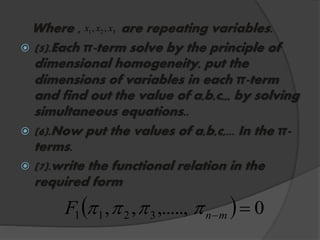
Where , are repeating variables.
 (5).Each π-term solve by the principle of
dimensional homogeneity, put the
dimensions of variables in each π-term
and find out the value of a,b,c,,, by solving
simultaneous equations..
 (6).Now put the values of a,b,c,... In the π-
terms.
 (7).write the functional relation in the
required form
321 ,, xxx
  0,.....,,, 3211 mnF 
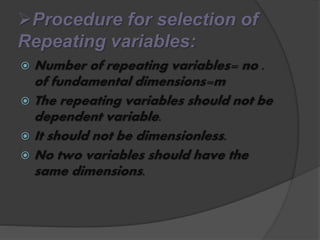
Procedure for selection of
Repeating variables:
 Number of repeating variables= no .
of fundamental dimensions=m
 The repeating variables should not be
dependent variable.
 It should not be dimensionless.
 No two variables should have the
same dimensions.
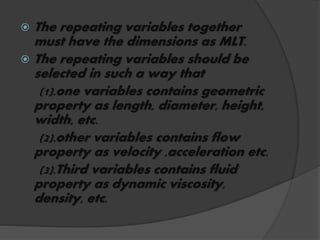
 The repeating variables together
must have the dimensions as MLT.
 The repeating variables should be
selected in such a way that
(1).one variables contains geometric
property as length, diameter, height,
width, etc.
(2).other variables contains flow
property as velocity ,acceleration etc.
(3).Third variables contains fluid
property as dynamic viscosity,
density, etc.
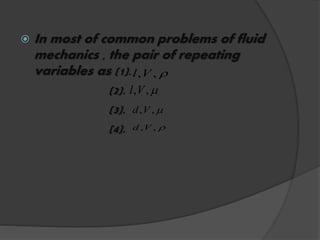
 In most of common problems of fluid
mechanics , the pair of repeating
variables as (1).
(2).
(3).
(4).
,,Vl
,,Vl
,,Vd
,,Vd
REYLEIGH’S METHOD,BUCKINGHAM  π-THEOREM

REYLEIGH’S METHOD,BUCKINGHAM π-THEOREM

  • 2.
     FLUIDMECHANICS  GROUPNO:9  PREPAREDBY: ENROLLMENTNO:141080119050 141080119052 141080119059 151083119013.  MECHANICALBRANCH.  Semester:4th(2nd year)  TOPICNAME: REYLEIGH’SMETHOD,BUCKINGHAM π- THEOREM.
  • 3.
    INTRODUCTION  It ismethod of dimensional analysis.  This two methods is very important for dimensional analysis. (1).Rayleigh`s method (2).Buckingham`s - theorem.
  • 4.
    Rayleigh'sMethod  In thismethod, the expression for the variables in form of exponential equation and dimensionally homogeneous.  Let, Y is a variable, which depends on variables, then functional relationship may be written as: .............321 ,, xxx  ,.....,, 321 xxxfY 
  • 5.
     Where ,Y=dependent variable, =independent variables, f=function.  This method is used for determining expressions for a variables which depends upon maximum three or four variables only..  If the number of independent variables becomes more than four, then it is very difficulty to find expression for the dependent variables. .............321 ,, xxx
  • 6.
    Method involves the followingsteps  (1).Gather all the independent variables which govern variation of dependent variables.  (2).write the functional relationship with the given data  (3).write the equation in terms of a constant with exponents(power) a,b,c.....  ,.....,, 321 xxxfY   ,......,, 321 cba xxxKY 
  • 7.
    where , Kis a dimensionless co- efficient and a,b,c....are the arbitrary powers.  (4).Apply principal of dimensional homogeneity, and put the dimensions(M,L,T) of variables on both sides of equation.  (5).find out the values of exponents (a,b,c,...) by obtaining simultaneous equation.
  • 8.
     (6).put thevalue of exponents (a,b,c...) in the main equation and form the dimensionless parameter by grouping the variables with similar exponents..
  • 9.
    Buckingham’s π-Theorem  Thismethod is minimized difficulties of Rayleigh's theorem....  It states, "If there are n numbers of variables (dependent and independent variables) in the physical phenomenon and if these variables m numbers of fundamental dimensions (M,L,T), then the variables may be grouped into (n-m) dimensionless terms”
  • 10.
     This dimensionlessterm is known as π.  Let us consider a variable depends upon independent variables then the functional equation can be written as  The equation may be written in general form as 1x nxxx ,......, 32 ),.....,,( 321 nxxxkx  cxxxxf n ),....,,,( 321
  • 11.
     Where ,c is a constant and f is a function.  If there are n variables and m fundamental dimensions, then according to Buckingham’s π-theorem =constant.  The π-term is dimensionless and independent of the system.  mnF  ,.....,,, 3211
  • 12.
    Buckingham’s method involved followingsteps:  (1).write the functional relationship of given data,  (2).write the equation in its general form  (3).Find the numbers of π-terms . If there are n variables and m is fundamental dimensions , numbers of π-terms=n-m ),.....,,( 321 nxxxfx  0),.....,,( 32 nxxxf
  • 13.
     (4).select mnumber of repeating variables and write separate equation for each π-term. Each π- terms contain the repeating variables. The repeating variables are written in exponential form... ....................................... ........................... 43211 111 xxxx cba  53212 222 xxxx cba  6321 333 3 xxxx cba  n cba mn xxxx mnmnmn   321
  • 14.
    Where , arerepeating variables.  (5).Each π-term solve by the principle of dimensional homogeneity, put the dimensions of variables in each π-term and find out the value of a,b,c,,, by solving simultaneous equations..  (6).Now put the values of a,b,c,... In the π- terms.  (7).write the functional relation in the required form 321 ,, xxx   0,.....,,, 3211 mnF 
  • 15.
    Procedure for selectionof Repeating variables:  Number of repeating variables= no . of fundamental dimensions=m  The repeating variables should not be dependent variable.  It should not be dimensionless.  No two variables should have the same dimensions.
  • 16.
     The repeatingvariables together must have the dimensions as MLT.  The repeating variables should be selected in such a way that (1).one variables contains geometric property as length, diameter, height, width, etc. (2).other variables contains flow property as velocity ,acceleration etc. (3).Third variables contains fluid property as dynamic viscosity, density, etc.
  • 17.
     In mostof common problems of fluid mechanics , the pair of repeating variables as (1). (2). (3). (4). ,,Vl ,,Vl ,,Vd ,,Vd