OBJECTIVE
Develop a better understanding of dimensions, units,
and dimensional homogeneity of equations.
Understand the numerous benefits of dimensional
analysis.
Know how to use the method of repeating variables to
identify non-dimensional parameters.
Understand the concept of dynamic similarity and how
to apply it to experimental modelling.
10/11/2022 1
Dimension: A measure of a physical quantity (without
numerical values).
Unit: A way to assign a number to that dimension.
10/11/2022 2
Fundamental Dimension: There are seven primary dimensions (also
called fundamental or basic dimensions): mass, length, time,
temperature, electric current, amount of light, and amount of matter.
There is no direct relationship between these dimensions, therefore
they are called fundamental dimensions or fundamental quantities.
There are two systems for fundamental dimensions namely MLT (i.e.
Mass, Length and Time) and FLT (i.e. Force, Length and Time). (Most
of engineer prefer to use MLT system instead of FLT system. we will use
MLT system in most cases).
Derived Dimensions: All non-primary dimensions can be formed by
some combination of the seven primary dimensions; thus they are
called derived dimensions, derived quantities or secondary quantities.
Such as velocity, force and volume etc.
10/11/2022 3
10/11/2022 4
10/11/2022 5
10/11/2022 6
10/11/2022 7
The law of dimensional homogeneity: Every additive term in an
equation must have the same dimensions. An equation is called
dimensionally homogeneous, if the fundamental dimensions have
identical powers of M-L-T or FLT on both sides of the equation.
Example:
10/11/2022 8
DIMENSIONAL HOMOGENEITY (Continue)
Example (contd.):
10/11/2022 9
DIMENSIONAL HOMOGENEITY (CONTINUE)
Problem-1:
10/11/2022 10
DIMENSIONAL HOMOGENEITY (Continue)
Problem-1 (Solution):
10/11/2022 11
NONDIMENSIONALIZATION OF EQUATIONS
10/11/2022 12
VARIABLES, PARAMETER AND CONSTANT
10/11/2022 13
DIMENSIONAL ANALYSIS
Dimensional analysis is a mathematical technique, which deals with the
dimensions of the physical quantities involved in the phenomenon. It
helps to determine how variables are related and the phenomenon can be
expressed by a dimensionally homogeneous equation with certain
variables.
(Dimensional analysis is a method for reducing the number and complexity of
experimental variables that affect a given physical phenomena.)
Dimensional analysis alone does not give the exact form of an equation,
but it can lead to a significant reduction of the number of variables. It is
based on two assumptions:
 Physical quantities have dimensions (fundamental are mass M, length
L, and time T). Any physical quantity has a dimension which is a
product of powers of the basic dimensions M, L and T.
 Physical laws are unaltered when changing the units measuring the
dimensions.
10/11/2022 14
WHY DIMENSIONAL ANALYSIS??
Advantage of Dimensional analysis:
 Reduce the number of variables by forming non-dimensional parameter.
 Non‐dimensional equations which provides insight on controlling
parameters and the nature of the problem.
 By Scaling laws it is allow to test models instead of expensive full‐scale
prototypes.
 Bring simplicity of complex analytic phenomenon.
Disadvantage: Error in the model analysis leads to predict inaccurate and
poor performance of the prototype.
Example: Find the pressure drop per unit length that develops along the
pipe as a result of friction of a incompressible Newtonian fluid, is flowing
steadily through a long, smooth- walled, horizontal and circular pipe.
Since designing a pipeline, the first step in the planning of an experiment is
to study this problem and the factors, or variables, that will have an effect on
the pressure drop.
10/11/2022 15
WHY DIMENSIONAL ANALYSIS??
Solution: Pressure drop per unit length depends on 4 variables: Pipe
Diameter (D); Fluid Velocity (V); fluid density (ρ); fluid viscosity (µ).
 To perform the experiments in a meaningful and systematic manner, it
would be necessary to change one of the variable, such as the velocity,
and holding all other constant, then measure the corresponding
pressure drop.
 It is difficult to determine the functional relationship between the
pressure drop and the various facts that influence it.
10/11/2022 16
WHY DIMENSIONAL ANALYSIS?? (CONTINUE)
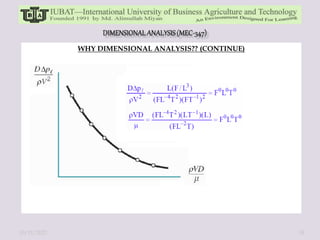
 Fortunately, there is a much simpler approach to the problem that will eliminate
the difficulties described above.
 Collecting these variables into two non-dimensional combinations of the
variables (called dimensionless product or dimensionless groups).
Only one dependent and one independent variable.
Easy to set up experiments to determine dependency.
Easy to present results (one graph).
10/11/2022 17
WHY DIMENSIONAL ANALYSIS?? (CONTINUE)
10/11/2022 18
EXAMPLE OF DIMENSIONAL ANALYSIS IN REAL WORLD
10/11/2022 19
EXAMPLE OF DIMENSIONAL ANALYSIS IN REAL WORLD
10/11/2022 20
EXAMPLE OF DIMENSIONAL ANALYSIS IN REAL WORLD
10/11/2022 21
EXAMPLE OF DIMENSIONAL ANALYSIS IN REAL WORLD
10/11/2022 22
METHOD OF DIMENSIONAL ANLAYSIS
The following two methods of dimensional analysis are important from the subject
point of view:
1) Rayleigh’s Method and
2) Buckingham’s - theorem
Rayleigh’s Method: In this method the functional relationship of some variables is
expressed in the form of an exponential equation, which must be dimensionally
homogenous. If ‘Y’ is function of independent variables X1, X2, X3 . . . etc then
functional relationship may be written as
Y = f (X1, X2, X3 ......)
Steps:
1) Write the functional relationship with all given data.
2) Write equation in terms of constant with exponents (i.e. Power) a, b, c.....
3) Find the value of a, b, c... With the help of dimensional homogeneity.
4) Substitute the values of the exponents in the main equation and simplify it.
10/11/2022 23
PROBLEMS (Rayleigh’s Method)
Problem-1: Show that the resistance ‘R’ to the motion of a sphere of diameter ‘D’ is
moving with a uniform velocity ‘V’ through a real fluid having mass density ‘ρ’ and
viscosity ‘μ’ is given by
10/11/2022 24
UNIT OF FORCE, VELOCITY, ENERGY ETC
10/11/2022 25
UNIT OF FORCE, VELOCITY, ENERGY ETC
10/11/2022 26
PROBLEMS (Rayleigh’s Method)
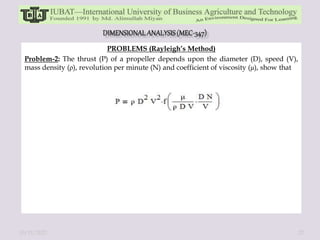
Problem-2: The thrust (P) of a propeller depends upon the diameter (D), speed (V),
mass density (ρ), revolution per minute (N) and coefficient of viscosity (μ), show that
10/11/2022 27
PROBLEMS (Rayleigh’s Method)
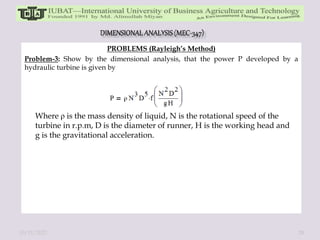
Problem-3: Show by the dimensional analysis, that the power P developed by a
hydraulic turbine is given by
Where ρ is the mass density of liquid, N is the rotational speed of the
turbine in r.p.m, D is the diameter of runner, H is the working head and
g is the gravitational acceleration.
10/11/2022 28
BUCKINGHAM’S - THEOREM
Buckingham’s -Theorem: If an equation involving k variables is dimensionally
homogeneous, it can be reduced to a relationship among k-r independent
dimensionless products, where r is the minimum number of reference or primary
dimensions required to describe the variables.
Given a physical problem in which the dependent variable is a function of k-1
numbers of independent variables.
u1 = f (u2 , u3 ,....., uk )
Mathematically, we can express the functional relationship in the equivalent form
g(u1, u2 , u3 ,....., uk ) = 0 ; where g is an unspecified function different from ‘f’.
The Buckingham Pi theorem states that: Given a relation among k variables of the
form
g(u1, u2 , u3 ,....., uk ) = 0
The k variables may be grouped into k-r independent dimensionless products, or
Π terms, expressible in functional form by
10/11/2022 29
BUCKINGHAM’S - THEOREM
Buckingham’s -Theorem (continue):
The number r is usually (but not always) equal to the minimum number of
independent dimensions required to specify the dimensions of all the parameters.
Usually the reference dimensions required to describe the variables will be the
basic dimensions M, L, and T or F, L, and T.
The theorem does not predict the functional form of ϕ . The functional relation
among the independent dimensionless products Π must be determined
experimentally.
The k-r dimensionless products Π terms obtained from the procedure are
independent.
A Π term is not independent if it can be obtained from a product or quotient of the
other dimensionless products (or Π term ) of the problem. For example, if
then neither Π5 nor Π6 is independent of the other dimensionless products or
dimensionless groups.
10/11/2022 30
BUCKINGHAM’S - THEOREM
Steps to Find PI ( ) Terms:
1. List all the variables: Assume ‘k’ is the number of variables in the problem
or phenomenon.
2. Express each of the variables in terms of basic dimensions. Find the
minimum number of reference dimensions or primary dimension. Assume
‘r’ is the minimum number of primary dimensions in MLT or FLT system.
3. Determine the required number of ‘ ’ (PI) term. The number of ‘ ’ (PI) term
will be ‘k-r’ .
4. Select a number of repeating variables, where the number required is equal
to the number of reference dimensions. Then select a set of r dimensional
variables that includes all the primary dimensions ( repeating variables) .
These repeating variables will all be combined with each (or one) of the
remaining parameters. No repeating variables should have dimensions that
are power of the dimensions of another repeating variable. Normally, one
from geometry, one from fluid property and one from flow characteristics.
10/11/2022 31
BUCKINGHAM’S - THEOREM
Steps to Find PI ( ) Terms:
5. Form a pi term by multiplying one of the non-repeating variables by the
product of the repeating variables, each raised to an exponent that will make
the combination dimensionless. There will be k –r equations for (PI) terms.
6. Check all the resulting (PI) terms to make sure they are dimensionless.
7. Express the final form as a relationship among the (PI) terms, and think
about what is means. Express the result of the dimensional analysis.
10/11/2022 32
BUCKINGHAM’S - THEOREM (PROBLEM)
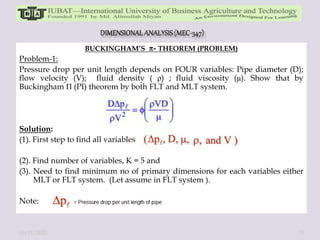
Problem-1:
Pressure drop per unit length depends on FOUR variables: Pipe diameter (D);
flow velocity (V); fluid density ( ρ) ; fluid viscosity (μ). Show that by
Buckingham П (PI) theorem by both FLT and MLT system.
Solution:
(1). First step to find all variables
(2). Find number of variables, K = 5 and
(3). Need to find minimum no of primary dimensions for each variables either
MLT or FLT system. (Let assume in FLT system ).
Note:
10/11/2022 33
BUCKINGHAM’S - THEOREM (PROBLEM)
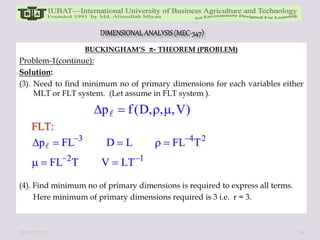
Problem-1(continue):
Solution:
(3). Need to find minimum no of primary dimensions for each variables either
MLT or FLT system. (Let assume in FLT system ).
(4). Find minimum no of primary dimensions is required to express all terms.
Here minimum of primary dimensions required is 3 i.e. r = 3.
10/11/2022 34
BUCKINGHAM’S - THEOREM (PROBLEM)
Problem-1(continue):
Solution:
(4). Find minimum no of primary dimensions is required to express all terms.
Here minimum of primary dimensions required is 3 i.e. r = 3.
(5). Number of П (PI) terms will be k-r = 5-3 = 2. So we need two П terms.
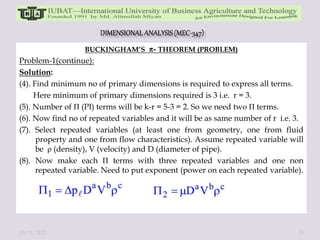
(6). Now find no of repeated variables and it will be as same number of r i.e. 3.
(7). Select repeated variables (at least one from geometry, one from fluid
property and one from flow characteristics). Assume repeated variable will
be ρ (density), V (velocity) and D (diameter of pipe).
(8). Now make each П terms with three repeated variables and one non
repeated variable. Need to put exponent (power on each repeated variable).
10/11/2022 35
BUCKINGHAM’S - THEOREM (PROBLEM)
Problem-1(continue):
Solution:
(8). Now make each П terms with three repeated variables and one non
repeated variable. Need to put exponent (power on each repeated variable).
(9). Substitute FLT for each variable in each П equation and find value of a, b , c.
Substitute value of a, b, c
in first equation:
10/11/2022 36
BUCKINGHAM’S - THEOREM (PROBLEM)
Problem-1(continue):
Solution:
(9).
(10). Check each П term to make sure , we didn’t make any mistake. Each П
term should dimensionless.
(11). Finally find expression by using formula
Substitute value of a, b, c
in second equation:
10/11/2022 37
BUCKINGHAM’S - THEOREM (PROBLEM)
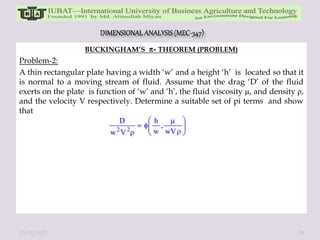
Problem-2:
A thin rectangular plate having a width ‘w’ and a height ‘h’ is located so that it
is normal to a moving stream of fluid. Assume that the drag ‘D’ of the fluid
exerts on the plate is function of ‘w’ and ‘h’, the fluid viscosity µ, and density ρ,
and the velocity V respectively. Determine a suitable set of pi terms and show
that
10/11/2022 38
BUCKINGHAM’S - THEOREM (PROBLEM)
(Home Work/Assignment-1):
Prove that the discharge over a spillway is given by the relation:
Where V = Velocity of flow, D = Depth at the throat, H = Head of water and
g = Acceleration due to gravity.
10/11/2022 39
BUCKINGHAM’S - THEOREM (PROBLEM)
Home Work -2 / Assignment:
An open cylindrical tank having a diameter D is supported around its bottom
circumference and is filled with liquid up to a depth h, liquid having a specific
weight γ. The vertical deflection δ of the cylinder at the bottom center is
function of D, h, d, γ, and E, where d is the thickness of cylinder at bottom and
E is the modulus of elasticity of cylinder material.
Find (a). all П terms by Buckingham П (PI) theorem in both MLT and FLT
system; and (b). Find suitable expression of deflection δ .
10/11/2022 40

dimensional_analysis.pptx

  • 1.
    OBJECTIVE Develop a betterunderstanding of dimensions, units, and dimensional homogeneity of equations. Understand the numerous benefits of dimensional analysis. Know how to use the method of repeating variables to identify non-dimensional parameters. Understand the concept of dynamic similarity and how to apply it to experimental modelling. 10/11/2022 1
  • 2.
    Dimension: A measureof a physical quantity (without numerical values). Unit: A way to assign a number to that dimension. 10/11/2022 2
  • 3.
    Fundamental Dimension: Thereare seven primary dimensions (also called fundamental or basic dimensions): mass, length, time, temperature, electric current, amount of light, and amount of matter. There is no direct relationship between these dimensions, therefore they are called fundamental dimensions or fundamental quantities. There are two systems for fundamental dimensions namely MLT (i.e. Mass, Length and Time) and FLT (i.e. Force, Length and Time). (Most of engineer prefer to use MLT system instead of FLT system. we will use MLT system in most cases). Derived Dimensions: All non-primary dimensions can be formed by some combination of the seven primary dimensions; thus they are called derived dimensions, derived quantities or secondary quantities. Such as velocity, force and volume etc. 10/11/2022 3
  • 4.
  • 5.
  • 6.
  • 7.
  • 8.
    The law ofdimensional homogeneity: Every additive term in an equation must have the same dimensions. An equation is called dimensionally homogeneous, if the fundamental dimensions have identical powers of M-L-T or FLT on both sides of the equation. Example: 10/11/2022 8
  • 9.
  • 10.
  • 11.
  • 12.
  • 13.
    VARIABLES, PARAMETER ANDCONSTANT 10/11/2022 13
  • 14.
    DIMENSIONAL ANALYSIS Dimensional analysisis a mathematical technique, which deals with the dimensions of the physical quantities involved in the phenomenon. It helps to determine how variables are related and the phenomenon can be expressed by a dimensionally homogeneous equation with certain variables. (Dimensional analysis is a method for reducing the number and complexity of experimental variables that affect a given physical phenomena.) Dimensional analysis alone does not give the exact form of an equation, but it can lead to a significant reduction of the number of variables. It is based on two assumptions:  Physical quantities have dimensions (fundamental are mass M, length L, and time T). Any physical quantity has a dimension which is a product of powers of the basic dimensions M, L and T.  Physical laws are unaltered when changing the units measuring the dimensions. 10/11/2022 14
  • 15.
    WHY DIMENSIONAL ANALYSIS?? Advantageof Dimensional analysis:  Reduce the number of variables by forming non-dimensional parameter.  Non‐dimensional equations which provides insight on controlling parameters and the nature of the problem.  By Scaling laws it is allow to test models instead of expensive full‐scale prototypes.  Bring simplicity of complex analytic phenomenon. Disadvantage: Error in the model analysis leads to predict inaccurate and poor performance of the prototype. Example: Find the pressure drop per unit length that develops along the pipe as a result of friction of a incompressible Newtonian fluid, is flowing steadily through a long, smooth- walled, horizontal and circular pipe. Since designing a pipeline, the first step in the planning of an experiment is to study this problem and the factors, or variables, that will have an effect on the pressure drop. 10/11/2022 15
  • 16.
    WHY DIMENSIONAL ANALYSIS?? Solution:Pressure drop per unit length depends on 4 variables: Pipe Diameter (D); Fluid Velocity (V); fluid density (ρ); fluid viscosity (µ).  To perform the experiments in a meaningful and systematic manner, it would be necessary to change one of the variable, such as the velocity, and holding all other constant, then measure the corresponding pressure drop.  It is difficult to determine the functional relationship between the pressure drop and the various facts that influence it. 10/11/2022 16
  • 17.
    WHY DIMENSIONAL ANALYSIS??(CONTINUE)  Fortunately, there is a much simpler approach to the problem that will eliminate the difficulties described above.  Collecting these variables into two non-dimensional combinations of the variables (called dimensionless product or dimensionless groups). Only one dependent and one independent variable. Easy to set up experiments to determine dependency. Easy to present results (one graph). 10/11/2022 17
  • 18.
    WHY DIMENSIONAL ANALYSIS??(CONTINUE) 10/11/2022 18
  • 19.
    EXAMPLE OF DIMENSIONALANALYSIS IN REAL WORLD 10/11/2022 19
  • 20.
    EXAMPLE OF DIMENSIONALANALYSIS IN REAL WORLD 10/11/2022 20
  • 21.
    EXAMPLE OF DIMENSIONALANALYSIS IN REAL WORLD 10/11/2022 21
  • 22.
    EXAMPLE OF DIMENSIONALANALYSIS IN REAL WORLD 10/11/2022 22
  • 23.
    METHOD OF DIMENSIONALANLAYSIS The following two methods of dimensional analysis are important from the subject point of view: 1) Rayleigh’s Method and 2) Buckingham’s - theorem Rayleigh’s Method: In this method the functional relationship of some variables is expressed in the form of an exponential equation, which must be dimensionally homogenous. If ‘Y’ is function of independent variables X1, X2, X3 . . . etc then functional relationship may be written as Y = f (X1, X2, X3 ......) Steps: 1) Write the functional relationship with all given data. 2) Write equation in terms of constant with exponents (i.e. Power) a, b, c..... 3) Find the value of a, b, c... With the help of dimensional homogeneity. 4) Substitute the values of the exponents in the main equation and simplify it. 10/11/2022 23
  • 24.
    PROBLEMS (Rayleigh’s Method) Problem-1:Show that the resistance ‘R’ to the motion of a sphere of diameter ‘D’ is moving with a uniform velocity ‘V’ through a real fluid having mass density ‘ρ’ and viscosity ‘μ’ is given by 10/11/2022 24
  • 25.
    UNIT OF FORCE,VELOCITY, ENERGY ETC 10/11/2022 25
  • 26.
    UNIT OF FORCE,VELOCITY, ENERGY ETC 10/11/2022 26
  • 27.
    PROBLEMS (Rayleigh’s Method) Problem-2:The thrust (P) of a propeller depends upon the diameter (D), speed (V), mass density (ρ), revolution per minute (N) and coefficient of viscosity (μ), show that 10/11/2022 27
  • 28.
    PROBLEMS (Rayleigh’s Method) Problem-3:Show by the dimensional analysis, that the power P developed by a hydraulic turbine is given by Where ρ is the mass density of liquid, N is the rotational speed of the turbine in r.p.m, D is the diameter of runner, H is the working head and g is the gravitational acceleration. 10/11/2022 28
  • 29.
    BUCKINGHAM’S - THEOREM Buckingham’s-Theorem: If an equation involving k variables is dimensionally homogeneous, it can be reduced to a relationship among k-r independent dimensionless products, where r is the minimum number of reference or primary dimensions required to describe the variables. Given a physical problem in which the dependent variable is a function of k-1 numbers of independent variables. u1 = f (u2 , u3 ,....., uk ) Mathematically, we can express the functional relationship in the equivalent form g(u1, u2 , u3 ,....., uk ) = 0 ; where g is an unspecified function different from ‘f’. The Buckingham Pi theorem states that: Given a relation among k variables of the form g(u1, u2 , u3 ,....., uk ) = 0 The k variables may be grouped into k-r independent dimensionless products, or Π terms, expressible in functional form by 10/11/2022 29
  • 30.
    BUCKINGHAM’S - THEOREM Buckingham’s-Theorem (continue): The number r is usually (but not always) equal to the minimum number of independent dimensions required to specify the dimensions of all the parameters. Usually the reference dimensions required to describe the variables will be the basic dimensions M, L, and T or F, L, and T. The theorem does not predict the functional form of ϕ . The functional relation among the independent dimensionless products Π must be determined experimentally. The k-r dimensionless products Π terms obtained from the procedure are independent. A Π term is not independent if it can be obtained from a product or quotient of the other dimensionless products (or Π term ) of the problem. For example, if then neither Π5 nor Π6 is independent of the other dimensionless products or dimensionless groups. 10/11/2022 30
  • 31.
    BUCKINGHAM’S - THEOREM Stepsto Find PI ( ) Terms: 1. List all the variables: Assume ‘k’ is the number of variables in the problem or phenomenon. 2. Express each of the variables in terms of basic dimensions. Find the minimum number of reference dimensions or primary dimension. Assume ‘r’ is the minimum number of primary dimensions in MLT or FLT system. 3. Determine the required number of ‘ ’ (PI) term. The number of ‘ ’ (PI) term will be ‘k-r’ . 4. Select a number of repeating variables, where the number required is equal to the number of reference dimensions. Then select a set of r dimensional variables that includes all the primary dimensions ( repeating variables) . These repeating variables will all be combined with each (or one) of the remaining parameters. No repeating variables should have dimensions that are power of the dimensions of another repeating variable. Normally, one from geometry, one from fluid property and one from flow characteristics. 10/11/2022 31
  • 32.
    BUCKINGHAM’S - THEOREM Stepsto Find PI ( ) Terms: 5. Form a pi term by multiplying one of the non-repeating variables by the product of the repeating variables, each raised to an exponent that will make the combination dimensionless. There will be k –r equations for (PI) terms. 6. Check all the resulting (PI) terms to make sure they are dimensionless. 7. Express the final form as a relationship among the (PI) terms, and think about what is means. Express the result of the dimensional analysis. 10/11/2022 32
  • 33.
    BUCKINGHAM’S - THEOREM(PROBLEM) Problem-1: Pressure drop per unit length depends on FOUR variables: Pipe diameter (D); flow velocity (V); fluid density ( ρ) ; fluid viscosity (μ). Show that by Buckingham П (PI) theorem by both FLT and MLT system. Solution: (1). First step to find all variables (2). Find number of variables, K = 5 and (3). Need to find minimum no of primary dimensions for each variables either MLT or FLT system. (Let assume in FLT system ). Note: 10/11/2022 33
  • 34.
    BUCKINGHAM’S - THEOREM(PROBLEM) Problem-1(continue): Solution: (3). Need to find minimum no of primary dimensions for each variables either MLT or FLT system. (Let assume in FLT system ). (4). Find minimum no of primary dimensions is required to express all terms. Here minimum of primary dimensions required is 3 i.e. r = 3. 10/11/2022 34
  • 35.
    BUCKINGHAM’S - THEOREM(PROBLEM) Problem-1(continue): Solution: (4). Find minimum no of primary dimensions is required to express all terms. Here minimum of primary dimensions required is 3 i.e. r = 3. (5). Number of П (PI) terms will be k-r = 5-3 = 2. So we need two П terms. (6). Now find no of repeated variables and it will be as same number of r i.e. 3. (7). Select repeated variables (at least one from geometry, one from fluid property and one from flow characteristics). Assume repeated variable will be ρ (density), V (velocity) and D (diameter of pipe). (8). Now make each П terms with three repeated variables and one non repeated variable. Need to put exponent (power on each repeated variable). 10/11/2022 35
  • 36.
    BUCKINGHAM’S - THEOREM(PROBLEM) Problem-1(continue): Solution: (8). Now make each П terms with three repeated variables and one non repeated variable. Need to put exponent (power on each repeated variable). (9). Substitute FLT for each variable in each П equation and find value of a, b , c. Substitute value of a, b, c in first equation: 10/11/2022 36
  • 37.
    BUCKINGHAM’S - THEOREM(PROBLEM) Problem-1(continue): Solution: (9). (10). Check each П term to make sure , we didn’t make any mistake. Each П term should dimensionless. (11). Finally find expression by using formula Substitute value of a, b, c in second equation: 10/11/2022 37
  • 38.
    BUCKINGHAM’S - THEOREM(PROBLEM) Problem-2: A thin rectangular plate having a width ‘w’ and a height ‘h’ is located so that it is normal to a moving stream of fluid. Assume that the drag ‘D’ of the fluid exerts on the plate is function of ‘w’ and ‘h’, the fluid viscosity µ, and density ρ, and the velocity V respectively. Determine a suitable set of pi terms and show that 10/11/2022 38
  • 39.
    BUCKINGHAM’S - THEOREM(PROBLEM) (Home Work/Assignment-1): Prove that the discharge over a spillway is given by the relation: Where V = Velocity of flow, D = Depth at the throat, H = Head of water and g = Acceleration due to gravity. 10/11/2022 39
  • 40.
    BUCKINGHAM’S - THEOREM(PROBLEM) Home Work -2 / Assignment: An open cylindrical tank having a diameter D is supported around its bottom circumference and is filled with liquid up to a depth h, liquid having a specific weight γ. The vertical deflection δ of the cylinder at the bottom center is function of D, h, d, γ, and E, where d is the thickness of cylinder at bottom and E is the modulus of elasticity of cylinder material. Find (a). all П terms by Buckingham П (PI) theorem in both MLT and FLT system; and (b). Find suitable expression of deflection δ . 10/11/2022 40