Reverse Engineering
Protecting and Breaking the Software
Satria Ady Pradana
https://xathrya.id
Reversing.ID
Revealing the Truth through Breaking Things
# Whoami?
 Cyber Security Consultant at Mitra Integrasi Informatika (MII)
 Researcher at dracOs Dev Team
 Coordinator of Reversing.ID
 Member of Indonesia Honeynet Project
Disclaimer
 This presentation is intended for educational purposes only.
 Reverse engineering of copyrighted material is illegal an might
cause you a direct or indirect consequence. We have no
responsibility of anything you do after learning this.
Today’s Adventure
 Fundamental of Reverse Engineering
 Basic Principle
 Tools
 Common Practice
 Common Protection
Revealing the Reversing
What, Why, and How?
The Term
 Originally used in the context of mechanical engineering
 Breaks down an existing object or system to its construction
and then rebuild it based on new demand.
 Extracting knowledge or design information from anything man-
mad and reproducing it or reproduce anything based on the
extracted information.
What it Means?
 Take things apart to figure out how it works
 Solving puzzle
 Constantly learn new things
 Thinking out of the box
Motivation
 Interfacing
 Improve documentation shortcomings
 Bug Fixing
 Creation of unlicensed duplicates
 Repurposing
 Finding security bugs
 For fun!
The Yin Yang
 Reverse engineer and developer compete each other.
 Developer want to protect their intellectual property
 Reverse engineer want to break the protection.
 Who will win?
Too Broad
 Software
 Hardware
 Radio Frequency
 Protocol
Limit ourselves to reverse engineering for code and data.
Success Story
Success Story
BIOS
Fundamental Principle
 Comprehension
 Gain knowledge of basic principle or mechanics of object, the
behavior, and knowledge that might related to subject.
 Decomposition
 Breaking down the system into its structure and gain insight about
inherent structure and properties of the component that make the
system.
 Reconstruction
 Reform or reconstruct the components based on need.
Common Practice
Some popular and commonly used practice or operation
 Resource Modification (Modding)
 Control Flow Bypass
 Code Caving
Resource Modification (Modding)
 Modify the resource of application
 Icon
 Menu
 Layout
 Sprite
Control Flow Bypass
 Alter program flow
 Force program to takes (or leaves) intended action.
 Jump over the protection mechanism
Code Caving
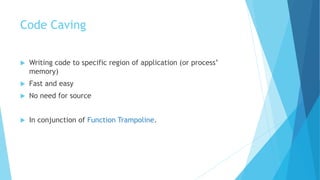
 Writing code to specific region of application (or process’
memory)
 Fast and easy
 No need for source
 In conjunction of Function Trampoline.
Basic Knowledge
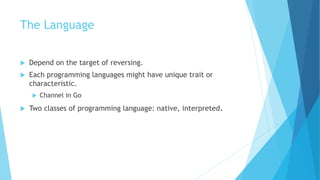
The Language
 Depend on the target of reversing.
 Each programming languages might have unique trait or
characteristic.
 Channel in Go
 Two classes of programming language: native, interpreted.
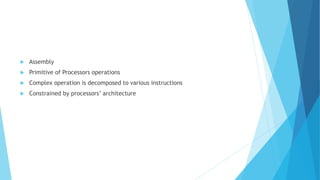
 Assembly
 Primitive of Processors operations
 Complex operation is decomposed to various instructions
 Constrained by processors’ architecture
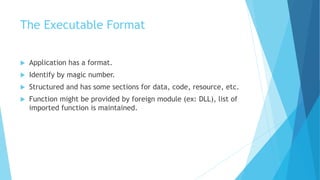
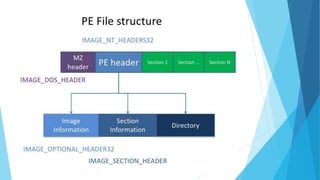
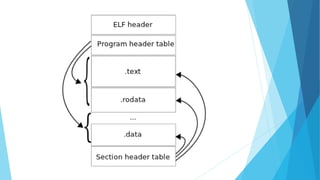
The Executable Format
 Application has a format.
 Identify by magic number.
 Structured and has some sections for data, code, resource, etc.
 Function might be provided by foreign module (ex: DLL), list of
imported function is maintained.
Design Pattern
 Software is divided into conceptual module and working
together.
 Repeatable solution to a commonly occurring problem in a
software design.
Common Code Base
 Library
 Framework
Common Tools
Breaking the system to fine-grain components
 Hex Editor
 Disassembler
 Debugger
 Resource Editor
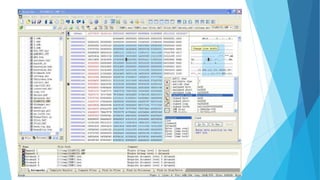
Hex Editor
 Display the content of file as collection of hex formatted-data and modify
part of them.
 Find pattern and occurrence.
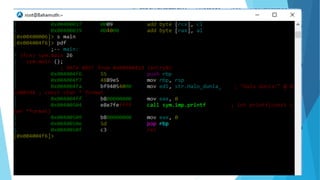
Disassembler
 Transform stream of hex bytes to its assembly representation.
 Resolve data and resource, referred by the code.
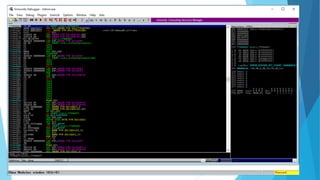
Debugger
 Test or debug other (target) program
 Examine program condition at runtime.
 Modify code or data section.
 Modify CPU state
 Alter control flow
Comprehension
Gaining the knowledge related to the target
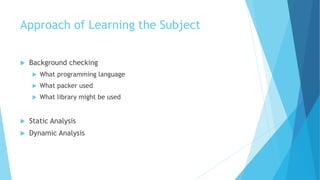
Approach of Learning the Subject
 Background checking
 What programming language
 What packer used
 What library might be used
 Static Analysis
 Dynamic Analysis
Decomposition
Breaking the structure of system to its fine-grained components
 Get the global view of program flows
 Graph
 Grouping
Reconstruction
Creating the system based on the extracted knowledge
 anything
Common Protection
 Obfuscation
 Self debug
 Section Corruption
 Packer
 Encryption
 Virtual Machine
Advance Stuffs

 Dynamic Binary Instrumentation
 Symbolic Execution
References
 http://www.openrce.org/articles/
 http://vxheaven.org/
 https://www.reddit.com/r/reverseengineering

Reverse Engineering: Protecting and Breaking the Software