Retreating
Tayyaba
BEDF19M015
Topics To be covered
Introduction
Defining the retreat phase: reviewing and recharging
From advance to retreat
Retreating in order to rest
Retreating to get feedback from others
Exercises in retreating from your writing
Checklist and strategy for retreating from your writing
Summary
Introduction
This chapter presents the importance of retreating or
stepping back from your academic writing.
It provides guidance about how to prepare to engage in
this less active, more reflective, objective, detached
mode.
this is an essential phase of the academic writing process.
It will also highlight the importance of balancing regular
and successive phases of progress and revision.
Defining the retreat phase:
reviewing and recharging
THERE ARE THREE IMPORTANT DIMENSIONS OF THE RETREAT PHASE
OF ACADEMIC WRITING.
THE FIRST IS THE IMPORTANT NEED TO RELAX AND REST FROM
WRITING TASKS
THE SECOND DIMENSION IS THAT OF RE-EVALUATION, AN ACTIVITY
THAT NECESSARILY REQUIRES REVISITING, GETTING FEEDBACK AND
LISTENING TO OTHER PEOPLE’S VIEWS ON WHAT YOU HAVE WRITTEN.
THE THIRD DIMENSION IS GETTING READY FOR ANOTHER PHASE OF
ADVANCE.
From advance to retreat
Rewriting and revisiting one’s writing is not an admission of failure, nor should it be a
depressing raking over the coals of one’s inadequacies.
Re-evaluating your writing, preferably after a period of rest and detachment, is a positive and
almost definitely a necessary phase in all your writing projects (Zinsser, 1980; Levine, 2004).
In the writing sessions that it is observed as facilitators of academic writing, often struck by
how quickly and fluently self-confessed non-writers or blocked writers start to write.
Slowing down is just as important as speeding up.
Retreating in
order to rest
1. There does come a stage in academic
writing tasks when constant, relentless
engagement in your writing is simply
unproductive.
2. This stage encourage you to nurture the
skill of switching off completely
3. Productive, successful writers, and those
who derive more pleasure out of writing.
4. We need strategies for taking our breaks.
5. Turk and Kirkman (1998) advise: ‘try to
leave [your writing] for a few days, or at
least overnight . . .
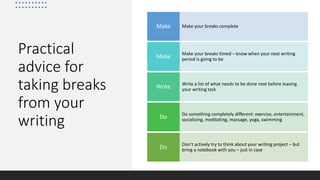
Practical
advice for
taking breaks
from your
writing
Make your breaks completeMake
Make your breaks timed – know when your next writing
period is going to beMake
Write a list of what needs to be done next before leaving
your writing taskWrite
Do something completely different: exercise, entertainment,
socializing, meditating, massage, yoga, swimmingDo
Don’t actively try to think about your writing project – but
bring a notebook with you – just in caseDo
Retreating to get
feedback from others
• At least as important as rest and
detachment is the dimension of retreat that
involves getting feedback from others.
• The psychology of negative feedback
• The psychology of positive feedback
• Potential blocks to effective feedback
• Functional approaches to getting feedback
on your writing
Functional
approaches to
getting
feedback on
your writing
• Understanding the importance of audience
• The beauty of criticism
• The utility of receptivity: becoming a receptive
listener
• Staying in charge
• A focus on professional development and
learning
• Letting other people play a role in your writing
• Coping with unhelpful or destructive feedback
Setting up writing partnerships
and some guidelines for providing
effective feedback
• find someone who is prepared to spend
time getting involved in thoughtful
dialogue about your writing.
Exercises in
retreating
from your
writing
Contextualizing your work to
enhance the feedback process
Deciding on the feedback you
want
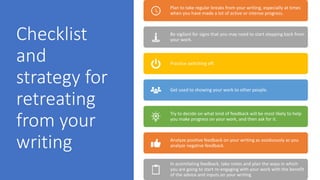
Checklist
and
strategy for
retreating
from your
writing
Plan to take regular breaks from your writing, especially at times
when you have made a lot of active or intense progress.
Be vigilant for signs that you may need to start stepping back from
your work.
Practice switching off.
Get used to showing your work to other people.
Try to decide on what kind of feedback will be most likely to help
you make progress on your work, and then ask for it.
Analyze positive feedback on your writing as assiduously as you
analyze negative feedback.
In assimilating feedback, take notes and plan the ways in which
you are going to start re-engaging with your work with the benefit
of the advice and inputs on your writing
Summary

Retreating your writing

  • 1.
  • 2.
    Topics To becovered Introduction Defining the retreat phase: reviewing and recharging From advance to retreat Retreating in order to rest Retreating to get feedback from others Exercises in retreating from your writing Checklist and strategy for retreating from your writing Summary
  • 3.
    Introduction This chapter presentsthe importance of retreating or stepping back from your academic writing. It provides guidance about how to prepare to engage in this less active, more reflective, objective, detached mode. this is an essential phase of the academic writing process. It will also highlight the importance of balancing regular and successive phases of progress and revision.
  • 4.
    Defining the retreatphase: reviewing and recharging THERE ARE THREE IMPORTANT DIMENSIONS OF THE RETREAT PHASE OF ACADEMIC WRITING. THE FIRST IS THE IMPORTANT NEED TO RELAX AND REST FROM WRITING TASKS THE SECOND DIMENSION IS THAT OF RE-EVALUATION, AN ACTIVITY THAT NECESSARILY REQUIRES REVISITING, GETTING FEEDBACK AND LISTENING TO OTHER PEOPLE’S VIEWS ON WHAT YOU HAVE WRITTEN. THE THIRD DIMENSION IS GETTING READY FOR ANOTHER PHASE OF ADVANCE.
  • 5.
    From advance toretreat Rewriting and revisiting one’s writing is not an admission of failure, nor should it be a depressing raking over the coals of one’s inadequacies. Re-evaluating your writing, preferably after a period of rest and detachment, is a positive and almost definitely a necessary phase in all your writing projects (Zinsser, 1980; Levine, 2004). In the writing sessions that it is observed as facilitators of academic writing, often struck by how quickly and fluently self-confessed non-writers or blocked writers start to write. Slowing down is just as important as speeding up.
  • 6.
    Retreating in order torest 1. There does come a stage in academic writing tasks when constant, relentless engagement in your writing is simply unproductive. 2. This stage encourage you to nurture the skill of switching off completely 3. Productive, successful writers, and those who derive more pleasure out of writing. 4. We need strategies for taking our breaks. 5. Turk and Kirkman (1998) advise: ‘try to leave [your writing] for a few days, or at least overnight . . .
  • 7.
    Practical advice for taking breaks fromyour writing Make your breaks completeMake Make your breaks timed – know when your next writing period is going to beMake Write a list of what needs to be done next before leaving your writing taskWrite Do something completely different: exercise, entertainment, socializing, meditating, massage, yoga, swimmingDo Don’t actively try to think about your writing project – but bring a notebook with you – just in caseDo
  • 8.
    Retreating to get feedbackfrom others • At least as important as rest and detachment is the dimension of retreat that involves getting feedback from others. • The psychology of negative feedback • The psychology of positive feedback • Potential blocks to effective feedback • Functional approaches to getting feedback on your writing
  • 9.
    Functional approaches to getting feedback on yourwriting • Understanding the importance of audience • The beauty of criticism • The utility of receptivity: becoming a receptive listener • Staying in charge • A focus on professional development and learning • Letting other people play a role in your writing • Coping with unhelpful or destructive feedback
  • 10.
    Setting up writingpartnerships and some guidelines for providing effective feedback • find someone who is prepared to spend time getting involved in thoughtful dialogue about your writing.
  • 11.
    Exercises in retreating from your writing Contextualizingyour work to enhance the feedback process Deciding on the feedback you want
  • 12.
    Checklist and strategy for retreating from your writing Planto take regular breaks from your writing, especially at times when you have made a lot of active or intense progress. Be vigilant for signs that you may need to start stepping back from your work. Practice switching off. Get used to showing your work to other people. Try to decide on what kind of feedback will be most likely to help you make progress on your work, and then ask for it. Analyze positive feedback on your writing as assiduously as you analyze negative feedback. In assimilating feedback, take notes and plan the ways in which you are going to start re-engaging with your work with the benefit of the advice and inputs on your writing
  • 13.