From guilty pleasure to
legitimate activity:
the structured writing retreat
@solentlearning
@tansyjtweets
Workshop outline
1. Why a writing retreat
2. Why write? Why publish? Why research?
3. Writing for academic journals
4. Mapping your writing identity
5. Academic writing strategies.
6. Improving the quality of your writing
Why a writing retreat
•Time and place for concentrated writing
•Imaginative space
•Social space
•Writing as community of practice
Academic writing can be exhilarating, or quietly pleasurable,
or plain hard work. In common with our students, it is
something we – academics – must do, usually alone.
Sometimes we may feel ourselves resisting the imperative to
write; at other times we may experience the frustration of
planning to write yet never quite getting there. So much
seems to come between us and our writing.
(Grant 2006, 483)
Why write? Why publish?
1. This is what we do.
2. Thinking happens when we write.
3. It vivifies our teaching; it makes it cutting edge.
4. It enables us to share our discoveries.
5. ‘Mastery’ comes out of the furnace of writing.
6. Writing arises from our research.
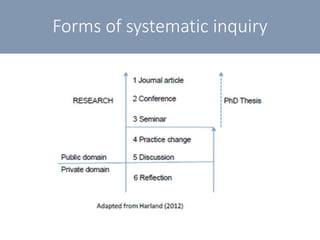
Forms of systematic inquiry
Why do research?
Learning
1) Own learning
2) Colleagues’ learning
3) Students’ learning
4) Contributing to knowledge field – reader’s learning
5) Something useful for society.
Employment
Getting and keeping a job, ensuring a career – promotion
and future mobility
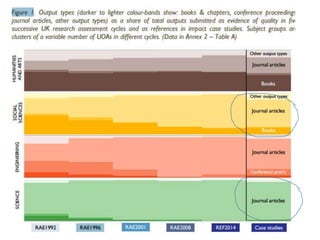
Journals are #1 currency
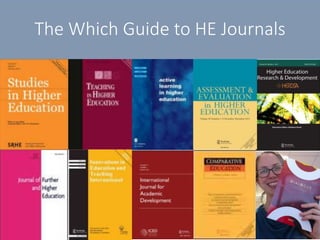
The Which Guide to HE Journals
Activity 1
What makes a good journal article?
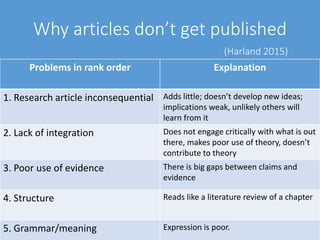
Why articles don’t get published
(Harland 2015)
Problems in rank order Explanation
1. Research article inconsequential Adds little; doesn’t develop new ideas;
implications weak, unlikely others will
learn from it
2. Lack of integration Does not engage critically with what is out
there, makes poor use of theory, doesn’t
contribute to theory
3. Poor use of evidence There is big gaps between claims and
evidence
4. Structure Reads like a literature review of a chapter
5. Grammar/meaning Expression is poor.
Activity 2
List what should be included in the abstract of
a journal article
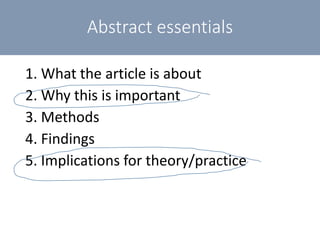
Abstract essentials
1. What the article is about
2. Why this is important
3. Methods
4. Findings
5. Implications for theory/practice
Mapping your writing identity
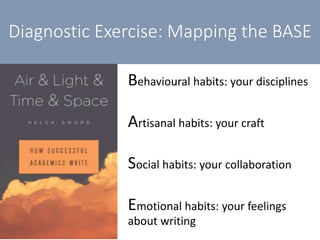
Diagnostic Exercise: Mapping the BASE
Behavioural habits: your disciplines
Artisanal habits: your craft
Social habits: your collaboration
Emotional habits: your feelings
about writing
Behavioural habits
Binge or daily grind…
The evidence is compelling
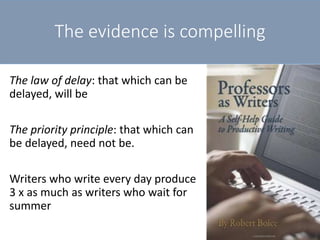
The law of delay: that which can be
delayed, will be
The priority principle: that which can
be delayed, need not be.
Writers who write every day produce
3 x as much as writers who wait for
summer
Writing strategies
1. Momentum – always write
2. Perfectionism - shut down the censor, free write?
3. Perfectionism - do not try out drafts on journal referees
4. Good writing is difficult – accept this proposition
5. Elaborate rituals are unhealthy
6. Resilience and realism in the face of high rejection rates
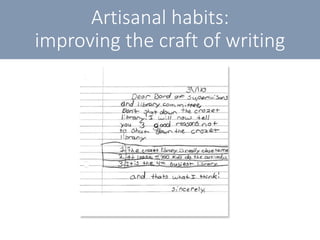
Artisanal habits:
improving the craft of writing
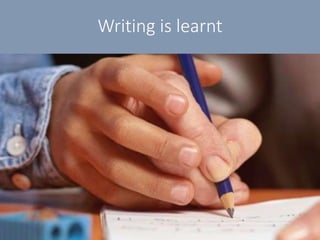
Writing is learnt
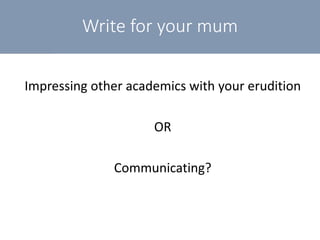
Impressing other academics with your erudition
OR
Communicating?
Write for your mum
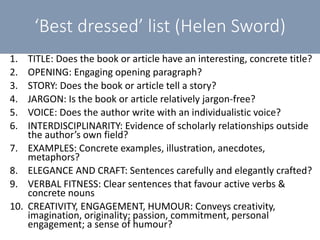
1. TITLE: Does the book or article have an interesting, concrete title?
2. OPENING: Engaging opening paragraph?
3. STORY: Does the book or article tell a story?
4. JARGON: Is the book or article relatively jargon-free?
5. VOICE: Does the author write with an individualistic voice?
6. INTERDISCIPLINARITY: Evidence of scholarly relationships outside
the author’s own field?
7. EXAMPLES: Concrete examples, illustration, anecdotes,
metaphors?
8. ELEGANCE AND CRAFT: Sentences carefully and elegantly crafted?
9. VERBAL FITNESS: Clear sentences that favour active verbs &
concrete nouns
10. CREATIVITY, ENGAGEMENT, HUMOUR: Conveys creativity,
imagination, originality; passion, commitment, personal
engagement; a sense of humour?
‘Best dressed’ list (Helen Sword)
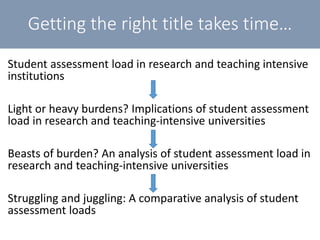
Getting the right title takes time…
Student assessment load in research and teaching intensive
institutions
Light or heavy burdens? Implications of student assessment
load in research and teaching-intensive universities
Beasts of burden? An analysis of student assessment load in
research and teaching-intensive universities
Struggling and juggling: A comparative analysis of student
assessment loads
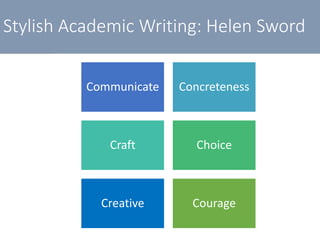
Communicate Concreteness
Craft Choice
Creative Courage
Stylish Academic Writing: Helen Sword
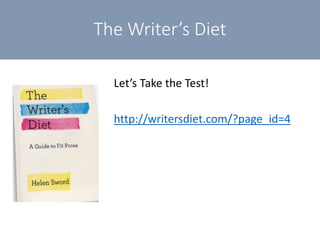
The Writer’s Diet
Let’s Take the Test!
http://writersdiet.com/?page_id=4
This paper describes a process of analysis and the development of representational
strategies in a narrative study. It takes the reader through the often hidden steps
involved in doing research, and unveils some of the problematics of narrative and
voice. Within the context of rural post-Apartheid South Africa, the researchers were
positioned as outsiders, bordercrossing into the lives of the researched, in the
name of articulating their voices. The ethical dilemmas of this kind of research are
examined, as is the perspective that the researcher is positioned, not as an
objective, all-seeing eye, but as a re-presenter from 'somewhere'. The heart of the
paper analyses the development of different strategies of analysis, including poetry
and various mapping, graphic and matrix techniques. Representational models are
developed progressively, in response to the dilemmas and complexities of re-telling
'a' story, and the particular challenge of capturing the contradictory, partial and
fluid nature of each teacher's story. The research process culminates in a model
which allows for a reading of each narrative as complex, nuanced and intrinsically
ambivalent. Against the backdrop of a wider study of teacher narratives (on which
this paper is based) and the policy context of education, some conclusions about
the implications of narrative study for teacher development in South Africa are
drawn.
Jessop, T. and Penny, A. 1999. A story behind a story: Developing strategies for
making sense of teacher narratives. International Journal of Social Research
Methodology 2 (3). 213-230.
Evidence from 73 programmes in 14 U.K universities sheds light on the typical
student experience of assessment over a three-year undergraduate degree. A
previous small-scale study in three universities characterised programme
assessment environments using a similar method. The current study analyses data
about assessment patterns using descriptive statistical methods, drawing on a
large sample in a wider range of universities than the original study. Findings
demonstrate a wide range of practice across programmes: from 12 summative
assessments on one programme to 227 on another; from 87% by examination to
none on others. While variations cast doubt on the comparability of U.K degrees,
programme assessment patterns are complex. Further analysis distinguishes
common assessment patterns across the sample. Typically, students encounter
eight times as much summative as formative assessment, a dozen different types
of assessment, more than three quarters by coursework. The presence of high
summative and low formative assessment diets is likely to compound students’
grade orientation, reinforcing narrow and instrumental approaches to learning.
High varieties of assessment are probable contributors to student confusion about
goals and standards. Making systematic headway to improve student learning from
assessment requires a programmatic and evidence-led approach to design,
characterised by dialogue and social practice.
Jessop, T and Tomas, C. 2016. The implications of programme assessment patterns
for student learning, Assessment and Evaluation in Higher Education. Published
online 2 August 2016.
How to improve your writing
• Read it aloud
• Read books on how to improve writing (Becker;
Sword; Murray)
• Draft. Edit. Redraft. Edit. Redraft. Persevere.
• Read articles in target journal
• Get trusty critical friends to read your work
Social habits
…vacating the solitude of the garret and moving
into the house of many rooms
Virginia Woolf (1942) Professions for women
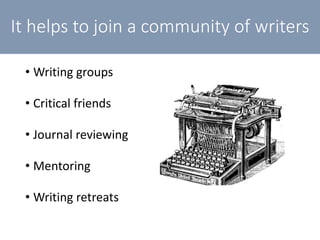
It helps to join a community of writers
• Writing groups
• Critical friends
• Journal reviewing
• Mentoring
• Writing retreats
Emotional habits
• Good feelings from spending time doing it rather
than feeling guilty about not doing it
• Create space: deploy the priority principle
• Success builds confidence, confidence builds feel
good factor
• Being part of a community of writers, sharing
struggles and joys
Final thoughts
• Writing is an important part of an academic’s job
• Writing is a difficult skill to master
• Writing lifts the quality of our thinking and vivifies
our teaching
• Learning to write is an unfinished project
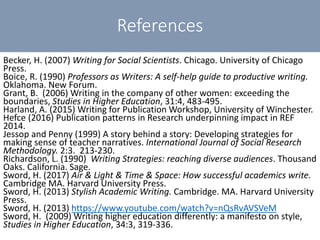
Planning your writing:
one bite at a time
References
Becker, H. (2007) Writing for Social Scientists. Chicago. University of Chicago
Press.
Boice, R. (1990) Professors as Writers: A self-help guide to productive writing.
Oklahoma. New Forum.
Grant, B. (2006) Writing in the company of other women: exceeding the
boundaries, Studies in Higher Education, 31:4, 483-495.
Harland, A. (2015) Writing for Publication Workshop, University of Winchester.
Hefce (2016) Publication patterns in Research underpinning impact in REF
2014.
Jessop and Penny (1999) A story behind a story: Developing strategies for
making sense of teacher narratives. International Journal of Social Research
Methodology. 2:3. 213-230.
Richardson, L. (1990) Writing Strategies: reaching diverse audiences. Thousand
Oaks. California. Sage.
Sword, H. (2017) Air & Light & Time & Space: How successful academics write.
Cambridge MA. Harvard University Press.
Sword, H. (2013) Stylish Academic Writing. Cambridge. MA. Harvard University
Press.
Sword, H. (2013) https://www.youtube.com/watch?v=nQsRvAVSVeM
Sword, H. (2009) Writing higher education differently: a manifesto on style,
Studies in Higher Education, 34:3, 319-336.

Guilty pleasure vs legitimate activity

  • 1.
    From guilty pleasureto legitimate activity: the structured writing retreat @solentlearning @tansyjtweets
  • 2.
    Workshop outline 1. Whya writing retreat 2. Why write? Why publish? Why research? 3. Writing for academic journals 4. Mapping your writing identity 5. Academic writing strategies. 6. Improving the quality of your writing
  • 3.
    Why a writingretreat •Time and place for concentrated writing •Imaginative space •Social space •Writing as community of practice
  • 4.
    Academic writing canbe exhilarating, or quietly pleasurable, or plain hard work. In common with our students, it is something we – academics – must do, usually alone. Sometimes we may feel ourselves resisting the imperative to write; at other times we may experience the frustration of planning to write yet never quite getting there. So much seems to come between us and our writing. (Grant 2006, 483)
  • 5.
    Why write? Whypublish? 1. This is what we do. 2. Thinking happens when we write. 3. It vivifies our teaching; it makes it cutting edge. 4. It enables us to share our discoveries. 5. ‘Mastery’ comes out of the furnace of writing. 6. Writing arises from our research.
  • 6.
  • 7.
    Why do research? Learning 1)Own learning 2) Colleagues’ learning 3) Students’ learning 4) Contributing to knowledge field – reader’s learning 5) Something useful for society. Employment Getting and keeping a job, ensuring a career – promotion and future mobility
  • 8.
  • 10.
    The Which Guideto HE Journals
  • 11.
    Activity 1 What makesa good journal article?
  • 12.
    Why articles don’tget published (Harland 2015) Problems in rank order Explanation 1. Research article inconsequential Adds little; doesn’t develop new ideas; implications weak, unlikely others will learn from it 2. Lack of integration Does not engage critically with what is out there, makes poor use of theory, doesn’t contribute to theory 3. Poor use of evidence There is big gaps between claims and evidence 4. Structure Reads like a literature review of a chapter 5. Grammar/meaning Expression is poor.
  • 13.
    Activity 2 List whatshould be included in the abstract of a journal article
  • 14.
    Abstract essentials 1. Whatthe article is about 2. Why this is important 3. Methods 4. Findings 5. Implications for theory/practice
  • 15.
  • 16.
    Diagnostic Exercise: Mappingthe BASE Behavioural habits: your disciplines Artisanal habits: your craft Social habits: your collaboration Emotional habits: your feelings about writing
  • 17.
  • 18.
  • 19.
    The evidence iscompelling The law of delay: that which can be delayed, will be The priority principle: that which can be delayed, need not be. Writers who write every day produce 3 x as much as writers who wait for summer
  • 20.
    Writing strategies 1. Momentum– always write 2. Perfectionism - shut down the censor, free write? 3. Perfectionism - do not try out drafts on journal referees 4. Good writing is difficult – accept this proposition 5. Elaborate rituals are unhealthy 6. Resilience and realism in the face of high rejection rates
  • 21.
  • 22.
  • 23.
    Impressing other academicswith your erudition OR Communicating? Write for your mum
  • 24.
    1. TITLE: Doesthe book or article have an interesting, concrete title? 2. OPENING: Engaging opening paragraph? 3. STORY: Does the book or article tell a story? 4. JARGON: Is the book or article relatively jargon-free? 5. VOICE: Does the author write with an individualistic voice? 6. INTERDISCIPLINARITY: Evidence of scholarly relationships outside the author’s own field? 7. EXAMPLES: Concrete examples, illustration, anecdotes, metaphors? 8. ELEGANCE AND CRAFT: Sentences carefully and elegantly crafted? 9. VERBAL FITNESS: Clear sentences that favour active verbs & concrete nouns 10. CREATIVITY, ENGAGEMENT, HUMOUR: Conveys creativity, imagination, originality; passion, commitment, personal engagement; a sense of humour? ‘Best dressed’ list (Helen Sword)
  • 25.
    Getting the righttitle takes time… Student assessment load in research and teaching intensive institutions Light or heavy burdens? Implications of student assessment load in research and teaching-intensive universities Beasts of burden? An analysis of student assessment load in research and teaching-intensive universities Struggling and juggling: A comparative analysis of student assessment loads
  • 26.
    Communicate Concreteness Craft Choice CreativeCourage Stylish Academic Writing: Helen Sword
  • 27.
    The Writer’s Diet Let’sTake the Test! http://writersdiet.com/?page_id=4
  • 28.
    This paper describesa process of analysis and the development of representational strategies in a narrative study. It takes the reader through the often hidden steps involved in doing research, and unveils some of the problematics of narrative and voice. Within the context of rural post-Apartheid South Africa, the researchers were positioned as outsiders, bordercrossing into the lives of the researched, in the name of articulating their voices. The ethical dilemmas of this kind of research are examined, as is the perspective that the researcher is positioned, not as an objective, all-seeing eye, but as a re-presenter from 'somewhere'. The heart of the paper analyses the development of different strategies of analysis, including poetry and various mapping, graphic and matrix techniques. Representational models are developed progressively, in response to the dilemmas and complexities of re-telling 'a' story, and the particular challenge of capturing the contradictory, partial and fluid nature of each teacher's story. The research process culminates in a model which allows for a reading of each narrative as complex, nuanced and intrinsically ambivalent. Against the backdrop of a wider study of teacher narratives (on which this paper is based) and the policy context of education, some conclusions about the implications of narrative study for teacher development in South Africa are drawn. Jessop, T. and Penny, A. 1999. A story behind a story: Developing strategies for making sense of teacher narratives. International Journal of Social Research Methodology 2 (3). 213-230.
  • 29.
    Evidence from 73programmes in 14 U.K universities sheds light on the typical student experience of assessment over a three-year undergraduate degree. A previous small-scale study in three universities characterised programme assessment environments using a similar method. The current study analyses data about assessment patterns using descriptive statistical methods, drawing on a large sample in a wider range of universities than the original study. Findings demonstrate a wide range of practice across programmes: from 12 summative assessments on one programme to 227 on another; from 87% by examination to none on others. While variations cast doubt on the comparability of U.K degrees, programme assessment patterns are complex. Further analysis distinguishes common assessment patterns across the sample. Typically, students encounter eight times as much summative as formative assessment, a dozen different types of assessment, more than three quarters by coursework. The presence of high summative and low formative assessment diets is likely to compound students’ grade orientation, reinforcing narrow and instrumental approaches to learning. High varieties of assessment are probable contributors to student confusion about goals and standards. Making systematic headway to improve student learning from assessment requires a programmatic and evidence-led approach to design, characterised by dialogue and social practice. Jessop, T and Tomas, C. 2016. The implications of programme assessment patterns for student learning, Assessment and Evaluation in Higher Education. Published online 2 August 2016.
  • 30.
    How to improveyour writing • Read it aloud • Read books on how to improve writing (Becker; Sword; Murray) • Draft. Edit. Redraft. Edit. Redraft. Persevere. • Read articles in target journal • Get trusty critical friends to read your work
  • 31.
    Social habits …vacating thesolitude of the garret and moving into the house of many rooms Virginia Woolf (1942) Professions for women
  • 32.
    It helps tojoin a community of writers • Writing groups • Critical friends • Journal reviewing • Mentoring • Writing retreats
  • 33.
    Emotional habits • Goodfeelings from spending time doing it rather than feeling guilty about not doing it • Create space: deploy the priority principle • Success builds confidence, confidence builds feel good factor • Being part of a community of writers, sharing struggles and joys
  • 34.
    Final thoughts • Writingis an important part of an academic’s job • Writing is a difficult skill to master • Writing lifts the quality of our thinking and vivifies our teaching • Learning to write is an unfinished project
  • 35.
  • 36.
    References Becker, H. (2007)Writing for Social Scientists. Chicago. University of Chicago Press. Boice, R. (1990) Professors as Writers: A self-help guide to productive writing. Oklahoma. New Forum. Grant, B. (2006) Writing in the company of other women: exceeding the boundaries, Studies in Higher Education, 31:4, 483-495. Harland, A. (2015) Writing for Publication Workshop, University of Winchester. Hefce (2016) Publication patterns in Research underpinning impact in REF 2014. Jessop and Penny (1999) A story behind a story: Developing strategies for making sense of teacher narratives. International Journal of Social Research Methodology. 2:3. 213-230. Richardson, L. (1990) Writing Strategies: reaching diverse audiences. Thousand Oaks. California. Sage. Sword, H. (2017) Air & Light & Time & Space: How successful academics write. Cambridge MA. Harvard University Press. Sword, H. (2013) Stylish Academic Writing. Cambridge. MA. Harvard University Press. Sword, H. (2013) https://www.youtube.com/watch?v=nQsRvAVSVeM Sword, H. (2009) Writing higher education differently: a manifesto on style, Studies in Higher Education, 34:3, 319-336.

Editor's Notes