




PROFESSORS AS
          WRITERS
         BY ROBERT BOICE

Wafa Hozien, Ph.D
Education Administration
Virginia State University
whozien@vsu.edu
whozien@gmail.com
Write oh Yeah Writer, Write (Hozien)
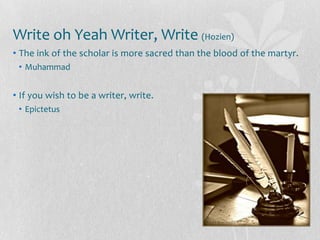
• The ink of the scholar is more sacred than the blood of the martyr.
 • Muhammad


• If you wish to be a writer, write.
 • Epictetus
Why Professors Don’t Write
• Scholarly writing is laborious, slow and worrisome
• Why do few professors write for publication
• Social Darwinism: Only the fittest survive
• Acadamia has been slow to help its own
• We are only beginning to understand the reasons why few write
Causes of Writing Problems: Censors
• Freud “internal censors” – nowadays they are “internal critics”
• Our “watchers at the gates” critically examine ideas as they vie for
  conscious consideration
• The “watchers” reject too soon
• Discriminate too severely
• The result?
 • Premature editing that keeps us from getting ideas on paper
 • Unless they seem safe and perfect
Causes of Writing Problems:
Fears of Failure
• Negative self attitudes
• Negative self statements
• Phobias
• Self fulfilling prophecies
• Daly (1985) Writing Apprehension explained fears of evaluation to
  include:
 • Procrastination
 • Maladaptive writing habits
 • Rigid beliefs about how to write
Perfection                                 Procrastination
• Perfectionism blocks writing       •   Writing is a non recurring task
• Papers never reach acceptable      •   Without short term reward
  levels                             •   We ensure distractions
• Creates unproductive writers       •   And set up ineffective programs to
• It is the morbid fear of making        ensure little progress
  mistakes and of being exposed as   •   Blame it on culture
  mediocre
                                     •   Set impossible high standards
                                     •   Due to:
                                     •   Evaluation anxiety, perfectionism
                                         and low self confidence
                                     •   Aversiveness of task being put off
                                     •   Low energy and decisiveness
Activity One
• Describe your most recent attempts to write, especially those with
  problems.
Phenomenology of Writing Problems
• Writers express relief that someone else has had so much difficulty
  writing
• Sharing writing experiences combats the privateness and mysteries
  of which blocks thrive
• Writers own experiences are not unique
• Better to know your writing problems and observe them in others
• This makes writing problems understandable and manageable
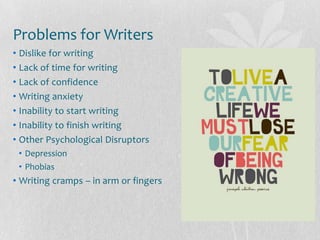
Problems for Writers
• Dislike for writing
• Lack of time for writing
• Lack of confidence
• Writing anxiety
• Inability to start writing
• Inability to finish writing
• Other Psychological Disruptors
 • Depression
 • Phobias
• Writing cramps – in arm or fingers
Assessment for writing
• Distaste for writing:
 • Describe your dislikes of writing. Do you find it typically difficult? Tiring?
• Lack of time for writing
 • Talk about time as something that hampers your writing. Do you have too
   much, too little? Or is it just badly managed?
• Lack of confidence:
 • Do you feel good about yourself as a writer or are there doubts and fears
   that get in the way? Are you afraid of being uncovered as a “fraud” or of
   not being able to make real contributions?
Disrupting Your Writing
• Writing anxiety
• Write about the nervousness you’ve experienced while writing.
  How did it feel (e.g. queasy stomach, sweaty forehead)? Where
  were you when it happened? Is it likely to recur?
• Inability to start writing
• Recall times, particularly recent ones, when you had trouble
  starting. How did it feel? What did you do to help?
• Inability to finish writing
• Have there been times when you obsessed too long over a paper or
  some part of it? Or did you tend to the opposite extremes by
  attempting to finish with a single draft or by not looking at what
  you’d written (and then having to face problems of submitting
  manuscripts with unnecessary errors)?
Other Writing Factors
• Other psychological disruptions:
• Describe your experiences related to the following
• Depression
• Do you tend to give up too easily, to be too sad or negativistic?
• What do you do to cope or get out of the negative mood?
• Phobic avoidance:
• Does your avoidance of writing go beyond the realistic aversiveness of
  writing?
• Do you hurt your personal and professional development by reflexively
  avoiding writing if you can?
• Cramping
• When pressured do you try to write too quickly, so that your
  hand/wrist/arm tires easily? How do you cope when you feel yourself
  cramping?
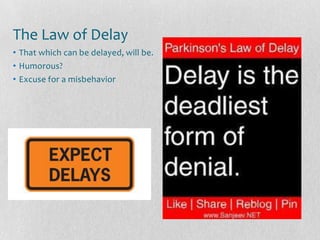
The Law of Delay
• That which can be delayed, will be.
• Humorous?
• Excuse for a misbehavior
The Priority Principle
• That which can be delayed, need not be. Decide which recurrent,
  daily activities you enjoy and make them contingent on doing a
  valued but delayable task first.

• In other words. . .
• You can ensure the performance of highly valued tasks like writing
  by requiring their daily occurrence before more recurrent activities
  like checking your Facebook or email.
• No writing no Facebook.
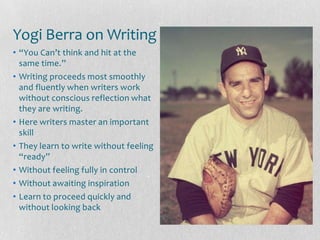
Yogi Berra on Writing
• “You Can’t think and hit at the
  same time.”
• Writing proceeds most smoothly
  and fluently when writers work
  without conscious reflection what
  they are writing.
• Here writers master an important
  skill
• They learn to write without feeling
  “ready”
• Without feeling fully in control
• Without awaiting inspiration
• Learn to proceed quickly and
  without looking back
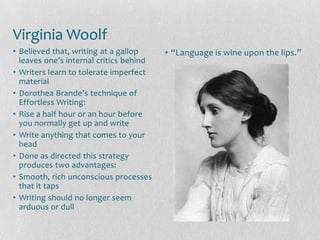
Virginia Woolf
• Believed that, writing at a gallop     • “Language is wine upon the lips.”
  leaves one’s internal critics behind
• Writers learn to tolerate imperfect
  material
• Dorothea Brande’s technique of
  Effortless Writing:
• Rise a half hour or an hour before
  you normally get up and write
• Write anything that comes to your
  head
• Done as directed this strategy
  produces two advantages:
• Smooth, rich unconscious processes
  that it taps
• Writing should no longer seem
  arduous or dull
Spontaneous Writing Squared

• Conscious mind can provide valuable services
 • Planning,
 • problem solving and
 • developing a sense of audience
• Bring back spontaneous writing for consultation, regularly
Generative Writing
• Adding planning and direction to already established spontaneity
• Working toward useful copy
• With some loosely defined goals in mind
• But still writing with little concern for perfection
• Relies on both sides of the mind
• Until the copy approaches a complete first draft
• GW helps make the transition from pure spontaneity to
• Producing useful copy almost painless
• GW at first hurts
• Spontaneous mind hates to give up the control
Activity Two
• Pause just long enough to recall an experience from your school
  years that helped or hindered your writing. Then, before you’ve
  had a chance to think it all out, begin writing it spontaneously. Stick
  to the story, but do not stop for anything. Go quickly without
  rushing. Do not struggle over form or correctness. Just get
  something down. Keep it up for ten minutes.
Activity Three
• Reflect briefly on a new writing project you would like to develop.
  But do not reflect for long; you can always try another possibility in
  your next trial. Then begin writing. Go quickly if you have ideas
  readily available. Go slowly when you’re thinking about directions,
  goals, audience, etc. But keep going. Do not struggle over form or
  correctness just make a beginning keep it up for at least ten
  minutes. For up to an hour if you are generating good, on topic
  material.
Stimulus Control Procedures
• Rearranging the writing environment
• Establish one or a few regular places in which you will do all serious
  writing
• Rearrange writing habits
• Make writing a daily activity
• Regardless of mood
• Regardless of readiness to write
• Write while you are fresh
• Schedule everything else
• around your writing schedule
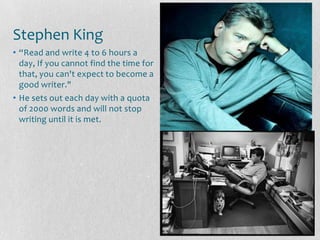
Stephen King
• “Read and write 4 to 6 hours a
  day, If you cannot find the time for
  that, you can't expect to become a
  good writer."
• He sets out each day with a quota
  of 2000 words and will not stop
  writing until it is met.
Four Step Plan
• Automatically:                         • Externality:
• Like spontaneous                       • External Controls that ensure
• Releases your inner writer               writing
• Establishes momentum                   • Priority principle: makes writing a
                                           higher priority by requiring its
• Bypasses infernal censors
                                           practice before moving on to more
• Generates rhythm and voice               desirable, current activities
• Builds confidence in abilities to be   • Time management: works
  spontaneous                              externally to rearrange writers
• Playful and creative                     environment and schedule
                                         • Creates a discipline of writing
Four Step Plan: Self Control
• Mechanisms that induce voluntary control over automatic functions
  such as heart rate
• When s/he sets up external control techniques that ensure planned
  behaviors
• Strong will power
• Carries on narratives
• Assigns causes
• Encourages self awareness of time
Four Step Plan: Sociality
• Writing is a social act
• Social skills have Four components:
• Soliciting comments or criticism on writing
• Build Social Networks
 • Other writers act as gatekeepers
 • Or working to be influential with editors
• Develop a sense of audience
• As you solicit more criticism, especially from writers you admire and
  who work on similar topics
• You will learn to anticipate their reactions to your writing
• Pause and carry on imaginary dialogs with these critics
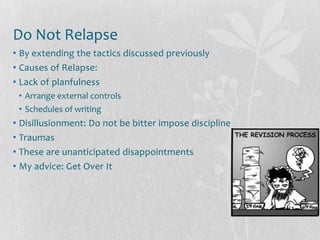
Do Not Relapse
• By extending the tactics discussed previously
• Causes of Relapse:
• Lack of planfulness
 • Arrange external controls
 • Schedules of writing
• Disillusionment: Do not be bitter impose discipline
• Traumas
• These are unanticipated disappointments
• My advice: Get Over It
Writing
• Is hard
• Brings frequent disappointment
• Not all ideas come to fruition
• Much writing is rejected for publication
 • Writing elicits hostility
 • Gatekeepers reject too harshly and too arbitrarily
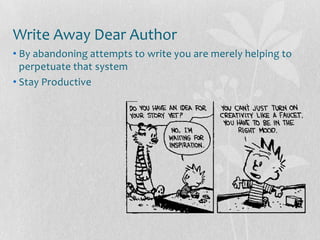
Write Away Dear Author
• By abandoning attempts to write you are merely helping to
  perpetuate that system
• Stay Productive
Boice, Robert. 1990. Professors as Writers: A Self-Help Guide
to Productive Writing. New Forums Press.

Professors as Writers

  • 1.
    PROFESSORS AS WRITERS BY ROBERT BOICE Wafa Hozien, Ph.D Education Administration Virginia State University whozien@vsu.edu whozien@gmail.com
  • 2.
    Write oh YeahWriter, Write (Hozien) • The ink of the scholar is more sacred than the blood of the martyr. • Muhammad • If you wish to be a writer, write. • Epictetus
  • 4.
    Why Professors Don’tWrite • Scholarly writing is laborious, slow and worrisome • Why do few professors write for publication • Social Darwinism: Only the fittest survive • Acadamia has been slow to help its own • We are only beginning to understand the reasons why few write
  • 5.
    Causes of WritingProblems: Censors • Freud “internal censors” – nowadays they are “internal critics” • Our “watchers at the gates” critically examine ideas as they vie for conscious consideration • The “watchers” reject too soon • Discriminate too severely • The result? • Premature editing that keeps us from getting ideas on paper • Unless they seem safe and perfect
  • 6.
    Causes of WritingProblems: Fears of Failure • Negative self attitudes • Negative self statements • Phobias • Self fulfilling prophecies • Daly (1985) Writing Apprehension explained fears of evaluation to include: • Procrastination • Maladaptive writing habits • Rigid beliefs about how to write
  • 7.
    Perfection Procrastination • Perfectionism blocks writing • Writing is a non recurring task • Papers never reach acceptable • Without short term reward levels • We ensure distractions • Creates unproductive writers • And set up ineffective programs to • It is the morbid fear of making ensure little progress mistakes and of being exposed as • Blame it on culture mediocre • Set impossible high standards • Due to: • Evaluation anxiety, perfectionism and low self confidence • Aversiveness of task being put off • Low energy and decisiveness
  • 9.
    Activity One • Describeyour most recent attempts to write, especially those with problems.
  • 10.
    Phenomenology of WritingProblems • Writers express relief that someone else has had so much difficulty writing • Sharing writing experiences combats the privateness and mysteries of which blocks thrive • Writers own experiences are not unique • Better to know your writing problems and observe them in others • This makes writing problems understandable and manageable
  • 12.
    Problems for Writers •Dislike for writing • Lack of time for writing • Lack of confidence • Writing anxiety • Inability to start writing • Inability to finish writing • Other Psychological Disruptors • Depression • Phobias • Writing cramps – in arm or fingers
  • 13.
    Assessment for writing •Distaste for writing: • Describe your dislikes of writing. Do you find it typically difficult? Tiring? • Lack of time for writing • Talk about time as something that hampers your writing. Do you have too much, too little? Or is it just badly managed? • Lack of confidence: • Do you feel good about yourself as a writer or are there doubts and fears that get in the way? Are you afraid of being uncovered as a “fraud” or of not being able to make real contributions?
  • 14.
    Disrupting Your Writing •Writing anxiety • Write about the nervousness you’ve experienced while writing. How did it feel (e.g. queasy stomach, sweaty forehead)? Where were you when it happened? Is it likely to recur? • Inability to start writing • Recall times, particularly recent ones, when you had trouble starting. How did it feel? What did you do to help? • Inability to finish writing • Have there been times when you obsessed too long over a paper or some part of it? Or did you tend to the opposite extremes by attempting to finish with a single draft or by not looking at what you’d written (and then having to face problems of submitting manuscripts with unnecessary errors)?
  • 15.
    Other Writing Factors •Other psychological disruptions: • Describe your experiences related to the following • Depression • Do you tend to give up too easily, to be too sad or negativistic? • What do you do to cope or get out of the negative mood? • Phobic avoidance: • Does your avoidance of writing go beyond the realistic aversiveness of writing? • Do you hurt your personal and professional development by reflexively avoiding writing if you can? • Cramping • When pressured do you try to write too quickly, so that your hand/wrist/arm tires easily? How do you cope when you feel yourself cramping?
  • 17.
    The Law ofDelay • That which can be delayed, will be. • Humorous? • Excuse for a misbehavior
  • 18.
    The Priority Principle •That which can be delayed, need not be. Decide which recurrent, daily activities you enjoy and make them contingent on doing a valued but delayable task first. • In other words. . . • You can ensure the performance of highly valued tasks like writing by requiring their daily occurrence before more recurrent activities like checking your Facebook or email. • No writing no Facebook.
  • 19.
    Yogi Berra onWriting • “You Can’t think and hit at the same time.” • Writing proceeds most smoothly and fluently when writers work without conscious reflection what they are writing. • Here writers master an important skill • They learn to write without feeling “ready” • Without feeling fully in control • Without awaiting inspiration • Learn to proceed quickly and without looking back
  • 20.
    Virginia Woolf • Believedthat, writing at a gallop • “Language is wine upon the lips.” leaves one’s internal critics behind • Writers learn to tolerate imperfect material • Dorothea Brande’s technique of Effortless Writing: • Rise a half hour or an hour before you normally get up and write • Write anything that comes to your head • Done as directed this strategy produces two advantages: • Smooth, rich unconscious processes that it taps • Writing should no longer seem arduous or dull
  • 21.
    Spontaneous Writing Squared •Conscious mind can provide valuable services • Planning, • problem solving and • developing a sense of audience • Bring back spontaneous writing for consultation, regularly
  • 22.
    Generative Writing • Addingplanning and direction to already established spontaneity • Working toward useful copy • With some loosely defined goals in mind • But still writing with little concern for perfection • Relies on both sides of the mind • Until the copy approaches a complete first draft • GW helps make the transition from pure spontaneity to • Producing useful copy almost painless • GW at first hurts • Spontaneous mind hates to give up the control
  • 23.
    Activity Two • Pausejust long enough to recall an experience from your school years that helped or hindered your writing. Then, before you’ve had a chance to think it all out, begin writing it spontaneously. Stick to the story, but do not stop for anything. Go quickly without rushing. Do not struggle over form or correctness. Just get something down. Keep it up for ten minutes.
  • 24.
    Activity Three • Reflectbriefly on a new writing project you would like to develop. But do not reflect for long; you can always try another possibility in your next trial. Then begin writing. Go quickly if you have ideas readily available. Go slowly when you’re thinking about directions, goals, audience, etc. But keep going. Do not struggle over form or correctness just make a beginning keep it up for at least ten minutes. For up to an hour if you are generating good, on topic material.
  • 25.
    Stimulus Control Procedures •Rearranging the writing environment • Establish one or a few regular places in which you will do all serious writing • Rearrange writing habits • Make writing a daily activity • Regardless of mood • Regardless of readiness to write • Write while you are fresh • Schedule everything else • around your writing schedule
  • 26.
    Stephen King • “Readand write 4 to 6 hours a day, If you cannot find the time for that, you can't expect to become a good writer." • He sets out each day with a quota of 2000 words and will not stop writing until it is met.
  • 27.
    Four Step Plan •Automatically: • Externality: • Like spontaneous • External Controls that ensure • Releases your inner writer writing • Establishes momentum • Priority principle: makes writing a higher priority by requiring its • Bypasses infernal censors practice before moving on to more • Generates rhythm and voice desirable, current activities • Builds confidence in abilities to be • Time management: works spontaneous externally to rearrange writers • Playful and creative environment and schedule • Creates a discipline of writing
  • 28.
    Four Step Plan:Self Control • Mechanisms that induce voluntary control over automatic functions such as heart rate • When s/he sets up external control techniques that ensure planned behaviors • Strong will power • Carries on narratives • Assigns causes • Encourages self awareness of time
  • 29.
    Four Step Plan:Sociality • Writing is a social act • Social skills have Four components: • Soliciting comments or criticism on writing • Build Social Networks • Other writers act as gatekeepers • Or working to be influential with editors • Develop a sense of audience • As you solicit more criticism, especially from writers you admire and who work on similar topics • You will learn to anticipate their reactions to your writing • Pause and carry on imaginary dialogs with these critics
  • 30.
    Do Not Relapse •By extending the tactics discussed previously • Causes of Relapse: • Lack of planfulness • Arrange external controls • Schedules of writing • Disillusionment: Do not be bitter impose discipline • Traumas • These are unanticipated disappointments • My advice: Get Over It
  • 31.
    Writing • Is hard •Brings frequent disappointment • Not all ideas come to fruition • Much writing is rejected for publication • Writing elicits hostility • Gatekeepers reject too harshly and too arbitrarily
  • 32.
    Write Away DearAuthor • By abandoning attempts to write you are merely helping to perpetuate that system • Stay Productive
  • 34.
    Boice, Robert. 1990.Professors as Writers: A Self-Help Guide to Productive Writing. New Forums Press.