Retractile testis
• retractile testis is found in the upper scrotum or
lower inguinal canal but can be positioned in the
scrotum without spermatic cord tension; it
remains there for a short period of time but
intermittently resides in the groin.
• retractile testes are often bilateral and are caused
by an overactive cremasteric reflex, which pulls
the testis out of the scrotum towards the inguinal
canal, particularly when the child is cold or upset
• parent should be asked if they have ever seen
the testis in the scrotum, for example when
bathing the child. Similarly, previous records
should be reviewed, looking for
documentation of normal gonad position after
birth.
• With warm hands, the surgeon should examine the
size, location, and texture of the contralateral
descended testis (if present).
• The UDT is then sought by gently advancing the fingers
along the inguinal canal, sweeping the groin from
lateral to medial. The inguinal testis may be felt to pop
up under the fingers. If the testis is palpable, one
should attempt to bring it down to the scrotum and
hold it in the scrotum for about one minute to cause
fatigue of the cremasteric muscle. If the testis remains
in the scrotum after release, even momentarily, it is
not con sidered as an UDT, but rather a retractile one.
• Criteria to differentiate an incompletely
descended testis from a retractile testis:
– (1) incompletely descended testes are smaller
than the con-tralateral gonad,
– (2) the testis rapidly retracts out of the scrotum
when the testis is released, and
– (3) pain is elicited when the testis is manipulated
into the scrotum.
• Retractile testis has a risk of requiring
orchidopexy.
• The risk is higher in the population diagnosed
at a younger age.
• Boys with retractile testis should be observed
periodically (6 monthly) until the testis is
descended in the normal position.
• According to the guidelines of the European
Association of Urology, cases of retractile
testis do not warrant medication or surgical
intervention, and instead should only be
monitored periodically until adolescence
• imaging cannot be recommended as a standard
adjunct to preoperative assessment of UDT.
• Ultrasound can misdiagnose retractile testes as
true UDT by triggering a cremaster reflex.
• A meta-analysis of 12 studies showed that
ultrasound has both a low sensitivity (45%) and
specificity (78%) in locating a non-palpable testis.
• it does not alter its management, therefore it is
considered unnecessary.
• Ultrasound may, however, be useful in certain
circumstances, such as in obese patients.8
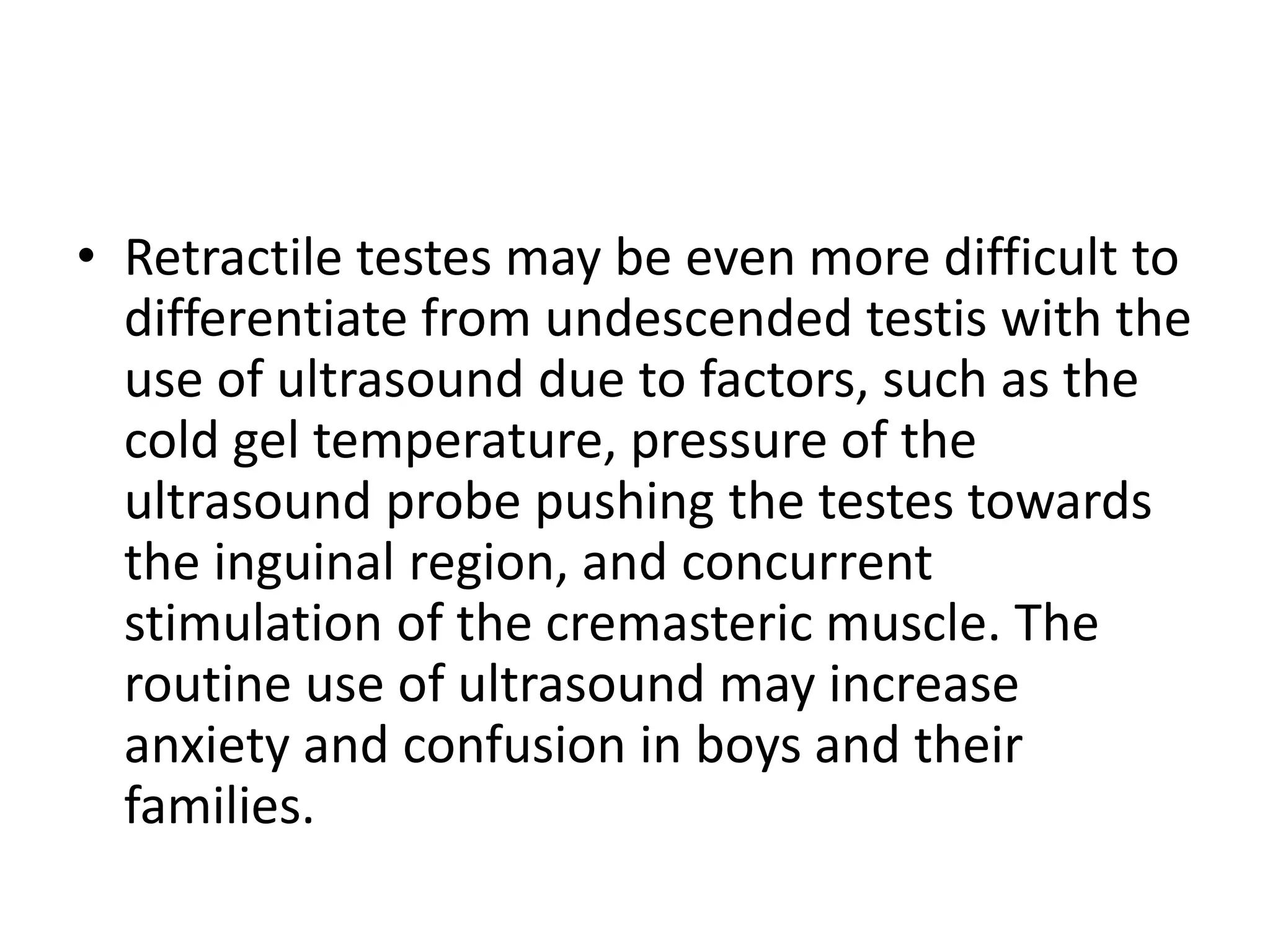
• Retractile testes may be even more difficult to
differentiate from undescended testis with the
use of ultrasound due to factors, such as the
cold gel temperature, pressure of the
ultrasound probe pushing the testes towards
the inguinal region, and concurrent
stimulation of the cremasteric muscle. The
routine use of ultrasound may increase
anxiety and confusion in boys and their
families.
retractile testis.pptx

retractile testis.pptx

  • 1.
  • 2.
    • retractile testisis found in the upper scrotum or lower inguinal canal but can be positioned in the scrotum without spermatic cord tension; it remains there for a short period of time but intermittently resides in the groin. • retractile testes are often bilateral and are caused by an overactive cremasteric reflex, which pulls the testis out of the scrotum towards the inguinal canal, particularly when the child is cold or upset
  • 3.
    • parent shouldbe asked if they have ever seen the testis in the scrotum, for example when bathing the child. Similarly, previous records should be reviewed, looking for documentation of normal gonad position after birth.
  • 4.
    • With warmhands, the surgeon should examine the size, location, and texture of the contralateral descended testis (if present). • The UDT is then sought by gently advancing the fingers along the inguinal canal, sweeping the groin from lateral to medial. The inguinal testis may be felt to pop up under the fingers. If the testis is palpable, one should attempt to bring it down to the scrotum and hold it in the scrotum for about one minute to cause fatigue of the cremasteric muscle. If the testis remains in the scrotum after release, even momentarily, it is not con sidered as an UDT, but rather a retractile one.
  • 5.
    • Criteria todifferentiate an incompletely descended testis from a retractile testis: – (1) incompletely descended testes are smaller than the con-tralateral gonad, – (2) the testis rapidly retracts out of the scrotum when the testis is released, and – (3) pain is elicited when the testis is manipulated into the scrotum.
  • 6.
    • Retractile testishas a risk of requiring orchidopexy. • The risk is higher in the population diagnosed at a younger age. • Boys with retractile testis should be observed periodically (6 monthly) until the testis is descended in the normal position.
  • 7.
    • According tothe guidelines of the European Association of Urology, cases of retractile testis do not warrant medication or surgical intervention, and instead should only be monitored periodically until adolescence
  • 8.
    • imaging cannotbe recommended as a standard adjunct to preoperative assessment of UDT. • Ultrasound can misdiagnose retractile testes as true UDT by triggering a cremaster reflex. • A meta-analysis of 12 studies showed that ultrasound has both a low sensitivity (45%) and specificity (78%) in locating a non-palpable testis. • it does not alter its management, therefore it is considered unnecessary. • Ultrasound may, however, be useful in certain circumstances, such as in obese patients.8
  • 9.
    • Retractile testesmay be even more difficult to differentiate from undescended testis with the use of ultrasound due to factors, such as the cold gel temperature, pressure of the ultrasound probe pushing the testes towards the inguinal region, and concurrent stimulation of the cremasteric muscle. The routine use of ultrasound may increase anxiety and confusion in boys and their families.