DR . GYANENDRA KUMAR
INTRODUCTION
 ERG is a recording of changes in resting potential in the retina
when stimulated with a brief flash of light.
 It is the composite of electrical activity from the
photoreceptors, Muller cells & RPE.
 In normal eye there is a potential difference of 1 mv b/w cornea
and retina exist ,called as corneo-retinal potential.
 By changing corneo retinal potential with the help of light
stimulus,a resultant waveform is obtained ,it is known as ERG.
ERG
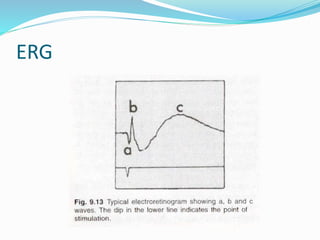
 ERG is made up of mainly 3 waves :a wave,b wave,c wave
 ‘a’ wave-Origin from photoreceptors.it is a negative wave.
 ‘b’ wave- Origin from Muller’s cells + bipolar cells. Large
amplitude positive wave.
Mainly from Muller’s in response to increase (ECF) K+.
 ‘c’ wave- Prolonged positive wave with lower
amplitude. Origin from RPE.
 Oscillatory potentials- Small wavelets on ascending limb of
‘b’. Origin from Amacrine cells.
ERG
PHYSIOLOGICAL BASIS OF ERG
 ‘a’ wave –
 when Light fall on photoreceptors, Hyperpolarisation occurs
 Outer portion of photoreceptor – positive
 Inner portion – negative
 Both rods and cones contributes in ‘a’ wave, but
contributions can be separated by stimulus conditions.
 Blue dim flash light - Rod ERG
 Bright red light flash- Cone ERG.
‘b’ wave
 Mainly from Muller cells in inner retina – modified astrocytes has no
synaptic junction.
 Respond to potassium concentration in ECF. In form of Change in
membrane potential.
 Though originates from Muller cells and bipolar cells ,b wave is
dependent on electrical activity of photoreceptors.
 So in this way ,Muller Cells can provide b wave either from rods
receptors or cones or combined, depends on type of stimulus.
 If light flickered at 20 Hz or faster only cones can respond. So flicker
ERG represents cones function.
 Oscillatory potential-reflects feedback circuits in inner retina,
originate from Amacrine cells.
 Seen on dark adapted b wave. Disappears in cone dysfunction syndrome.
c wave
 Originates from RPE in response to rod signals only.
 Because direct contact of rod cells with RPE.
 Considerably slower so not used clinically.
Imp point.
 It is evident that the ERG arises from parts of the retina
distal to ganglion cells layer.
 Thus a normal ERG may be recorded from an eye with
advanced optic neuropathy ,provided outer retinal
layers are intact.
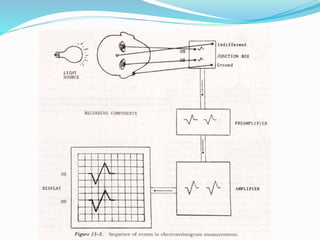
Recording of ERG requires:-
 1. Recording, reference & ground electrodes.
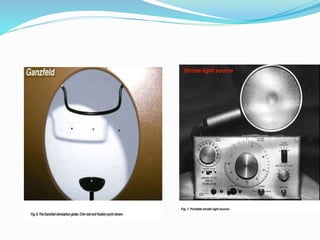
 2. Ganzfeld bowl stimulator(Light stimulating device):
 It is large white bowl which is used to stimulate the retina
during the recording of the ERG.
 It diffuses the light & allows equal stimulation of all parts
of retina.
 3. Signal averager & amplifier.These are the devices that
cause amplification of signals and make them recordable.
 4. Display monitor & printer.
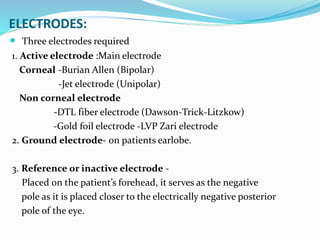
ELECTRODES:
 Three electrodes required
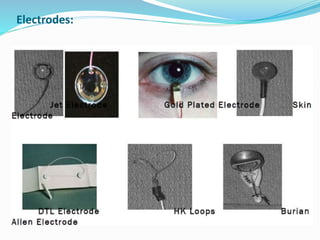
1. Active electrode :Main electrode
Corneal -Burian Allen (Bipolar)
-Jet electrode (Unipolar)
Non corneal electrode
-DTL fiber electrode (Dawson-Trick-Litzkow)
-Gold foil electrode -LVP Zari electrode
2. Ground electrode- on patients earlobe.
3. Reference or inactive electrode -
Placed on the patient’s forehead, it serves as the negative
pole as it is placed closer to the electrically negative posterior
pole of the eye.
Electrodes:
MEASUREMENTS OF ERG COMPONENTS
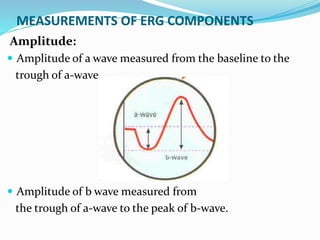
Amplitude:
 Amplitude of a wave measured from the baseline to the
trough of a-wave.
 Amplitude of b wave measured from
the trough of a-wave to the peak of b-wave.
Time sequences:
 Latency:- It is the time interval b/w onset of stimulus & the
beginning of the a-wave response.
 Normally it’s 2 ms.
 Implicit time:- Time from the onset of light stimulus until
the maximum a-wave or b-wave response.
 Considering only a-wave and b-wave response the duration
of ERG is less than 1/4th s.
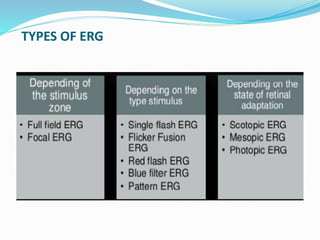
TYPES OF ERG
Factors influencing ERG
 1. Light Stimulus –
With increase in the intensity of stimulus -
 ‘a’ wave increase in size.
 Whereas b wave reaches maximum.
 Shortening of latency of peaks and position of the wavelets
changes.
 Flickering light stimulus with 30 Hz – cone response only.
 2. Recording equipment –Inadequately positioned
electrodes can distort response.
 3. Dark adaptation –
ERG increases in size
b wave becomes slower and more rounded.
 4. Age and sex –
 Small ERG within hr of birth with strong stimulus.
 Reaches to adult value after the age of 2 years.
 Gradually declines in adults with age.
 Slightly Larger in females than males.
ISCV (INTERNATIONAL SOCIETY FOR CLINICAL
ELECTROPHYSIOLOGY OF VISION)
 Standard protocol for ERG,EOG,VEP
 Global standard, easy understanding and comparable.
According to ISCEV-
 For ERG The light stimulus should consist of flashes having a maximum
duration of 5ms.
 The standard stimulus strength is defined as one that produces a
stimulus strength at the surface of the Ganzfeld bowl of 1.5-3.0 cd·m-2.
This is also k/a the Standard Flash.
 The stimulator should be capable of producing a steady and even
background luminance of 17-34 cd·m-2 .
 The stimulus system should be able to modify both stimulus and
background intensity.
 The bandpass of the amplifier and preamplifier should include the
range of 0.2-300 Hz and be adjustable.
Principle Responses demanded by
ISCEV
 Scotopic rod response
 Scotopic maximal combined response
 Photopic single flash cone response
 Photopic 30 Hz flicker response
 Oscillatory potentials
Recording protocol
 1. Full mydriasis.
 2. 20 min dark adaptation for Scotopic response.
 3. Scotopic Rod response using blue/dim white flash.
 4. Scotopic Max. combined response using standard white flash.
 5. Oscillatory potentials
 6. 10 min of light adaptation for photopic response
 7. Single flash cone response using standard white flash.
 8. 30 Hz flicker
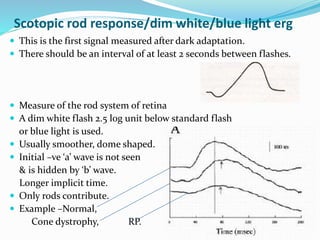
Scotopic rod response/dim white/blue light erg
 This is the first signal measured after dark adaptation.
 There should be an interval of at least 2 seconds between flashes.
 Measure of the rod system of retina
 A dim white flash 2.5 log unit below standard flash
or blue light is used.
 Usually smoother, dome shaped.
 Initial –ve ‘a’ wave is not seen
& is hidden by ‘b’ wave.
Longer implicit time.
 Only rods contribute.
 Example –Normal,
Cone dystrophy, RP.
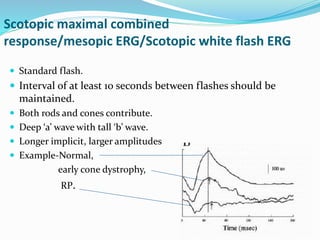
Scotopic maximal combined
response/mesopic ERG/Scotopic white flash ERG
 Standard flash.
 Interval of at least 10 seconds between flashes should be
maintained.
 Both rods and cones contribute.
 Deep ‘a’ wave with tall ‘b’ wave.
 Longer implicit, larger amplitudes
 Example-Normal,
early cone dystrophy,
RP.
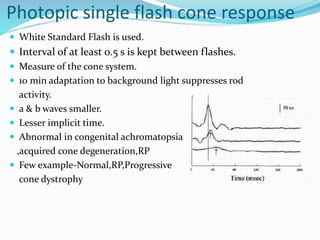
Photopic single flash cone response
 White Standard Flash is used.
 Interval of at least 0.5 s is kept between flashes.
 Measure of the cone system.
 10 min adaptation to background light suppresses rod
activity.
 a & b waves smaller.
 Lesser implicit time.
 Abnormal in congenital achromatopsia
,acquired cone degeneration,RP
 Few example-Normal,RP,Progressive
cone dystrophy
Photopic 30-Hz flicker response
 Repetitive stimuli
 Standard white Flashes are flickered at a frequency of
30/second(Hz).
 The first few responses should be discarded.
 Represents Cone activity.
 Flicker implicit time measure is sensitive.
 Abnormal in RP,Cone dystrophy.
Oscillatory potential
 High-frequency wavelets
 That are said to be riding on the b-wave
 To record OPs, the bandpass filters on the
amplifiers are changed to
eliminate the lower frequencies
While allowing the higher
frequencies to pass.
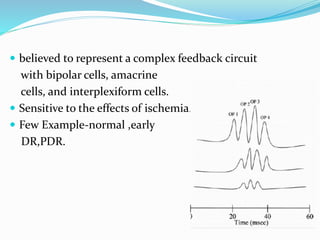
 believed to represent a complex feedback circuit
with bipolar cells, amacrine
cells, and interplexiform cells.
 Sensitive to the effects of ischemia.
 Few Example-normal ,early
DR,PDR.
Interpretation of ERG
 ERG is abnormal only if more than 30% to 40% of retina
is affected.
 A clinical correlation is necessary.
 Media opacities, non-dilating pupils & nystagmus can
cause an abnormal ERG.
Abnormal ERG response
 The b-wave with a potential of <0.19 mV or > 0.54 mV is
considered abnormal.
Abnormal ERG is graded as follows:-
Supernormal response-
 Characterized by a potential above normal upper limit.
 Such as response is seen in:-
1. Albinism.
2. Siderosis bulbi
Sub-normal response
 Potential < 0.08 mV.
 Indicates that a large area of retina is not functioning.
 Seen in:-
 1. Early cases of RP.
 2. Chloroquine & quinine toxicity.
 3. Retinal detachment.
 4. Systemic diseases like vit. A deficiency, hypothyroidism,
mucopolysaccharidosis & anemia
Extinguished response
 Complete absence of response.
 Seen in:-
 1. Advanced cases of RP.
 2. Complete RD.
 3. Choroideremia.
 4. Leber’s congenital amaurosis
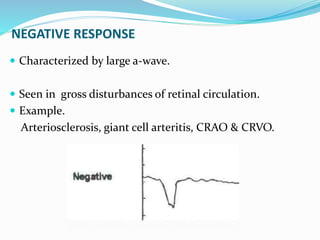
NEGATIVE RESPONSE
 Characterized by large a-wave.
 Seen in gross disturbances of retinal circulation.
 Example.
Arteriosclerosis, giant cell arteritis, CRAO & CRVO.
Clinical Applications
1. Diagnosis and prognosis of retinal disorders –
 a. Retinitis pigmentosa
 b. Diabetic retinopathy
 c. Retinal detachment
 d. Vascular occlusions of retina
 e. Toxic and deficiency status
2.To assess retinal function when fundus examination is
not possible-
 Corneal opacities.
 Dense cataract.
 Vitreous haemorrhage.
ERG IN FEW CLINICAL CASES
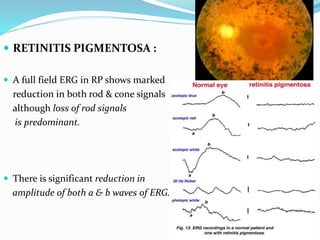
 RETINITIS PIGMENTOSA :
 A full field ERG in RP shows marked
reduction in both rod & cone signals
although loss of rod signals
is predominant.
 There is significant reduction in
amplitude of both a & b waves of ERG.
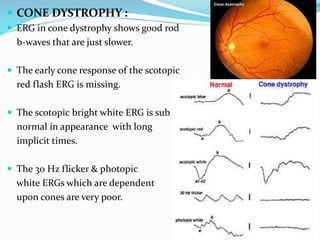
 CONE DYSTROPHY :
 ERG in cone dystrophy shows good rod
b-waves that are just slower.
 The early cone response of the scotopic
red flash ERG is missing.
 The scotopic bright white ERG is sub
normal in appearance with long
implicit times.
 The 30 Hz flicker & photopic
white ERGs which are dependent
upon cones are very poor.
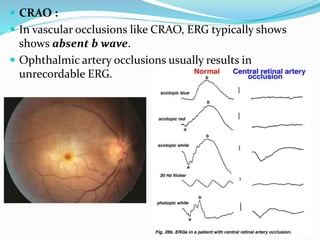
 CRAO :
 In vascular occlusions like CRAO, ERG typically shows
shows absent b wave.
 Ophthalmic artery occlusions usually results in
unrecordable ERG.
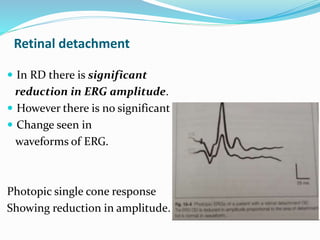
Retinal detachment
 In RD there is significant
reduction in ERG amplitude.
 However there is no significant
 Change seen in
waveforms of ERG.
Photopic single cone response
Showing reduction in amplitude.
Focal ERG
 Local measure of ERG fuction or pathologies which are
missed by standard full field ERG.
Provide topographic information.
 Provides information about smaller areas of retina.
 A small stimulus of 4 degree size is projected on area of
retina to be tested.
 Due to light scattering & poor signal to noise ratio, this
technique is mostly used in research setting than in clinical
setting.
 Two type Rod driven fERG and cone driven fERG
 Clinical uses of fERG :
 Early detection of cone dystrophy or macular disease before
the fundus changes are evident.
 Can differentiate between early macular & optic nerve
pathology.
 Can be used for evaluation of any type focal macular
pathology.
Abnormal in:
 Stargardt disease
 Macular dystrophy
 RP
 ARMD.
 Macular hole
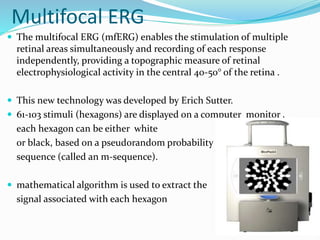
Multifocal ERG
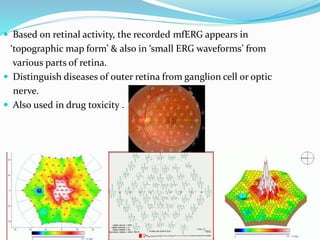
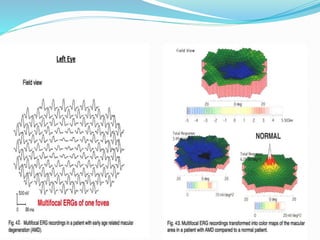
 The multifocal ERG (mfERG) enables the stimulation of multiple
retinal areas simultaneously and recording of each response
independently, providing a topographic measure of retinal
electrophysiological activity in the central 40-50° of the retina .
 This new technology was developed by Erich Sutter.
 61-103 stimuli (hexagons) are displayed on a computer monitor ,
each hexagon can be either white
or black, based on a pseudorandom probability
sequence (called an m-sequence).
 mathematical algorithm is used to extract the
signal associated with each hexagon
 Based on retinal activity, the recorded mfERG appears in
‘topographic map form’ & also in ‘small ERG waveforms’ from
various parts of retina.
 Distinguish diseases of outer retina from ganglion cell or optic
nerve.
 Also used in drug toxicity .
Pattern ERG
 It mainly represents inner retinal activity (especially ganglion
cellactivity)
 Useful in differentiating optic nerve disorders from macular
disorders.
 Unlike flash ERG, pattern ERG is a very small response.
 Recorded with full correction of refractive errors as visualization of
stimulus for extended time is essential for recording.
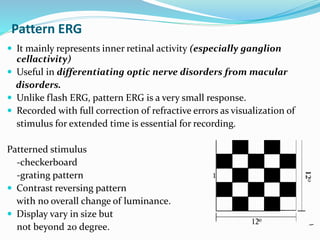
Patterned stimulus
-checkerboard
-grating pattern
 Contrast reversing pattern
with no overall change of luminance.
 Display vary in size but
not beyond 20 degree.
RECORDINGS AND MEASUREMENTS
 Recorded without mydriasis .
 With refractive correction
 With non contact lens electrodes.
 Reference electrodes placed at ipsilateral outer canthi.
 Not on forehead or ear.
 Binocular stimulation preferred ,except in squint.
 Transient PERG-clinically use because transient recording allows
separation of the PERG components.
 While Steady state PERG not so not used in clinically .
 Stimulus rate 2 to 6 reversal per second for transient PERG.
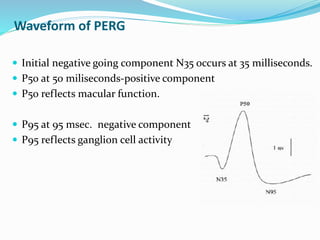
Waveform of PERG
 Initial negative going component N35 occurs at 35 milliseconds.
 P50 at 50 miliseconds-positive component
 P50 reflects macular function.
 P95 at 95 msec. negative component
 P95 reflects ganglion cell activity
uses
 Most effective in distinguishing between abnormality
at ganglion cell level and distal lesions
 N95 abnormal in optic nerve disease.
 P 50 abnormal in macular disease.
 Example- optic nerve atrophy ,optic nerve
compression and glaucoma
ELECTROOCULOGRAM
 EOG examines the function of the RPE and the interaction
between the RPE and the photoreceptors.
 Based on the measurement of resting potential of the eye
which exists b/w the cornea (+ve) & back of the retina (-ve)
during fully dark-adapted & fully light-adapted conditions.
 It is recording of standing potential of the eye.
Technique
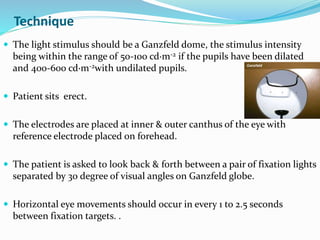
 The light stimulus should be a Ganzfeld dome, the stimulus intensity
being within the range of 50-100 cd·m-2 if the pupils have been dilated
and 400-600 cd·m-2with undilated pupils.
 Patient sits erect.
 The electrodes are placed at inner & outer canthus of the eye with
reference electrode placed on forehead.
 The patient is asked to look back & forth between a pair of fixation lights
separated by 30 degree of visual angles on Ganzfeld globe.
 Horizontal eye movements should occur in every 1 to 2.5 seconds
between fixation targets. .
 SECOND:
Ratio of Light Peak to Dark Adapted Baseline-
Dark adaptation for at least 40 minutes is done to establish a
stable baseline following which the light is turned on and the light
peak measured and ratio of light peak to dark adapted baseline
taken.
 As validity of results depends upon consistent tracking of fixation
target over 30 min., this test is not suitable in unco-operative patients
& children.
 Also EOG depends upon a minimum degree of light adaptation so it is
not reliable in patients with dense cataracts.
 Responses from a set number of saccades are recorded every minute.
 Prior to the test patients should be preadapted to ordinary room
lighting for at least 15 minutes.
 A choice of two methods of recording the light phase is recommended:
FIRST -
The room lights are turned off and recordings made for 15 minutes in
the dark.
The minimum amplitude during this period is termed the dark trough.
It usually occurs after 11 or 12 minutes.
The light is then turned on and recording continued until the signal
amplitude reaches a clearly defined peak which usually comes in 6-9
min., k/a the light peak.
The ratio of light peak to dark trough is then measured and this ratio is
k/a Arden’s ratio.
Components of EOG :
 The light-insensitive component accounts for the dark trough and is
dependent on the integrity of the retinal pigment epithelium (RPE) as
well as the photoreceptors and inner nuclear layer.
 The light-sensitive component is the slow light rise of the EOG and is
generated by the depolarization of the basal membrane of the RPE.
Reporting of EOG
According to the ISCEV standards, the report of EOG should
include-
 Light peak: dark trough ratio (this terminology is preferred over
conventional Arden ratio)
 Amplitude of dark trough (mv)
 Time from the start of light phase to light peak (when present)
 type of adapting light source
 pupil size
 Difficulties/deviation from protocol including patient compliance,
inconsistent eye movements
Interpretation of Results
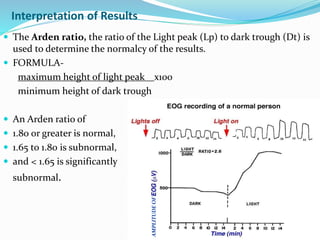
 The Arden ratio, the ratio of the Light peak (Lp) to dark trough (Dt) is
used to determine the normalcy of the results.
 FORMULA-
maximum height of light peak x100
minimum height of dark trough
 An Arden ratio of
 1.80 or greater is normal,
 1.65 to 1.80 is subnormal,
 and < 1.65 is significantly
subnormal.
AMPLITUDEOF
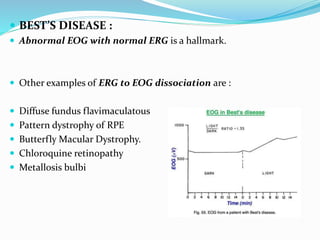
 BEST’S DISEASE :
 Abnormal EOG with normal ERG is a hallmark.
 Other examples of ERG to EOG dissociation are :
 Diffuse fundus flavimaculatous
 Pattern dystrophy of RPE
 Butterfly Macular Dystrophy.
 Chloroquine retinopathy
 Metallosis bulbi
 EOG is also affected in diseases such as RP & other hereditary
degeneration's, vitamin A deficiency, RD, toxic retinopathies & retinal
vascular occlusions.
 As a general rule those conditions which cause a reduction in size of b-
wave in ERG also produce reduction in value of Arden ratio.
 EOG serves as a test that is supplementary & complementary to ERG.
 In certain conditions it is more sensitive than ERG e.g. patients with
vitelliform macular degeneration, fundus flavimaculatus, & generalized
drusen often show a striking EOG reduction in presence of normal ERG.
THANK YOU

Erg and eog

  • 1.
  • 2.
    INTRODUCTION  ERG isa recording of changes in resting potential in the retina when stimulated with a brief flash of light.  It is the composite of electrical activity from the photoreceptors, Muller cells & RPE.  In normal eye there is a potential difference of 1 mv b/w cornea and retina exist ,called as corneo-retinal potential.  By changing corneo retinal potential with the help of light stimulus,a resultant waveform is obtained ,it is known as ERG.
  • 3.
    ERG  ERG ismade up of mainly 3 waves :a wave,b wave,c wave  ‘a’ wave-Origin from photoreceptors.it is a negative wave.  ‘b’ wave- Origin from Muller’s cells + bipolar cells. Large amplitude positive wave. Mainly from Muller’s in response to increase (ECF) K+.  ‘c’ wave- Prolonged positive wave with lower amplitude. Origin from RPE.  Oscillatory potentials- Small wavelets on ascending limb of ‘b’. Origin from Amacrine cells.
  • 4.
  • 5.
    PHYSIOLOGICAL BASIS OFERG  ‘a’ wave –  when Light fall on photoreceptors, Hyperpolarisation occurs  Outer portion of photoreceptor – positive  Inner portion – negative  Both rods and cones contributes in ‘a’ wave, but contributions can be separated by stimulus conditions.  Blue dim flash light - Rod ERG  Bright red light flash- Cone ERG.
  • 6.
    ‘b’ wave  Mainlyfrom Muller cells in inner retina – modified astrocytes has no synaptic junction.  Respond to potassium concentration in ECF. In form of Change in membrane potential.  Though originates from Muller cells and bipolar cells ,b wave is dependent on electrical activity of photoreceptors.  So in this way ,Muller Cells can provide b wave either from rods receptors or cones or combined, depends on type of stimulus.  If light flickered at 20 Hz or faster only cones can respond. So flicker ERG represents cones function.  Oscillatory potential-reflects feedback circuits in inner retina, originate from Amacrine cells.  Seen on dark adapted b wave. Disappears in cone dysfunction syndrome.
  • 7.
    c wave  Originatesfrom RPE in response to rod signals only.  Because direct contact of rod cells with RPE.  Considerably slower so not used clinically. Imp point.  It is evident that the ERG arises from parts of the retina distal to ganglion cells layer.  Thus a normal ERG may be recorded from an eye with advanced optic neuropathy ,provided outer retinal layers are intact.
  • 8.
    Recording of ERGrequires:-  1. Recording, reference & ground electrodes.  2. Ganzfeld bowl stimulator(Light stimulating device):  It is large white bowl which is used to stimulate the retina during the recording of the ERG.  It diffuses the light & allows equal stimulation of all parts of retina.  3. Signal averager & amplifier.These are the devices that cause amplification of signals and make them recordable.  4. Display monitor & printer.
  • 10.
    ELECTRODES:  Three electrodesrequired 1. Active electrode :Main electrode Corneal -Burian Allen (Bipolar) -Jet electrode (Unipolar) Non corneal electrode -DTL fiber electrode (Dawson-Trick-Litzkow) -Gold foil electrode -LVP Zari electrode 2. Ground electrode- on patients earlobe. 3. Reference or inactive electrode - Placed on the patient’s forehead, it serves as the negative pole as it is placed closer to the electrically negative posterior pole of the eye.
  • 11.
  • 12.
    MEASUREMENTS OF ERGCOMPONENTS Amplitude:  Amplitude of a wave measured from the baseline to the trough of a-wave.  Amplitude of b wave measured from the trough of a-wave to the peak of b-wave.
  • 13.
    Time sequences:  Latency:-It is the time interval b/w onset of stimulus & the beginning of the a-wave response.  Normally it’s 2 ms.  Implicit time:- Time from the onset of light stimulus until the maximum a-wave or b-wave response.  Considering only a-wave and b-wave response the duration of ERG is less than 1/4th s.
  • 14.
  • 15.
    Factors influencing ERG 1. Light Stimulus – With increase in the intensity of stimulus -  ‘a’ wave increase in size.  Whereas b wave reaches maximum.  Shortening of latency of peaks and position of the wavelets changes.  Flickering light stimulus with 30 Hz – cone response only.
  • 16.
     2. Recordingequipment –Inadequately positioned electrodes can distort response.  3. Dark adaptation – ERG increases in size b wave becomes slower and more rounded.  4. Age and sex –  Small ERG within hr of birth with strong stimulus.  Reaches to adult value after the age of 2 years.  Gradually declines in adults with age.  Slightly Larger in females than males.
  • 17.
    ISCV (INTERNATIONAL SOCIETYFOR CLINICAL ELECTROPHYSIOLOGY OF VISION)  Standard protocol for ERG,EOG,VEP  Global standard, easy understanding and comparable. According to ISCEV-  For ERG The light stimulus should consist of flashes having a maximum duration of 5ms.  The standard stimulus strength is defined as one that produces a stimulus strength at the surface of the Ganzfeld bowl of 1.5-3.0 cd·m-2. This is also k/a the Standard Flash.  The stimulator should be capable of producing a steady and even background luminance of 17-34 cd·m-2 .  The stimulus system should be able to modify both stimulus and background intensity.  The bandpass of the amplifier and preamplifier should include the range of 0.2-300 Hz and be adjustable.
  • 18.
    Principle Responses demandedby ISCEV  Scotopic rod response  Scotopic maximal combined response  Photopic single flash cone response  Photopic 30 Hz flicker response  Oscillatory potentials
  • 19.
    Recording protocol  1.Full mydriasis.  2. 20 min dark adaptation for Scotopic response.  3. Scotopic Rod response using blue/dim white flash.  4. Scotopic Max. combined response using standard white flash.  5. Oscillatory potentials  6. 10 min of light adaptation for photopic response  7. Single flash cone response using standard white flash.  8. 30 Hz flicker
  • 21.
    Scotopic rod response/dimwhite/blue light erg  This is the first signal measured after dark adaptation.  There should be an interval of at least 2 seconds between flashes.  Measure of the rod system of retina  A dim white flash 2.5 log unit below standard flash or blue light is used.  Usually smoother, dome shaped.  Initial –ve ‘a’ wave is not seen & is hidden by ‘b’ wave. Longer implicit time.  Only rods contribute.  Example –Normal, Cone dystrophy, RP.
  • 22.
    Scotopic maximal combined response/mesopicERG/Scotopic white flash ERG  Standard flash.  Interval of at least 10 seconds between flashes should be maintained.  Both rods and cones contribute.  Deep ‘a’ wave with tall ‘b’ wave.  Longer implicit, larger amplitudes  Example-Normal, early cone dystrophy, RP.
  • 23.
    Photopic single flashcone response  White Standard Flash is used.  Interval of at least 0.5 s is kept between flashes.  Measure of the cone system.  10 min adaptation to background light suppresses rod activity.  a & b waves smaller.  Lesser implicit time.  Abnormal in congenital achromatopsia ,acquired cone degeneration,RP  Few example-Normal,RP,Progressive cone dystrophy
  • 24.
    Photopic 30-Hz flickerresponse  Repetitive stimuli  Standard white Flashes are flickered at a frequency of 30/second(Hz).  The first few responses should be discarded.  Represents Cone activity.  Flicker implicit time measure is sensitive.  Abnormal in RP,Cone dystrophy.
  • 25.
    Oscillatory potential  High-frequencywavelets  That are said to be riding on the b-wave  To record OPs, the bandpass filters on the amplifiers are changed to eliminate the lower frequencies While allowing the higher frequencies to pass.
  • 26.
     believed torepresent a complex feedback circuit with bipolar cells, amacrine cells, and interplexiform cells.  Sensitive to the effects of ischemia.  Few Example-normal ,early DR,PDR.
  • 27.
    Interpretation of ERG ERG is abnormal only if more than 30% to 40% of retina is affected.  A clinical correlation is necessary.  Media opacities, non-dilating pupils & nystagmus can cause an abnormal ERG.
  • 28.
    Abnormal ERG response The b-wave with a potential of <0.19 mV or > 0.54 mV is considered abnormal. Abnormal ERG is graded as follows:- Supernormal response-  Characterized by a potential above normal upper limit.  Such as response is seen in:- 1. Albinism. 2. Siderosis bulbi
  • 29.
    Sub-normal response  Potential< 0.08 mV.  Indicates that a large area of retina is not functioning.  Seen in:-  1. Early cases of RP.  2. Chloroquine & quinine toxicity.  3. Retinal detachment.  4. Systemic diseases like vit. A deficiency, hypothyroidism, mucopolysaccharidosis & anemia
  • 30.
    Extinguished response  Completeabsence of response.  Seen in:-  1. Advanced cases of RP.  2. Complete RD.  3. Choroideremia.  4. Leber’s congenital amaurosis
  • 31.
    NEGATIVE RESPONSE  Characterizedby large a-wave.  Seen in gross disturbances of retinal circulation.  Example. Arteriosclerosis, giant cell arteritis, CRAO & CRVO.
  • 32.
    Clinical Applications 1. Diagnosisand prognosis of retinal disorders –  a. Retinitis pigmentosa  b. Diabetic retinopathy  c. Retinal detachment  d. Vascular occlusions of retina  e. Toxic and deficiency status 2.To assess retinal function when fundus examination is not possible-  Corneal opacities.  Dense cataract.  Vitreous haemorrhage.
  • 33.
    ERG IN FEWCLINICAL CASES
  • 34.
     RETINITIS PIGMENTOSA:  A full field ERG in RP shows marked reduction in both rod & cone signals although loss of rod signals is predominant.  There is significant reduction in amplitude of both a & b waves of ERG.
  • 35.
     CONE DYSTROPHY:  ERG in cone dystrophy shows good rod b-waves that are just slower.  The early cone response of the scotopic red flash ERG is missing.  The scotopic bright white ERG is sub normal in appearance with long implicit times.  The 30 Hz flicker & photopic white ERGs which are dependent upon cones are very poor.
  • 36.
     CRAO : In vascular occlusions like CRAO, ERG typically shows shows absent b wave.  Ophthalmic artery occlusions usually results in unrecordable ERG.
  • 37.
    Retinal detachment  InRD there is significant reduction in ERG amplitude.  However there is no significant  Change seen in waveforms of ERG. Photopic single cone response Showing reduction in amplitude.
  • 38.
    Focal ERG  Localmeasure of ERG fuction or pathologies which are missed by standard full field ERG. Provide topographic information.  Provides information about smaller areas of retina.  A small stimulus of 4 degree size is projected on area of retina to be tested.  Due to light scattering & poor signal to noise ratio, this technique is mostly used in research setting than in clinical setting.  Two type Rod driven fERG and cone driven fERG
  • 39.
     Clinical usesof fERG :  Early detection of cone dystrophy or macular disease before the fundus changes are evident.  Can differentiate between early macular & optic nerve pathology.  Can be used for evaluation of any type focal macular pathology. Abnormal in:  Stargardt disease  Macular dystrophy  RP  ARMD.  Macular hole
  • 40.
    Multifocal ERG  Themultifocal ERG (mfERG) enables the stimulation of multiple retinal areas simultaneously and recording of each response independently, providing a topographic measure of retinal electrophysiological activity in the central 40-50° of the retina .  This new technology was developed by Erich Sutter.  61-103 stimuli (hexagons) are displayed on a computer monitor , each hexagon can be either white or black, based on a pseudorandom probability sequence (called an m-sequence).  mathematical algorithm is used to extract the signal associated with each hexagon
  • 41.
     Based onretinal activity, the recorded mfERG appears in ‘topographic map form’ & also in ‘small ERG waveforms’ from various parts of retina.  Distinguish diseases of outer retina from ganglion cell or optic nerve.  Also used in drug toxicity .
  • 43.
    Pattern ERG  Itmainly represents inner retinal activity (especially ganglion cellactivity)  Useful in differentiating optic nerve disorders from macular disorders.  Unlike flash ERG, pattern ERG is a very small response.  Recorded with full correction of refractive errors as visualization of stimulus for extended time is essential for recording. Patterned stimulus -checkerboard -grating pattern  Contrast reversing pattern with no overall change of luminance.  Display vary in size but not beyond 20 degree.
  • 44.
    RECORDINGS AND MEASUREMENTS Recorded without mydriasis .  With refractive correction  With non contact lens electrodes.  Reference electrodes placed at ipsilateral outer canthi.  Not on forehead or ear.  Binocular stimulation preferred ,except in squint.  Transient PERG-clinically use because transient recording allows separation of the PERG components.  While Steady state PERG not so not used in clinically .  Stimulus rate 2 to 6 reversal per second for transient PERG.
  • 45.
    Waveform of PERG Initial negative going component N35 occurs at 35 milliseconds.  P50 at 50 miliseconds-positive component  P50 reflects macular function.  P95 at 95 msec. negative component  P95 reflects ganglion cell activity
  • 46.
    uses  Most effectivein distinguishing between abnormality at ganglion cell level and distal lesions  N95 abnormal in optic nerve disease.  P 50 abnormal in macular disease.  Example- optic nerve atrophy ,optic nerve compression and glaucoma
  • 47.
    ELECTROOCULOGRAM  EOG examinesthe function of the RPE and the interaction between the RPE and the photoreceptors.  Based on the measurement of resting potential of the eye which exists b/w the cornea (+ve) & back of the retina (-ve) during fully dark-adapted & fully light-adapted conditions.  It is recording of standing potential of the eye.
  • 48.
    Technique  The lightstimulus should be a Ganzfeld dome, the stimulus intensity being within the range of 50-100 cd·m-2 if the pupils have been dilated and 400-600 cd·m-2with undilated pupils.  Patient sits erect.  The electrodes are placed at inner & outer canthus of the eye with reference electrode placed on forehead.  The patient is asked to look back & forth between a pair of fixation lights separated by 30 degree of visual angles on Ganzfeld globe.  Horizontal eye movements should occur in every 1 to 2.5 seconds between fixation targets. .
  • 49.
     SECOND: Ratio ofLight Peak to Dark Adapted Baseline- Dark adaptation for at least 40 minutes is done to establish a stable baseline following which the light is turned on and the light peak measured and ratio of light peak to dark adapted baseline taken.  As validity of results depends upon consistent tracking of fixation target over 30 min., this test is not suitable in unco-operative patients & children.  Also EOG depends upon a minimum degree of light adaptation so it is not reliable in patients with dense cataracts.
  • 50.
     Responses froma set number of saccades are recorded every minute.  Prior to the test patients should be preadapted to ordinary room lighting for at least 15 minutes.  A choice of two methods of recording the light phase is recommended: FIRST - The room lights are turned off and recordings made for 15 minutes in the dark. The minimum amplitude during this period is termed the dark trough. It usually occurs after 11 or 12 minutes. The light is then turned on and recording continued until the signal amplitude reaches a clearly defined peak which usually comes in 6-9 min., k/a the light peak. The ratio of light peak to dark trough is then measured and this ratio is k/a Arden’s ratio.
  • 51.
    Components of EOG:  The light-insensitive component accounts for the dark trough and is dependent on the integrity of the retinal pigment epithelium (RPE) as well as the photoreceptors and inner nuclear layer.  The light-sensitive component is the slow light rise of the EOG and is generated by the depolarization of the basal membrane of the RPE. Reporting of EOG According to the ISCEV standards, the report of EOG should include-  Light peak: dark trough ratio (this terminology is preferred over conventional Arden ratio)  Amplitude of dark trough (mv)  Time from the start of light phase to light peak (when present)  type of adapting light source  pupil size  Difficulties/deviation from protocol including patient compliance, inconsistent eye movements
  • 52.
    Interpretation of Results The Arden ratio, the ratio of the Light peak (Lp) to dark trough (Dt) is used to determine the normalcy of the results.  FORMULA- maximum height of light peak x100 minimum height of dark trough  An Arden ratio of  1.80 or greater is normal,  1.65 to 1.80 is subnormal,  and < 1.65 is significantly subnormal. AMPLITUDEOF
  • 53.
     BEST’S DISEASE:  Abnormal EOG with normal ERG is a hallmark.  Other examples of ERG to EOG dissociation are :  Diffuse fundus flavimaculatous  Pattern dystrophy of RPE  Butterfly Macular Dystrophy.  Chloroquine retinopathy  Metallosis bulbi
  • 54.
     EOG isalso affected in diseases such as RP & other hereditary degeneration's, vitamin A deficiency, RD, toxic retinopathies & retinal vascular occlusions.  As a general rule those conditions which cause a reduction in size of b- wave in ERG also produce reduction in value of Arden ratio.  EOG serves as a test that is supplementary & complementary to ERG.  In certain conditions it is more sensitive than ERG e.g. patients with vitelliform macular degeneration, fundus flavimaculatus, & generalized drusen often show a striking EOG reduction in presence of normal ERG.
  • 55.