Retail Supply ChainRetail Supply Chain
A Brief Overview
Prof. R. Sathyanarayanan
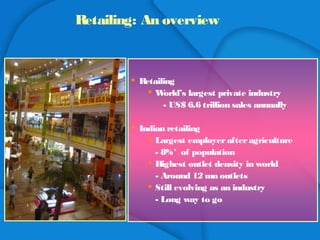
 Retailing
 World’s largest private industry
- US$ 6.6 trillion sales annually
 Indian retailing
 Largest employerafteragriculture
- 8%* of population
 Highest outlet density in world
- Around 12 mn outlets
 Still evolving as an industry
- Long way to go
Retailing: An overview
Weekly Markets
Village Fairs
Melas
Weekly Markets
Village Fairs
Melas
Convenience Stores
Momand Pop/Kiranas
Convenience Stores
Momand Pop/Kiranas
PDS Outlets
Khadi Stores
Cooperatives
PDS Outlets
Khadi Stores
Cooperatives
Exclusive Brand Outlets
Hyper/SuperMarkets
Department Stores
Shopping Malls
Exclusive Brand Outlets
Hyper/SuperMarkets
Department Stores
Shopping Malls
Traditional/Pervasive
Reach
Government
Supported
Historic/Rural
Reach
Modern Formats/
International
Evolution of Indian retail
Source of
Entertainment
Neighborhood
Stores/Convenience
Availability/Low
Costs /Distribution
Shopping
Experience/Efficiency
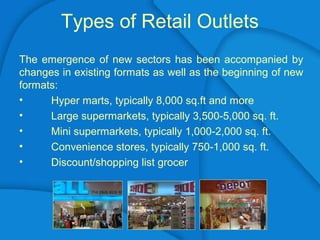
Types of Retail Outlets
The emergence of new sectors has been accompanied by
changes in existing formats as well as the beginning of new
formats:
• Hyper marts, typically 8,000 sq.ft and more
• Large supermarkets, typically 3,500-5,000 sq. ft.
• Mini supermarkets, typically 1,000-2,000 sq. ft.
• Convenience stores, typically 750-1,000 sq. ft.
• Discount/shopping list grocer
SUPPLY CHAIN – PUSH vs PULL MODEL
RETAIL SUPPLY CHAIN
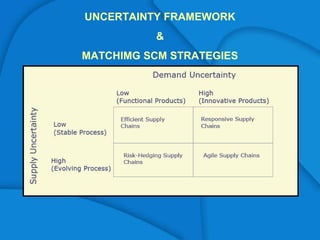
– UNCERTAINTY FRAMEWORK
UNCERTAINTY FRAMEWORK
&
MATCHIMG SCM STRATEGIES
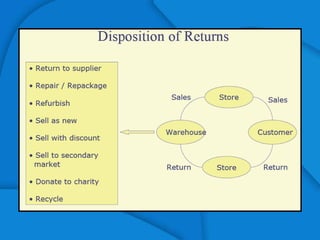
TYPICAL REVERSE LOGISTICS PROCESS IN RETAIL
INFORMATION TECHNOLOGY
THE BACKBONE
RFID Technology
What is RFID ?
• Radio Frequency Identification
• A micro-chip in a label used to transmit
data when the label is exposed to radio
waves
RFID Basics
What are the main components ?
• RFID Tags
• RFID Reader – Antena and
transceiver(reader)
• Host Computer
• Major players: IBM, Texas Instruments
Integrated chip
RFID in Retail Supply Chain
Automate the Supply chain process
RFID TAG
Reader
RFID in Retail Supply Chain
Benefits at a glance
• Decrease in lost stock
• Faster locating stock
• Lower labour requirement
• Reduction of out-of-stock
• Low safety stock level
Retail: Wal-Mart's Business Case
$180 millionImproved visibility of where products are in the
supply chain in Wal-Mart’s DCs and supplier’s
warehouses offers reduced inventory and costs
of carrying this inventory
Product
Visibility
$300 millionImproved tracking of the more than 1 billion pallets
and cases moving through DCs annually
Tracking
$575 millionReal-time product monitoring reduces warehouse
shrink, administrative errors and vendor fraud
Shrink
$600 millionSmart shelves monitor on-shelf product availabilityOut-of-Stock
$6.7 billionEliminating bar code scanning on pallets and cases
in the supply chain and on items in-store can
reduce labor costs by 15%
Scanning
Source: eWeek, September 15, 2003
Potential Annual Saving
SavingsFunction Execution Savings
Total $8.355 Billion
• Vital to Wal-Mart's successful retail model are the tremendous
Walmart distribution centers that serve the thousands of stores
across the states. Georgia, for example, is home to five Walmart
distribution centers-Statesboro, Macon, LaGrange, Monroe, and
Douglas.
• A typical Walmart distribution center is more than one million square
feet, or the equivalent of 10 Wal-Mart retail stores. More than two
hundred and fifty dock doors serve the fleet of Walmart distribution
center trucks that wait in the vast parking lots surrounding the
buildings. The aforementioned LaGrange distribution center, which
serves stores in Georgia and Alabama, loads and ships over five
hundred tractor-trailers of merchandise a day from the one Walmart
distribution center alone.
• A majority of the merchandise one sees in a Wal Mart store goes
through a Walmart distribution center first. This enormous volume
necessitates the twenty-four hour a day, seven day a week
schedule.
THANK YOU
profsathya@gmail.com

Retail logistics1

  • 1.
    Retail Supply ChainRetailSupply Chain A Brief Overview Prof. R. Sathyanarayanan
  • 2.
     Retailing  World’slargest private industry - US$ 6.6 trillion sales annually  Indian retailing  Largest employerafteragriculture - 8%* of population  Highest outlet density in world - Around 12 mn outlets  Still evolving as an industry - Long way to go Retailing: An overview
  • 3.
    Weekly Markets Village Fairs Melas WeeklyMarkets Village Fairs Melas Convenience Stores Momand Pop/Kiranas Convenience Stores Momand Pop/Kiranas PDS Outlets Khadi Stores Cooperatives PDS Outlets Khadi Stores Cooperatives Exclusive Brand Outlets Hyper/SuperMarkets Department Stores Shopping Malls Exclusive Brand Outlets Hyper/SuperMarkets Department Stores Shopping Malls Traditional/Pervasive Reach Government Supported Historic/Rural Reach Modern Formats/ International Evolution of Indian retail Source of Entertainment Neighborhood Stores/Convenience Availability/Low Costs /Distribution Shopping Experience/Efficiency
  • 5.
    Types of RetailOutlets The emergence of new sectors has been accompanied by changes in existing formats as well as the beginning of new formats: • Hyper marts, typically 8,000 sq.ft and more • Large supermarkets, typically 3,500-5,000 sq. ft. • Mini supermarkets, typically 1,000-2,000 sq. ft. • Convenience stores, typically 750-1,000 sq. ft. • Discount/shopping list grocer
  • 9.
    SUPPLY CHAIN –PUSH vs PULL MODEL
  • 10.
    RETAIL SUPPLY CHAIN –UNCERTAINTY FRAMEWORK
  • 11.
  • 15.
    TYPICAL REVERSE LOGISTICSPROCESS IN RETAIL
  • 20.
  • 22.
    RFID Technology What isRFID ? • Radio Frequency Identification • A micro-chip in a label used to transmit data when the label is exposed to radio waves
  • 23.
    RFID Basics What arethe main components ? • RFID Tags • RFID Reader – Antena and transceiver(reader) • Host Computer • Major players: IBM, Texas Instruments Integrated chip
  • 24.
    RFID in RetailSupply Chain Automate the Supply chain process RFID TAG Reader
  • 25.
    RFID in RetailSupply Chain Benefits at a glance • Decrease in lost stock • Faster locating stock • Lower labour requirement • Reduction of out-of-stock • Low safety stock level
  • 26.
    Retail: Wal-Mart's BusinessCase $180 millionImproved visibility of where products are in the supply chain in Wal-Mart’s DCs and supplier’s warehouses offers reduced inventory and costs of carrying this inventory Product Visibility $300 millionImproved tracking of the more than 1 billion pallets and cases moving through DCs annually Tracking $575 millionReal-time product monitoring reduces warehouse shrink, administrative errors and vendor fraud Shrink $600 millionSmart shelves monitor on-shelf product availabilityOut-of-Stock $6.7 billionEliminating bar code scanning on pallets and cases in the supply chain and on items in-store can reduce labor costs by 15% Scanning Source: eWeek, September 15, 2003 Potential Annual Saving SavingsFunction Execution Savings Total $8.355 Billion
  • 27.
    • Vital toWal-Mart's successful retail model are the tremendous Walmart distribution centers that serve the thousands of stores across the states. Georgia, for example, is home to five Walmart distribution centers-Statesboro, Macon, LaGrange, Monroe, and Douglas. • A typical Walmart distribution center is more than one million square feet, or the equivalent of 10 Wal-Mart retail stores. More than two hundred and fifty dock doors serve the fleet of Walmart distribution center trucks that wait in the vast parking lots surrounding the buildings. The aforementioned LaGrange distribution center, which serves stores in Georgia and Alabama, loads and ships over five hundred tractor-trailers of merchandise a day from the one Walmart distribution center alone. • A majority of the merchandise one sees in a Wal Mart store goes through a Walmart distribution center first. This enormous volume necessitates the twenty-four hour a day, seven day a week schedule.
  • 29.