
LOGISTICS IN WALMART
BACKGROUND
 Founder: Sam Walton
 Year of establishment: 1962
 First store: Rogers in Arkansas
 The US-based Wal-Mart ranks in the global Fortune 500 list
 Wal-Mart is the largest retailing company in the world.
 The company is much bigger than its competitors in the US - Sears Roebuck,
K-Mart, JC Penney and Nordstrom combined.
 Walmart averages a profit of $1.8 million every hour.
 35 million people shop at Walmart every day, as much as the population of
Canada.
GLOBAL PRESENCE
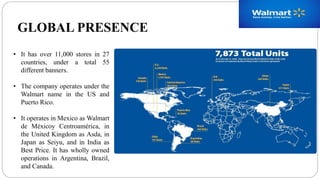
• It has over 11,000 stores in 27
countries, under a total 55
different banners.
• The company operates under the
Walmart name in the US and
Puerto Rico.
• It operates in Mexico as Walmart
de Méxicoy Centroamérica, in
the United Kingdom as Asda, in
Japan as Seiyu, and in India as
Best Price. It has wholly owned
operations in Argentina, Brazil,
and Canada.
SUPPLY CHAIN ELEMENTS
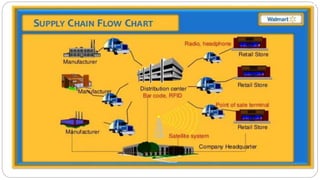
 Bar Code System - Pallets passed through conveyor belt are scanned automatically and product codes are
transferred to centralized computer system
 RFID - Use radio waves to identify objects, tags with microchip and antenna built in
 Large Scale Satellite system - Link all of the stores to headquarter, giving Wal-Mart’s central computer
system real-time inventory data.
 Information Sharing - Retail Link private extranet system : gives more than 2000 suppliers computer
access to point-of-sale data.
 Walmart Advanced Vehicle Experience Concept Truck – The trailer is made almost exclusively with
carbon fibre, saving around 4,000 pounds, which can then be used to carry more freight.
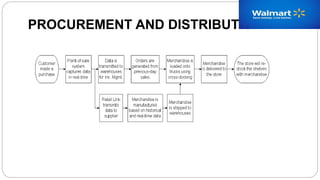
 Cross-docking -In this system, finished goods are directly picked up from the manufacturing site of
supplier, sorted out and directly supplied to the customers. This reduces handling and storage of finished
products.
PROCUREMENT AND DISTRIBUTION
SUPPLIERS
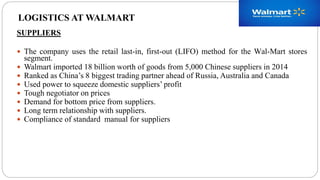
 The company uses the retail last-in, first-out (LIFO) method for the Wal-Mart stores
segment.
 Walmart imported 18 billion worth of goods from 5,000 Chinese suppliers in 2014
 Ranked as China’s 8 biggest trading partner ahead of Russia, Australia and Canada
 Used power to squeeze domestic suppliers’ profit
 Tough negotiator on prices
 Demand for bottom price from suppliers.
 Long term relationship with suppliers.
 Compliance of standard manual for suppliers
LOGISTICS AT WALMART
DISTRIBUTION CENTRES
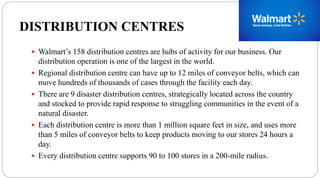
 Walmart’s 158 distribution centres are hubs of activity for our business. Our
distribution operation is one of the largest in the world.
 Regional distribution centre can have up to 12 miles of conveyor belts, which can
move hundreds of thousands of cases through the facility each day.
 There are 9 disaster distribution centres, strategically located across the country
and stocked to provide rapid response to struggling communities in the event of a
natural disaster.
 Each distribution centre is more than 1 million square feet in size, and uses more
than 5 miles of conveyor belts to keep products moving to our stores 24 hours a
day.
 Every distribution centre supports 90 to 100 stores in a 200-mile radius.
TRANSPORTATION
• Walmart is able to move goods to and from distribution centers because we
maintain a private fleet of trucks and a skilled staff of
• truck drivers.
• Walmart logistics has a fleet of 6,500 tractors, 55,000 trailers and more than 7,000
drivers.
• Company hired experienced drivers having more than 300,000 accident free miles
with no major traffic violation.
• Every year they drive 700 million miles to make millions of deliveries to our stores
and clubs.
• Each driver averages around 100,000 miles annually—that’s like driving around
the world 4 times!
• Drivers follow the most efficient routes to their destinations, and work to minimize
the number of “empty miles” they drive
Walmart

Walmart

  • 1.
  • 2.
    BACKGROUND  Founder: SamWalton  Year of establishment: 1962  First store: Rogers in Arkansas  The US-based Wal-Mart ranks in the global Fortune 500 list  Wal-Mart is the largest retailing company in the world.  The company is much bigger than its competitors in the US - Sears Roebuck, K-Mart, JC Penney and Nordstrom combined.  Walmart averages a profit of $1.8 million every hour.  35 million people shop at Walmart every day, as much as the population of Canada.
  • 3.
    GLOBAL PRESENCE • Ithas over 11,000 stores in 27 countries, under a total 55 different banners. • The company operates under the Walmart name in the US and Puerto Rico. • It operates in Mexico as Walmart de Méxicoy Centroamérica, in the United Kingdom as Asda, in Japan as Seiyu, and in India as Best Price. It has wholly owned operations in Argentina, Brazil, and Canada.
  • 4.
    SUPPLY CHAIN ELEMENTS Bar Code System - Pallets passed through conveyor belt are scanned automatically and product codes are transferred to centralized computer system  RFID - Use radio waves to identify objects, tags with microchip and antenna built in  Large Scale Satellite system - Link all of the stores to headquarter, giving Wal-Mart’s central computer system real-time inventory data.  Information Sharing - Retail Link private extranet system : gives more than 2000 suppliers computer access to point-of-sale data.  Walmart Advanced Vehicle Experience Concept Truck – The trailer is made almost exclusively with carbon fibre, saving around 4,000 pounds, which can then be used to carry more freight.  Cross-docking -In this system, finished goods are directly picked up from the manufacturing site of supplier, sorted out and directly supplied to the customers. This reduces handling and storage of finished products.
  • 6.
  • 7.
    SUPPLIERS  The companyuses the retail last-in, first-out (LIFO) method for the Wal-Mart stores segment.  Walmart imported 18 billion worth of goods from 5,000 Chinese suppliers in 2014  Ranked as China’s 8 biggest trading partner ahead of Russia, Australia and Canada  Used power to squeeze domestic suppliers’ profit  Tough negotiator on prices  Demand for bottom price from suppliers.  Long term relationship with suppliers.  Compliance of standard manual for suppliers LOGISTICS AT WALMART
  • 8.
    DISTRIBUTION CENTRES  Walmart’s158 distribution centres are hubs of activity for our business. Our distribution operation is one of the largest in the world.  Regional distribution centre can have up to 12 miles of conveyor belts, which can move hundreds of thousands of cases through the facility each day.  There are 9 disaster distribution centres, strategically located across the country and stocked to provide rapid response to struggling communities in the event of a natural disaster.  Each distribution centre is more than 1 million square feet in size, and uses more than 5 miles of conveyor belts to keep products moving to our stores 24 hours a day.  Every distribution centre supports 90 to 100 stores in a 200-mile radius.
  • 9.
    TRANSPORTATION • Walmart isable to move goods to and from distribution centers because we maintain a private fleet of trucks and a skilled staff of • truck drivers. • Walmart logistics has a fleet of 6,500 tractors, 55,000 trailers and more than 7,000 drivers. • Company hired experienced drivers having more than 300,000 accident free miles with no major traffic violation. • Every year they drive 700 million miles to make millions of deliveries to our stores and clubs. • Each driver averages around 100,000 miles annually—that’s like driving around the world 4 times! • Drivers follow the most efficient routes to their destinations, and work to minimize the number of “empty miles” they drive