ISSN 2350-1022
International Journal of Recent Research in Mathematics Computer Science and Information Technology
Vol. 2, Issue 1, pp: (209-214), Month: April 2015 – September 2015, Available at: www.paperpublications.org
Page | 209
Paper Publications
Non Split Edge Domination in Fuzzy Graphs
C.Y.Ponnappan1
, S. Basheer Ahamed2
, P.Surulinathan3
,
1
Department of Mathematics, Government Arts College, Paramakudi, Tamilnadu, India
2
Department of Mathematics, P.S.N.A. College of Engineering and Technology, Dindigul, Tamilnadu, India
3
Department of Mathematics, Lathamathavan Engineering College, Kidaripatti, Alagarkovil, Madurai-625301,
Tamilnadu, India
Abstract: An edge dominating set D of a fuzzy graph G= (σ, µ) is a non-split edge dominating set if the induced
fuzzy sub graph H= (<E-D>, σ, µ) is connected. The split edge domination number γns(G) or γns is the minimum
fuzzy cardinality of a non-split edge dominating set. In this paper we study a non-split edge dominating set of fuzzy
graphs and investigate the relationship of γns (G) with other known parameter of G.
Keywords: Fuzzy graphs, fuzzy domination, fuzzy edge domination, fuzzy non split edge domination number.
1. INTRODUCTION
The study of domination set in graphs was begun by Ore and Berge. Kulli V.R. et.al introduced the concept of split
domination and non-split domination in graphs. Rosenfield introduced the notion of fuzzy graph and several fuzzy
analogs of graph theoretic concepts such as path, cycles and connectedness. A.Somasundram and S.Somasundram
discussed domination in Fuzzy graphs. They defined domination using effective edges in fuzzy graph. In this paper we
discuss the non-split edge domination number of fuzzy graph and establish the relationship with other parameter which is
also investigated.
2. PRELIMINARIES
Definition 2.1
Let V be a finite non empty set. Let E be the collection of all two element subsets of V. A fuzzy graph G=(σ,µ) is a set
with two functions σ :V→[0,1] and µ: E→[0,1] such that µ(uv) ≤ σ(u)σ(v) for all u,v  V.
Definition 2.2
Let G=( σ,µ) be a fuzzy graph on V and V1 V. Define σ1 on V1 by σ1(u)=σ(u) for all u V1 and µ1 on the collection E1
of two element subsets of V1 by µ1(u v) = µ(u v) for all u,v  V1, then (σ1,µ1) is called the fuzzy subgraph of G induced
by V1 and is denoted by <V1>.
Definition 2.3
The order p and size q of a fuzzy graph G= (σ, µ) are defined to be p=
u V
(u)

 and q=
uv E
(uv)

 .
Definition 2.4
Let G= (σ, µ) be a fuzzy graph on V and DV then the fuzzy cardinality of D is defined to be
u D
(u)


.
Definition 2.5
Let G = (,) be a fuzzy graph on E and D  E then the fuzzy edge cardinality of D is defined to be
e D
 (e)
ISSN 2350-1022
International Journal of Recent Research in Mathematics Computer Science and Information Technology
Vol. 2, Issue 1, pp: (209-214), Month: April 2015 – September 2015, Available at: www.paperpublications.org
Page | 210
Paper Publications
Definition 2.6
An edge e= uv of a fuzzy graph is called an effective edge if µ(uv) = σ(u)  σ(v).
N(u) = { vV/ µ(uv) = σ(u)  σ(v)} is called the neighborhood of u and N[u]=N(u)  {u} is the closed neighborhood of
u.
The effective degree of a vertex u is defined to be the sum of the weights of the effective edges incident at u and is
denoted by dE(u).
v N(u)
(v)

 is called the neighborhood degree of u and is denoted by dN(u). The minimum effective
degree E(G)=min{dE(u)|uV(G)} and the maximum effective degree E (G) = max{dE(u)|uV(G)}.
Definition 2.7
The effective edge degree of an edge e = uv, is defined to be dE(e) = dE(u) dE(v) . The minimum edge effective degree and
the maximum edge effective degree are
'
E (G) = min {dE(e) | eX} and
'
E (G) = max {dE(e) | e X} respectively. N(e)
is the set of all effective edges incident with the vertices of e. In a similar way minimum neighborhood degree and the
maximum neighborhood degree denoted by
'
N and
'
N respectively can also be defined.
Definition 2.8
The complement of a fuzzy graph G denoted by ̅ is defined to be ̅  ̅ where ̅    
Definition 2.9
Let :V [0,1] be a fuzzy subset of V. Then the complete fuzzy graph on  is defined to be (,) where (uv) = (u)
(v) for all uvE and is denoted by K.
Definition 2.10
A fuzzy graph G= (,) is said to be connected if any two vertices in G are connected.
Definition 2.11
Let G = (,) be a fuzzy graph on (V, E). A subset S of E is said to be an edge dominating set in G if for every edge in E-
S is adjacent to atleast one effective edge in S. The minimum fuzzy cardinality of an edge dominating set is G is called the
edge domination number of G and is denoted by (G) or .
Definition 2.12
A fuzzy graph G=(,µ) is said to be bipartite if the vertex V can be partitioned into two nonempty sets V1 and V2 such
that µ(v1,v2)=0 if v1,v2V1 or v1,v2V2. Further if (u,v)=(u)  (v) for all uV1 and vV2 then G is called a complete
bipartite graph and is denoted by   where 1 and 2 are, respectively, the restrictions of  to V1 and V2.
Definition 2.13
An edge Dominating set D of a graph G = (V, E) is a fuzzy split edge dominating set if the induced subgraph <E-D> is
disconnected. The split edge domination number γs is the minimum fuzzy cardinality of a split edge dominating set.
Remark 2 .14
It is clear that if G has atleast one edge, then 0 ≤ (G) ≤ q. However, if a graph G has no effective edges, then  (G) = 0.
Definition 2.15
An edge Dominating set D of a graph G = (V, E) is a fuzzy non split edge dominating set if the induced sub graph <E-
D> is connected. The non-split edge domination number γns is the minimum fuzzy cardinality of a non split edge
dominating set.
Definition 2.16
An edge Dominating set D of a fuzzy graph G=(V,E) is a fuzzy path non split edge dominating set if the induced sub
graph <E-D> is a path in G .The path non split edge domination number γpns is the minimum fuzzy cardinality of a path
non split edge dominating set.
ISSN 2350-1022
International Journal of Recent Research in Mathematics Computer Science and Information Technology
Vol. 2, Issue 1, pp: (209-214), Month: April 2015 – September 2015, Available at: www.paperpublications.org
Page | 211
Paper Publications
Definition 2.17
An edge Dominating set D of a fuzzy graph G=(V,E) is a fuzzy cycle non split edge dominating set if the induced sub
graph <E-D> is a cycle in G .The cycle non split edge domination number γcns is the minimum fuzzy cardinality of a cycle
non split edge dominating set.
Definition 2.18
An edge dominating set S of a fuzzy graph G is said to be minimal edge dominating set if no proper subset S is an edge
dominating set of G.
Definition 2.19
An edge e of a fuzzy graph G is said to be an isolated edge if no effective edges incident with the vertices of e. Thus an
isolated edge does not dominate any other edge in G.
Definition 2.20
A set D of edges of a fuzzy graph is said to be independent if for every edge e D, no effective edge of D is incident with
the vertices of e.
An edge dominating set D is a said to be an edge independent edge dominating set if <D> is independent.
The minimum fuzzy cardinality of an independent edge dominating set is called the independent edge domination number
of G. It is denoted by '
i .
Definition 2.21
An edge covering of a fuzzy graph G is a subset F of E such that each vertex of G is an end of some edge in F minimum
of edge.
The minimum fuzzy edge covering cardinality of G is called the fuzzy edge covering number of G and it is denoted by
(G)
Definition 2.22
An edge independent set of a fuzzy graph G is a subset F of E such that no two edges of F are adjacent. The maximal edge
independent number (G) is defined of the fuzzy cardinality of maximal edge independent set of G.
3. MAIN RESULTS
Theorem 3.1
For any fuzzy graph G=(,µ),
Proof.
By definition of the result is obvious.
Theorem 3.2
For any fuzzy graph G= (σ, µ)  where (G) is a fuzzy edge covering number of G.
Proof.
Let D be a minimal independent fuzzy edge set in G, then D has at least two fuzzy edges and every fuzzy edge in D is
incident to some edge in E-D. This implies that E-D is a non split edge dominating set of G thus result holds.
Theorem 3.3
For any fuzzy graph G= (σ, µ)  where (G) is a fuzzy edge independent number of G.
ISSN 2350-1022
International Journal of Recent Research in Mathematics Computer Science and Information Technology
Vol. 2, Issue 1, pp: (209-214), Month: April 2015 – September 2015, Available at: www.paperpublications.org
Page | 212
Paper Publications
Proof.
Let D be a maximal independent fuzzy edge set in G, then D has at least two fuzzy edges and every fuzzy edge in D is
incident to some edge in E-D. This implies that E-D is a non split edge dominating set of G thus result holds.
Example:
D = {e1, e2, e5, e6}, V-D = {e3, e4}
(G) = 1.3
= 1.1
'
sD = {e3, e6}
 
F = {e2, e4, e6}
(G) = 1.1
 
Theorem 3.4
A non split edge dominating set Dꞌ of G is minimal if and only if for each edge eDꞌ one of the following conditions
holds.
(i) There exists an edge fE-Dꞌ such that N(f)Dꞌ={e}.
(ii) <E-Dꞌ> is connected.
Proof.
(i) Suppose that Dꞌ is minimal and there exists an edge eDꞌ such that e does not satisfy any of the above conditions.
Then by conditions (i) and (ii), De=Dꞌ-{e} is a dominating set of G, also by (ii), <E-D> is disconnected. This implies that
D is non split edge dominating set of G, which is contradiction. Hence <E-Dꞌ> is connected.
Theorem 3.5
For any fuzzy graph G = (, µ),
Theorem 3.6
For any fuzzy graph G = (, µ), .
Theorem 3.7
For any fuzzy graph G=(,µ),
u2 0.4u1 0.5
e2
0.4
e3
0.4e1 0.2
u3 0.6
u6 0.2
e4
0.5
e6
0.2
u5 0.3 u4 0.5
e5
0.3
ISSN 2350-1022
International Journal of Recent Research in Mathematics Computer Science and Information Technology
Vol. 2, Issue 1, pp: (209-214), Month: April 2015 – September 2015, Available at: www.paperpublications.org
Page | 213
Paper Publications
Proof.
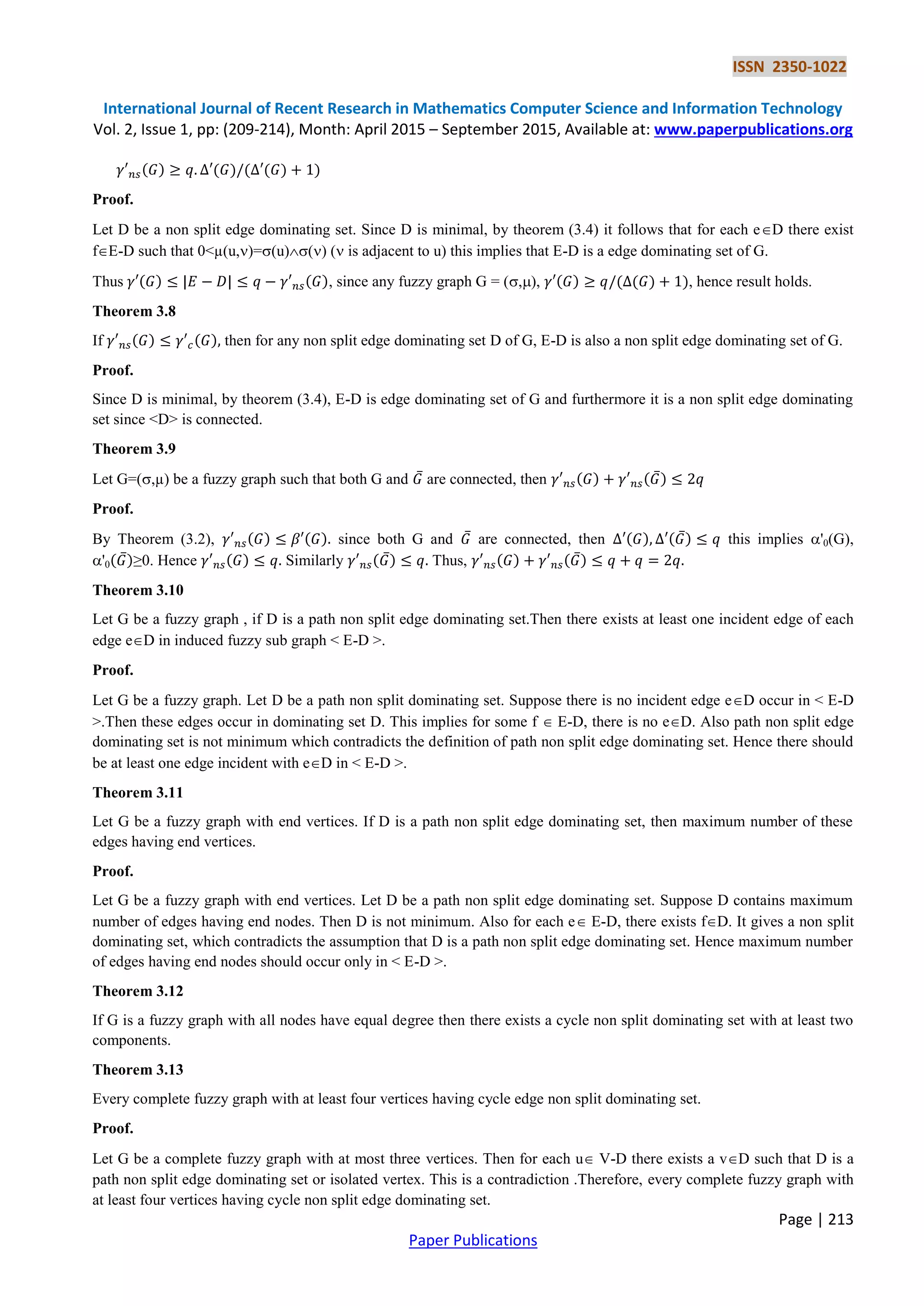
Let D be a non split edge dominating set. Since D is minimal, by theorem (3.4) it follows that for each eD there exist
fE-D such that 0<µ(u,)=(u)() ( is adjacent to u) this implies that E-D is a edge dominating set of G.
Thus , since any fuzzy graph G = (,), , hence result holds.
Theorem 3.8
If then for any non split edge dominating set D of G, E-D is also a non split edge dominating set of G.
Proof.
Since D is minimal, by theorem (3.4), E-D is edge dominating set of G and furthermore it is a non split edge dominating
set since <D> is connected.
Theorem 3.9
Let G=(,µ) be a fuzzy graph such that both G and ̅ are connected, then ̅
Proof.
By Theorem (3.2), since both G and ̅ are connected, then ̅ this implies '0(G),
'0
̅ ≥0. Hence Similarly ̅ Thus, ̅
Theorem 3.10
Let G be a fuzzy graph , if D is a path non split edge dominating set.Then there exists at least one incident edge of each
edge eD in induced fuzzy sub graph < E-D >.
Proof.
Let G be a fuzzy graph. Let D be a path non split dominating set. Suppose there is no incident edge eD occur in < E-D
>.Then these edges occur in dominating set D. This implies for some f  E-D, there is no eD. Also path non split edge
dominating set is not minimum which contradicts the definition of path non split edge dominating set. Hence there should
be at least one edge incident with eD in < E-D >.
Theorem 3.11
Let G be a fuzzy graph with end vertices. If D is a path non split edge dominating set, then maximum number of these
edges having end vertices.
Proof.
Let G be a fuzzy graph with end vertices. Let D be a path non split edge dominating set. Suppose D contains maximum
number of edges having end nodes. Then D is not minimum. Also for each e E-D, there exists fD. It gives a non split
dominating set, which contradicts the assumption that D is a path non split edge dominating set. Hence maximum number
of edges having end nodes should occur only in < E-D >.
Theorem 3.12
If G is a fuzzy graph with all nodes have equal degree then there exists a cycle non split dominating set with at least two
components.
Theorem 3.13
Every complete fuzzy graph with at least four vertices having cycle edge non split dominating set.
Proof.
Let G be a complete fuzzy graph with at most three vertices. Then for each u V-D there exists a vD such that D is a
path non split edge dominating set or isolated vertex. This is a contradiction .Therefore, every complete fuzzy graph with
at least four vertices having cycle non split edge dominating set.
ISSN 2350-1022
International Journal of Recent Research in Mathematics Computer Science and Information Technology
Vol. 2, Issue 1, pp: (209-214), Month: April 2015 – September 2015, Available at: www.paperpublications.org
Page | 214
Paper Publications
ACKNOWLEDGEMENT
Thanks are due to the referees for their valuable comments and suggestions.
REFERENCES
[1] Harary, E., 1969. Graph Theory. Addison Wesley, Reading, MA. McAlester, M.L.N., 1988. Fuzzy intersection
graphs. Comp. Math. Appl. 15(10), 871-886.
[2] Haynes, T.W., Hedetniemi S.T. and Slater P.J. (1998). Domination in Graphs: Advanced Topics, Marcel Dekker Inc.
New York, U.S.A.
[3] Haynes, T.W., Hedetniemi S.T. and Slater P.J. (1998). Fundamentals of domination in graphs, Marcel Dekker Inc.
New York, U.S.A.
[4] Kulli, V.R. and Janakiram B. (1997). The split domination number of graph. Graph Theory notes of New York. New
York Academy of Sciences, XXXII, pp. 16-19.
[5] Mahioub.Q.M. and Soner.N.D (2007), “The split domination number of fuzzy graph “Accepted for publication in
Far East Journal of Applied Mathematics”.
[6] Ore, O. (1962). Theory of Graphs. American Mathematical Society Colloq. Publi., Providence, RI, 38.
[7] Ponnappan.C.Y.,.Basheer Ahamed.S and Surulinathan.P.,Edge domination in fuzzy graph – new approach,
International journal of IT,Engg&Applied sciences Research.Vol 4,No.1,Jan (2015)
[8] Rosenfeld, A., 1975. Fuzzy graphs. In : Zadeh, L.A., Fu, K.S., Shimura, M. (Eds.), Fuzzy Sets and Their
Applications. Academic Press, New York.
[9] Somasundaram, A., and Somasundaram, S., Domination in fuzzy graphs-I, Pattern Recognit. Lett. 19(9) 1998), 787-
791.

Non Split Edge Domination in Fuzzy Graphs

  • 1.
    ISSN 2350-1022 International Journalof Recent Research in Mathematics Computer Science and Information Technology Vol. 2, Issue 1, pp: (209-214), Month: April 2015 – September 2015, Available at: www.paperpublications.org Page | 209 Paper Publications Non Split Edge Domination in Fuzzy Graphs C.Y.Ponnappan1 , S. Basheer Ahamed2 , P.Surulinathan3 , 1 Department of Mathematics, Government Arts College, Paramakudi, Tamilnadu, India 2 Department of Mathematics, P.S.N.A. College of Engineering and Technology, Dindigul, Tamilnadu, India 3 Department of Mathematics, Lathamathavan Engineering College, Kidaripatti, Alagarkovil, Madurai-625301, Tamilnadu, India Abstract: An edge dominating set D of a fuzzy graph G= (σ, µ) is a non-split edge dominating set if the induced fuzzy sub graph H= (<E-D>, σ, µ) is connected. The split edge domination number γns(G) or γns is the minimum fuzzy cardinality of a non-split edge dominating set. In this paper we study a non-split edge dominating set of fuzzy graphs and investigate the relationship of γns (G) with other known parameter of G. Keywords: Fuzzy graphs, fuzzy domination, fuzzy edge domination, fuzzy non split edge domination number. 1. INTRODUCTION The study of domination set in graphs was begun by Ore and Berge. Kulli V.R. et.al introduced the concept of split domination and non-split domination in graphs. Rosenfield introduced the notion of fuzzy graph and several fuzzy analogs of graph theoretic concepts such as path, cycles and connectedness. A.Somasundram and S.Somasundram discussed domination in Fuzzy graphs. They defined domination using effective edges in fuzzy graph. In this paper we discuss the non-split edge domination number of fuzzy graph and establish the relationship with other parameter which is also investigated. 2. PRELIMINARIES Definition 2.1 Let V be a finite non empty set. Let E be the collection of all two element subsets of V. A fuzzy graph G=(σ,µ) is a set with two functions σ :V→[0,1] and µ: E→[0,1] such that µ(uv) ≤ σ(u)σ(v) for all u,v  V. Definition 2.2 Let G=( σ,µ) be a fuzzy graph on V and V1 V. Define σ1 on V1 by σ1(u)=σ(u) for all u V1 and µ1 on the collection E1 of two element subsets of V1 by µ1(u v) = µ(u v) for all u,v  V1, then (σ1,µ1) is called the fuzzy subgraph of G induced by V1 and is denoted by <V1>. Definition 2.3 The order p and size q of a fuzzy graph G= (σ, µ) are defined to be p= u V (u)   and q= uv E (uv)   . Definition 2.4 Let G= (σ, µ) be a fuzzy graph on V and DV then the fuzzy cardinality of D is defined to be u D (u)   . Definition 2.5 Let G = (,) be a fuzzy graph on E and D  E then the fuzzy edge cardinality of D is defined to be e D  (e)
  • 2.
    ISSN 2350-1022 International Journalof Recent Research in Mathematics Computer Science and Information Technology Vol. 2, Issue 1, pp: (209-214), Month: April 2015 – September 2015, Available at: www.paperpublications.org Page | 210 Paper Publications Definition 2.6 An edge e= uv of a fuzzy graph is called an effective edge if µ(uv) = σ(u)  σ(v). N(u) = { vV/ µ(uv) = σ(u)  σ(v)} is called the neighborhood of u and N[u]=N(u)  {u} is the closed neighborhood of u. The effective degree of a vertex u is defined to be the sum of the weights of the effective edges incident at u and is denoted by dE(u). v N(u) (v)   is called the neighborhood degree of u and is denoted by dN(u). The minimum effective degree E(G)=min{dE(u)|uV(G)} and the maximum effective degree E (G) = max{dE(u)|uV(G)}. Definition 2.7 The effective edge degree of an edge e = uv, is defined to be dE(e) = dE(u) dE(v) . The minimum edge effective degree and the maximum edge effective degree are ' E (G) = min {dE(e) | eX} and ' E (G) = max {dE(e) | e X} respectively. N(e) is the set of all effective edges incident with the vertices of e. In a similar way minimum neighborhood degree and the maximum neighborhood degree denoted by ' N and ' N respectively can also be defined. Definition 2.8 The complement of a fuzzy graph G denoted by ̅ is defined to be ̅  ̅ where ̅     Definition 2.9 Let :V [0,1] be a fuzzy subset of V. Then the complete fuzzy graph on  is defined to be (,) where (uv) = (u) (v) for all uvE and is denoted by K. Definition 2.10 A fuzzy graph G= (,) is said to be connected if any two vertices in G are connected. Definition 2.11 Let G = (,) be a fuzzy graph on (V, E). A subset S of E is said to be an edge dominating set in G if for every edge in E- S is adjacent to atleast one effective edge in S. The minimum fuzzy cardinality of an edge dominating set is G is called the edge domination number of G and is denoted by (G) or . Definition 2.12 A fuzzy graph G=(,µ) is said to be bipartite if the vertex V can be partitioned into two nonempty sets V1 and V2 such that µ(v1,v2)=0 if v1,v2V1 or v1,v2V2. Further if (u,v)=(u)  (v) for all uV1 and vV2 then G is called a complete bipartite graph and is denoted by   where 1 and 2 are, respectively, the restrictions of  to V1 and V2. Definition 2.13 An edge Dominating set D of a graph G = (V, E) is a fuzzy split edge dominating set if the induced subgraph <E-D> is disconnected. The split edge domination number γs is the minimum fuzzy cardinality of a split edge dominating set. Remark 2 .14 It is clear that if G has atleast one edge, then 0 ≤ (G) ≤ q. However, if a graph G has no effective edges, then  (G) = 0. Definition 2.15 An edge Dominating set D of a graph G = (V, E) is a fuzzy non split edge dominating set if the induced sub graph <E- D> is connected. The non-split edge domination number γns is the minimum fuzzy cardinality of a non split edge dominating set. Definition 2.16 An edge Dominating set D of a fuzzy graph G=(V,E) is a fuzzy path non split edge dominating set if the induced sub graph <E-D> is a path in G .The path non split edge domination number γpns is the minimum fuzzy cardinality of a path non split edge dominating set.
  • 3.
    ISSN 2350-1022 International Journalof Recent Research in Mathematics Computer Science and Information Technology Vol. 2, Issue 1, pp: (209-214), Month: April 2015 – September 2015, Available at: www.paperpublications.org Page | 211 Paper Publications Definition 2.17 An edge Dominating set D of a fuzzy graph G=(V,E) is a fuzzy cycle non split edge dominating set if the induced sub graph <E-D> is a cycle in G .The cycle non split edge domination number γcns is the minimum fuzzy cardinality of a cycle non split edge dominating set. Definition 2.18 An edge dominating set S of a fuzzy graph G is said to be minimal edge dominating set if no proper subset S is an edge dominating set of G. Definition 2.19 An edge e of a fuzzy graph G is said to be an isolated edge if no effective edges incident with the vertices of e. Thus an isolated edge does not dominate any other edge in G. Definition 2.20 A set D of edges of a fuzzy graph is said to be independent if for every edge e D, no effective edge of D is incident with the vertices of e. An edge dominating set D is a said to be an edge independent edge dominating set if <D> is independent. The minimum fuzzy cardinality of an independent edge dominating set is called the independent edge domination number of G. It is denoted by ' i . Definition 2.21 An edge covering of a fuzzy graph G is a subset F of E such that each vertex of G is an end of some edge in F minimum of edge. The minimum fuzzy edge covering cardinality of G is called the fuzzy edge covering number of G and it is denoted by (G) Definition 2.22 An edge independent set of a fuzzy graph G is a subset F of E such that no two edges of F are adjacent. The maximal edge independent number (G) is defined of the fuzzy cardinality of maximal edge independent set of G. 3. MAIN RESULTS Theorem 3.1 For any fuzzy graph G=(,µ), Proof. By definition of the result is obvious. Theorem 3.2 For any fuzzy graph G= (σ, µ)  where (G) is a fuzzy edge covering number of G. Proof. Let D be a minimal independent fuzzy edge set in G, then D has at least two fuzzy edges and every fuzzy edge in D is incident to some edge in E-D. This implies that E-D is a non split edge dominating set of G thus result holds. Theorem 3.3 For any fuzzy graph G= (σ, µ)  where (G) is a fuzzy edge independent number of G.
  • 4.
    ISSN 2350-1022 International Journalof Recent Research in Mathematics Computer Science and Information Technology Vol. 2, Issue 1, pp: (209-214), Month: April 2015 – September 2015, Available at: www.paperpublications.org Page | 212 Paper Publications Proof. Let D be a maximal independent fuzzy edge set in G, then D has at least two fuzzy edges and every fuzzy edge in D is incident to some edge in E-D. This implies that E-D is a non split edge dominating set of G thus result holds. Example: D = {e1, e2, e5, e6}, V-D = {e3, e4} (G) = 1.3 = 1.1 ' sD = {e3, e6}   F = {e2, e4, e6} (G) = 1.1   Theorem 3.4 A non split edge dominating set Dꞌ of G is minimal if and only if for each edge eDꞌ one of the following conditions holds. (i) There exists an edge fE-Dꞌ such that N(f)Dꞌ={e}. (ii) <E-Dꞌ> is connected. Proof. (i) Suppose that Dꞌ is minimal and there exists an edge eDꞌ such that e does not satisfy any of the above conditions. Then by conditions (i) and (ii), De=Dꞌ-{e} is a dominating set of G, also by (ii), <E-D> is disconnected. This implies that D is non split edge dominating set of G, which is contradiction. Hence <E-Dꞌ> is connected. Theorem 3.5 For any fuzzy graph G = (, µ), Theorem 3.6 For any fuzzy graph G = (, µ), . Theorem 3.7 For any fuzzy graph G=(,µ), u2 0.4u1 0.5 e2 0.4 e3 0.4e1 0.2 u3 0.6 u6 0.2 e4 0.5 e6 0.2 u5 0.3 u4 0.5 e5 0.3
  • 5.
    ISSN 2350-1022 International Journalof Recent Research in Mathematics Computer Science and Information Technology Vol. 2, Issue 1, pp: (209-214), Month: April 2015 – September 2015, Available at: www.paperpublications.org Page | 213 Paper Publications Proof. Let D be a non split edge dominating set. Since D is minimal, by theorem (3.4) it follows that for each eD there exist fE-D such that 0<µ(u,)=(u)() ( is adjacent to u) this implies that E-D is a edge dominating set of G. Thus , since any fuzzy graph G = (,), , hence result holds. Theorem 3.8 If then for any non split edge dominating set D of G, E-D is also a non split edge dominating set of G. Proof. Since D is minimal, by theorem (3.4), E-D is edge dominating set of G and furthermore it is a non split edge dominating set since <D> is connected. Theorem 3.9 Let G=(,µ) be a fuzzy graph such that both G and ̅ are connected, then ̅ Proof. By Theorem (3.2), since both G and ̅ are connected, then ̅ this implies '0(G), '0 ̅ ≥0. Hence Similarly ̅ Thus, ̅ Theorem 3.10 Let G be a fuzzy graph , if D is a path non split edge dominating set.Then there exists at least one incident edge of each edge eD in induced fuzzy sub graph < E-D >. Proof. Let G be a fuzzy graph. Let D be a path non split dominating set. Suppose there is no incident edge eD occur in < E-D >.Then these edges occur in dominating set D. This implies for some f  E-D, there is no eD. Also path non split edge dominating set is not minimum which contradicts the definition of path non split edge dominating set. Hence there should be at least one edge incident with eD in < E-D >. Theorem 3.11 Let G be a fuzzy graph with end vertices. If D is a path non split edge dominating set, then maximum number of these edges having end vertices. Proof. Let G be a fuzzy graph with end vertices. Let D be a path non split edge dominating set. Suppose D contains maximum number of edges having end nodes. Then D is not minimum. Also for each e E-D, there exists fD. It gives a non split dominating set, which contradicts the assumption that D is a path non split edge dominating set. Hence maximum number of edges having end nodes should occur only in < E-D >. Theorem 3.12 If G is a fuzzy graph with all nodes have equal degree then there exists a cycle non split dominating set with at least two components. Theorem 3.13 Every complete fuzzy graph with at least four vertices having cycle edge non split dominating set. Proof. Let G be a complete fuzzy graph with at most three vertices. Then for each u V-D there exists a vD such that D is a path non split edge dominating set or isolated vertex. This is a contradiction .Therefore, every complete fuzzy graph with at least four vertices having cycle non split edge dominating set.
  • 6.
    ISSN 2350-1022 International Journalof Recent Research in Mathematics Computer Science and Information Technology Vol. 2, Issue 1, pp: (209-214), Month: April 2015 – September 2015, Available at: www.paperpublications.org Page | 214 Paper Publications ACKNOWLEDGEMENT Thanks are due to the referees for their valuable comments and suggestions. REFERENCES [1] Harary, E., 1969. Graph Theory. Addison Wesley, Reading, MA. McAlester, M.L.N., 1988. Fuzzy intersection graphs. Comp. Math. Appl. 15(10), 871-886. [2] Haynes, T.W., Hedetniemi S.T. and Slater P.J. (1998). Domination in Graphs: Advanced Topics, Marcel Dekker Inc. New York, U.S.A. [3] Haynes, T.W., Hedetniemi S.T. and Slater P.J. (1998). Fundamentals of domination in graphs, Marcel Dekker Inc. New York, U.S.A. [4] Kulli, V.R. and Janakiram B. (1997). The split domination number of graph. Graph Theory notes of New York. New York Academy of Sciences, XXXII, pp. 16-19. [5] Mahioub.Q.M. and Soner.N.D (2007), “The split domination number of fuzzy graph “Accepted for publication in Far East Journal of Applied Mathematics”. [6] Ore, O. (1962). Theory of Graphs. American Mathematical Society Colloq. Publi., Providence, RI, 38. [7] Ponnappan.C.Y.,.Basheer Ahamed.S and Surulinathan.P.,Edge domination in fuzzy graph – new approach, International journal of IT,Engg&Applied sciences Research.Vol 4,No.1,Jan (2015) [8] Rosenfeld, A., 1975. Fuzzy graphs. In : Zadeh, L.A., Fu, K.S., Shimura, M. (Eds.), Fuzzy Sets and Their Applications. Academic Press, New York. [9] Somasundaram, A., and Somasundaram, S., Domination in fuzzy graphs-I, Pattern Recognit. Lett. 19(9) 1998), 787- 791.