International Reseach Journal,November,2010 ISSN-0975-3486 RNI: RAJBIL 2009/300097 VOL-I *ISSUE 14
64 RESEARCH ANALYSIS AND EVALUATION
Research Paper
123456789012345678901234567890121234567890123456789012345678901212345678901234567890123456789012123456789012345678901234567
123456789012345678901234567890121234567890123456789012345678901212345678901234567890123456789012123456789012345678901234567
123456789012345678901234567890121234567890123456789012345678901212345678901234567890123456789012123456789012345678901234567
123456789012345678901234567890121234567890123456789012345678901212345678901234567890123456789012123456789012345678901234567
123456789012345678901234567890121234567890123456789012345678901212345678901234567890123456789012123456789012345678901234567
123456789012345678901234567890121234567890123456789012345678901212345678901234567890123456789012123456789012345678901234567
November, 2010
1.1INTRODUCTION:
In1859,SirWilliamHamiltondevisedamath-
ematical game on the graph of dodecahedron i.e.
puzzle.Inthispuzzle20verticesofdodecahedronwas
labelled by the name of some city and the objective
of puzzle was construct a tour of all the cities going
throughedgessuchthatnocityappearmorethanone
in the tour. That means one needs to construct a
closed walk that each vertex graph is traced exactly
once. This closed walk is called Hamiltonian circuit
and a graph containing Hamiltonian circuit is called
aHamiltoniangraph.
STUDYOFDIRAC & CHARVALTHEOREM
FOR HAMILTONIAN GRAPH
* Dr. Sudhir Prakash Srivastava
them,eachoflengthatlast2.Thegraphabovefig.2.1
is an example of Theta graph is clear that theta graph
is obviously non-hamiltonian and every non-
homiltonian connected graph has theta subgraph.
Theorem 2.1 :- The complete graph Kn (n³3) is
Hamiltonian.
DuringamathematicalgameongraphofSirWillianHamiltonin1859giveaconceptofHamiltoniangraph.
SeveralnecessaryandsufficientconditionforHamiltoniangraphexist,butnoelegantcharacterizationof
Hamiltonian graph is known. In fact, the problem of determining which graph are Hamiltonian as one the
major problem of graph theory. In this paper we try to determine different graph whether they are
Hamiltonian or not with help of Dirac & Charval Theorem.
A B S T R A C T
1
14
13
12
5
8
9
10
15
20
16
19
18
17
4
3
2
6
7
11
Fig 1.1 : Dodecahedron
In other word a spanning cycle in a graph is
calledHamiltoniancircuitorcycleandagraphhaving
aHamiltoniancyclecalledHamiltoniangraph.Several
necessary and sufficient conditions for Hamiltonian
graph exist but no elegent characterization of Hamil-
tonian graph is known.
2.1Somebasicdefinitionandtheorem
Definition2.1: Ablockwithtwononadjacentvertex
of degree 3 and all other vertices of degree 2 is called
Theta graph.
Fig2.1
ThisimpliesthatThetagraphconsistoftwo
vertices of degree 3 and three disjoining path join
4
6
3
1 2
5
7
Theorem 2.2 :- The complete bipartite
graph Km, n
is Hamiltonian iff m=n and
n>1.
Theorem 2.3:-EveryHamiltoniangraph
is 2-connected. Let G be a Hamiltonian
graphandZbeaHamiltoniancircuitinG.
For any vertex v of G, Z-v is connected
and hence G-v also connected. Hence G
has no cut set and thus G is 2-connected.
Theorem 2.4:-EveryGraphGhasaHamiltonianifthe
sumofdegreeofeverypairverticesVi,VjinGsatisfies
the condition d(Vi
)+ d(Vj
) ³ n-1.
Theorem 2.5 :- Let the number of edges of G be m.
Then G has Hamiltonian circuit if m
³
21
( 3 6)
2
n n− − wherenisthenumberofvertices.
Let u and v are any two vertex of G that are not
adjacent. Suppose H be a graph produced by elimi-
natinguandvfromGalongwithanyedgesthathave
u or v as end point. Then H has n-2 vertices and m-
* IET, Dr. R.M.L.Avadh University, Faizabad-224 001
International Reseach Journal,November,2010 ISSN-0975-3486 RNI: RAJBIL 2009/300097 VOL-I *ISSUE 14
65RESEARCH ANALYSIS AND EVALUATION
deg(u)-deg(v)edges.Themaximumnumberofedges
that H is n-2
C2
.This happens when there is an edges
connecting every distinct pair of vertices. Thus the
numher of edges of H is at must.
or
21
( 5 6 )
2
n n− +
We have
d e g ( ) d e g ( )m u v− −
³
21
( 5 6)
2
n n− +
Therefore
deg( ) deg( )u v+ ³
21
( 5 6)
2
m n n− − +
by the hypothesis of the theorem
deg( ) deg( )u v+ ³
2 21 1
( 3 6) ( 5 6)
2 2
n n n n− + − − +
= n
Hence proved
The following theorem gives a simple and
useful necessary condition for Hamiltonian graph.
Theorem 2.6 :- If G is Hamiltonian, then for every
nonemptypropersubsetSofV(G),W(G-S)£|S|where
W(H) denotes the numbers of components in any
graph H. Let Z be a Hamiltonian circuit of G.& S be
another proper subset of V(G).
Now W(Z-S) £ |S|. Also Z-S is a spanning
subsetofG-S&W(G-S)£W(Z-S)HenceW(G-S)£|S|.
Note2.1Theabovetheoremisusefulinshowingthat
some graph are non Hamiltonian. For example, con-
siderthecompletebipartitegraphKm,n
withm<n.Let
( 1v , 2v ) be a bipartite of the graph with | 1v |=m and
| 2v |=n. The graph Km,n
- 1v is totally disconnected
graph with n point
Hence w K Vm n , − 1d i =n>m=|
1v
|.
So Km,n
is nonhamiltonian.
NOTE2.2:-Theconverseoftheabovetheoremisnot
condition of the theorem but is non Hamiltonian.
Fig2.2:PeterseGraph
3. Dirac Theorem, 1952
Statement : If G is a graph with n³3 vertices and d³n/
2thenGisHamiltonian.
Proof : Let the above statement is false. Let G be
maximal(Duetoedges)nonHamiltoniangraphwith
n vertex & d³n/2
Since n³3, G cannot be complete
Suppose u and v be nonadjacent vertices in G. By the
choices of G, G+uv is Hamiltonian. Since G is non
HamiltoniancircuitofG+uvmustcontainthelineuv
Thus G has a spanning path v1
, v2
, .............vp
with
origin u=v1
and terminal v=up
.
Suppose S={vi
/ uvi+1 ∈E} and T= { vi
/ i < n and vi
v
∈
E } where E is edge set of G. Clearly up
Ï S ÈTand
hence | S È T| < n ............(1)
Again if vi
∈
S Ç T then v1
v2
.....vi
vp
vp-1
.....vi+1
v1
Is
2
3
5
4
b
c
d
e
1
a
true For example the Petersen graph satisfies the
aHamiltoniancircuitinG.
HenceSÇT=ØSothat|SÇT|=0 ………….(2)
AlsobythedefinitionofSandTd(u)=|S| andd(v)=|T|
Hence by (1) and (2) d(u)+d(v)=|S|+|T|
=|S È T|< n
Thus d(u)+d(v) < n
But since d ³ n/2 we have d(u)+d(v) ³ n which give a
contradiction.
Hence theorem prove.
Lemma:LetGbeagraphwithnpointandu;vbenon
adjacent point in G such that d(u)+d(v) ³ n Then G is
HamiltonianifG+uvisHamiltonian.IfGisHamilto-
nian, then G+uv is also Hamiltonian conversely let
G+uv is Hamiltonian, but G is not.
Then as the proof above theorem we obtain
d(u)+d(v)<n, contradicts the hypothesis d(u)+d(v) ³
n Thus G+uv is Hamiltonian ie. G is Hamiltonian.
According to above lemma we find follow-
ing definition of closure.
Definition 3.1 :- The closure of graph G with n point
is the graph obtained from G by repeatedly joing pair
of nonadjacent vertices whose degree sum is at least
nunitnosuchpairremain.TheclosureofGisdenoted
byc(G)
If two persons construct a closure graph then they
ending sane graph.
Theorem3.1:-c(G)iswelldefined.C(G)iscomplete
International Reseach Journal,November,2010 ISSN-0975-3486 RNI: RAJBIL 2009/300097 VOL-I *ISSUE 14
66 RESEARCH ANALYSIS AND EVALUATION
withfollowingexample
c(G).
Clearly|S|=çSç=n-1-
'
( )d v &çTç=n-1-
'
( )d u
......................(3).
Also by the choice of u and v, each vertex
in S has degree at most '
( )d u and each vertex in
TU{u}hasdegreeatmost '
( )d v .Putting(2)inthe
firstequationof(3)weget+|S|>p-1-(p-m)=m-1.
Hence |S| ³ m. Hence c(G) has at least m point with
degree £m. ...................(4)
From(3),|T|=n-1-m.SinceeachvertexinT
U {u} has degree, this implies that c (G) has at least
n-m vertices of degree <p-m ...................(5)
BecauseGisaspanningsubgraphofc(G),degreeof
each point in G cannot exceed that in c(G). hence
statement (4) and (5) hold in the case of G also.
Hence md <mand n md − <n-m.alsoby(1)&(2)
m < n/2. This is contradicts the hypothesis on G.
 c(G) is complete. Hence G is Hamiltonian.
5.Conclusion:-
According to unit 3 and 4 it is clear that
Dirac'sandchvatal'stheoremplayonimportantroll
to decide any graph is Hamilton or not. But both are
theorem is only hypothesis because some graph,
which is not a hamiltonian graph satisfy the law of
above theorem. Some graph not satisfy the law of
above theorem but they are hamiltonian. In general
way by fidning the degree sequence & appying the
above both theorem, after we can deduce that given
graph is hamiltonian. Any graph that satisfies the
hypothesis of Dirac theorem also satisfies the hy-
pothesisofchvatal'stheorem.Hencechvatal'stheo-
rem is stronger than Dirac's theorem.
However the graph G in fig 3.1 has degree
of sequence 2, 2, 3, 3, 3, 3 and it does not satisfy the
hypothesis of Chvatal's theorem.
Fig3.1
Theorem 3.2 :-AgraphisHamiltonianiffitsclosure
isHamiltonian.
Lemma3.2:-LetGbeagraphwithatlest3pointifc(G)
is complete, then G is Hamiltonian. The above theo-
rem and Lemma are useful in showing that a given
graphisHamiltonian.
Forexamplefraphinfig3.1isHamiltonian.
G isHamiltonian.Henced>n/2and n>3=GisHamil-
tonian.
4.ChauatalTheoraem1972
In 1972 a mathematician chauatal proved a theorem
for test he given graph is Hamiltonian or not.
Statement :- Let G be a graph with degree sequence
(d1
d2
.....dn
) where d1
£ d2
£ d3
£ ........ £ dn
and n ³ 3.
Suppose that for every value of m less than n/2 either
dm
> m or dn–m
> n–m (i.e. there is no value of m less
than n/2 for which dm
£ m and dn–m
< n–m. Then G is
Hamiltonian.
Proof :- yet G satisfy the hypothsis of the theorem .
We consider c(G) is completed, suppose we denote
the degree of a vertex v in c(G) by d1
(v).
If the possible, let c(G) be not complete .
Now let u and v be two nonadjacent vertices in c(G)
with
' '
( ) ( )d u d v≤ .....................(1)
and '
( )d u + '
( )d v as large as possible. Let
'
( )d u =m.
Since no two nonadjacent point in c(G) can have
degree sum n or more, we have '
( )d u +
'
( )d v <
n
 '
( )d v < n- '
( )d u  '
( )d v <n-m.........................(2)
Let S-denote the set of vertices in V-
{v}whicharenoadjacenttovinc(G).LetTdenotethe
set of vertices inV-{u} which are not adjacent to u in
1]-Bondy &Murthy : Graph Theory with application Macmillan, London, 1976, Chapter 4&9. 2]-Bermond J.c, Hamiltonian
graph, in selected Topices in graph Theory , Beineke & Wilson Editied, Acadmic press Landon, 1978,127-167page.3]-Bela
Bollobas, Modern Graph Theory, springer, New York, Third Indian reprint 2009,page 15-17.4]-Harary F.(ed), New Directions
in the theory of Graph Academic press, New York, 1973.5]-Lemiak L., Some recent result in Hamiltonian graph; J Graph
Theory , 1977, Page,27-36.6]-Narsingh Deo, Graph theory. With application to Engg. And Computer Science, PHI(EEE),
2008,page30.7]-Ramachandran S., Invitation to Graph Theory, Scitech Pvt Chennai, Page.132-134.8]- T e r e s a W ,
Fundamental of Graph Marecle Dekker 1998.
R E F E R E N C E

64 66

  • 1.
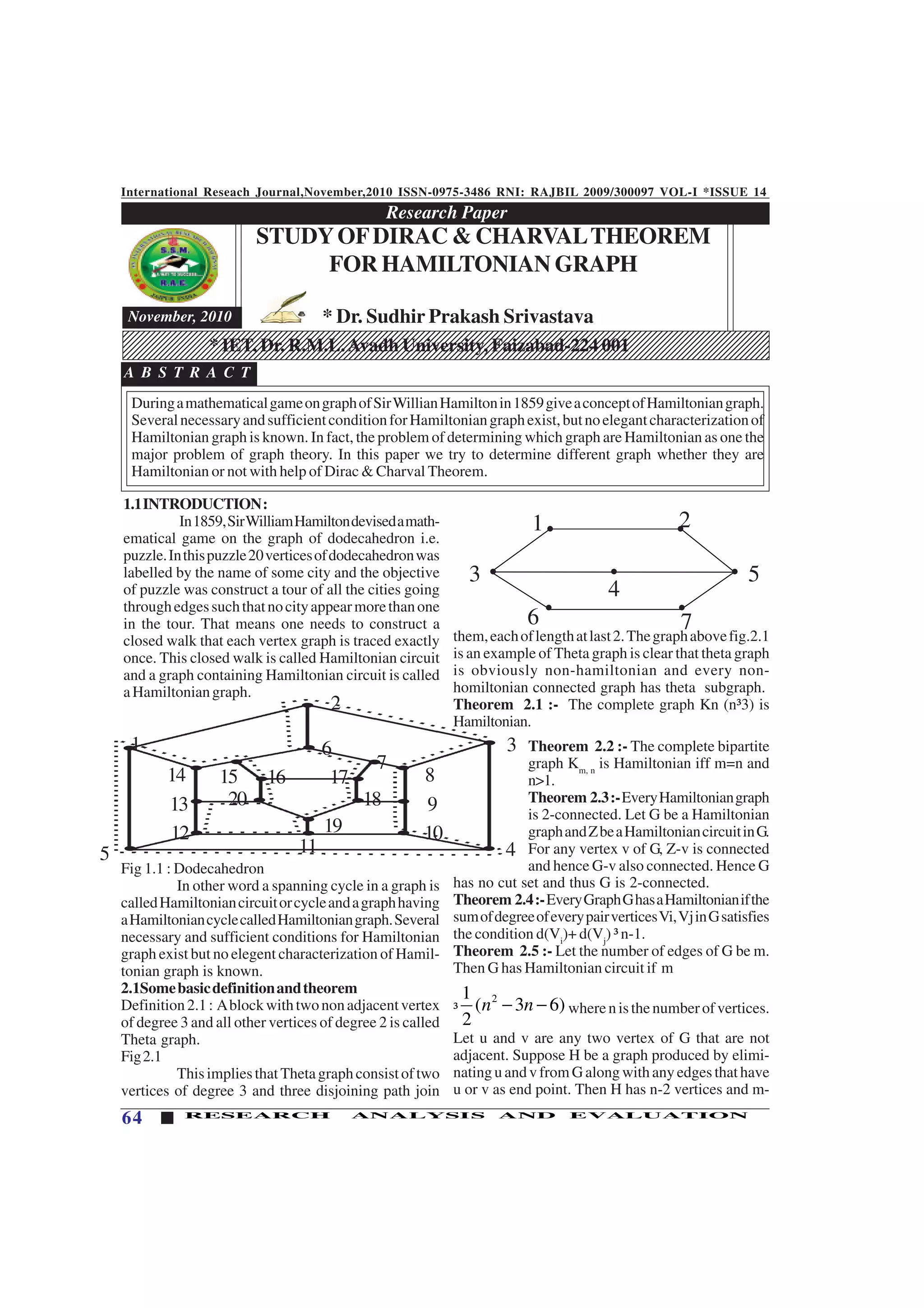
    International Reseach Journal,November,2010ISSN-0975-3486 RNI: RAJBIL 2009/300097 VOL-I *ISSUE 14 64 RESEARCH ANALYSIS AND EVALUATION Research Paper 123456789012345678901234567890121234567890123456789012345678901212345678901234567890123456789012123456789012345678901234567 123456789012345678901234567890121234567890123456789012345678901212345678901234567890123456789012123456789012345678901234567 123456789012345678901234567890121234567890123456789012345678901212345678901234567890123456789012123456789012345678901234567 123456789012345678901234567890121234567890123456789012345678901212345678901234567890123456789012123456789012345678901234567 123456789012345678901234567890121234567890123456789012345678901212345678901234567890123456789012123456789012345678901234567 123456789012345678901234567890121234567890123456789012345678901212345678901234567890123456789012123456789012345678901234567 November, 2010 1.1INTRODUCTION: In1859,SirWilliamHamiltondevisedamath- ematical game on the graph of dodecahedron i.e. puzzle.Inthispuzzle20verticesofdodecahedronwas labelled by the name of some city and the objective of puzzle was construct a tour of all the cities going throughedgessuchthatnocityappearmorethanone in the tour. That means one needs to construct a closed walk that each vertex graph is traced exactly once. This closed walk is called Hamiltonian circuit and a graph containing Hamiltonian circuit is called aHamiltoniangraph. STUDYOFDIRAC & CHARVALTHEOREM FOR HAMILTONIAN GRAPH * Dr. Sudhir Prakash Srivastava them,eachoflengthatlast2.Thegraphabovefig.2.1 is an example of Theta graph is clear that theta graph is obviously non-hamiltonian and every non- homiltonian connected graph has theta subgraph. Theorem 2.1 :- The complete graph Kn (n³3) is Hamiltonian. DuringamathematicalgameongraphofSirWillianHamiltonin1859giveaconceptofHamiltoniangraph. SeveralnecessaryandsufficientconditionforHamiltoniangraphexist,butnoelegantcharacterizationof Hamiltonian graph is known. In fact, the problem of determining which graph are Hamiltonian as one the major problem of graph theory. In this paper we try to determine different graph whether they are Hamiltonian or not with help of Dirac & Charval Theorem. A B S T R A C T 1 14 13 12 5 8 9 10 15 20 16 19 18 17 4 3 2 6 7 11 Fig 1.1 : Dodecahedron In other word a spanning cycle in a graph is calledHamiltoniancircuitorcycleandagraphhaving aHamiltoniancyclecalledHamiltoniangraph.Several necessary and sufficient conditions for Hamiltonian graph exist but no elegent characterization of Hamil- tonian graph is known. 2.1Somebasicdefinitionandtheorem Definition2.1: Ablockwithtwononadjacentvertex of degree 3 and all other vertices of degree 2 is called Theta graph. Fig2.1 ThisimpliesthatThetagraphconsistoftwo vertices of degree 3 and three disjoining path join 4 6 3 1 2 5 7 Theorem 2.2 :- The complete bipartite graph Km, n is Hamiltonian iff m=n and n>1. Theorem 2.3:-EveryHamiltoniangraph is 2-connected. Let G be a Hamiltonian graphandZbeaHamiltoniancircuitinG. For any vertex v of G, Z-v is connected and hence G-v also connected. Hence G has no cut set and thus G is 2-connected. Theorem 2.4:-EveryGraphGhasaHamiltonianifthe sumofdegreeofeverypairverticesVi,VjinGsatisfies the condition d(Vi )+ d(Vj ) ³ n-1. Theorem 2.5 :- Let the number of edges of G be m. Then G has Hamiltonian circuit if m ³ 21 ( 3 6) 2 n n− − wherenisthenumberofvertices. Let u and v are any two vertex of G that are not adjacent. Suppose H be a graph produced by elimi- natinguandvfromGalongwithanyedgesthathave u or v as end point. Then H has n-2 vertices and m- * IET, Dr. R.M.L.Avadh University, Faizabad-224 001
  • 2.
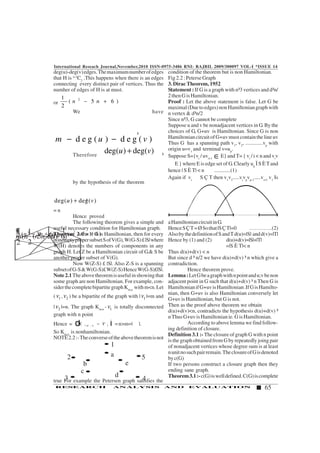
    International Reseach Journal,November,2010ISSN-0975-3486 RNI: RAJBIL 2009/300097 VOL-I *ISSUE 14 65RESEARCH ANALYSIS AND EVALUATION deg(u)-deg(v)edges.Themaximumnumberofedges that H is n-2 C2 .This happens when there is an edges connecting every distinct pair of vertices. Thus the numher of edges of H is at must. or 21 ( 5 6 ) 2 n n− + We have d e g ( ) d e g ( )m u v− − ³ 21 ( 5 6) 2 n n− + Therefore deg( ) deg( )u v+ ³ 21 ( 5 6) 2 m n n− − + by the hypothesis of the theorem deg( ) deg( )u v+ ³ 2 21 1 ( 3 6) ( 5 6) 2 2 n n n n− + − − + = n Hence proved The following theorem gives a simple and useful necessary condition for Hamiltonian graph. Theorem 2.6 :- If G is Hamiltonian, then for every nonemptypropersubsetSofV(G),W(G-S)£|S|where W(H) denotes the numbers of components in any graph H. Let Z be a Hamiltonian circuit of G.& S be another proper subset of V(G). Now W(Z-S) £ |S|. Also Z-S is a spanning subsetofG-S&W(G-S)£W(Z-S)HenceW(G-S)£|S|. Note2.1Theabovetheoremisusefulinshowingthat some graph are non Hamiltonian. For example, con- siderthecompletebipartitegraphKm,n withm<n.Let ( 1v , 2v ) be a bipartite of the graph with | 1v |=m and | 2v |=n. The graph Km,n - 1v is totally disconnected graph with n point Hence w K Vm n , − 1d i =n>m=| 1v |. So Km,n is nonhamiltonian. NOTE2.2:-Theconverseoftheabovetheoremisnot condition of the theorem but is non Hamiltonian. Fig2.2:PeterseGraph 3. Dirac Theorem, 1952 Statement : If G is a graph with n³3 vertices and d³n/ 2thenGisHamiltonian. Proof : Let the above statement is false. Let G be maximal(Duetoedges)nonHamiltoniangraphwith n vertex & d³n/2 Since n³3, G cannot be complete Suppose u and v be nonadjacent vertices in G. By the choices of G, G+uv is Hamiltonian. Since G is non HamiltoniancircuitofG+uvmustcontainthelineuv Thus G has a spanning path v1 , v2 , .............vp with origin u=v1 and terminal v=up . Suppose S={vi / uvi+1 ∈E} and T= { vi / i < n and vi v ∈ E } where E is edge set of G. Clearly up Ï S ÈTand hence | S È T| < n ............(1) Again if vi ∈ S Ç T then v1 v2 .....vi vp vp-1 .....vi+1 v1 Is 2 3 5 4 b c d e 1 a true For example the Petersen graph satisfies the aHamiltoniancircuitinG. HenceSÇT=ØSothat|SÇT|=0 ………….(2) AlsobythedefinitionofSandTd(u)=|S| andd(v)=|T| Hence by (1) and (2) d(u)+d(v)=|S|+|T| =|S È T|< n Thus d(u)+d(v) < n But since d ³ n/2 we have d(u)+d(v) ³ n which give a contradiction. Hence theorem prove. Lemma:LetGbeagraphwithnpointandu;vbenon adjacent point in G such that d(u)+d(v) ³ n Then G is HamiltonianifG+uvisHamiltonian.IfGisHamilto- nian, then G+uv is also Hamiltonian conversely let G+uv is Hamiltonian, but G is not. Then as the proof above theorem we obtain d(u)+d(v)<n, contradicts the hypothesis d(u)+d(v) ³ n Thus G+uv is Hamiltonian ie. G is Hamiltonian. According to above lemma we find follow- ing definition of closure. Definition 3.1 :- The closure of graph G with n point is the graph obtained from G by repeatedly joing pair of nonadjacent vertices whose degree sum is at least nunitnosuchpairremain.TheclosureofGisdenoted byc(G) If two persons construct a closure graph then they ending sane graph. Theorem3.1:-c(G)iswelldefined.C(G)iscomplete
  • 3.
    International Reseach Journal,November,2010ISSN-0975-3486 RNI: RAJBIL 2009/300097 VOL-I *ISSUE 14 66 RESEARCH ANALYSIS AND EVALUATION withfollowingexample c(G). Clearly|S|=çSç=n-1- ' ( )d v &çTç=n-1- ' ( )d u ......................(3). Also by the choice of u and v, each vertex in S has degree at most ' ( )d u and each vertex in TU{u}hasdegreeatmost ' ( )d v .Putting(2)inthe firstequationof(3)weget+|S|>p-1-(p-m)=m-1. Hence |S| ³ m. Hence c(G) has at least m point with degree £m. ...................(4) From(3),|T|=n-1-m.SinceeachvertexinT U {u} has degree, this implies that c (G) has at least n-m vertices of degree <p-m ...................(5) BecauseGisaspanningsubgraphofc(G),degreeof each point in G cannot exceed that in c(G). hence statement (4) and (5) hold in the case of G also. Hence md <mand n md − <n-m.alsoby(1)&(2) m < n/2. This is contradicts the hypothesis on G. c(G) is complete. Hence G is Hamiltonian. 5.Conclusion:- According to unit 3 and 4 it is clear that Dirac'sandchvatal'stheoremplayonimportantroll to decide any graph is Hamilton or not. But both are theorem is only hypothesis because some graph, which is not a hamiltonian graph satisfy the law of above theorem. Some graph not satisfy the law of above theorem but they are hamiltonian. In general way by fidning the degree sequence & appying the above both theorem, after we can deduce that given graph is hamiltonian. Any graph that satisfies the hypothesis of Dirac theorem also satisfies the hy- pothesisofchvatal'stheorem.Hencechvatal'stheo- rem is stronger than Dirac's theorem. However the graph G in fig 3.1 has degree of sequence 2, 2, 3, 3, 3, 3 and it does not satisfy the hypothesis of Chvatal's theorem. Fig3.1 Theorem 3.2 :-AgraphisHamiltonianiffitsclosure isHamiltonian. Lemma3.2:-LetGbeagraphwithatlest3pointifc(G) is complete, then G is Hamiltonian. The above theo- rem and Lemma are useful in showing that a given graphisHamiltonian. Forexamplefraphinfig3.1isHamiltonian. G isHamiltonian.Henced>n/2and n>3=GisHamil- tonian. 4.ChauatalTheoraem1972 In 1972 a mathematician chauatal proved a theorem for test he given graph is Hamiltonian or not. Statement :- Let G be a graph with degree sequence (d1 d2 .....dn ) where d1 £ d2 £ d3 £ ........ £ dn and n ³ 3. Suppose that for every value of m less than n/2 either dm > m or dn–m > n–m (i.e. there is no value of m less than n/2 for which dm £ m and dn–m < n–m. Then G is Hamiltonian. Proof :- yet G satisfy the hypothsis of the theorem . We consider c(G) is completed, suppose we denote the degree of a vertex v in c(G) by d1 (v). If the possible, let c(G) be not complete . Now let u and v be two nonadjacent vertices in c(G) with ' ' ( ) ( )d u d v≤ .....................(1) and ' ( )d u + ' ( )d v as large as possible. Let ' ( )d u =m. Since no two nonadjacent point in c(G) can have degree sum n or more, we have ' ( )d u + ' ( )d v < n ' ( )d v < n- ' ( )d u ' ( )d v <n-m.........................(2) Let S-denote the set of vertices in V- {v}whicharenoadjacenttovinc(G).LetTdenotethe set of vertices inV-{u} which are not adjacent to u in 1]-Bondy &Murthy : Graph Theory with application Macmillan, London, 1976, Chapter 4&9. 2]-Bermond J.c, Hamiltonian graph, in selected Topices in graph Theory , Beineke & Wilson Editied, Acadmic press Landon, 1978,127-167page.3]-Bela Bollobas, Modern Graph Theory, springer, New York, Third Indian reprint 2009,page 15-17.4]-Harary F.(ed), New Directions in the theory of Graph Academic press, New York, 1973.5]-Lemiak L., Some recent result in Hamiltonian graph; J Graph Theory , 1977, Page,27-36.6]-Narsingh Deo, Graph theory. With application to Engg. And Computer Science, PHI(EEE), 2008,page30.7]-Ramachandran S., Invitation to Graph Theory, Scitech Pvt Chennai, Page.132-134.8]- T e r e s a W , Fundamental of Graph Marecle Dekker 1998. R E F E R E N C E