Solutions, Solvents, and Solutes
D. Crowley, 2007
To understand the terms solution, solute, soluble, insoluble, dissolve
and solvent
Solutions, Solvents & Solutes
 Look at the different liquids - are these pure, or are they
mixtures? Explain your answer with reference to particles…
 So, if lots are things are jumbled up together we have a mixture,
e.g. sea water is a mixture of water particles, salt particles,
different chemical particles etc…
 Look at this ‘pure’ water - what happens when some sugar is
added to it?
 I now have a mixture of water & sugar; but the sugar seems to
have disappeared!
 What has happened?
Pure or Mixture
 Even though the water still looks ‘pure’, this term is wrong. Pure would
mean there were only water particles, however we now have water
particles + sugar particles!
 The sugar has not disappeared - instead it has dissolved in the water
 We would call the water + sugar a solution
 A solid dissolved in a liquid makes a solution
 In a solution the liquid is called the solvent, and the solid is called the
solute
Pure?!
Solute Solvent Solution
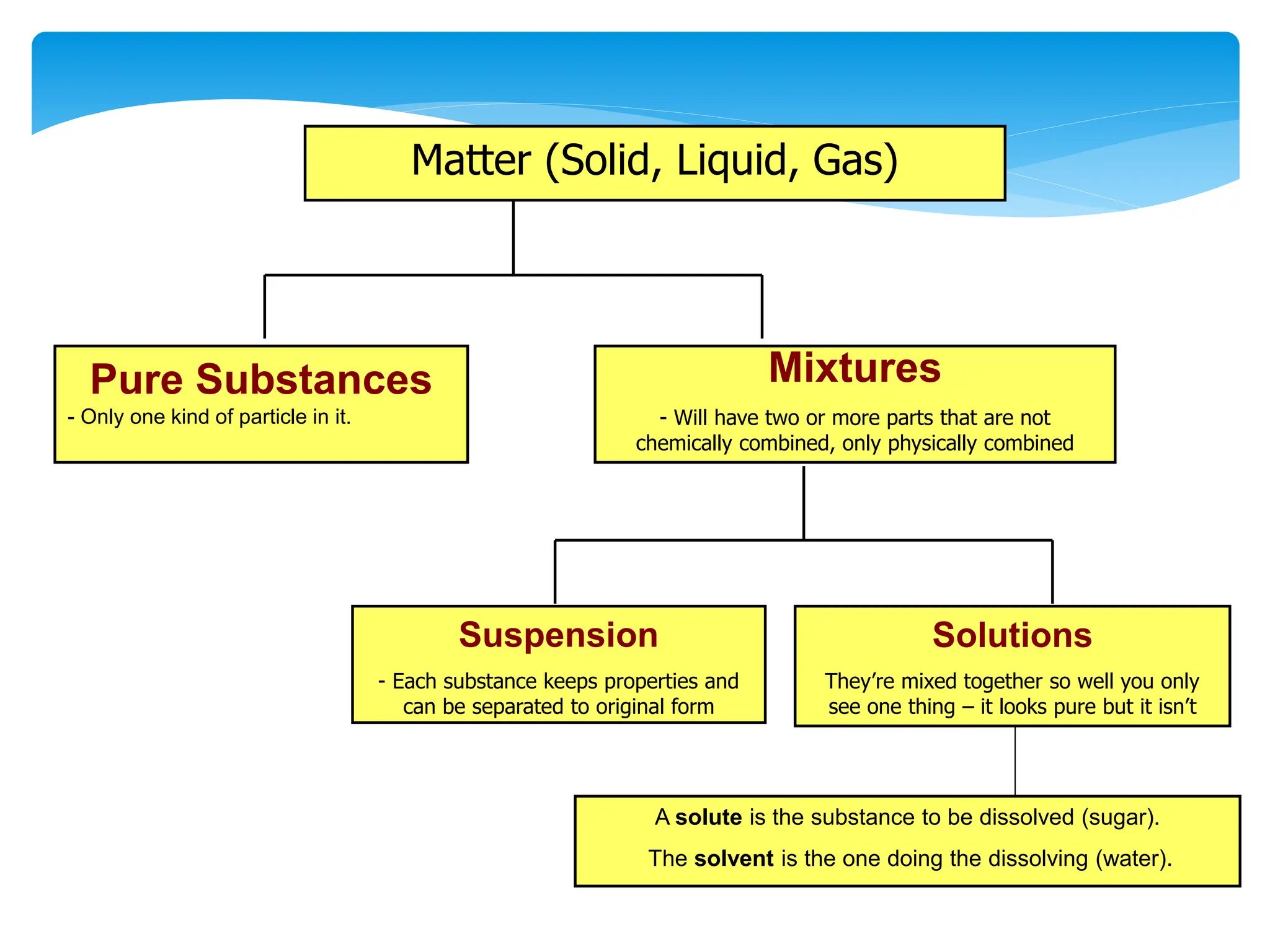
Mixtures
- Will have two or more parts that are not
chemically combined, only physically combined
Matter (Solid, Liquid, Gas)
Solutions
They’re mixed together so well you only
see one thing – it looks pure but it isn’t
Pure Substances
- Only one kind of particle in it.
Suspension
- Each substance keeps properties and
can be separated to original form
A solute is the substance to be dissolved (sugar).
The solvent is the one doing the dissolving (water).
Examples
Mixtures
 Chex Mix
 Raisin Bran
 Pizza
 Sand
Solutions
 Soda
 Gasoline
 Brass (Zinc/Copper)
 Vinegar
These words need to be learned - however, be careful because they
all sound pretty similar!
Solution - the mixture formed when a substance dissolves in it
Solute - the substance that dissolves
Solvent - the liquid in the solution
Dissolve - mixing of a substance in a liquid
Soluble - a substance which can dissolve (mix in a liquid)
Insoluble - a substance which cannot dissolve (mix in a liquid)
They all sound the same!
Solute Solvent Solution
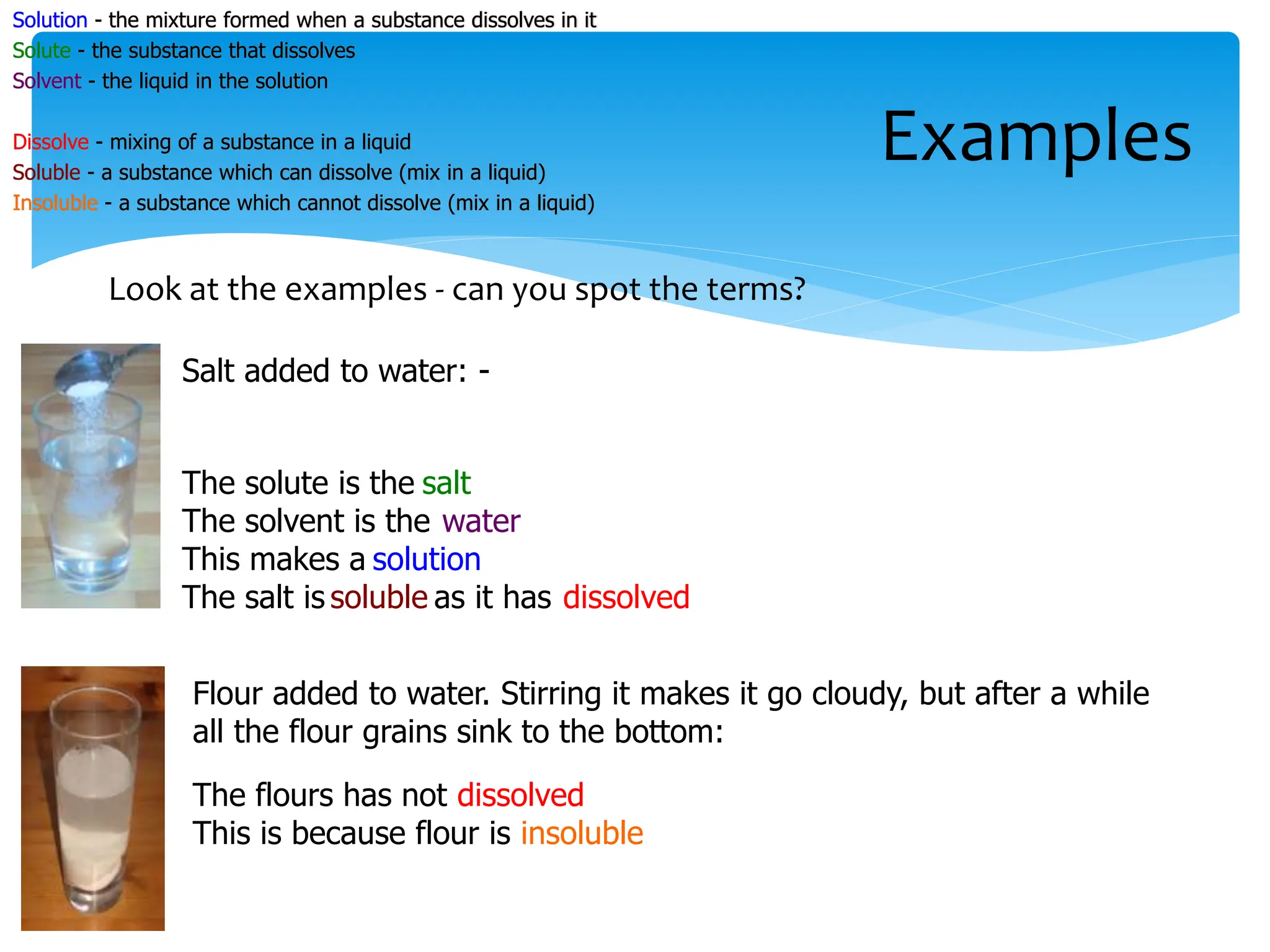
Look at the examples - can you spot the terms?
Examples
Solution - the mixture formed when a substance dissolves in it
Solute - the substance that dissolves
Solvent - the liquid in the solution
Dissolve - mixing of a substance in a liquid
Soluble - a substance which can dissolve (mix in a liquid)
Insoluble - a substance which cannot dissolve (mix in a liquid)
The solute is the
The solvent is the
This makes a
The salt is as it has
salt
water
solution
soluble dissolved
Salt added to water: -
Flour added to water. Stirring it makes it go cloudy, but after a while
all the flour grains sink to the bottom:
The flours has not
This is because flour is
dissolved
insoluble
 So when a solute dissolves, such as salt in water, where does it go? Does it
disappear?
 The solute does not disappear - its still there! But you cannot see it because
the particles are now mixed up (dissolved)
 Look at the particle box below - can you draw a particle box for a solid
which has dissolved (e.g. salt in water)
Where
Water
Salt, added to
the water
Solution - the mixture formed when a substance dissolves in it
Solute - the substance that dissolves
Solvent - the liquid in the solution
Dissolve - mixing of a substance in a liquid
Soluble - a substance which can dissolve (mix in a liquid)
Insoluble - a substance which cannot dissolve (mix in a liquid)
 Particle box for a solid which has dissolved (e.g. salt in water)
Where
Solution - the mixture formed when a substance dissolves in it
Solute - the substance that dissolves
Solvent - the liquid in the solution
Dissolve - mixing of a substance in a liquid
Soluble - a substance which can dissolve (mix in a liquid)
Insoluble - a substance which cannot dissolve (mix in a liquid)
Water
Salt, added to
the water
The number of salt particles and the number of water particles remains
the same - we haven’t lost any salt particles, nor have they got smaller.
They’re just spread out amongst the water particles, which is why we can
no longer see them (it looks as if the salt has disappeared)!
 Look at the particle box below - can you draw a particle box for an insoluble
solid in a liquid (e.g. flour in water)
Where
Solution - the mixture formed when a substance dissolves in it
Solute - the substance that dissolves
Solvent - the liquid in the solution
Dissolve - mixing of a substance in a liquid
Soluble - a substance which can dissolve (mix in a liquid)
Insoluble - a substance which cannot dissolve (mix in a liquid)
Water
Flour, added
to the water
 Particle box for an insoluble solid in a liquid (e.g. flour in water)
Where
Solution - the mixture formed when a substance dissolves in it
Solute - the substance that dissolves
Solvent - the liquid in the solution
Dissolve - mixing of a substance in a liquid
Soluble - a substance which can dissolve (mix in a liquid)
Insoluble - a substance which cannot dissolve (mix in a liquid)
Water
Flour, added
to the water
Remember - the number of particles and their size stays the same!
However this time we can still see the flour, as the flour particles
remain grouped together (no mixing (dissolving))
 A solution is always transparent - even it has a color
 If our liquid remains cloudy, then the solute has not completely dissolved
 If a substance will not dissolve (insoluble) then it will settle and be obvious
How do we know?
 There is a solution in the first beaker (as it is transparent), even though it is
colored red
 Milk (second beaker) contains water + fat. The fat has not completely
dissolved in the liquid as it is cloudy (Colloid)
 Flour is insoluble. This is why it settles at the bottom (stirring makes it go
cloudy, but eventually the flour particles settle to the bottom) (Suspension)
If lots of different things are jumbled up together, we have a
mixture. If you mix salt with water then the grains seem to
disappear. This is because the grains have split up and mixed with
the water. They have dissolved. A substance that dissolves is said
to be soluble.
A solid dissolved in liquid makes a solution. In a solution the liquid
is called the solvent, and the solid is called the solute. A solid that
does not dissolve in a liquid is called insoluble. If a solid has
completely dissolved in a liquid, then the solution is always
transparent (see-through), even if it has a color.
Solution - the mixture formed when a substance dissolves in it
Solute - the substance that dissolves
Solvent - the liquid in the solution
Dissolve - mixing of a substance in a liquid
Soluble - a substance which can dissolve (mix in a liquid)
Insoluble - a substance which cannot dissolve (mix in a liquid)
Solution - the mixture formed when a substance dissolves in it
Solute - the substance that dissolves
Solvent - the liquid in the solution
Dissolve - mixing of a substance in a liquid
Soluble - a substance which can dissolve (mix in a liquid)
Insoluble - a substance which cannot dissolve (mix in a liquid)

07-Solutions-Solvents-Solutes for Yr 8.ppt

  • 1.
    Solutions, Solvents, andSolutes D. Crowley, 2007
  • 2.
    To understand theterms solution, solute, soluble, insoluble, dissolve and solvent Solutions, Solvents & Solutes
  • 3.
     Look atthe different liquids - are these pure, or are they mixtures? Explain your answer with reference to particles…  So, if lots are things are jumbled up together we have a mixture, e.g. sea water is a mixture of water particles, salt particles, different chemical particles etc…  Look at this ‘pure’ water - what happens when some sugar is added to it?  I now have a mixture of water & sugar; but the sugar seems to have disappeared!  What has happened? Pure or Mixture
  • 4.
     Even thoughthe water still looks ‘pure’, this term is wrong. Pure would mean there were only water particles, however we now have water particles + sugar particles!  The sugar has not disappeared - instead it has dissolved in the water  We would call the water + sugar a solution  A solid dissolved in a liquid makes a solution  In a solution the liquid is called the solvent, and the solid is called the solute Pure?! Solute Solvent Solution
  • 5.
    Mixtures - Will havetwo or more parts that are not chemically combined, only physically combined Matter (Solid, Liquid, Gas) Solutions They’re mixed together so well you only see one thing – it looks pure but it isn’t Pure Substances - Only one kind of particle in it. Suspension - Each substance keeps properties and can be separated to original form A solute is the substance to be dissolved (sugar). The solvent is the one doing the dissolving (water).
  • 6.
    Examples Mixtures  Chex Mix Raisin Bran  Pizza  Sand Solutions  Soda  Gasoline  Brass (Zinc/Copper)  Vinegar
  • 7.
    These words needto be learned - however, be careful because they all sound pretty similar! Solution - the mixture formed when a substance dissolves in it Solute - the substance that dissolves Solvent - the liquid in the solution Dissolve - mixing of a substance in a liquid Soluble - a substance which can dissolve (mix in a liquid) Insoluble - a substance which cannot dissolve (mix in a liquid) They all sound the same! Solute Solvent Solution
  • 8.
    Look at theexamples - can you spot the terms? Examples Solution - the mixture formed when a substance dissolves in it Solute - the substance that dissolves Solvent - the liquid in the solution Dissolve - mixing of a substance in a liquid Soluble - a substance which can dissolve (mix in a liquid) Insoluble - a substance which cannot dissolve (mix in a liquid) The solute is the The solvent is the This makes a The salt is as it has salt water solution soluble dissolved Salt added to water: - Flour added to water. Stirring it makes it go cloudy, but after a while all the flour grains sink to the bottom: The flours has not This is because flour is dissolved insoluble
  • 9.
     So whena solute dissolves, such as salt in water, where does it go? Does it disappear?  The solute does not disappear - its still there! But you cannot see it because the particles are now mixed up (dissolved)  Look at the particle box below - can you draw a particle box for a solid which has dissolved (e.g. salt in water) Where Water Salt, added to the water Solution - the mixture formed when a substance dissolves in it Solute - the substance that dissolves Solvent - the liquid in the solution Dissolve - mixing of a substance in a liquid Soluble - a substance which can dissolve (mix in a liquid) Insoluble - a substance which cannot dissolve (mix in a liquid)
  • 10.
     Particle boxfor a solid which has dissolved (e.g. salt in water) Where Solution - the mixture formed when a substance dissolves in it Solute - the substance that dissolves Solvent - the liquid in the solution Dissolve - mixing of a substance in a liquid Soluble - a substance which can dissolve (mix in a liquid) Insoluble - a substance which cannot dissolve (mix in a liquid) Water Salt, added to the water The number of salt particles and the number of water particles remains the same - we haven’t lost any salt particles, nor have they got smaller. They’re just spread out amongst the water particles, which is why we can no longer see them (it looks as if the salt has disappeared)!
  • 11.
     Look atthe particle box below - can you draw a particle box for an insoluble solid in a liquid (e.g. flour in water) Where Solution - the mixture formed when a substance dissolves in it Solute - the substance that dissolves Solvent - the liquid in the solution Dissolve - mixing of a substance in a liquid Soluble - a substance which can dissolve (mix in a liquid) Insoluble - a substance which cannot dissolve (mix in a liquid) Water Flour, added to the water
  • 12.
     Particle boxfor an insoluble solid in a liquid (e.g. flour in water) Where Solution - the mixture formed when a substance dissolves in it Solute - the substance that dissolves Solvent - the liquid in the solution Dissolve - mixing of a substance in a liquid Soluble - a substance which can dissolve (mix in a liquid) Insoluble - a substance which cannot dissolve (mix in a liquid) Water Flour, added to the water Remember - the number of particles and their size stays the same! However this time we can still see the flour, as the flour particles remain grouped together (no mixing (dissolving))
  • 13.
     A solutionis always transparent - even it has a color  If our liquid remains cloudy, then the solute has not completely dissolved  If a substance will not dissolve (insoluble) then it will settle and be obvious How do we know?  There is a solution in the first beaker (as it is transparent), even though it is colored red  Milk (second beaker) contains water + fat. The fat has not completely dissolved in the liquid as it is cloudy (Colloid)  Flour is insoluble. This is why it settles at the bottom (stirring makes it go cloudy, but eventually the flour particles settle to the bottom) (Suspension)
  • 14.
    If lots ofdifferent things are jumbled up together, we have a mixture. If you mix salt with water then the grains seem to disappear. This is because the grains have split up and mixed with the water. They have dissolved. A substance that dissolves is said to be soluble. A solid dissolved in liquid makes a solution. In a solution the liquid is called the solvent, and the solid is called the solute. A solid that does not dissolve in a liquid is called insoluble. If a solid has completely dissolved in a liquid, then the solution is always transparent (see-through), even if it has a color. Solution - the mixture formed when a substance dissolves in it Solute - the substance that dissolves Solvent - the liquid in the solution Dissolve - mixing of a substance in a liquid Soluble - a substance which can dissolve (mix in a liquid) Insoluble - a substance which cannot dissolve (mix in a liquid)
  • 15.
    Solution - themixture formed when a substance dissolves in it Solute - the substance that dissolves Solvent - the liquid in the solution Dissolve - mixing of a substance in a liquid Soluble - a substance which can dissolve (mix in a liquid) Insoluble - a substance which cannot dissolve (mix in a liquid)

Editor's Notes

  • #4 The different liquids should be: clear water, colored water, flour (or cornstarch) in water, sand in water, have sugar ready to create a sugar water solution.