Resources for
Measuring and
Maximizing
Research Impact
Rachel Borchardt, Science Librarian
borchard@american.edu
August 24, 2015
Maximizing Research Impact
• Making strategic publication decisions
• Maximizing exposure of your research
• Utilizing tools to track scholarly impact and engagement
Quick note about accessing resources
All resources discussed are available through:
tinyurl.com/AUmetrics
(on or off campus!)
Another quick note
• These are not necessarily concrete facts!
• Check departmental guidelines, tenure manual, CFA guideline
• When in doubt, ask others in your department
• Many, many differences across campus
Research prior to publication*
*primarily journal article publication
Strategic Publication
Decisions:
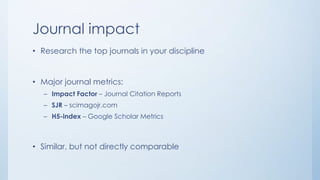
Journal impact
• Research the top journals in your discipline
• Major journal metrics:
– Impact Factor – Journal Citation Reports
– SJR – scimagojr.com
– H5-index – Google Scholar Metrics
• Similar, but not directly comparable
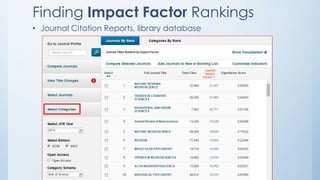
Finding Impact Factor Rankings
• Journal Citation Reports, library database
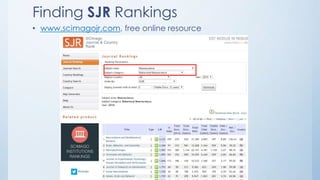
Finding SJR Rankings
• www.scimagojr.com, free online resource
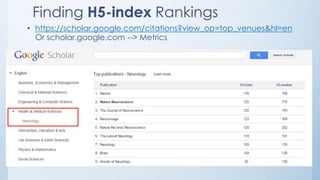
Finding H5-index Rankings
• https://scholar.google.com/citations?view_op=top_venues&hl=en
Or scholar.google.com --> Metrics
Other Considerations
• What is valued in your department?
• Journal acceptance rates
• Niche vs. broad vs. interdisciplinary journal scope
• Book publication considerations – publisher prestige
• Journal quality vs. article quality
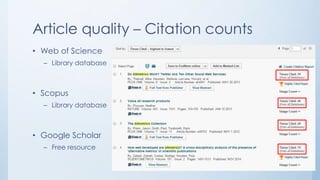
Article quality – Citation counts
• Web of Science
– Library database
• Scopus
– Library database
• Google Scholar
– Free resource
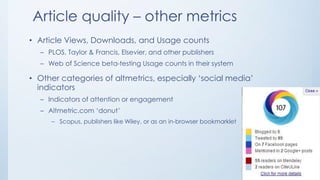
Article quality – other metrics
• Article Views, Downloads, and Usage counts
– PLOS, Taylor & Francis, Elsevier, and other publishers
– Web of Science beta-testing Usage counts in their system
• Other categories of altmetrics, especially ‘social media’
indicators
– Indicators of attention or engagement
– Altmetric.com ‘donut’
– Scopus, publishers like Wiley, or as an in-browser bookmarklet
Maximizing
Research Exposure:
How can people find my research?
Ways to Maximize Exposure
• Google Scholar profile
• Publishing Open Access
• Engaging abstract and keywords
• Scholarly networks
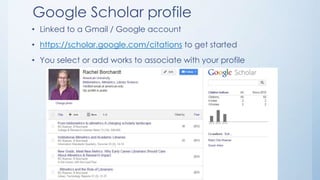
Google Scholar profile
• Linked to a Gmail / Google account
• https://scholar.google.com/citations to get started
• You select or add works to associate with your profile
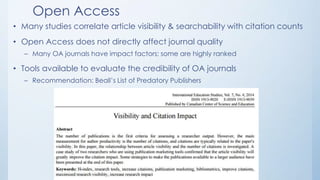
Open Access
• Many studies correlate article visibility & searchability with citation counts
• Open Access does not directly affect journal quality
– Many OA journals have impact factors; some are highly ranked
• Tools available to evaluate the credibility of OA journals
– Recommendation: Beall’s List of Predatory Publishers
Abstract and keywords
• Engaging abstract
– Quick overview, including most relevant results
– Easily understood by researchers and others
• Appropriate keywords
– Both jargon-based and laymen
– Not everyone searching for information is necessarily a researcher in your
field
– Consider words not in your title/abstract
Maximizing Exposure and
Tracking Engagement:
Scholarly Networks and other tools
Scholarly Networks
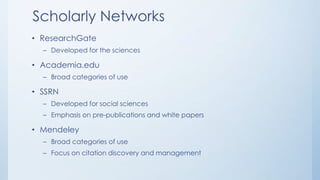
• ResearchGate
– Developed for the sciences
• Academia.edu
– Broad categories of use
• SSRN
– Developed for social sciences
– Emphasis on pre-publications and white papers
• Mendeley
– Broad categories of use
– Focus on citation discovery and management
Scholarly Networks
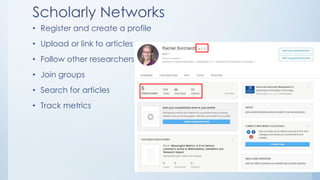
• Register and create a profile
• Upload or link to articles
• Follow other researchers
• Join groups
• Search for articles
• Track metrics
Other tools for tracking scholarship
and engagement
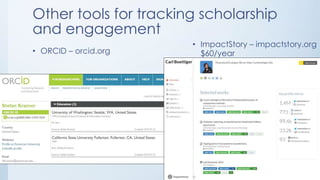
• ORCID – orcid.org
• ImpactStory – impactstory.org
$60/year
Closing thoughts
• How can I provide evidence of my scholarly impact?
– How can I track my evidence along the way?
• Who will be evaluating my scholarship?
• What is the best way to measure impact in my discipline?
Library Assistance and
Resources
Rachel Borchardt
borchard@american.edu
Metrics research guide:
http://tinyurl.com/AUmetrics
Faculty research guide:
http://subjectguides.library.american.edu
/faculty_research
Questions?

Resources for measuring and maximizing research impact fall 2015

  • 1.
    Resources for Measuring and Maximizing ResearchImpact Rachel Borchardt, Science Librarian borchard@american.edu August 24, 2015
  • 2.
    Maximizing Research Impact •Making strategic publication decisions • Maximizing exposure of your research • Utilizing tools to track scholarly impact and engagement
  • 3.
    Quick note aboutaccessing resources All resources discussed are available through: tinyurl.com/AUmetrics (on or off campus!)
  • 4.
    Another quick note •These are not necessarily concrete facts! • Check departmental guidelines, tenure manual, CFA guideline • When in doubt, ask others in your department • Many, many differences across campus
  • 5.
    Research prior topublication* *primarily journal article publication Strategic Publication Decisions:
  • 6.
    Journal impact • Researchthe top journals in your discipline • Major journal metrics: – Impact Factor – Journal Citation Reports – SJR – scimagojr.com – H5-index – Google Scholar Metrics • Similar, but not directly comparable
  • 7.
    Finding Impact FactorRankings • Journal Citation Reports, library database
  • 8.
    Finding SJR Rankings •www.scimagojr.com, free online resource
  • 9.
    Finding H5-index Rankings •https://scholar.google.com/citations?view_op=top_venues&hl=en Or scholar.google.com --> Metrics
  • 10.
    Other Considerations • Whatis valued in your department? • Journal acceptance rates • Niche vs. broad vs. interdisciplinary journal scope • Book publication considerations – publisher prestige • Journal quality vs. article quality
  • 11.
    Article quality –Citation counts • Web of Science – Library database • Scopus – Library database • Google Scholar – Free resource
  • 12.
    Article quality –other metrics • Article Views, Downloads, and Usage counts – PLOS, Taylor & Francis, Elsevier, and other publishers – Web of Science beta-testing Usage counts in their system • Other categories of altmetrics, especially ‘social media’ indicators – Indicators of attention or engagement – Altmetric.com ‘donut’ – Scopus, publishers like Wiley, or as an in-browser bookmarklet
  • 13.
    Maximizing Research Exposure: How canpeople find my research?
  • 14.
    Ways to MaximizeExposure • Google Scholar profile • Publishing Open Access • Engaging abstract and keywords • Scholarly networks
  • 15.
    Google Scholar profile •Linked to a Gmail / Google account • https://scholar.google.com/citations to get started • You select or add works to associate with your profile
  • 16.
    Open Access • Manystudies correlate article visibility & searchability with citation counts • Open Access does not directly affect journal quality – Many OA journals have impact factors; some are highly ranked • Tools available to evaluate the credibility of OA journals – Recommendation: Beall’s List of Predatory Publishers
  • 17.
    Abstract and keywords •Engaging abstract – Quick overview, including most relevant results – Easily understood by researchers and others • Appropriate keywords – Both jargon-based and laymen – Not everyone searching for information is necessarily a researcher in your field – Consider words not in your title/abstract
  • 18.
    Maximizing Exposure and TrackingEngagement: Scholarly Networks and other tools
  • 19.
    Scholarly Networks • ResearchGate –Developed for the sciences • Academia.edu – Broad categories of use • SSRN – Developed for social sciences – Emphasis on pre-publications and white papers • Mendeley – Broad categories of use – Focus on citation discovery and management
  • 20.
    Scholarly Networks • Registerand create a profile • Upload or link to articles • Follow other researchers • Join groups • Search for articles • Track metrics
  • 21.
    Other tools fortracking scholarship and engagement • ORCID – orcid.org • ImpactStory – impactstory.org $60/year
  • 22.
    Closing thoughts • Howcan I provide evidence of my scholarly impact? – How can I track my evidence along the way? • Who will be evaluating my scholarship? • What is the best way to measure impact in my discipline?
  • 23.
    Library Assistance and Resources RachelBorchardt borchard@american.edu Metrics research guide: http://tinyurl.com/AUmetrics Faculty research guide: http://subjectguides.library.american.edu /faculty_research
  • 24.