Google Scholar Can it really be used for bibliometrics? Isobel Stark & Michael Whitton June 2011
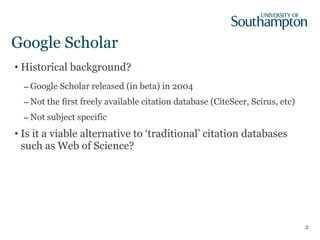
Google Scholar Historical background? Google Scholar released (in beta) in 2004 Not the first freely available citation database (CiteSeer, Scirus, etc) Not subject specific Is it a viable alternative to ‘traditional’ citation databases such as Web of Science?
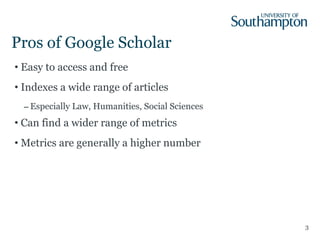
Pros of Google Scholar Easy to access and free Indexes a wide range of articles Especially Law, Humanities, Social Sciences Can find a wider range of metrics Metrics are generally a higher number
Cons of Google Scholar Questionable data Lack of de-duplication Gaps Relies on algorithms Not designed for popular bibliometric measures Requires add-ons to calculate  h -index etc.
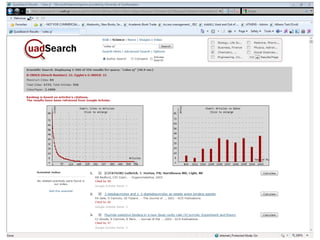
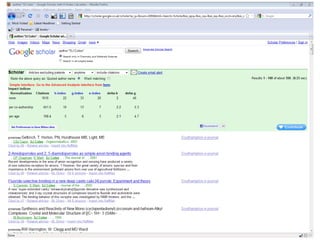
Recommended services ( h -index on GS) Quadsearch (Any browser) Scholar  H -index Calculator (Mozilla Firefox) Scholarometer (Mozilla Firefox/Google Chrome) Publish or Perish (Separate Application)


How our researchers use it CVs and bids for funding Preferred by Medicine over InCites Factsheet for “Finding your  h -index in Google Scholar” is very popular 6,764 visits in the last year To compare WoS  h -Index guide is 1,559 and Impact Factors 1,045
From the literature … Bar-Illan (2008) – Israeli highly cited researchers Significant differences from WoS and Scopus Metrics can be higher (computer science), similar or lower (physics) Jasco (2008) Problems of missing & wrong authors Prolific authors F Password & M Profile Specific problems often resolved
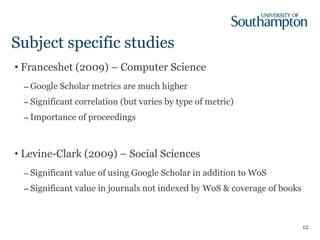
Subject specific studies Franceshet (2009) – Computer Science Google Scholar metrics are much higher Significant correlation (but varies by type of metric) Importance of proceedings Levine-Clark (2009) – Social Sciences Significant value of using Google Scholar in addition to WoS Significant value in journals not indexed by WoS & coverage of books
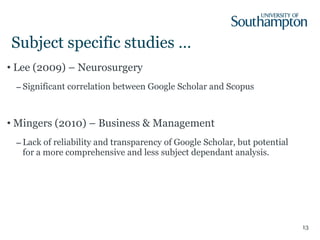
Subject specific studies … Lee (2009) – Neurosurgery Significant correlation between Google Scholar and Scopus Mingers (2010) – Business & Management Lack of reliability and transparency of Google Scholar, but potential for a more comprehensive and less subject dependant analysis.
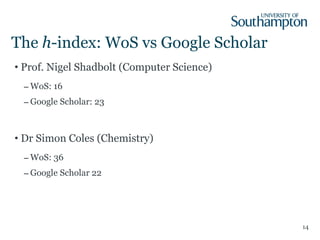
The  h -index: WoS vs Google Scholar Prof. Nigel Shadbolt (Computer Science) WoS: 16 Google Scholar: 23 Dr Simon Coles (Chemistry) WoS: 36 Google Scholar 22
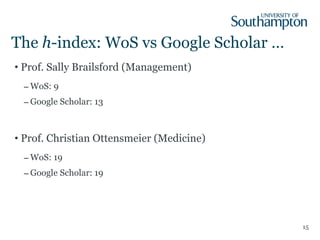
The  h -index: WoS vs Google Scholar … Prof. Sally Brailsford (Management) WoS: 9 Google Scholar: 13 Prof. Christian Ottensmeier (Medicine) WoS: 19 Google Scholar: 19
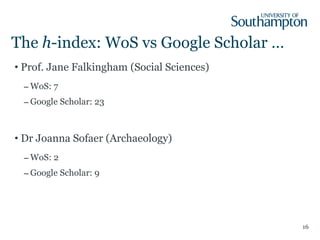
The  h -index: WoS vs Google Scholar … Prof. Jane Falkingham   (Social Sciences) WoS: 7 Google Scholar: 23 Dr Joanna Sofaer (Archaeology) WoS: 2 Google Scholar: 9
Supporting bibliometrics Library research guides www.soton.ac.uk/library/research/bibliometrics Deskside training 1-2-1 training for staff & research postgraduates Planned session for research postgraduates delivered through the Graduate School training programme
Conclusions Some variation by subject Significant issues with quality of the data Can be useful to use in addition to Web of Science and/or Scopus
References BAR-ILAN, J. 2008. Which h-index? — A comparison of WoS, Scopus and Google Scholar.  Scientometrics , 74, 257-271. FRANCESCHET, M. 2009. A comparison of bibliometric indicators for computer science scholars and journals on Web of Science and Google Scholar.  Scientometrics , 83, 243-258. JACSO, P. 2008. The pros and cons of computing the h-index using Google Scholar.  Online Information Review,  32 ,  437-452.
References … LEVINE-CLARK, M. & GIL, E. 2009. A comparative analysis of social sciences citation tools.  Online Information Review,  33 ,  986-996. LEE, J., KRAUS, K. L. & COULDWELL, W. T. 2009. Use of the h index in neurosurgery.  Journal of Neurosurgery,  111 ,  387-392. MINGERS, J. & LIPITAKIS, E. A. E. C. G. 2010. Counting the citations: a comparison of Web of Science and Google Scholar in the field of business and management.  Scientometrics,  85 ,  613-625.

Google Scholar for Bibliometrics

  • 1.
    Google Scholar Canit really be used for bibliometrics? Isobel Stark & Michael Whitton June 2011
  • 2.
    Google Scholar Historicalbackground? Google Scholar released (in beta) in 2004 Not the first freely available citation database (CiteSeer, Scirus, etc) Not subject specific Is it a viable alternative to ‘traditional’ citation databases such as Web of Science?
  • 3.
    Pros of GoogleScholar Easy to access and free Indexes a wide range of articles Especially Law, Humanities, Social Sciences Can find a wider range of metrics Metrics are generally a higher number
  • 4.
    Cons of GoogleScholar Questionable data Lack of de-duplication Gaps Relies on algorithms Not designed for popular bibliometric measures Requires add-ons to calculate h -index etc.
  • 5.
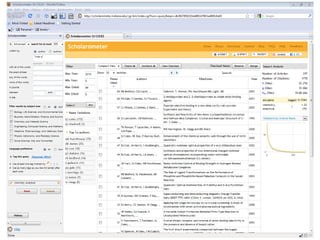
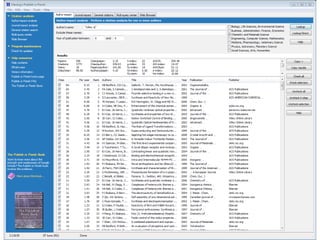
    Recommended services (h -index on GS) Quadsearch (Any browser) Scholar H -index Calculator (Mozilla Firefox) Scholarometer (Mozilla Firefox/Google Chrome) Publish or Perish (Separate Application)
  • 6.
  • 7.
  • 8.
  • 9.
  • 10.
    How our researchersuse it CVs and bids for funding Preferred by Medicine over InCites Factsheet for “Finding your h -index in Google Scholar” is very popular 6,764 visits in the last year To compare WoS h -Index guide is 1,559 and Impact Factors 1,045
  • 11.
    From the literature… Bar-Illan (2008) – Israeli highly cited researchers Significant differences from WoS and Scopus Metrics can be higher (computer science), similar or lower (physics) Jasco (2008) Problems of missing & wrong authors Prolific authors F Password & M Profile Specific problems often resolved
  • 12.
    Subject specific studiesFranceshet (2009) – Computer Science Google Scholar metrics are much higher Significant correlation (but varies by type of metric) Importance of proceedings Levine-Clark (2009) – Social Sciences Significant value of using Google Scholar in addition to WoS Significant value in journals not indexed by WoS & coverage of books
  • 13.
    Subject specific studies… Lee (2009) – Neurosurgery Significant correlation between Google Scholar and Scopus Mingers (2010) – Business & Management Lack of reliability and transparency of Google Scholar, but potential for a more comprehensive and less subject dependant analysis.
  • 14.
    The h-index: WoS vs Google Scholar Prof. Nigel Shadbolt (Computer Science) WoS: 16 Google Scholar: 23 Dr Simon Coles (Chemistry) WoS: 36 Google Scholar 22
  • 15.
    The h-index: WoS vs Google Scholar … Prof. Sally Brailsford (Management) WoS: 9 Google Scholar: 13 Prof. Christian Ottensmeier (Medicine) WoS: 19 Google Scholar: 19
  • 16.
    The h-index: WoS vs Google Scholar … Prof. Jane Falkingham (Social Sciences) WoS: 7 Google Scholar: 23 Dr Joanna Sofaer (Archaeology) WoS: 2 Google Scholar: 9
  • 17.
    Supporting bibliometrics Libraryresearch guides www.soton.ac.uk/library/research/bibliometrics Deskside training 1-2-1 training for staff & research postgraduates Planned session for research postgraduates delivered through the Graduate School training programme
  • 18.
    Conclusions Some variationby subject Significant issues with quality of the data Can be useful to use in addition to Web of Science and/or Scopus
  • 19.
    References BAR-ILAN, J.2008. Which h-index? — A comparison of WoS, Scopus and Google Scholar. Scientometrics , 74, 257-271. FRANCESCHET, M. 2009. A comparison of bibliometric indicators for computer science scholars and journals on Web of Science and Google Scholar. Scientometrics , 83, 243-258. JACSO, P. 2008. The pros and cons of computing the h-index using Google Scholar. Online Information Review, 32 , 437-452.
  • 20.
    References … LEVINE-CLARK,M. & GIL, E. 2009. A comparative analysis of social sciences citation tools. Online Information Review, 33 , 986-996. LEE, J., KRAUS, K. L. & COULDWELL, W. T. 2009. Use of the h index in neurosurgery. Journal of Neurosurgery, 111 , 387-392. MINGERS, J. & LIPITAKIS, E. A. E. C. G. 2010. Counting the citations: a comparison of Web of Science and Google Scholar in the field of business and management. Scientometrics, 85 , 613-625.

Editor's Notes

  • #4 Metrics are generally a higher number - Bibliometrics calculated on GS are generally higher than those calculated on (eg.) WoS, but this varies by discipline
  • #5 Google Scholar *was* designed for bibliometrics, just not necessarily for g-index and h-index (it does citation counting
  • #6 Quadsearch http://quadsearch.csd.auth.gr/index.php?lan=1&s=2 (i.e. the ‘Science’ search) Scholar H-index Calculator https://addons.mozilla.org/en-US/firefox/addon/45283 (add-on for the Mozilla Firefox browser, adds metrics to the standard Google Scholar site, easy to use but only calculates for the articles on the current page, a maximum of 100) Scholarometer http://scholarometer.indiana.edu/ (add-on for the Mozilla Firefox and Google Chrome browsers – appears as a sidebar when installed) Publish or Perish http://www.harzing.com/pop.htm (application that calculates a wide variety of metrics
  • #11 CVs – h-index increasingly mandated for Performance/Personal Development Reviews
  • #12 BAR-ILAN, J. 2008. Which h-index? — A comparison of WoS, Scopus and Google Scholar. Scientometrics , 74, 257-271. JACSO, P. 2008. The pros and cons of computing the h-index using Google Scholar. Online Information Review, 32 , 437-452.
  • #13 FRANCESCHET, M. 2009. A comparison of bibliometric indicators for computer science scholars and journals on Web of Science and Google Scholar. Scientometrics , 83, 243-258. Academics at University of Udine, high impact computer science journals LEVINE-CLARK, M. & GIL, E. 2009. A comparative analysis of social sciences citation tools. Online Information Review, 33, 986-996. Highly downloaded articles from Elsevier social sciences journals
  • #14 LEE, J., KRAUS, K. L. & COULDWELL, W. T. 2009. Use of thehindex in neurosurgery. Journal of Neurosurgery, 111 , 387-392. Research outputs from 3 UK Business schools MINGERS, J. & LIPITAKIS, E. A. E. C. G. 2010. Counting the citations: a comparison of Web of Science and Google Scholar in the field of business and management. Scientometrics, 85 , 613-625. Random sample of academic neurosurgeons
  • #18 Library Research Guides www.soton.ac.uk/library/research/bibliometrics Deskside Training 1-2-1 training for staff & research postgraduates Planned session for research postgraduates Delivered through the Graduate School training programme to compliment our Open Access, e-theses, Academic Copyright and Current Awareness sessions
  • #19 Google Scholar’s subject classification is variable – fails to correctly classify some, thus reducing recall and therefore calculated h-index