Judging research quality:
bibliometrics and beyond
Roger Watson
Editor-in-Chief, Journal of Advanced Nursing
Editor, Nursing Open
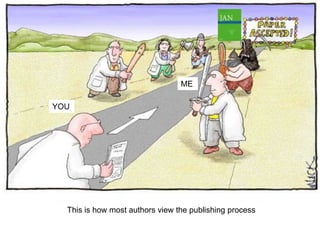
YOU
ME
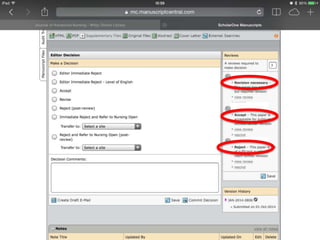
This is how most authors view the publishing process
Content
•Publication
•Authorship
•Open access
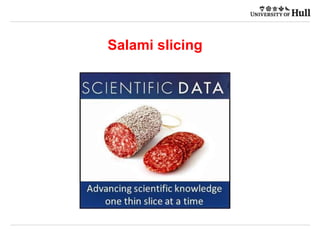
•Salami slicing
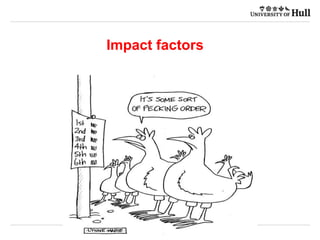
•Impact factors
•Bibliometrics
•…and beyond
Promoting integrity in research
publication
COPE http://publicationethics.org/
Publication
2015:
56 countries
1126 submissions
Aims and scope
Tells you:
• The mission of the journal
• What it publishes
• Who is expected to write for the journal
• The nature of the articles published
• Who is the intended readership
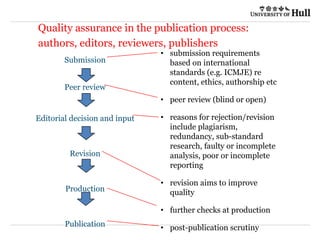
Quality assurance in the publication process:
authors, editors, reviewers, publishers
Submission
Peer review
Editorial decision and input
Revision
Production
Publication
• submission requirements
based on international
standards (e.g. ICMJE) re
content, ethics, authorship etc
• peer review (blind or open)
• reasons for rejection/revision
include plagiarism,
redundancy, sub-standard
research, faulty or incomplete
analysis, poor or incomplete
reporting
• revision aims to improve
quality
• further checks at production
• post-publication scrutiny
Authorship
Authorship
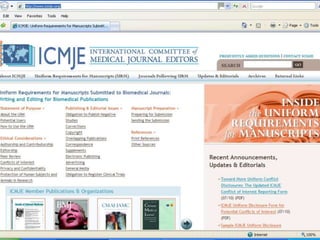
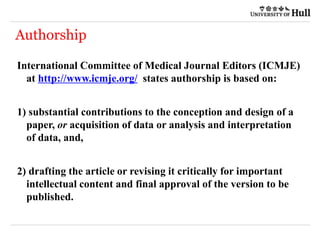
International Committee of Medical Journal Editors (ICMJE)
at http://www.icmje.org/ states authorship is based on:
1) substantial contributions to the conception and design of a
paper, or acquisition of data or analysis and interpretation
of data, and,
2) drafting the article or revising it critically for important
intellectual content and final approval of the version to be
published.
Open access
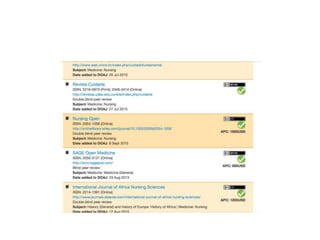
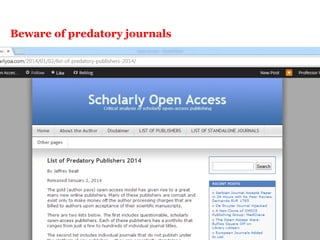
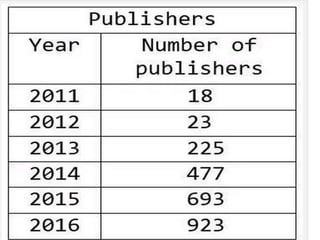
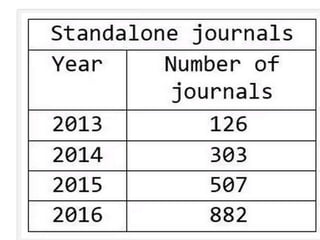
Beware of predatory journals
Salami slicing
Impact factors
Impact factor
In a given year, the impact factor of a journal is the average number
of citations to those papers that were published during the two
preceding years.
For example, the 2014 impact factor of a journal would be calculated
as follows:
2014 impact factor = A/B
where:
A = the number of times articles published in 2012 and 2013
were cited by indexed journals during 2014
B = the total number of "citable items" published in 2012 and
2014. ("Citable items" are usually articles, reviews,
proceedings, or notes; not editorials or Letters-to-the-Editor.)
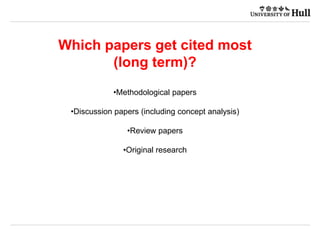
Which papers get cited most
(long term)?
•Methodological papers
•Discussion papers (including concept analysis)
•Review papers
•Original research
Which papers get cited most
(short term)?
•Review papers
•Methodological papers
•Discussion papers (including concept analysis)
•Original research
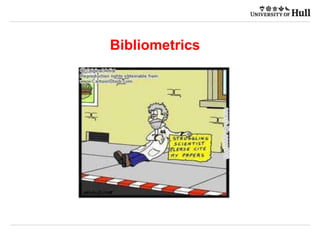
Bibliometrics
…and beyond
…and beyond
…and beyond
21/02/2016
Altmetrics
In scholarly and scientific publishing, Altmetrics are new
metrics proposed as an alternative to the widely used
journal impact factor and personal citation indices like the
h-index.
(Wikipedia)
Enhancing the QUAlity and
Transparency Of health Research
Enhancing the QUAlity and
Transparency Of health Research
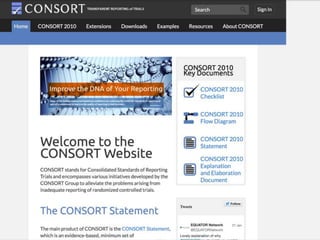
CONSORT http://www.consort-statement.org/
Enhancing the QUAlity and
Transparency Of health Research
CONSORT http://www.consort-statement.org/
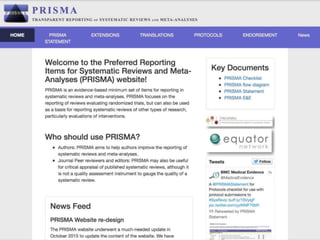
PRISMA http://www.prisma-statement.org/
Preventing Plagiarism in Published Works
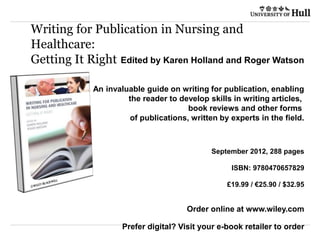
Edited by Karen Holland and Roger Watson
An invaluable guide on writing for publication, enabling
the reader to develop skills in writing articles,
book reviews and other forms
of publications, written by experts in the field.
September 2012, 288 pages
ISBN: 9780470657829
£19.99 / €25.90 / $32.95
Order online at www.wiley.com
Prefer digital? Visit your e-book retailer to order
Writing for Publication in Nursing and
Healthcare:
Getting It Right
Thank you
Email: r.watson@hull.ac.uk
@rwatson1955

Judging research quality bibliometrics and beyond

  • 1.
    Judging research quality: bibliometricsand beyond Roger Watson Editor-in-Chief, Journal of Advanced Nursing Editor, Nursing Open
  • 2.
    YOU ME This is howmost authors view the publishing process
  • 3.
  • 4.
    Promoting integrity inresearch publication COPE http://publicationethics.org/
  • 5.
  • 6.
  • 7.
    Aims and scope Tellsyou: • The mission of the journal • What it publishes • Who is expected to write for the journal • The nature of the articles published • Who is the intended readership
  • 8.
    Quality assurance inthe publication process: authors, editors, reviewers, publishers Submission Peer review Editorial decision and input Revision Production Publication • submission requirements based on international standards (e.g. ICMJE) re content, ethics, authorship etc • peer review (blind or open) • reasons for rejection/revision include plagiarism, redundancy, sub-standard research, faulty or incomplete analysis, poor or incomplete reporting • revision aims to improve quality • further checks at production • post-publication scrutiny
  • 10.
  • 12.
    Authorship International Committee ofMedical Journal Editors (ICMJE) at http://www.icmje.org/ states authorship is based on: 1) substantial contributions to the conception and design of a paper, or acquisition of data or analysis and interpretation of data, and, 2) drafting the article or revising it critically for important intellectual content and final approval of the version to be published.
  • 13.
  • 16.
  • 19.
  • 21.
  • 22.
    Impact factor In agiven year, the impact factor of a journal is the average number of citations to those papers that were published during the two preceding years. For example, the 2014 impact factor of a journal would be calculated as follows: 2014 impact factor = A/B where: A = the number of times articles published in 2012 and 2013 were cited by indexed journals during 2014 B = the total number of "citable items" published in 2012 and 2014. ("Citable items" are usually articles, reviews, proceedings, or notes; not editorials or Letters-to-the-Editor.)
  • 23.
    Which papers getcited most (long term)? •Methodological papers •Discussion papers (including concept analysis) •Review papers •Original research
  • 24.
    Which papers getcited most (short term)? •Review papers •Methodological papers •Discussion papers (including concept analysis) •Original research
  • 25.
  • 26.
  • 27.
  • 28.
  • 29.
    21/02/2016 Altmetrics In scholarly andscientific publishing, Altmetrics are new metrics proposed as an alternative to the widely used journal impact factor and personal citation indices like the h-index. (Wikipedia)
  • 30.
    Enhancing the QUAlityand Transparency Of health Research
  • 31.
    Enhancing the QUAlityand Transparency Of health Research CONSORT http://www.consort-statement.org/
  • 33.
    Enhancing the QUAlityand Transparency Of health Research CONSORT http://www.consort-statement.org/ PRISMA http://www.prisma-statement.org/
  • 36.
    Preventing Plagiarism inPublished Works
  • 37.
    Edited by KarenHolland and Roger Watson An invaluable guide on writing for publication, enabling the reader to develop skills in writing articles, book reviews and other forms of publications, written by experts in the field. September 2012, 288 pages ISBN: 9780470657829 £19.99 / €25.90 / $32.95 Order online at www.wiley.com Prefer digital? Visit your e-book retailer to order Writing for Publication in Nursing and Healthcare: Getting It Right
  • 38.